
Shelf Intelligence and Store Audits
AR-guided capture validates every shelf photo on the device, then vision models check stock, facings and planogram compliance.
See: AR Shelf Intelligence →Data & AI for Retail & E-Commerce
We build retail models that read shelves, forecast demand, rank products and answer shoppers. They run on your POS, OMS, PIM and store data, and they feed decisions back to merchants and store teams.
Store 214, aisle 7 bay 3 photo
Validate
Detect
Compare
Task
⟳ Model running…
AI in retail succeeds when it fixes something a shopper or store team can feel. An empty shelf spotted in minutes. A search that understands what the customer meant. A forecast that gets stock to the right store before the rush.
Our team builds AI in retail on the data you already hold: POS transactions, OMS orders, PIM attributes, store photos and web behaviour. We clean and join it, train models for your categories and regions, and send the results to merchants, store staff and shoppers through the tools they already use.
This guide covers the use cases that pay back, the architecture behind them and the traps that keep retail AI stuck in pilots.
AI in retail is the use of machine learning, computer vision and language models across stores, e-commerce and the supply chain behind them. It predicts demand, reads shelves, ranks products and talks to customers.
Retail runs on thin margins and huge SKU counts. People cannot check every shelf, price every item or tag every product by hand. AI in retail takes on that volume, so merchants and store teams can focus on the calls that need judgment.
It spans the full journey: planning, buying, replenishment, store execution, online discovery, checkout and service. Each stage has its own data and its own model.
Grocery, fashion and electronics use it differently. Grocers fight freshness and daily replenishment. Fashion brands fight short seasons and size curves. Electronics sellers fight fast price moves and complex specs. AI in retail should be shaped around your category's economics, not a generic template.
Working definition
“AI in retail is a decision layer across stores and channels that turns sales, catalogue, image and behaviour data into actions for merchants, store teams and shoppers.”
Foundations
PIM attributes, SKU hierarchies and store assortments must agree. Models cannot rank or forecast products the data describes inconsistently.
POS and OMS data are cleaned for returns, promotions and stock-outs, so forecasts learn true demand, not lost sales.
A city flagship and a rural outlet sell differently. Models learn at store, region and channel level.
Outputs land in replenishment systems, store handhelds, search results and merchant dashboards, never in a forgotten report.
Core capabilities
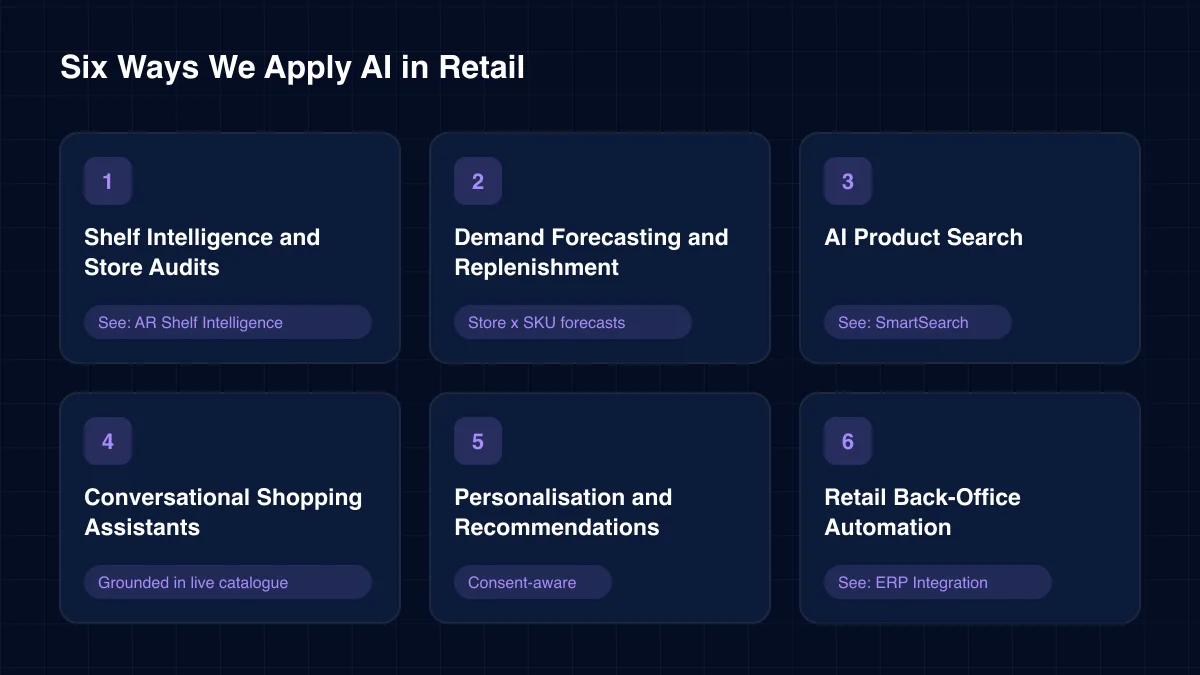
Each capability below is a production pattern our engineers deliver, from data pipeline to the screen a shopper or store worker sees.
AR-guided capture validates every shelf photo on the device, then vision models check stock, facings and planogram compliance.
See: AR Shelf Intelligence →Store and SKU forecasts blend sales history, promotions, holidays and weather. AI in retail planning works best when forecasts drive orders automatically.
Store x SKU forecasts
Semantic and vector search understands intent, synonyms and natural phrasing. Language models can also fill missing PIM attributes, so shoppers find products even when words do not match the catalogue.
See: SmartSearch →RAG assistants answer product, sizing and order questions from live catalogue and OMS data, then hand over to a human when needed.
Grounded in live catalogue →Models rank products and offers from browsing and purchase history, within the consent each customer has given.
Consent-aware
Integration and workflow automation keep receipts, billing and stock records in sync between front-office and ERP systems. Clean operational data makes every other use of AI in retail more accurate.
See: ERP Integration →Architecture
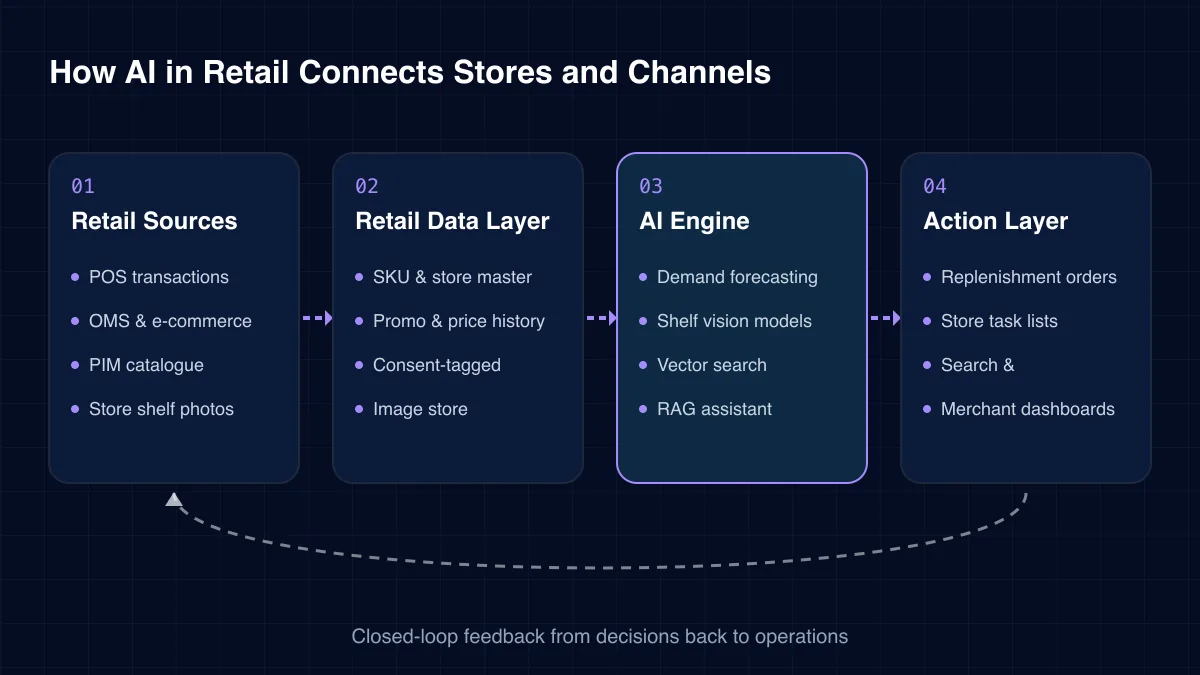
Our reference design sits beside your commerce stack. It reads from POS, OMS, PIM and store capture, and it writes decisions back into each of them.
01
02
03
04
Challenges we solve
Retail data is wide, noisy and seasonal. These are the failure modes we design around.
When a shelf is empty, sales drop to zero. A naive model reads that as low demand and orders even less next time.
Duplicate SKUs, missing attributes and inconsistent sizes break search, recommendations and forecasts at the same time.
Blurry or tilted shelf images cannot be analysed. The fix is validation at capture, not more back-office review.
If e-commerce and store data sit in separate systems, AI in retail sees half the customer and half the demand.
A chatbot that promises stock you do not have loses trust fast. Answers must come from live catalogue and OMS data.
Buyers ignore forecasts they cannot question. Explainable drivers and easy overrides keep them engaged.
Most retail programmes combine four model families across stores and channels.
Most retailers already plan in spreadsheets and report in BI tools. Here is what AI in retail adds.
| Capability | Spreadsheets | BI dashboards | Retail AI |
|---|---|---|---|
| Forecasts every store and SKU | No | No | ✓ Yes |
| Corrects for stock-outs | Partial | No | ✓ Yes |
| Reads shelf photos | No | No | ✓ Yes |
| Understands shopper intent | No | No | ✓ Yes |
| Explains its numbers | ✓ Yes | ✓ Yes | ✓ Yes |
Returns grow as more stores, categories and channels feed the same models.
Delivery
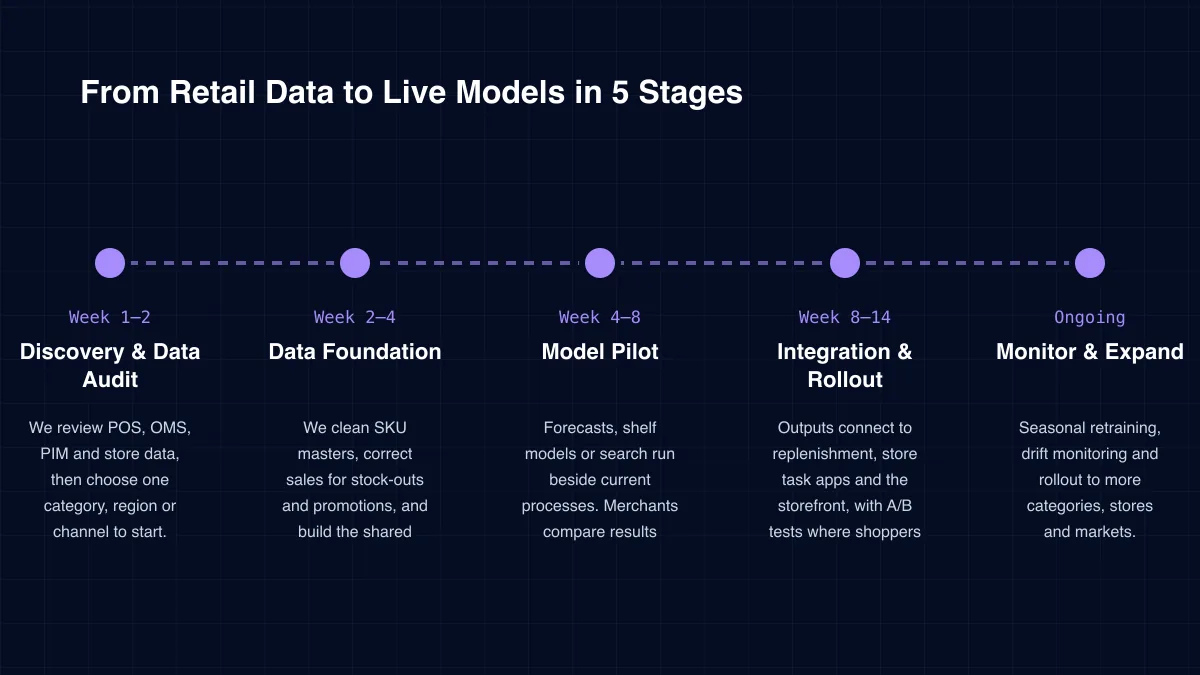
Week 1–2
We review POS, OMS, PIM and store data, then choose one category, region or channel to start.
Week 2–4
We clean SKU masters, correct sales for stock-outs and promotions, and build the shared retail data layer.
Week 4–8
Forecasts, shelf models or search run beside current processes. Merchants compare results before switching.
Week 8–14
Outputs connect to replenishment, store task apps and the storefront, with A/B tests where shoppers are involved.
Ongoing
Seasonal retraining, drift monitoring and rollout to more categories, stores and markets.
Case study
A retail field operations partner received blurry, unusable shelf photos from store audits, which caused retakes and heavy backend review. Our team built an AR-guided capture app for iOS and Android that validates tilt, slant and overlap in real time. Staff now capture usable images on the first try, and duplicate submissions are blocked on the device.
“A blurry shelf photo is not a minor inconvenience, it is a data point the business cannot use.”Read the full case study →
AR SDK · iOS & Android
Guides staff to the right distance and angle with live preview feedback.
Mobile computer vision
Checks tilt, slant and overlap before the photo is accepted.
Capture rules · Dedup checks
Adapts quality rules per client and blocks duplicate submissions.
We recommend five checks before you commit budget to retail AI.
The last point decides whether AI in retail survives its first holiday season. Every ICANIO engagement includes structured post-launch support.
Personalisation depends on trust. We tag customer data with consent status and respect it in every model, and we align with GDPR and other privacy laws where your customers live.
Card data never enters AI pipelines. We keep payment flows inside PCI DSS scope and work only with tokenised references. ICANIO operates under ISO 9001 and ISO 27001 certified processes.
Pick the leak you feel most: lost sales from empty shelves, markdowns from over-ordering, or shoppers who search and leave. Size it from last season's data. That is the value pool for your first model.
We agree baselines in discovery and measure with holdout stores or A/B tests. That keeps the case for AI in retail tied to your own sales, waste and conversion figures.
Count the hours saved too. Store staff spend less time on audits, merchandisers less time fixing product data, and planners less time adjusting orders by hand.
Technology stack
We select tools to fit your commerce stack. These appear in most of our retail builds.
Retail Systems
POSOMSPIMERP & MagOffice connectors
Data Engineering
Cloud data warehouse
Forecasting & ML
XGBoostTime-series modelsFeature store
Vision
AR SDKMobile computer visionShelf detection models
Search & Language
Vector searchNLPLLMsRAG pipelines
Delivery
Store task appsStorefront APIsMerchant dashboards
 Free white paper · Data & AIData & Artificial IntelligenceTransforming Enterprise Operations Through Advanced Analytics & Intelligent AutomationGet the white paper →
 Free white paper · RetailRetail & E-Commerce SolutionsTransforming Modern Retail Through Technology, AI, and Digital InnovationGet the white paper →
Start where the loss is visible and the data exists. Demand forecasting for a high-volume category, shelf audits in a store cluster or AI search on the storefront are common first projects. Each shows results in weeks.
No. We connect to the POS, OMS, PIM and ERP you already run. The AI layer reads their data and writes decisions back through APIs or integration tools.
Accuracy depends mostly on photo quality. That is why we validate images at capture, as in our AR shelf intelligence app. Clean images give the detection models a fair chance.
Any language model can if it is not grounded. We connect assistants to live catalogue and order data with RAG, restrict them to retail topics, and route anything uncertain to a human.
We use consent-tagged data only, minimise personal fields and keep card data out of scope entirely. Models run in your cloud tenancy under role-based access.
We compare pilot stores or traffic against control groups. Forecast accuracy, availability, markdowns and search conversion are measured against the same period without the model.
AI in retail is now practical across the whole chain. It reads shelves, forecasts demand, understands shopper intent and keeps back-office records clean.
ICANIO brings retail data engineering, computer vision, search and language AI into one team. We have built AR shelf capture, AI search and retail ERP automation in production, and we apply the same discipline to your stores and channels. That is how AI in retail moves from pilot to everyday trading tool.
By ICANIO Data & AI Engineering Team · Published · Updated
Book a free 30-minute discovery call with our team. We will review your store and commerce data and pick the first model worth building. You will leave with a scoped plan and clear milestones.
Contact Our Data & AI Team


