
Shipment Exception Management
Agents confirm a delay from telematics, work out which orders miss their window and gather backup carrier options. The dispatcher approves the fix in one click.
TMS + telematics
AgenticOps · Transportation & Logistics
We build and operate multi-agent systems that watch your TMS, WMS, telematics and EDI feeds. Agents chase the late load, audit the invoice and replan the dock. Dispatchers and managers approve the moves that cost money or promise a customer something.
⟳ Orchestrating agents…
every step traced · guardrails on · reversible
AI agents in logistics are software workers that watch shipments, read carrier and warehouse data, and prepare the next move. They join the dots between a telematics ping, a TMS order and a customer delivery window. Then a dispatcher gets a ready plan instead of five open tabs.
Logistics teams do not lack data. They lack time to act on it. A control tower can show hundreds of amber shipments, yet each one still needs someone to call a carrier, check a rate and email a customer.
Our team builds AI agents in logistics that take on that legwork inside clear limits. Agents track, audit, quote and draft. People approve anything that spends money, changes a carrier or makes a promise to a customer. The sections below show how we design, run and measure those systems.
An AI agent is a program that works toward a goal by planning steps, calling tools and checking results. In freight and warehousing, those tools are your TMS, WMS, carrier APIs, EDI messages and telematics platforms.
AI agents in logistics go beyond a visibility dashboard. A dashboard shows that a load is late. An agent works out which orders it affects, what the options are and who needs to know. It prepares that package for a person to approve.
Several agents usually share the work. One tracks, one checks rates, one talks to the WMS and one drafts messages. AgenticOps is the practice that keeps this team of agents traced, bounded and reliable when volumes spike on a Monday morning.
Operations definition
“AI agents in logistics are governed software agents that monitor shipment, carrier and warehouse events, reason across TMS, WMS, EDI and telematics data, and prepare actions that a dispatcher or manager approves.”
Foundations
AI agents in logistics earn trust on the loads that go wrong. We point them at exceptions, not at the shipments that already flow.
Each recommendation links to its source: a GPS trace, an ELD status, an EDI 214, a proof of delivery or a rate sheet.
Re-tenders, accessorial disputes, expedites and customer ETAs need a named approver before anything leaves the building.
Agents must hold up on the busiest day of the year. We load-test orchestration and fall back to human queues when it strains.
Core capabilities
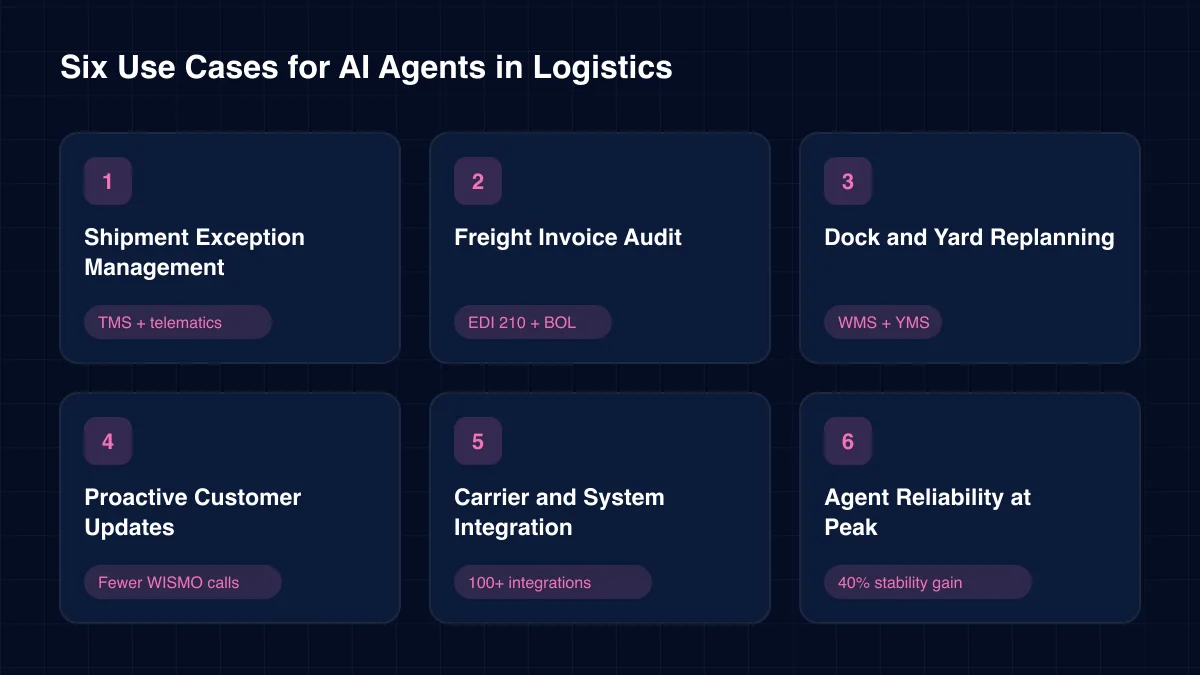
These are the areas where AI agents in logistics usually pay off first. Each keeps a human approver at the point of risk.
Agents confirm a delay from telematics, work out which orders miss their window and gather backup carrier options. The dispatcher approves the fix in one click.
TMS + telematics
AI agents in logistics match carrier invoices to bills of lading, proofs of delivery and contracted rates. They flag unsupported accessorials and draft disputes with evidence.
EDI 210 + BOL
Early or late trailers trigger agents that read door status, labour and outbound waves. They propose a new dock schedule for the shift manager to accept.
WMS + YMS
Agents draft ETA changes and delay notices in the customer's own terms. Account teams review sensitive accounts, and routine notices go out on approval rules.
Fewer WISMO calls
We wire agents into TMS, WMS, carrier portals, EDI and telematics through typed, scoped tools. Reading is wide. Writing is narrow and always logged.
100+ integrations →We trace every tool call, recover from carrier API timeouts and keep agents consistent under load. This builds on our audit-first agentic AI framework work.
40% stability gain →Architecture
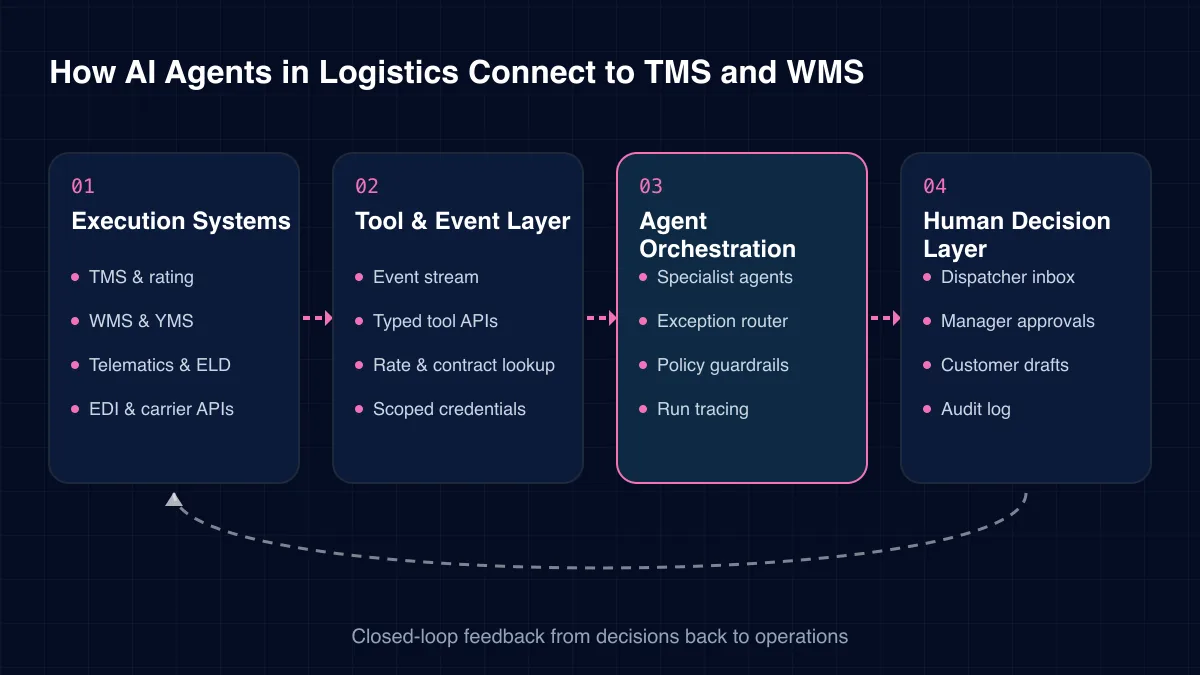
The agent layer sits between your execution systems and the people who run the network. Data flows up from carriers and sites, and approved actions flow back down.
01
02
03
04
Challenges we solve
Logistics runs on exceptions. Rules engines cover the expected cases, and AI agents in logistics help with the rest.
Visibility tools flag every slip, but teams can only chase a few. Agents triage by customer impact, so dispatchers work the loads that matter first.
Finding a backup truck means portals, emails and calls. Agents query approved carriers and rates in parallel and return ranked options.
Detention, layover and fuel charges often slip through without proof. Agents check each charge against gate times and contract terms.
Early and late arrivals break the door schedule by mid-morning. Agents replan against labour and outbound cut-offs in minutes.
Customers hear about delays too late. Agents draft proactive updates as soon as a window is at risk, for a person to confirm.
No one wants software booking trucks unchecked. We cap agent authority, gate spend and keep a clear off switch for every workflow.
AI agents in logistics usually expand in four stages as teams gain confidence.
Teams often already have a control tower and some bots. This table shows where agents add something new.
| Capability | Control tower | RPA bots | AI agents |
|---|---|---|---|
| Shows late shipments | ✓ Yes | No | ✓ Yes |
| Works out the fix | No | No | ✓ Yes |
| Reads emails and PODs | No | Partial | ✓ Yes |
| Works across TMS, WMS and EDI | Partial | Partial | ✓ Yes |
| Needs human approval gates | No | Rarely | Always |
Gains grow as more exception types share the same agents and approval inbox.
Delivery
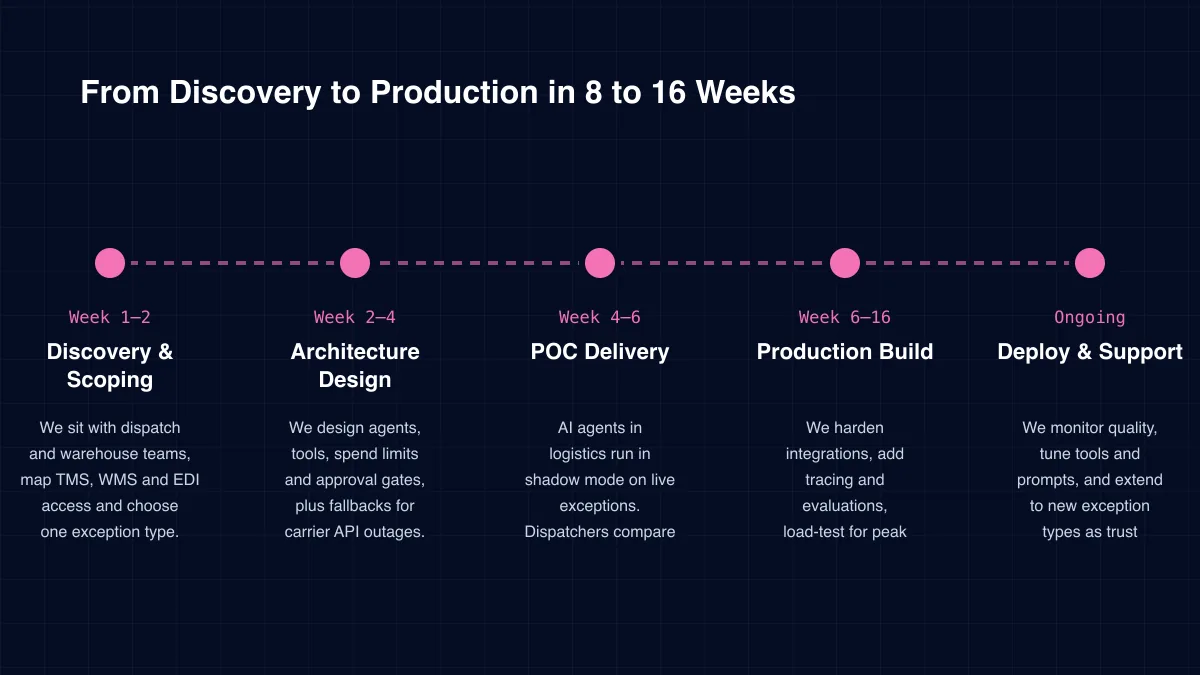
Week 1–2
We sit with dispatch and warehouse teams, map TMS, WMS and EDI access and choose one exception type.
Week 2–4
We design agents, tools, spend limits and approval gates, plus fallbacks for carrier API outages.
Week 4–6
AI agents in logistics run in shadow mode on live exceptions. Dispatchers compare agent plans with their own.
Week 6–16
We harden integrations, add tracing and evaluations, load-test for peak and roll out lane by lane.
Ongoing
We monitor quality, tune tools and prompts, and extend to new exception types as trust grows.
Case study
An enterprise AI platform's agents behaved well in tests but broke under real workloads. We audited each workflow, fixed tool invocation and reasoning chains, and added reflective agents that self-correct. The platform gained 40% in stability, 3x in reasoning capability and support for local and cloud LLMs. AI agents in logistics face the same test on every peak day.
“Stability is the foundation every agent capability depends on.”Read the full case study →
Workflow audit
Existing agent workflows were audited and fixed before new capability was added.
Reasoning chains
Tool calls and reasoning steps were reworked so identical inputs give consistent outputs.
Local & cloud LLMs
New agents can be added without degrading the ones already running.
A demo on ten clean shipments proves little. We recommend testing a partner on these five points.
Spend controls usually decide whether finance signs off. Design them in from week one.
ICANIO works under ISO 9001 and ISO 27001 certified processes. Carrier credentials, customer contracts and rate sheets stay in your vault and tenancy, and agents get scoped tokens only.
Driver location data is personal data in many regions. We minimise it, keep it only as long as the workflow needs and respect GDPR where it applies. Agents never override hours-of-service limits or safety rules, and customs filings stay with your licensed broker.
Agent risks are mapped against the NIST AI Risk Management Framework. Each workflow has an owner, spend limits and an off switch.
Pick one exception type and measure it today. How long does a late load take to resolve, and what do expedites, penalties and lost customers cost? For audits, how much of last quarter's accessorial spend lacked evidence?
We baseline those figures with your team in discovery. Shadow mode then shows how often agent plans match dispatcher choices. The return on AI agents in logistics is judged against your own lanes and invoices.
Technology stack
We pick tools for AI agents in logistics per network. These are common choices, not a fixed bundle.
Execution Systems
TMS platformsWMS platformsYard managementERP
Connectivity
EDI 204 / 210 / 214Carrier APIsTelematics & ELD feedsEvent streams
Agent Frameworks
Custom orchestrators
Models
Cloud LLMsLocal LLMsDocument extraction models
Retrieval
Contract & rate indexesPOD and BOL storeVector databases
Observability
Evaluation suitesApproval audit log
 Free white paper · AgenticOpsThe AgenticOps PlaybookA practical, framework-neutral guide to engineering, governing and running AI agents in production, from the first workflow to a trusted agent estate.Get the white paper →
 Free white paper · LogisticsTransportation & Logistics Technology SolutionsTransforming Modern Supply Chains with AI, Cloud, and IoT IntegrationGet the white paper →
Only within limits you set. By default, AI agents in logistics gather quotes and draft the tender, and a dispatcher approves it. Some teams later allow auto-booking below a spend cap on approved carriers. Anything above the cap still needs a person.
Usually the TMS, WMS, yard system, ERP, telematics and ELD platforms, EDI flows and carrier portals or APIs. Email and document stores are added for PODs and rate confirmations. Each connection has its own scoped permissions.
At any step that spends money, changes a carrier, disputes an invoice or tells a customer something new. The approver is whoever owns that decision today, such as a dispatcher, payables lead or account manager.
They check sources against each other, such as GPS against EDI status. When data conflicts or confidence is low, they escalate rather than act. Every plan shows its evidence, so reviewers can spot a bad input fast.
We load-test the orchestration layer for your peak volumes before go-live. If a carrier API or model slows, agents queue work or hand it to people. The goal is graceful degradation, not a silent backlog.
Most projects reach production in eight to sixteen weeks. Discovery, design and a shadow-mode proof of concept take about six weeks. The production build then adds hardening, monitoring and training for approvers.
AI agents in logistics give dispatchers and planners back the hours lost to chasing. They find the problem, gather the options and draft the message, then wait for a decision.
ICANIO applies AgenticOps discipline to that work: scoped tools, spend limits, human gates and full tracing. We take teams from one exception type in shadow mode to production agents in eight to sixteen weeks, then keep them steady through every peak.
By ICANIO AgenticOps Engineering Team · Published · Updated
Book a free 30-minute discovery call. We will map one costly exception type, its systems and its approvers to an agent design. You will leave with a clear scope and a shadow-mode plan.
Contact Our AgenticOps Team

