
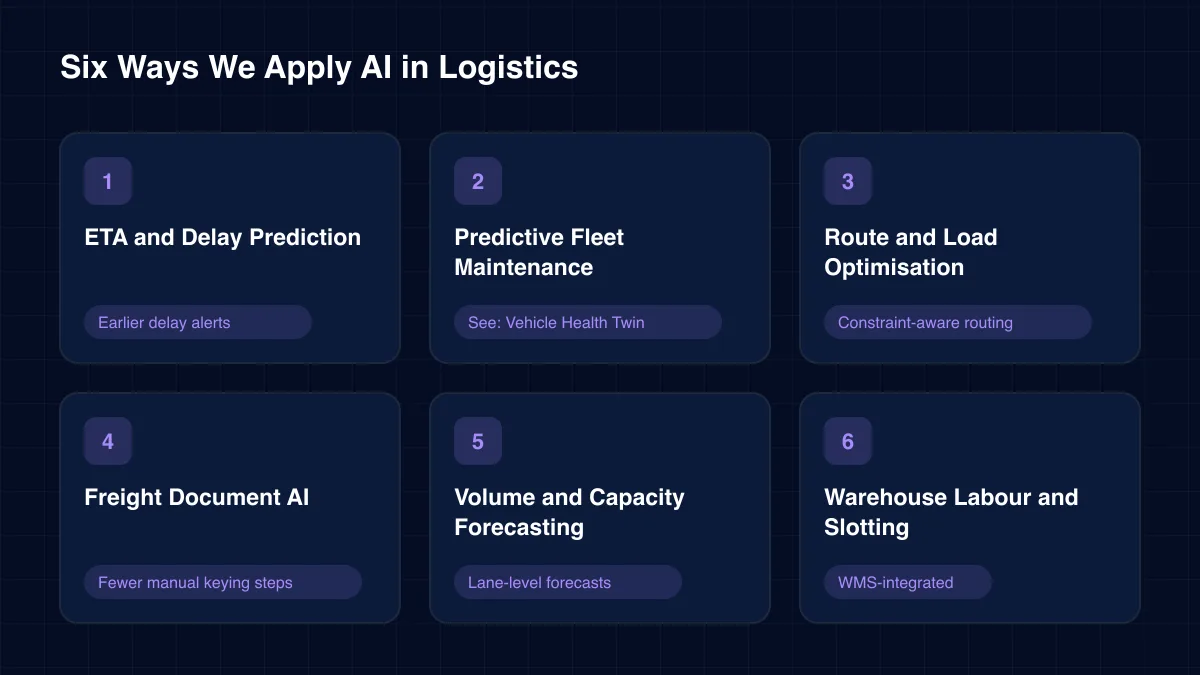
ETA and Delay Prediction
Models combine live position, traffic, dwell history and driver hours to predict arrival and flag SLA risk early. AI in logistics is most visible to customers here.
Earlier delay alerts
Data & AI for Transportation & Logistics
We turn telematics, TMS and WMS data into models that predict arrivals, flag failing vehicles and read freight paperwork. Dispatchers get earlier warnings and fewer manual checks.
Load 88213, Chennai to Bengaluru
Telematics
Traffic
Predict
Alert
⟳ Model running…
AI in logistics earns its place when it moves a decision earlier. A late truck flagged two hours ahead can still make its dock slot. A failing engine flagged a week ahead can be serviced between runs, not on the highway.
Our team builds AI in logistics on the data you already collect: GPS pings, CAN bus readings, TMS load plans, WMS scans and scanned paperwork. We connect those feeds, train models on your lanes and your fleet, and write predictions back into the tools dispatchers and planners use.
This page covers the use cases, the architecture, the common pitfalls and what to ask a partner before you start.
AI in logistics means applying machine learning, optimisation and document AI to transport and warehouse data. The goal is to predict what will happen to a shipment, a vehicle or a site before it happens.
Traditional logistics software records events after they occur. A TMS shows that a load is late once it is late. AI in logistics estimates the delay while the truck is still moving, and ranks the options for fixing it.
It covers the whole chain: first mile, linehaul, cross-dock, warehouse and last mile. Each leg produces different data, so each needs its own models.
A carrier, a 3PL and a shipper also see the network differently. A carrier cares about asset use and driver hours. A 3PL cares about dock throughput and billing accuracy. A shipper cares about on-time delivery and landed cost. AI in logistics should be scoped around whichever of those views pays your bills, because that decides which data matters first.
Working definition
“AI in logistics is a prediction layer over transport and warehouse systems that turns live movement data into earlier, ranked decisions for dispatchers, planners and customers.”
Foundations
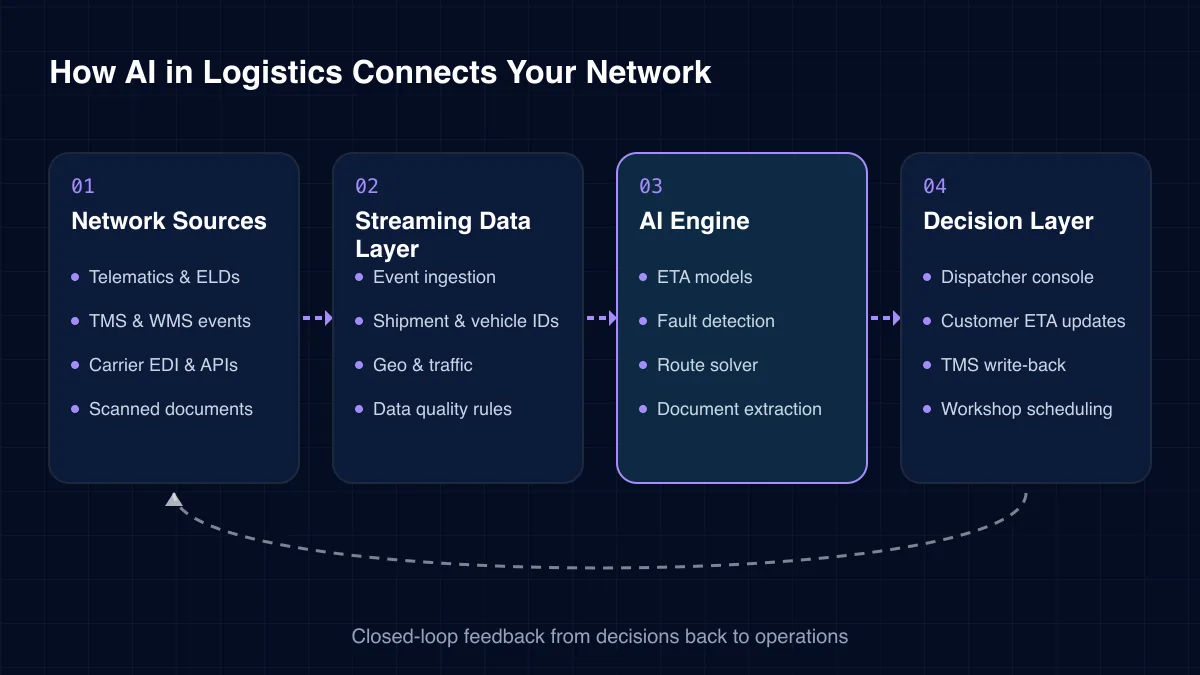
Telematics, TMS events, WMS scans and carrier EDI messages are joined on one shipment and vehicle ID, with consistent time zones.
A national average ETA is useless on a mountain route. Models learn from your own lanes, seasons, customers and drivers.
Predictions feed solvers that re-sequence stops, rebalance loads and reassign vehicles within real constraints.
Dispatchers approve reroutes and swaps. The model proposes, people decide, and every choice becomes training data.
Core capabilities
Each capability is a production pattern our engineers deliver end to end, from raw feeds to the dispatcher screen.
Models combine live position, traffic, dwell history and driver hours to predict arrival and flag SLA risk early. AI in logistics is most visible to customers here.
Earlier delay alerts
Engine and sensor data are compared with a healthy baseline, so developing faults surface before a roadside breakdown.
See: Vehicle Health Twin →Solvers sequence stops against delivery windows, vehicle capacity and hours-of-service rules, then re-plan when predictions change.
Constraint-aware routing
OCR and extraction models read bills of lading, proof of delivery scans, invoices and customs forms, then match them to the load in the TMS.
Fewer manual keying steps
Forecasts of shipment volume by lane and day help planners book carriers, staff docks and size the fleet ahead of peaks.
Lane-level forecasts
Models forecast pick volume and suggest slotting changes from order history. Applying AI in logistics inside the DC cuts travel time for pickers.
WMS-integrated
Architecture
Our reference design sits beside your TMS and WMS rather than replacing them. It reads their events, scores them and writes decisions back.
01
02
03
04
Challenges we solve
Logistics data is messy and fast. These are the failure modes we design around.
Dead zones, tunnels and cheap trackers leave holes in the trail. Models need cleaning and gap-filling before they see the data.
Company trucks and third-party carriers often sit in different tools. AI in logistics fails if half the network is invisible.
A single dwell time for every customer hides the slow docks. Useful models learn at lane and site level.
An ETA alert that lands in an unread inbox changes nothing. Each prediction needs a clear owner and a next step.
PODs and invoices arrive as photos and PDFs. Manual keying delays billing and hides short deliveries.
New customers, routes and seasons shift the patterns. Without retraining, accuracy slides and dispatchers stop trusting it.
Different parts of the network call for different model families.
Most networks already track shipments and run alert rules. Here is what AI in logistics adds.
| Capability | Tracking portal | Alert rules | Logistics AI |
|---|---|---|---|
| Shows current location | ✓ Yes | No | ✓ Yes |
| Predicts arrival time | No | Partial | ✓ Yes |
| Learns from each lane | No | No | ✓ Yes |
| Flags failing vehicles early | No | Partial | ✓ Yes |
| Reads freight paperwork | No | No | ✓ Yes |
Value grows as more lanes, sites and carriers feed the same models.
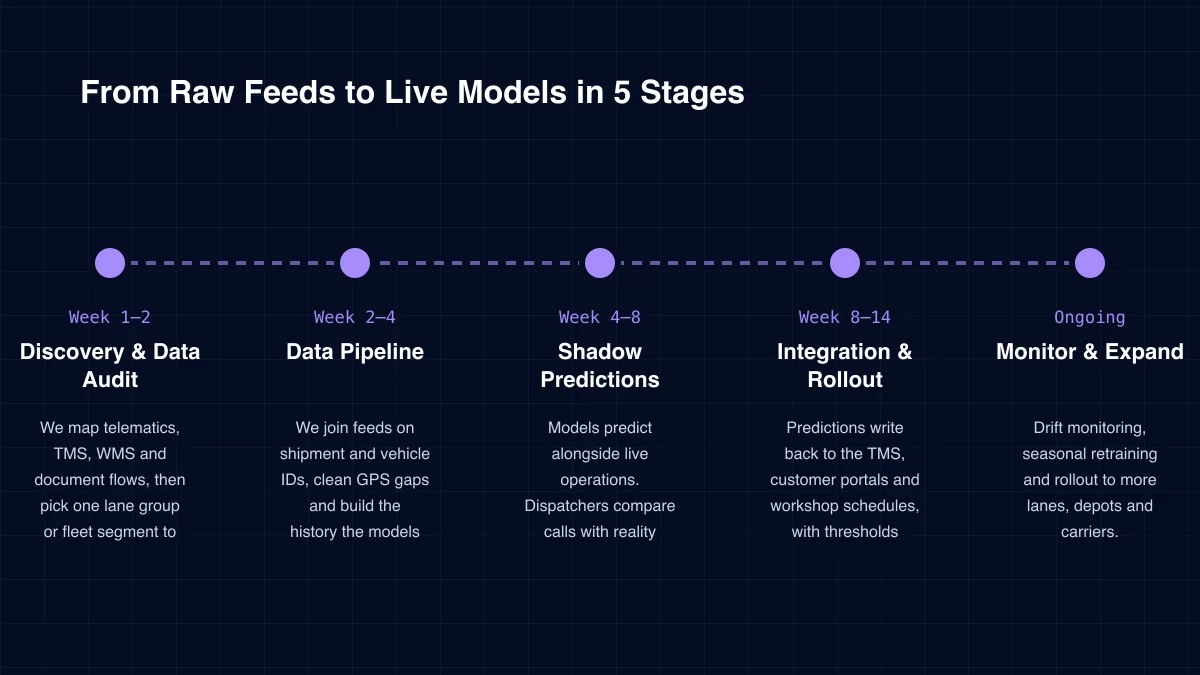
Delivery
Week 1–2
We map telematics, TMS, WMS and document flows, then pick one lane group or fleet segment to start.
Week 2–4
We join feeds on shipment and vehicle IDs, clean GPS gaps and build the history the models learn from.
Week 4–8
Models predict alongside live operations. Dispatchers compare calls with reality before anything is automated.
Week 8–14
Predictions write back to the TMS, customer portals and workshop schedules, with thresholds tuned by your team.
Ongoing
Drift monitoring, seasonal retraining and rollout to more lanes, depots and carriers.
Case study
A fleet management technology partner had no view of engine health until a warning light came on. Our team built a proof of concept that models how a healthy engine should behave, compares live readings with that baseline, and alerts on sustained deviation. It validated the full pipeline end to end and detected two distinct real-world engine faults.
“The goal was never just an alert. It was an alert an operator could actually trust and act on.”Read the full case study →
CARLA · OpenModelica FMU
Simulates healthy engine behaviour under current driving conditions.
XGBoost · Rule engine
Flags readings that drift beyond safe thresholds against the baseline.
NVIDIA Omniverse
Shows exactly which component is affected on an interactive vehicle model.
We recommend five checks before you hand over your freight data.
The fifth point decides whether AI in logistics survives its first peak season. Every ICANIO engagement includes structured post-launch support.
Telematics data reveals where drivers are and how they drive. We apply role-based access, data minimisation and retention limits, and we align with GDPR where European drivers or customers are involved.
Shipment and customer data stay in your cloud tenancy. ICANIO works under ISO 9001 and ISO 27001 certified processes, and every model decision is logged for audit.
Pick the cost you feel most: late-delivery penalties, roadside breakdowns, detention fees or billing delays. Count last year's events and their cost. That is the pool your first model attacks.
We agree those baselines in discovery and report against your own TMS and workshop records. That keeps the case for AI in logistics tied to real invoices and real downtime.
Soft gains count too, but track them separately. Fewer status calls to the dispatch desk, faster claim resolution and happier consignees all matter. They are simply harder to price, so we report them next to the hard numbers rather than inside them.
Technology stack
We select tools per network. These are the ones we reach for most often.
Network Data
Telematics APIsELD feedsEDI & carrier APIsWMS & TMS connectors
Streaming & Storage
PostGIS
Machine Learning
XGBoostTime-series forecastingAnomaly detection
Optimisation
Google OR-ToolsVehicle routing solversDock scheduling logic
Document AI
OCRField extraction modelsLLM validation
Delivery
Dispatcher dashboardsCustomer ETA APIsMobile driver apps
 Free white paper · Data & AIData & Artificial IntelligenceTransforming Enterprise Operations Through Advanced Analytics & Intelligent AutomationGet the white paper →
 Free white paper · LogisticsTransportation & Logistics Technology SolutionsTransforming Modern Supply Chains with AI, Cloud, and IoT IntegrationGet the white paper →
ETA prediction is often the best start. The data already exists in telematics and the TMS, and the value is easy to see. Predictive fleet maintenance and POD reading are strong second steps.
Yes. We integrate with the APIs, databases and EDI feeds your systems already expose. You keep your TMS, WMS and trackers. The AI layer reads their data and writes predictions back.
A few months of GPS and load history is usually enough for a first ETA model. Fault detection can start with a physics or statistical baseline, as our vehicle health twin did, and improve as real faults are logged.
No. It removes the manual chasing so dispatchers can focus on exceptions. Reroutes, vehicle swaps and customer promises stay with your team, and their choices train the next model.
We apply role-based access, minimise personal data and log every model decision. Data stays in your cloud tenancy, and we align with GDPR where it applies.
Shadow-mode predictions typically start within four to eight weeks. Full TMS integration follows once your dispatchers are happy with accuracy on their lanes.
AI in logistics turns movement data into foresight. It tells you which load will be late, which truck is about to fail and which delivery came up short, early enough to act.
ICANIO brings data engineering, machine learning and TMS integration into one team. We prove value on your own lanes, connect predictions to the tools your dispatchers use, and keep models accurate through every peak. That is how AI in logistics becomes part of daily operations.
By ICANIO Data & AI Engineering Team · Published · Updated
Book a free 30-minute discovery call with our team. We will review your telematics and TMS data and pick the first model worth building. You will leave with a scoped plan and clear milestones.
Contact Our Data & AI Team