
Depot & Driver Helpdesk (L1)
Our L1 desk handles driver app logins, scanner resets, printer faults and depot Wi-Fi issues. This is the front line of logistics IT support, and it runs around the clock.
Always on
Support Engineering · Logistics
A 24/7 support team for the systems freight depends on: warehouse and transport management, EDI and carrier APIs, telematics, handheld scanners and the networks in every depot.
128
Resolved today
100%
Within SLA
24/7
On shift
Freight does not wait for office hours. When a wave release fails at the distribution centre, trucks sit at the dock. Logistics IT support is the team that gets that wave moving again, at any hour.
Our team delivers logistics IT support as a 24/7, tiered service. L1 engineers keep drivers, pickers and dispatchers working. L2 engineers own the WMS, TMS and integration layer. L3 engineers handle databases, cloud infrastructure and the hard failures that cross system lines.
Below we explain what that service covers, where logistics operations usually break, and how to choose a partner that can handle peak season.
Logistics IT support keeps the systems of a freight, warehousing or delivery business running. The core is the warehouse management system and the transport management system. Around them sit EDI, carrier APIs, telematics, driver apps, scanners and label printers.
What makes the sector different is the number of outside parties. A single shipment may touch a shipper, a 3PL, several carriers and a customs broker. When one message fails, the error often shows up somewhere else, hours later.
So good logistics IT support watches the flows, not only the servers. It knows when an EDI status feed has gone quiet, and it knows which customer will notice first.
It also has to cope with the field. Drivers work from phones on the road. Pickers work from rugged handhelds on a busy floor. Neither group has time for long troubleshooting calls, so fixes must be quick and clear.
Working definition
“Logistics IT support is an always-on, tiered service that monitors and restores the warehouse, transport, telematics and partner integration systems a supply chain runs on, measured against shipment impact.”
Foundations
We trace incidents along the order flow, from order intake to proof of delivery, so the real break point is found fast.
EDI and carrier API failures are monitored like our own. Silence on a feed is treated as an alert, not good news.
Surge staffing, frozen change windows and pre-season checks are agreed months before the busiest weeks.
Pickers and drivers get short, clear fixes. Complex work moves up the tiers without them having to explain twice.
Core capabilities
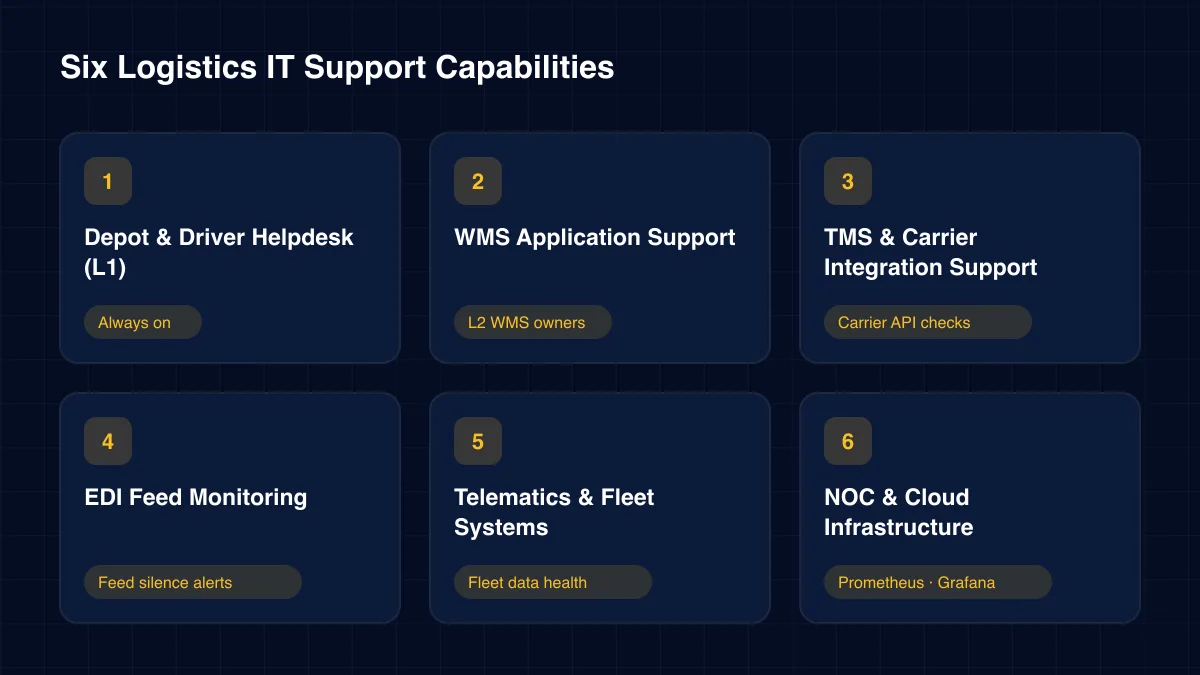
Each capability maps to a point in the freight flow where a failure costs time, money or a customer promise.
Our L1 desk handles driver app logins, scanner resets, printer faults and depot Wi-Fi issues. This is the front line of logistics IT support, and it runs around the clock.
Always on
L2 engineers own the warehouse management system. They clear stuck waves, fix slotting and replenishment errors, and keep inventory records in step with the physical stock.
L2 WMS owners
We monitor rate, booking and tracking calls between your TMS and carriers. Failed tenders are retried or routed to a human before the pickup window closes.
Carrier API checks
Orders, advance ship notices and status messages are tracked end to end. Our logistics IT support team replays failed documents and flags partners whose feeds go silent.
Feed silence alerts
We watch telematics data pipelines, device check-ins and the dashboards dispatch uses. Missing pings are triaged to tell a device fault from a platform fault.
Fleet data health
A NOC watches depot networks, cloud services and databases with tuned alerting. We built this kind of Prometheus and Grafana stack for an enterprise partner, reaching 99.9% uptime.
Prometheus · Grafana →Architecture
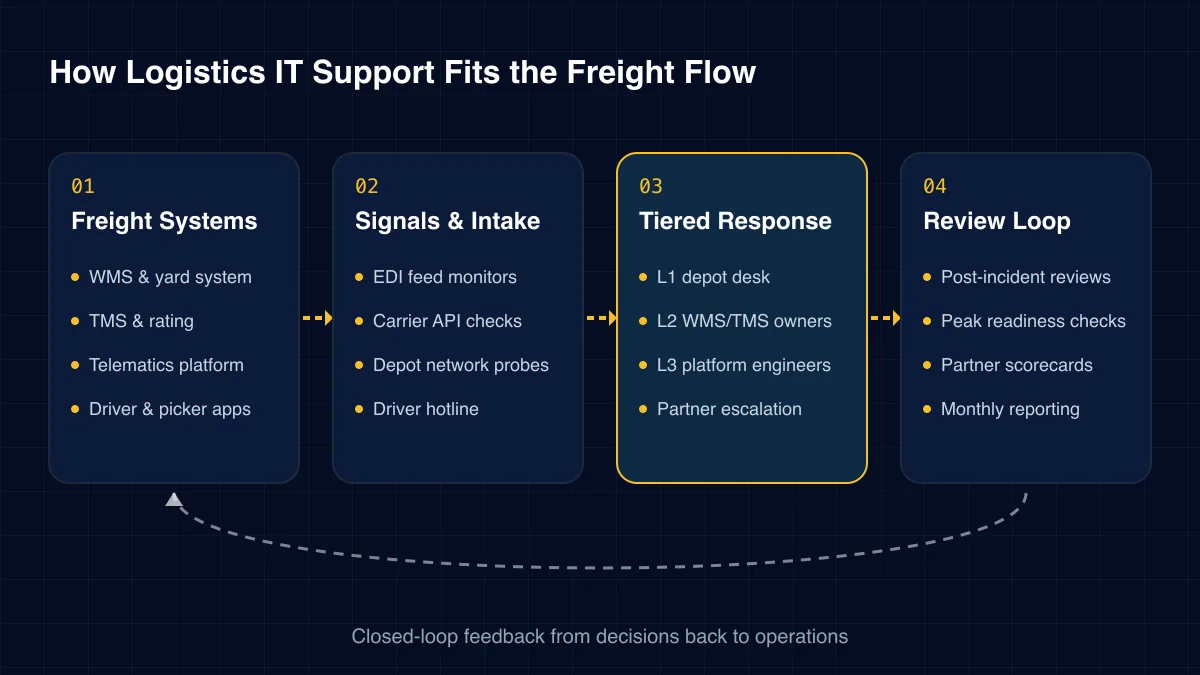
Our logistics IT support model has four layers. Signals come from depots, fleets and partners. Tiered engineers resolve them, and each fix feeds a review loop.
01
02
03
04
Challenges we solve
Logistics runs on thin margins and tight windows. These are the failures we see most often.
A partner changes a format and messages stop. Nobody notices until a customer asks where their freight is.
A WMS job hangs an hour before carrier cut-off. Without an engineer on hand, trucks leave half empty.
Order volume jumps and a database that coped all year starts to lock up. Nobody tested the surge.
Drivers who cannot sign in cannot capture proof of delivery. Invoices slip and disputes grow.
Carriers update endpoints and rate formats with little notice. Tenders fail quietly until someone checks by hand.
Wi-Fi in a busy depot degrades over time. Scanners drop out, pickers wait, and the problem is blamed on the handhelds.
Carriers, 3PLs and shippers need different things. Logistics IT support usually starts in one of four shapes.
Here is how specialist logistics IT support compares with a general managed service provider and an internal team alone.
| Capability | Generic MSP | In-house only | ICANIO freight support |
|---|---|---|---|
| 24/7 engineer coverage | Partial | Rarely | ✓ Yes |
| WMS and TMS skills | No | ✓ Yes | ✓ Yes |
| EDI feed monitoring | No | Partial | ✓ Yes |
| Peak season planning | Partial | Partial | ✓ Yes |
| Partner escalation | No | Partial | ✓ Yes |
The value of logistics IT support shows up at the dock, on the road and in customer service queues.
Delivery
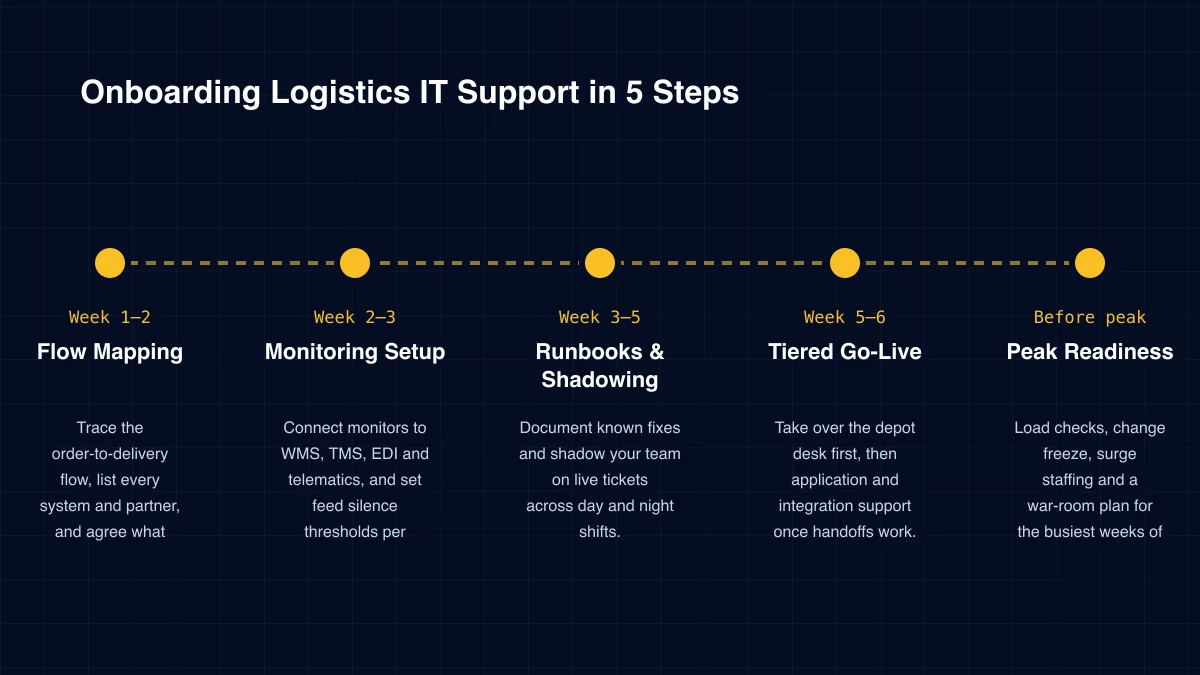
Week 1–2
Trace the order-to-delivery flow, list every system and partner, and agree what counts as a critical incident.
Week 2–3
Connect monitors to WMS, TMS, EDI and telematics, and set feed silence thresholds per partner.
Week 3–5
Document known fixes and shadow your team on live tickets across day and night shifts.
Week 5–6
Take over the depot desk first, then application and integration support once handoffs work.
Before peak
Load checks, change freeze, surge staffing and a war-room plan for the busiest weeks of the year.
A freight business needs more than a ticket desk. We recommend testing a partner on five points.
The first point is where most providers fall short. Logistics IT support that ignores partner feeds will always be a step behind the customer.
ICANIO runs support under ISO 9001 and ISO 27001 certified processes. Access to freight systems is role-based, logged and reviewed.
Logistics IT support has a wide attack surface to cover: depot Wi-Fi, shared handhelds, partner connections and driver phones. Our SOC watches for unusual logins, failed authentication bursts and endpoint alerts. Partner credentials and API keys are stored in managed vaults and rotated on schedule.
Shipment and customer data is handled on a least-privilege basis. Our engineers see only what a ticket needs.
When a partner connection looks compromised, we do not simply cut it off. We call your named contact, agree the action, and then suspend the link. Freight keeps moving on the other lanes while the issue is contained.
Start with the cost of a missed carrier cut-off. Count how often last year a system issue caused one. Add chargebacks from late or missing status messages.
Then add overtime for night callouts and the hours staff spend chasing partner feeds by hand. Those figures are the baseline for logistics IT support. We agree them with you at the start and report on them every month.
Technology stack
Our logistics IT support team works with the platforms you already run. These are the most common.
Warehouse
WMS platformsYard managementRF scannersLabel printing
Transport
TMS platformsRating enginesRoute planningDriver apps
Integration
EDI gatewaysCarrier APIsCustomer portalsMessage queues
Fleet
Telematics platformsGPS devicesDispatch dashboardsMobile device management
Monitoring
AlertmanagerSynthetic checks
Service Management
ITSM ticketingOn-call pagingRunbook libraryStatus pages
 Free white paper · Support EngineeringSupport EngineeringEnsuring Operational Excellence and Business Continuity Through Proactive, Intelligent OperationsGet the white paper →
 Free white paper · LogisticsTransportation & Logistics Technology SolutionsTransforming Modern Supply Chains with AI, Cloud, and IoT IntegrationGet the white paper →
Logistics IT support covers warehouse and transport management systems, EDI and carrier integrations, telematics platforms, driver and picker apps, scanners, printers and depot networks. It also includes cloud infrastructure, databases and security monitoring behind those systems.
Yes. We handle first and second line support for vendor platforms. We fix configuration, data and integration issues ourselves. When a code fix is needed, we open the vendor case with logs and follow it until it is closed.
We monitor each partner feed for errors and for silence. Failed documents are replayed after the cause is fixed. If a partner changes a format, we raise it with them and adjust the mapping with your approval.
Yes. Peak planning is part of every engagement. We agree surge staffing, change freezes and load checks well before the busiest weeks, and we run a war-room rota during them.
Most teams reach full logistics IT support in about six weeks. We start with the depot and driver desk, then take over WMS, TMS and integration work once the handoffs are proven.
Yes. ICANIO operates from India, Singapore and the USA, which suits networks that span time zones. Each depot gets its own contacts and runbooks inside one shared service.
Every minute a dock waits costs money and goodwill. Logistics IT support puts engineers on the WMS, TMS, EDI and telematics systems that keep freight moving, at every hour.
ICANIO delivers logistics IT support as a 24/7, L1–L3 service under ISO 27001 certified processes. We map your freight flow, watch your partner feeds and plan for peak with you. To see what that would look like for your network, contact our team.
By ICANIO Support Engineering Team · Published · Updated
Book a free discovery call. We will trace your order-to-delivery flow, find the weak points, and propose a support model sized for your peak.
Contact Our Support Team
