Real-Time Fraud Detection
Models score card, UPI and account transactions in milliseconds using device, behaviour and network signals, with reason codes for every alert.
Explainable scores →Data & AI for Fintech & Banking
We build explainable models for fraud, KYC, credit and reporting on top of clean, governed financial data. Every score can be traced, challenged and signed off by your risk team.
Card txn ₹48,900, new device, 02:14
Enrich
Score
Explain
Decide
⟳ Model running…
AI in banking is judged by two audiences at once. The business wants fewer fraud losses, faster onboarding and quicker reports. The regulator wants to know exactly why each decision was made. A model that satisfies only one of them never reaches production.
Our team builds AI in banking that satisfies both. We start with the data foundation: clean, reconciled feeds from core banking, payments, cards and wealth platforms. On top of that we build fraud, KYC, credit and reporting models with reason codes, human review steps and full audit logs.
This page covers the use cases, the architecture, the risks and the questions to ask any partner who will touch financial data.
AI in banking is the use of machine learning, document AI and language models across lending, payments, compliance, wealth and operations. It scores risk, reads documents, spots unusual behaviour and answers questions from financial data.
Banks have used statistical scorecards for decades. What has changed is scale and data type. Modern models read transaction streams in real time, parse scanned documents and answer questions in plain language.
The constraint has not changed. Every decision that affects a customer must be explainable, fair and recorded. AI in banking is as much a governance discipline as a modelling one.
Fintechs and incumbent banks start from different places. A fintech often has modern APIs but thin history. A bank has decades of data locked in core systems and batch files. The first job differs, but the destination is the same: a governed data layer that models can trust.
Working definition
“AI in banking is governed decision support for risk, compliance and operations, where every model output carries its reasons, its data lineage and a human owner.”
Foundations
Core banking, payments and wealth feeds must reconcile before any model sees them. Bad data creates bad risk scores.
Every score carries reason codes that analysts, customers and auditors can understand.
Models are documented, validated independently and monitored, in line with model risk guidance such as SR 11-7.
Analysts approve declines, escalations and credit decisions above agreed limits. Models recommend, people decide.
Core capabilities
Each capability is a production pattern our engineers deliver end to end, with governance built into the design.
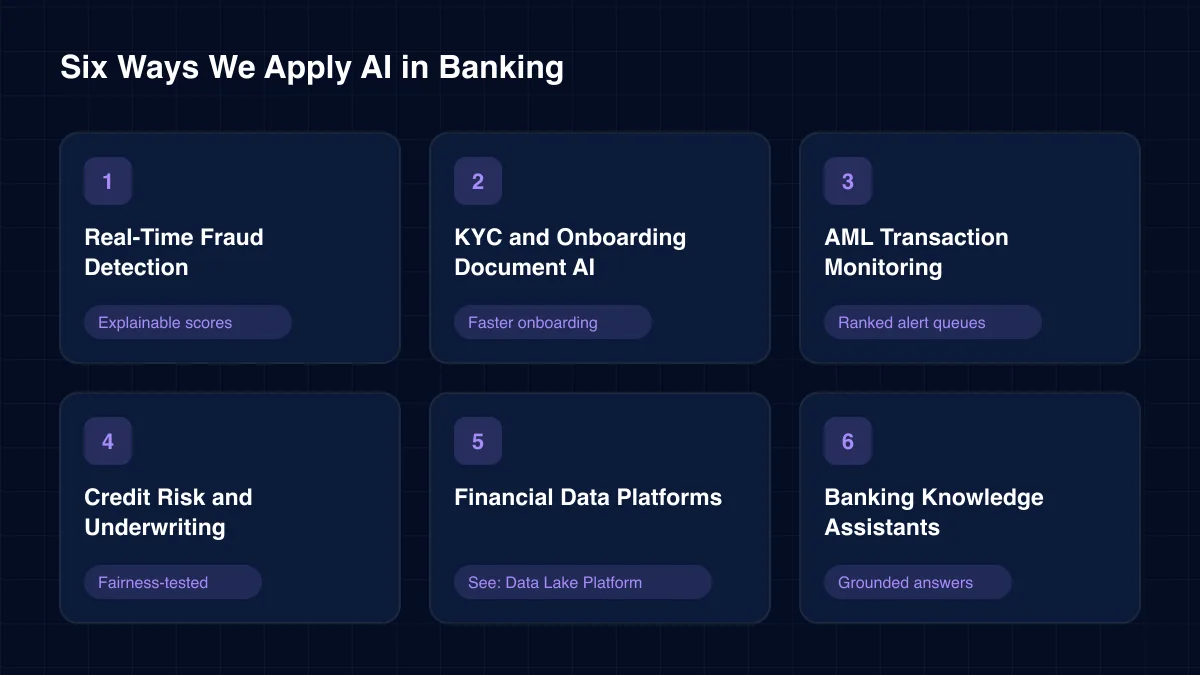
Models score card, UPI and account transactions in milliseconds using device, behaviour and network signals, with reason codes for every alert.
Explainable scores →OCR and extraction models read identity and address documents, match fields and flag forgery signs. AI in banking onboarding cuts manual review to the cases that need it.
Faster onboarding
Machine learning ranks alerts from rule-based monitoring, so investigators work the riskiest cases first and false positives fall.
Ranked alert queues
Scorecards and gradient-boosted models use bureau, bank statement and cash-flow data, with fairness tests and adverse-action reasons.
Fairness-tested
Automated pipelines pull wealth, ledger and transaction data into a governed lake. This is where AI in banking starts, because every model depends on it.
See: Data Lake Platform →RAG assistants answer staff questions from policies, product terms and reporting data, within role-based access and with sources cited.
Grounded answers →Architecture
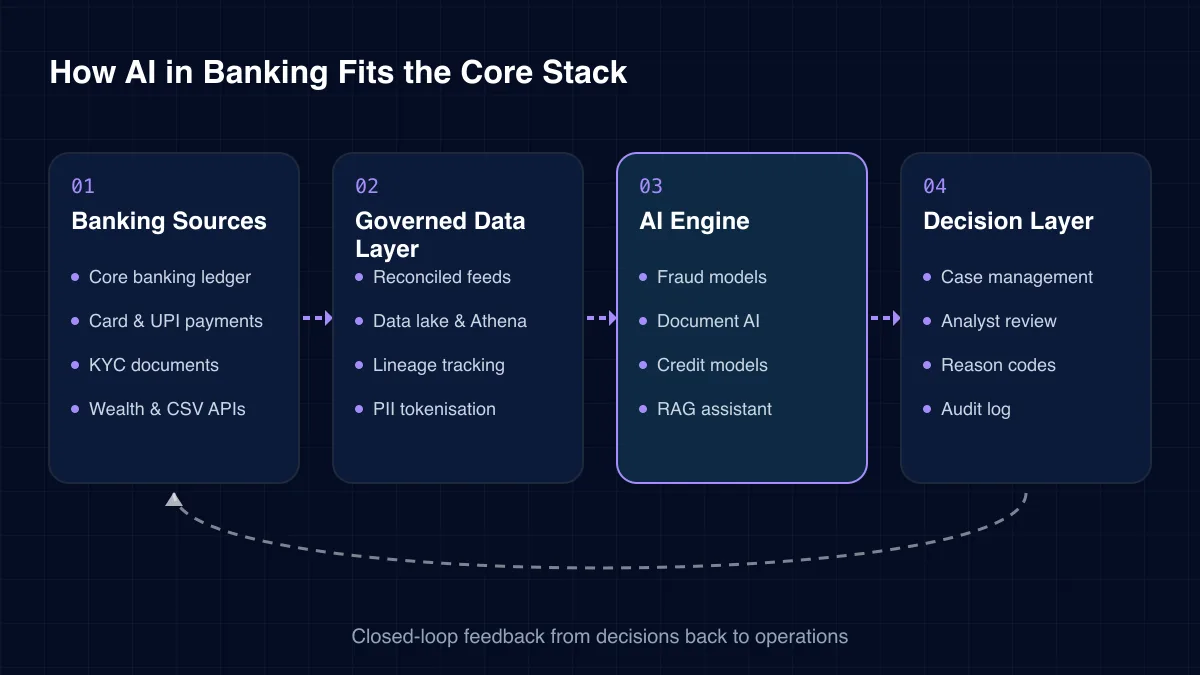
Our reference design keeps the core ledger untouched. AI reads governed copies of the data and returns decisions through controlled interfaces.
01
02
03
04
Challenges we solve
Financial services punishes weak governance. These are the blockers we see most.
If the lake and the ledger disagree, risk teams reject the model before it is tested. Reconciliation comes first.
A model that cannot explain a decline will not pass model validation or a customer complaint review.
Rule engines generate far more alerts than investigators can clear. AI in banking should rank and triage them, not add more.
Teams export CSVs from many systems and rebuild the same Excel report every week. Errors creep in at every step.
Historical lending data can carry bias. Without fairness testing, a model can repeat it at scale.
Fraud patterns change weekly. Without monitoring and fast, validated retraining, detection rates fall.
Banking AI falls into four families, each with its own review needs.
Banks already run rules and scorecards. Here is what AI in banking adds on top.
| Capability | Rules engine | Scorecard | Banking AI |
|---|---|---|---|
| Adapts to new fraud patterns | No | No | ✓ Yes |
| Explains each decision | ✓ Yes | ✓ Yes | ✓ Yes |
| Reads documents | No | No | ✓ Yes |
| Ranks alerts by risk | No | Partial | ✓ Yes |
| Needs model validation | Partial | ✓ Yes | ✓ Yes |
The gains reach risk, compliance, operations and customers.
Delivery
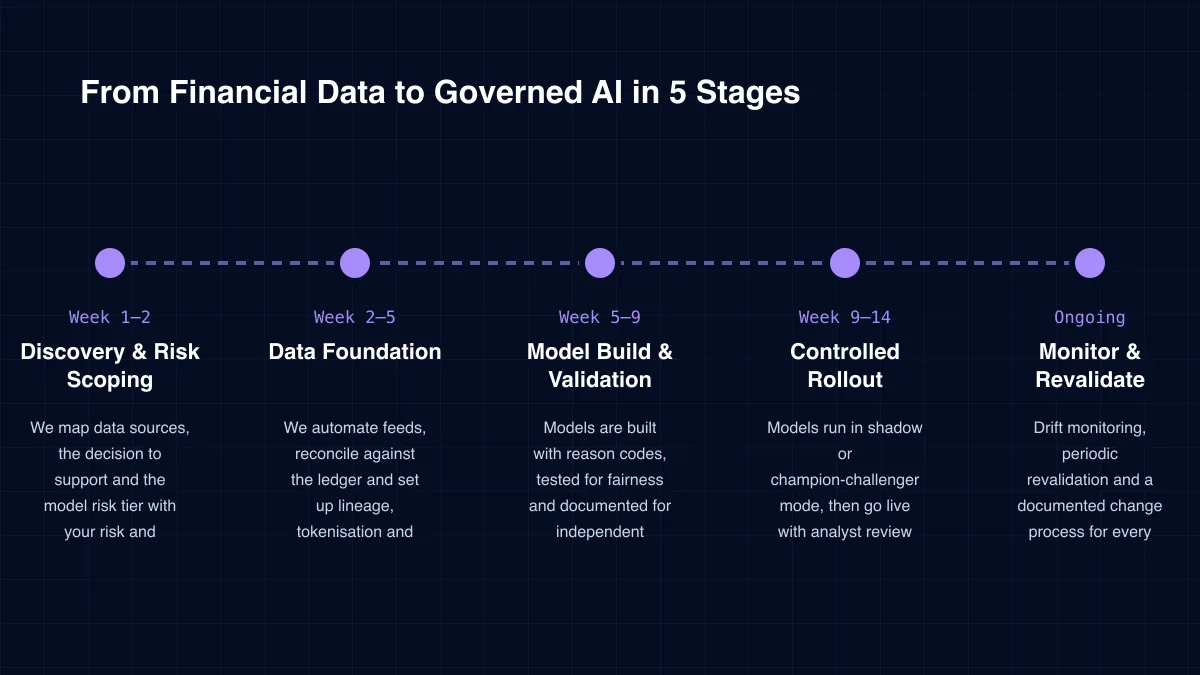
Week 1–2
We map data sources, the decision to support and the model risk tier with your risk and compliance leads.
Week 2–5
We automate feeds, reconcile against the ledger and set up lineage, tokenisation and access controls.
Week 5–9
Models are built with reason codes, tested for fairness and documented for independent validation.
Week 9–14
Models run in shadow or champion-challenger mode, then go live with analyst review steps.
Ongoing
Drift monitoring, periodic revalidation and a documented change process for every model version.
Case study
A wealth management technology partner assembled reports by hand from 10 separate CSV-based APIs. Our team automated extraction and parsing, structured the data in MySQL and delivered real-time Excel reports through secure APIs, with user-level logging. It cut manual effort by 30% and delivered insights 50% faster. This is the governed data layer that AI in banking needs underneath it.
“Ten separate CSV APIs feeding one Excel report by hand is not a reporting process.”Read the full case study →
CSV APIs · Parsers
Replaced manual pulls across all 10 source APIs with one repeatable process.
MySQL
One governed store for report data instead of scattered CSV files.
Excel API · User logging
Real-time reports through secure APIs, with traceable user activity.
We recommend five checks before a partner touches customer or transaction data.
The last point decides whether AI in banking stays compliant after launch. Every ICANIO engagement includes structured post-launch support.
Card data stays inside PCI DSS scope and models work on tokenised references. Personal data is minimised and encrypted, access is least-privilege, and every model call is logged. We align designs with KYC and AML obligations and with local data protection law.
Where credit decisions fall under stricter rules, such as the high-risk category in the EU AI Act, we plan documentation and human oversight from the start. ICANIO works under ISO 9001 and ISO 27001 certified processes.
Start with the cost you already track: fraud losses, analyst hours per KYC case, AML alerts cleared per investigator or hours spent building reports. Last year's figure is the pool your first model works against.
We baseline these in discovery and measure with champion-challenger tests. That keeps the case for AI in banking tied to your own loss, cost and turnaround data, which is also what your risk committee will ask for.
Remember the customer side as well. Fewer false declines and faster account opening protect revenue that never shows up in a fraud report. We track both, so the gain in approvals is not hidden by the gain in losses avoided.
Technology stack
We choose tools that pass security review. These appear in most of our financial builds.
Financial Sources
Core banking APIsPayment feedsWealth Spectrum APIsBank statement parsers
Data Platform
Risk Models
XGBoostScorecardsGraph featuresSHAP explanations
Document AI
OCRField extractionForgery checks
Language AI
LLMsRAG pipelinesEvaluation gates
Governance
Lineage trackingAudit loggingModel registryTokenisation
Start where losses or manual effort are measurable and the data is already flowing. Fraud scoring, KYC document checks and automated reporting are common first steps. Each can run in shadow mode before it affects customers.
We favour models that support reason codes, add SHAP-style explanations where needed and document every feature. Analysts see why a score is high, and adverse-action reasons can be given to customers.
No. Models read governed copies of the data and return decisions through APIs or case management tools. The core ledger stays under its existing controls.
Card data stays in PCI DSS scope and models see only tokens. Personal data is minimised, encrypted and access-controlled, and every read is logged.
Yes, by ranking alerts from existing rules. Investigators work the riskiest cases first, while low-risk alerts are grouped for faster clearance under your policy.
Drift monitoring, scheduled revalidation, retraining under change control and support for audits. AI in banking has to stay accurate and documented for its whole life.
AI in banking can cut fraud losses, speed onboarding and end manual report assembly. It only reaches production when every decision is explainable and every data point is traceable.
ICANIO builds the full stack: automated financial data pipelines, governed lakes, explainable risk models and grounded assistants. We have automated wealth reporting and data lake feeds for financial partners, and we bring that data discipline to every model. That is how AI in banking earns the trust of customers, risk teams and regulators.
By ICANIO Data & AI Engineering Team · Published · Updated
Book a free 30-minute discovery call with our team. We will review your data sources and risk priorities and pick the first model worth building. You will leave with a scoped plan and clear milestones.
Contact Our Data & AI Team