DEVOPS AUTOMATION · CI/CD PIPELINE · FINANCIAL SERVICES CLOUD
ICANIO built a DevOps automation platform for a financial services partner to replace fragmented delivery cycles with standardized, zero-manual-deployment pipelines.
Quick Answer
What Is a DevOps Automation Platform for Financial Services?
A DevOps automation platform for financial services unifies CI/CD pipelines, infrastructure provisioning, and observability into a single standardized system, replacing the fragmented, manual delivery cycles that slow release velocity and create compliance risk. ICANIO built this DevOps automation platform for a financial services partner, unifying CI/CD through Jenkins and GitHub Actions, automating infrastructure provisioning with Terraform and CloudFormation, and centralizing observability across Prometheus, Grafana, and the ELK Stack, delivering 70% faster deployments, a 30% cut in cloud costs, and 99.9% uptime.
Executive Summary
Turning Fragmented Delivery Into a Unified DevOps Automation Platform
Fragmented delivery cycles are a common failure mode in financial services engineering, but they carry a heavier cost than in most industries: every manual handoff between disconnected tools is also a potential compliance gap. ICANIO’s financial services partner was running exactly this kind of environment. Disconnected tooling limited visibility, and manual infrastructure provisioning introduced delay and error. Fragmented governance models created security and compliance vulnerabilities alongside rising operational costs from managing diverse, unoptimized environments.
ICANIO addressed this by building a single DevOps automation platform rather than patching the existing toolchain. The objective was to unify CI/CD delivery through Jenkins and GitHub Actions, replace manual infrastructure provisioning with Infrastructure as Code automation via Terraform and CloudFormation templates, and centralize observability across Prometheus, Grafana, and the ELK Stack. Automated security scanning and containerized orchestration would be built into the same pipeline. The result was a platform that deploys 70% faster, runs at 30% lower cloud cost, and sustains 99.9% uptime through proactive, automated alerting.
Every one of those outcomes traces back to the same design decision. ICANIO standardized on one DevOps automation platform instead of layering point solutions onto an already fragmented toolchain. As a result, speed, cost, and governance improved together rather than trading off against each other.
“Disconnected tools do not just slow a release, in financial services they turn every manual handoff into an unaudited gap in governance.”
The Challenge
Five Inefficiencies Blocking a Unified DevOps Automation Platform
Our financial services partner struggled with fragmented delivery cycles that compromised both speed and security. The resulting operational costs from managing diverse, unoptimized environments compounded every bottleneck below.
Disconnected Tools and Poor Visibility
Disconnected tools caused operational inefficiency and poor visibility across teams, leaving no single source of truth for the health of the delivery pipeline.
Manual Infrastructure Provisioning
Manual infrastructure provisioning led to deployment delays and errors, since every new environment depended on a team member repeating error-prone manual steps.
No Standardized Pipeline in the DevOps Automation Platform
The lack of standardized pipelines hindered rapid software delivery cycles, with each team maintaining its own inconsistent release process.
Fragmented Governance and Compliance Gaps
Fragmented governance models created security and compliance vulnerabilities, a direct risk for a platform operating under financial services oversight.
No Centralized Monitoring in the DevOps Automation Platform
The absence of centralized monitoring delayed critical incident response times, leaving the team without the real-time visibility needed to catch issues before they escalated.
DevOps Automation Platform Solutions Provided
A Six-Part DevOps Automation Platform for Zero-Manual Deployment
Icanio Technologies architected a unified DevOps automation platform that standardizes deployments and infrastructure management through high-performance automation. The solutions included:
Unified CI/CD Pipelines on Jenkins and GitHub Actions
Unified CI/CD pipelines using Jenkins and GitHub Actions replaced the patchwork of disconnected delivery tools with a single standardized release process.
Automated Infrastructure Provisioning via Terraform
Automated infrastructure provisioning via Terraform and CloudFormation templates turned manual, error-prone environment setup into repeatable, auditable deployments.
Centralized Observability With Prometheus and Grafana
Centralized observability with Prometheus, Grafana, and the ELK Stack gave the team a single centralized observability platform across every environment.
Automated Security in the DevOps Automation Platform
Automated security scanning and governance were built directly within the pipeline, closing the compliance gaps the previous fragmented toolchain had left open.
Container Orchestration in the DevOps Automation Platform
Containerized workload orchestration delivered consistent performance across environments, removing the configuration drift that had caused unpredictable incidents.
Proactive Alerting in the DevOps Automation Platform
Proactive alerting systems for real-time infrastructure health monitoring let the team catch and resolve issues before they affected customers.
Business Outcomes
Measurable Results Across Speed, Cost, and Governance
The DevOps automation platform delivered outcomes across every dimension of the client’s original bottlenecks, converting a fragmented, manual delivery process into a standardized platform that ships faster, costs less to run, and gives financial services stakeholders the governance visibility they require.
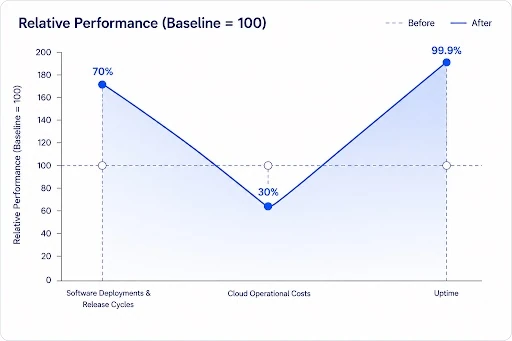
DevOps automation platform results: 70% faster deployments, a 30% reduction in cloud operational costs and 99.9% uptime through proactive monitoring.
70%Faster
In software deployments and release cycles
30%Reduction
In overall cloud operational costs
99.9%Uptime
Via proactive monitoring and alerts
Automated Workflows
Via 3-click IaC and pipeline triggers
Stronger Governance
Through integrated automated security scans
Unified Visibility
Via centralized Grafana and ELK dashboards
Key learnings
What This Engagement Proves for Financial Services Engineering Teams
Standardizing Delivery via a DevOps Automation Platform
Faster deployments and stronger governance are often treated as competing goals, but in this engagement they came from the same change: replacing a fragmented toolchain with one standardized DevOps automation platform. Once CI/CD, provisioning, and observability all ran through the same pipeline, automated security scanning and consistent environments became the natural byproduct of speed, not a separate initiative competing for the same engineering time.
Infrastructure as Code Removes the Manual Step That Caused the Errors
Manual infrastructure provisioning was not just slow, it was the direct source of the deployment errors the team was troubleshooting. Replacing it with Terraform and CloudFormation templates did not just speed up provisioning, it removed the manual step that had been generating the errors in the first place.
Observability Turns Incident Response From Reactive to Proactive
The absence of centralized monitoring meant the team only found out about problems after customers did. Consolidating Prometheus, Grafana, and the ELK Stack into one observability layer gave the team the proactive alerting needed to resolve issues before they escalated into customer-facing incidents.
Conclusion
From Fragmented Delivery to a Unified DevOps Automation Platform
Fragmented delivery cycles might be tolerable for a low-stakes internal tool, but for a financial services partner operating under strict governance expectations, disconnected tooling and manual provisioning had become a genuine business risk. This engagement demonstrates that a single, unified DevOps automation platform can resolve speed, cost, and governance gaps within one structured programme rather than three separate initiatives.
By unifying CI/CD through Jenkins and GitHub Actions, automating infrastructure provisioning with CI/CD pipeline automation and Infrastructure as Code, and centralizing observability across Prometheus, Grafana, and the ELK Stack, ICANIO helped this partner ship 70% faster, cut cloud costs by 30%, and sustain 99.9% uptime, all while strengthening governance through automated security scanning built into the same pipeline. The standardized CI/CD, Infrastructure as Code, and centralized observability delivered through this engagement are the foundation every future release and incident response on this platform will run on.
Related Resources
Our team delivers pipeline and cloud work like this through ICANIO's DevOps and cloud engineering services. This automation supports faster software development for fintech and banking teams. Related work includes DevOps automation and continuous testing for CI/CD. To plan a similar DevOps automation platform, contact ICANIO.
- DevOps and Cloud Engineering Services
- Fintech and Banking Industry Solutions
- DevOps Observability Platform: 99.9% Uptime
- Cloud Cost Optimization Platform: 25% Savings
- Top 5 Best Platform Engineering IDP Wins
References
- Terraform documentation: official Terraform docs.
- Jenkins user documentation: official Jenkins docs.
- GitHub Actions documentation: official GitHub Actions docs.
- Prometheus overview: official Prometheus introduction.
- Infrastructure as code: overview of the IaC practice.
Frequently asked questions
Common Questions About This DevOps Automation Platform
Why does a DevOps automation platform matter for financial services?
A DevOps automation platform unifies CI/CD, infrastructure provisioning, and observability into one standardized system, replacing the fragmented, manual delivery process that slows releases and creates compliance risk. For a financial services partner, it matters because disconnected tooling and manual provisioning are not just inefficient, they are governance gaps regulators and auditors will eventually ask about.
Why unify CI/CD through Jenkins and GitHub Actions?
Running CI/CD through a single Jenkins and GitHub Actions pipeline replaced a patchwork of inconsistent, team-specific release processes with one standardized, auditable workflow, the change that unlocked the 70% faster deployment cycle in this engagement.
How does Infrastructure as Code reduce deployment errors?
Terraform and CloudFormation define every environment as version-controlled code rather than a manual checklist, removing the human step that was the direct source of the client's original provisioning errors and delays.
How did Prometheus, Grafana, and the ELK Stack support 99.9% uptime?
Consolidating Prometheus, Grafana, and the ELK Stack into a single observability layer gave the team centralized, real-time visibility and proactive alerting, replacing the fragmented monitoring that had previously delayed incident response.
Does automating security scanning slow down the deployment pipeline?
No, in this engagement it did the opposite. Building automated security scanning directly into the CI/CD pipeline meant governance checks ran alongside every deployment rather than as a separate manual gate. Releases got faster and more secure at the same time.
How did the platform reduce cloud operational costs by 30%?
Standardizing on containerized workload orchestration and automated infrastructure provisioning eliminated the diverse, unoptimized environments the team had previously been maintaining manually. That is what drove the 30% reduction in cloud operational costs.