
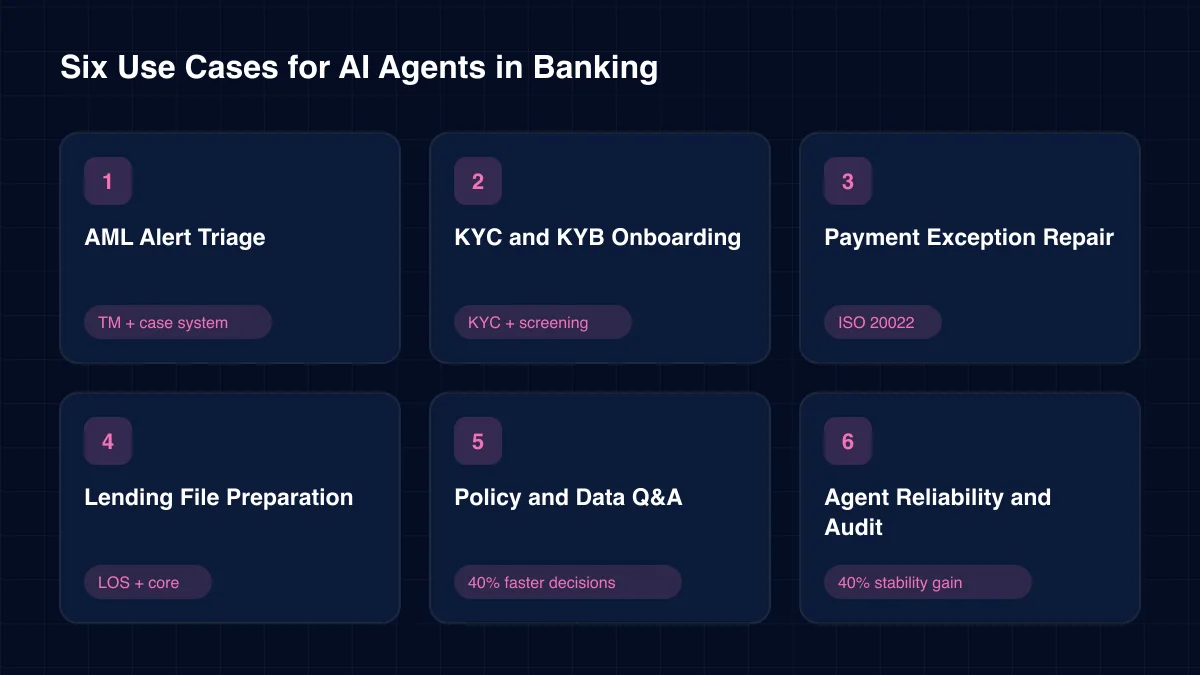
AML Alert Triage
Agents group related alerts, pull transaction history and KYC data, and draft a case narrative. The compliance officer decides whether to close or escalate.
TM + case system
AgenticOps · Fintech & Banking
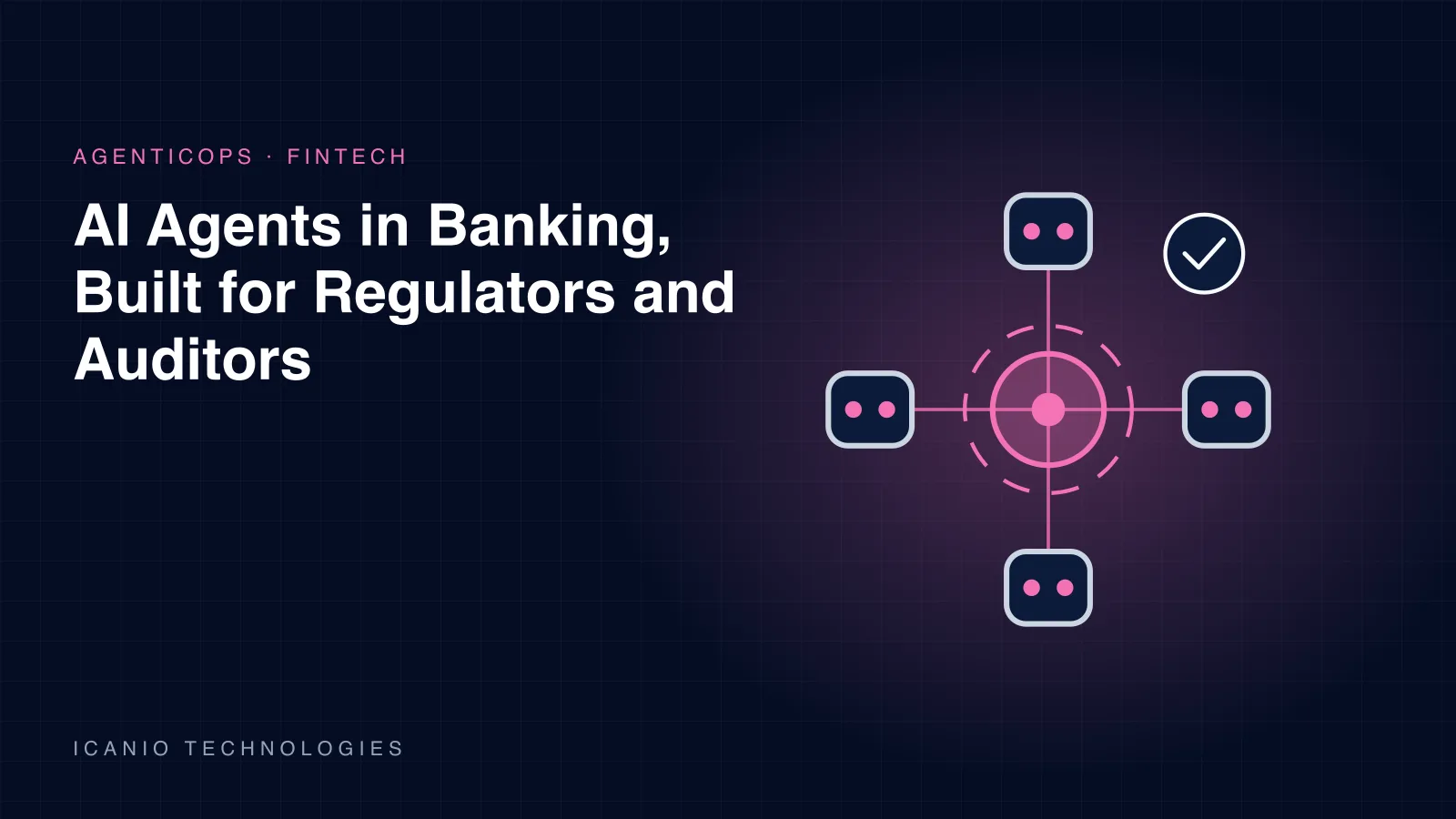
We design and operate multi-agent systems for financial crime, onboarding, lending and payment operations. Agents gather evidence from core banking, payments and KYC systems and draft the case. Compliance officers, credit officers and operations leads make every regulated decision.
⟳ Orchestrating agents…
every step traced · guardrails on · reversible
AI agents in banking are software workers that gather evidence, check it against policy and draft the case file. They read transaction monitoring alerts, KYC records, payment messages and core banking data. Then a compliance or operations professional reviews a complete file instead of building it by hand.
Banks carry heavy operational queues. AML alerts pile up, onboarding files wait for documents and payment exceptions need repair before cut-off. Most of that time goes on finding and joining data, not on judgement.
Our team builds AI agents in banking that take on the finding and joining. Regulated decisions stay with accountable people: escalating a case, rating a customer, approving credit or releasing a payment. This page explains how we design, govern and measure those systems.
An AI agent is a program that works toward a goal by planning steps, calling tools and checking results. In a bank, those tools include core banking, card and payment platforms, KYC and screening services, case management and document stores.
AI agents in banking are not a customer chatbot. They work in the back and middle office. An agent can pull twelve days of deposits, compare them with a customer profile and draft a case narrative. It cannot close or file that case.
Several narrow agents usually share one case. AgenticOps keeps them traced, versioned and explainable. That matters because model risk, audit and regulators will want to see how every recommendation was made.
Regulated-industry definition
“AI agents in banking are governed software agents that assemble evidence across core banking, payments, KYC and case systems, and prepare recommendations that an accountable officer reviews and decides.”
Foundations
AI agents in banking never file a report, close an alert, approve credit or release a held payment on their own.
Each recommendation lists its data, rules and reasoning steps, so a reviewer or examiner can follow it.
Approvals follow your maker-checker rules. The agent is the maker's assistant, never the checker.
Prompts, tools and models are versioned and validated like any other model under your model risk policy.
Core capabilities
These are the areas where AI agents in banking usually earn their place first. Each ends with an accountable human decision.
Agents group related alerts, pull transaction history and KYC data, and draft a case narrative. The compliance officer decides whether to close or escalate.
TM + case system
AI agents in banking extract registry and ownership data, run screening and assemble due diligence files. A KYC analyst approves the risk rating.
KYC + screening
Agents diagnose rejected ISO 20022 and card messages, propose repairs and re-screen them. An operations lead releases the corrected payment.
ISO 20022
Agents collect statements, verify documents and summarise affordability for a credit officer. Credit decisions stay with people and your approved models.
LOS + core
Staff ask questions of policies and data in plain language. Our enterprise AI chatbot build delivered 40% faster decisions.
40% faster decisions →We trace every tool call, version every prompt and replay any decision on demand. This builds on our agentic AI framework work.
40% stability gain →Architecture
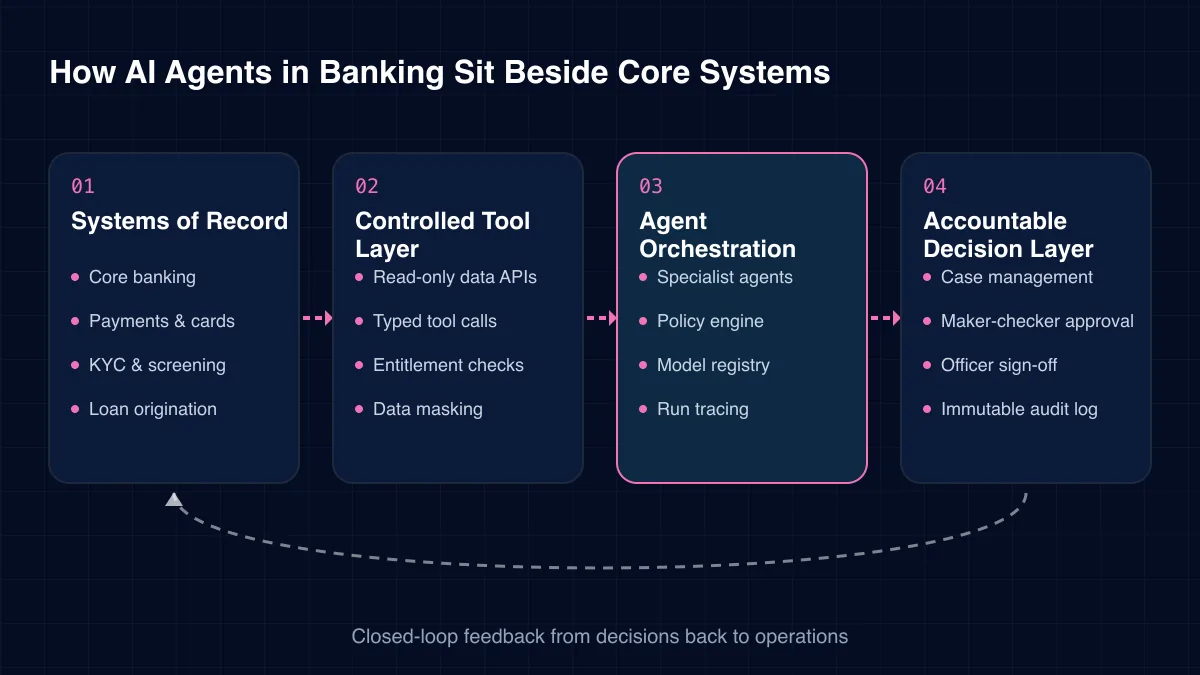
Agents read from systems of record through controlled tools. They write only drafts and case notes, and every regulated action passes a human checker.
01
02
03
04
Challenges we solve
Banks already run rules for monitoring, screening and payments. The investigation work behind each alert is where AI agents in banking help.
Rules generate many false positives. Analysts spend most of their time gathering data. Agents prepare the file so analysts can focus on judgement.
Ownership structures and documents take days to verify. Agents extract, cross-check and list what is still missing.
Rejected messages need fast, correct fixes. Agents find likely repairs from history and re-screen them before release.
Two analysts write the same case two ways. Agents draft to a standard template with sources, which helps quality review.
Staff hunt through long procedures for one rule. Agents retrieve the relevant section and cite it.
Examiners expect explainability and control. We log every step, version every component and keep people accountable.
AI agents in banking usually progress through four levels of responsibility.
Most banks already run RPA and rules. The table shows where agents add something new.
| Capability | Rules engine | RPA bots | AI agents |
|---|---|---|---|
| Generates alerts | ✓ Yes | No | No |
| Investigates an alert | No | Partial | ✓ Yes |
| Reads documents and free text | No | Partial | ✓ Yes |
| Drafts a sourced case narrative | No | No | ✓ Yes |
| Requires officer sign-off | Varies | Varies | Always |
Benefits compound as more queues share the same governed agents and audit trail.
Delivery
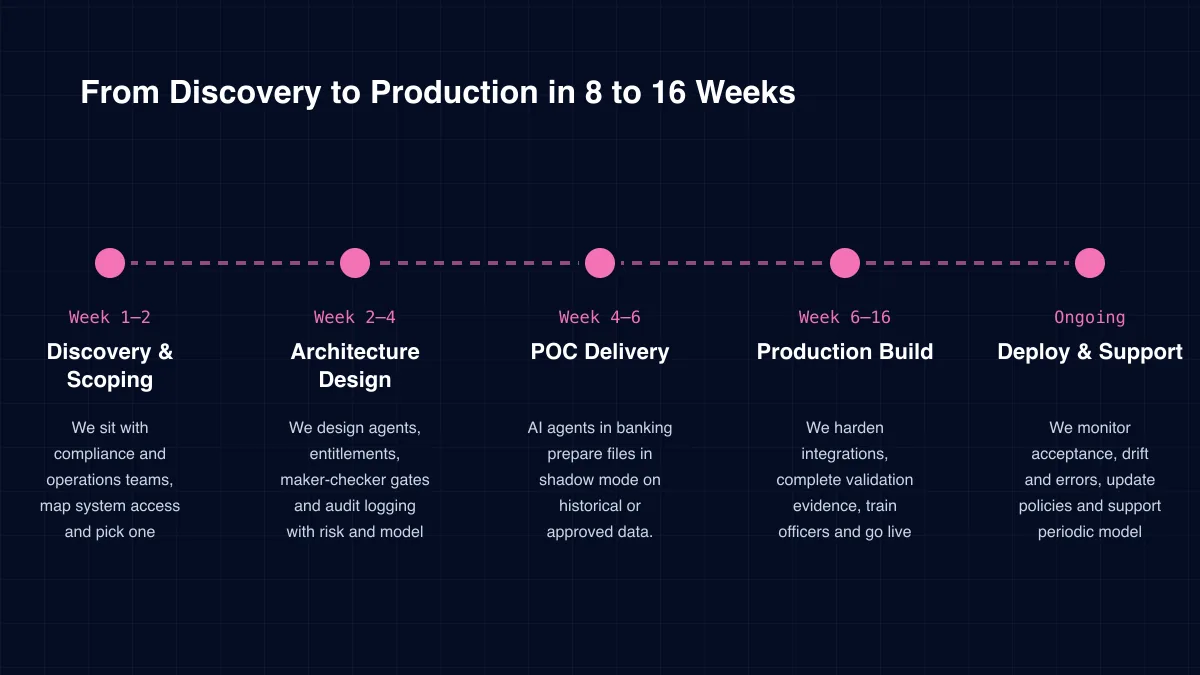
Week 1–2
We sit with compliance and operations teams, map system access and pick one high-volume queue.
Week 2–4
We design agents, entitlements, maker-checker gates and audit logging with risk and model validation.
Week 4–6
AI agents in banking prepare files in shadow mode on historical or approved data. Analysts compare them with their own.
Week 6–16
We harden integrations, complete validation evidence, train officers and go live queue by queue.
Ongoing
We monitor acceptance, drift and errors, update policies and support periodic model reviews.
Case study
An enterprise AI platform's agents gave divergent outputs for identical inputs. We audited every workflow, standardised reasoning chains and tool calls, and added collaborative and reflective agents. The framework gained 40% in stability and 3x in reasoning capability across local and cloud LLMs. Consistent, repeatable behaviour is what model risk teams expect from AI agents in banking.
“Optimize the framework architecture first.”Read the full case study →
Workflow debugging
Existing agents were reviewed and fixed before any capability was extended.
Standardised chains
Reasoning and tool use were redesigned so the same input gives the same result.
Local & cloud LLMs
Agents run on local or cloud models, which suits data residency rules.
Regulated work needs more than a strong model. We recommend testing a partner on these five points.
Validation evidence often decides the timeline. Plan it from week one, not after the build.
ICANIO operates under ISO 9001 and ISO 27001 certified processes. AI agents in banking access data through entitlement-checked tools, with masking for account and card numbers. Card data stays inside PCI DSS scope.
Suspicious activity reporting, credit approval and account closure stay human decisions. Agents prepare the evidence only. Where the EU AI Act applies, credit scoring of individuals is a high-risk use, so we design logging and human oversight to support it.
We map agent risks to the NIST AI Risk Management Framework and your model risk policy. Operational resilience rules such as DORA shape our fallback plans and third-party controls.
Pick one queue and measure it today. For AML, time per alert and backlog age. For onboarding, days from application to account. For payments, repairs per day and missed cut-offs.
We baseline those numbers with your team during discovery. Shadow mode then shows how often analysts accept agent-prepared files. The return on AI agents in banking is measured on your own queues.
Technology stack
We choose tools for AI agents in banking per institution. These are typical choices, not a fixed bundle.
Systems of Record
Core bankingCard platformsLoan originationCRM
Financial Crime
Transaction monitoringSanctions & PEP screeningCase management
Integration
ISO 20022REST APIsEvent streamsSecure file transfer
Agent Frameworks
Custom orchestrators
Models
Private cloud LLMsOn-premise LLMsDocument extraction
Governance
Model registryImmutable audit log
 Free white paper · AgenticOpsThe AgenticOps PlaybookA practical, framework-neutral guide to engineering, governing and running AI agents in production, from the first workflow to a trusted agent estate.Get the white paper →
 Free white paper · FintechFintech & BankingEnterprise Solutions for the Digital Financial Services EraGet the white paper →
No. AI agents in banking can gather evidence and draft a case narrative. The decision to escalate or file stays with your compliance officers. The agent's role is to make that decision faster and better informed.
Typically core banking, card and payment platforms, transaction monitoring, screening, KYC, case management, loan origination and document stores. Each tool is entitlement-checked and logged.
At every regulated or financial decision: closing or escalating an alert, rating a customer, approving credit and releasing a held payment. Gates follow your maker-checker rules and delegated authorities.
We treat prompts, tools and models as versioned components. We provide test sets, performance results, limitations and monitoring plans for your validators. Shadow-mode results on real cases form part of that evidence.
Yes. Our agentic framework work supports local and cloud LLMs. Banks can run models in their own tenancy or data centre, with masking on sensitive fields.
Most engagements reach production in eight to sixteen weeks. Discovery, design and a shadow-mode proof of concept take about six weeks. Validation and control evidence run alongside the production build.
AI agents in banking are most useful where skilled people lose hours to data gathering. They build the file, cite the sources and suggest a path, then hand the decision to an officer.
ICANIO applies AgenticOps discipline to that work: entitlement-checked tools, maker-checker gates, versioned components and full tracing. We take banks from one queue in shadow mode to production in eight to sixteen weeks, then support them through every model review.
By ICANIO AgenticOps Engineering Team · Published · Updated
Book a free 30-minute discovery call. We will map one banking queue, its systems and its approvers to a governed agent design. You will leave with a clear scope and a shadow-mode plan.
Contact Our AgenticOps Team

