Customer & Staff Helpdesk (L1)
Our L1 desk handles login failures, OTP and device binding problems, and staff access requests. This is fintech IT support at the front line, so identity checks are strict and replies are clear.
Day and night
Support Engineering · Fintech & Banking
Round-the-clock engineers for the systems money moves through: payment gateways, core banking, card processing, KYC checks, ledgers, reconciliation and customer apps.
128
Resolved today
100%
Within SLA
24/7
On shift
A payment that fails silently is worse than one that fails loudly. The customer is charged twice, or not at all, and nobody knows until the complaint arrives. Fintech IT support exists to catch that failure first.
Our team runs fintech IT support as a 24/7, tiered service for banks, payment companies, lenders and wealth platforms. L1 engineers help customers and staff with access and app issues. L2 engineers own payments APIs, KYC flows and reconciliation jobs. L3 engineers work on ledgers, databases, cloud platforms and card processing paths.
This page covers what that service includes, the failures it guards against, how it supports your regulatory duties, and what to ask a partner before you trust them with production money.
Fintech IT support is the ongoing operation of the systems that move, record and protect money. The core includes payment gateways, card processing, core banking or ledger platforms, and the APIs that connect them to partners and apps.
Around that core sit identity checks, fraud tools, reconciliation jobs, reporting and customer channels. Many of these depend on outside vendors, such as KYC providers, card schemes and banking partners. A slow response from any of them becomes your incident.
Regulators care how you handle these incidents. In the EU, the Digital Operational Resilience Act sets rules for ICT risk, incident reporting and third-party oversight. Fintech IT support has to produce the evidence those rules expect, not only fix the fault.
Working definition
“Fintech IT support is a tiered, always-on service that monitors, maintains and restores payment, banking and financial data systems, with priorities set by financial and customer impact and every action recorded for audit.”
Foundations
A fast fix that corrupts a ledger is a second incident. We verify balances and state before closing any payment ticket.
Every alert, action and approval is logged, so audit and regulatory questions have ready answers.
KYC, card and banking partners are monitored like internal services, with named contacts for escalation.
Engineers get the narrowest access a ticket needs, for the shortest time, with a second approver for sensitive changes.
Core capabilities
Each capability covers a point where a failure can move money wrongly, block a customer or create a compliance gap.
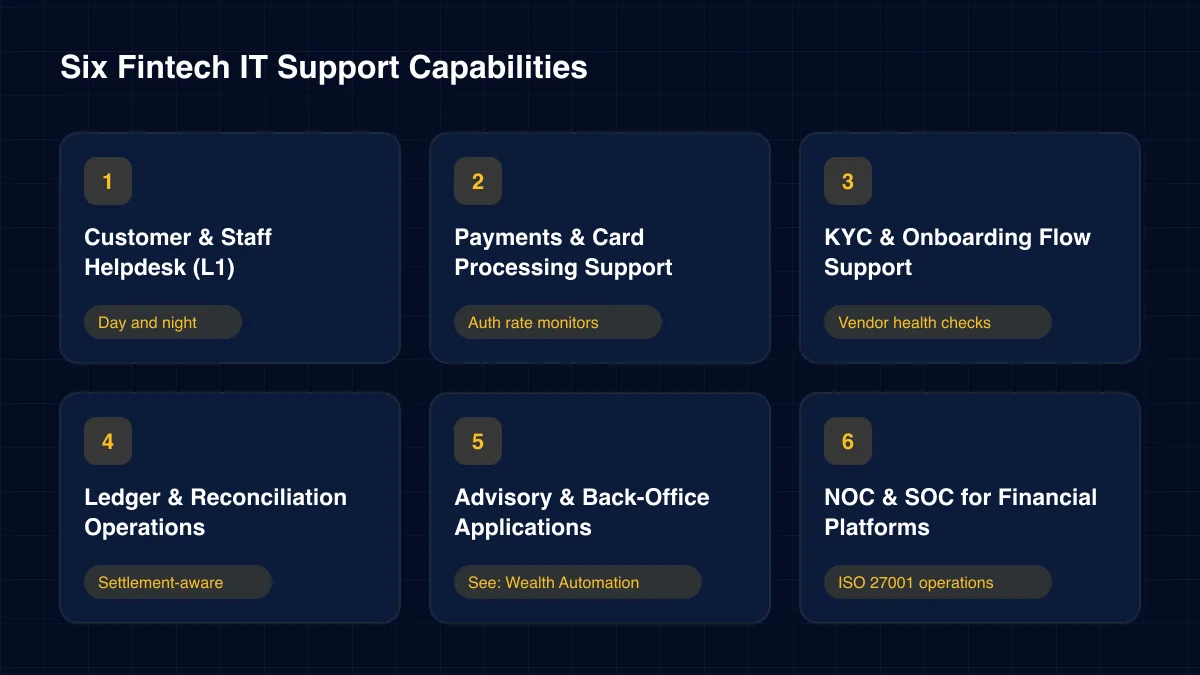
Our L1 desk handles login failures, OTP and device binding problems, and staff access requests. This is fintech IT support at the front line, so identity checks are strict and replies are clear.
Day and night
L2 and L3 engineers watch authorisation rates, latency and webhook queues. When approval rates dip, we trace whether the cause is ours, the gateway's or the scheme's.
Auth rate monitors
We monitor identity verification calls, document checks and onboarding funnels. Vendor timeouts are detected quickly, and stuck applications are cleared with care.
Vendor health checks
Fintech IT support for ledgers means watching replication, batch jobs and nightly reconciliations. Breaks are investigated before settlement deadlines, with balances checked after every fix.
Settlement-aware
We maintain the internal tools finance teams run on. Our wealth management automation console replaced spreadsheets with audited workflows and lifted advisory productivity by 75%.
See: Wealth Automation →A NOC watches infrastructure and APIs, while a SOC watches identity, endpoints and fraud signals. Both feed one incident process with regulator-ready timelines.
ISO 27001 operations →Architecture
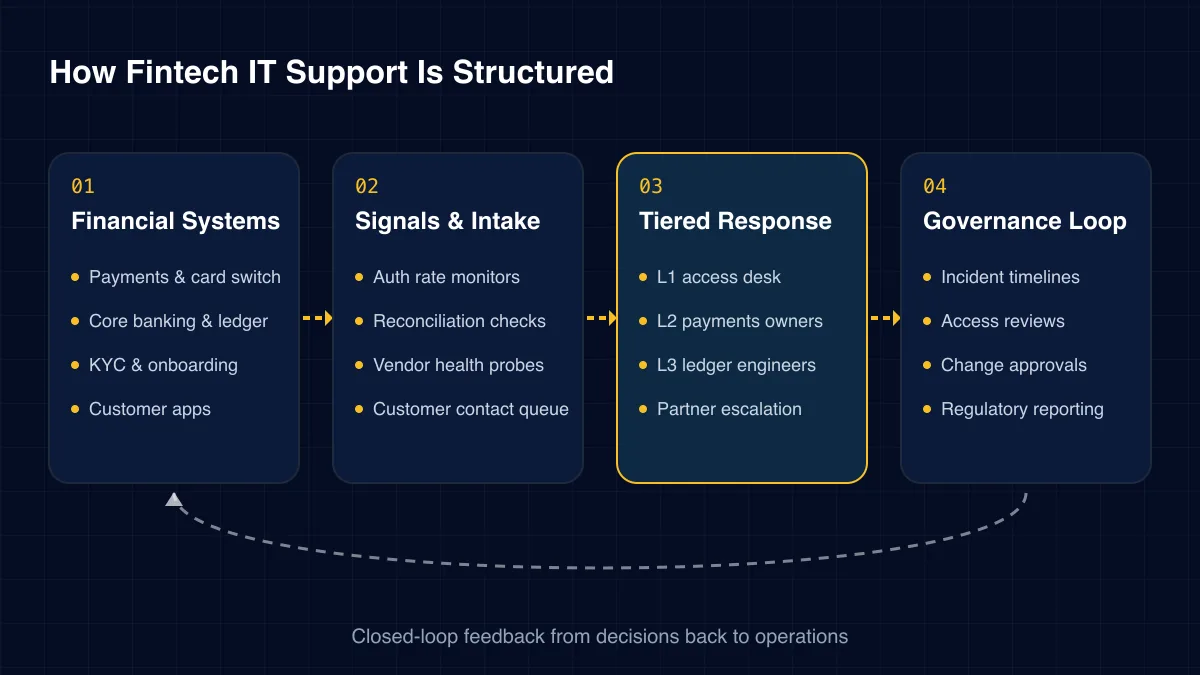
Our fintech IT support model has four layers. Signals come from payment, banking and customer systems. Tiered engineers resolve them, and a governance loop keeps the evidence straight.
01
02
03
04
Challenges we solve
In financial services, the costly failures are often quiet ones. These are the patterns we see most.
Webhooks fail and retries pile up. Payments look pending for hours, and customers try again, causing duplicates.
Card approvals dip a few points after a change. Without a monitor on the rate, the revenue loss runs for days.
A batch job fails after midnight. By morning, finance faces a gap that must be explained before settlement.
A KYC provider slows down and onboarding stalls. Customers blame your app, not the vendor.
Fixes are made over chat with no record. When auditors ask what happened, nobody can show the evidence.
Back-office teams run on manual spreadsheets. Reports are late, errors creep in and accountability is unclear.
Banks, payment firms and wealth platforms start from different places. Fintech IT support usually takes one of four forms.
This table compares specialist fintech IT support with a general provider and an internal team on its own.
| Capability | Generic MSP | In-house only | ICANIO fintech support |
|---|---|---|---|
| 24/7 engineer coverage | Partial | Partial | ✓ Yes |
| Payments and ledger skills | No | ✓ Yes | ✓ Yes |
| Regulator-ready timelines | No | Partial | ✓ Yes |
| Vendor health monitoring | Partial | Partial | ✓ Yes |
| Two-person sensitive changes | Rarely | Partial | ✓ Yes |
The value of fintech IT support shows up in fewer failed payments, cleaner books and easier audits.
Delivery
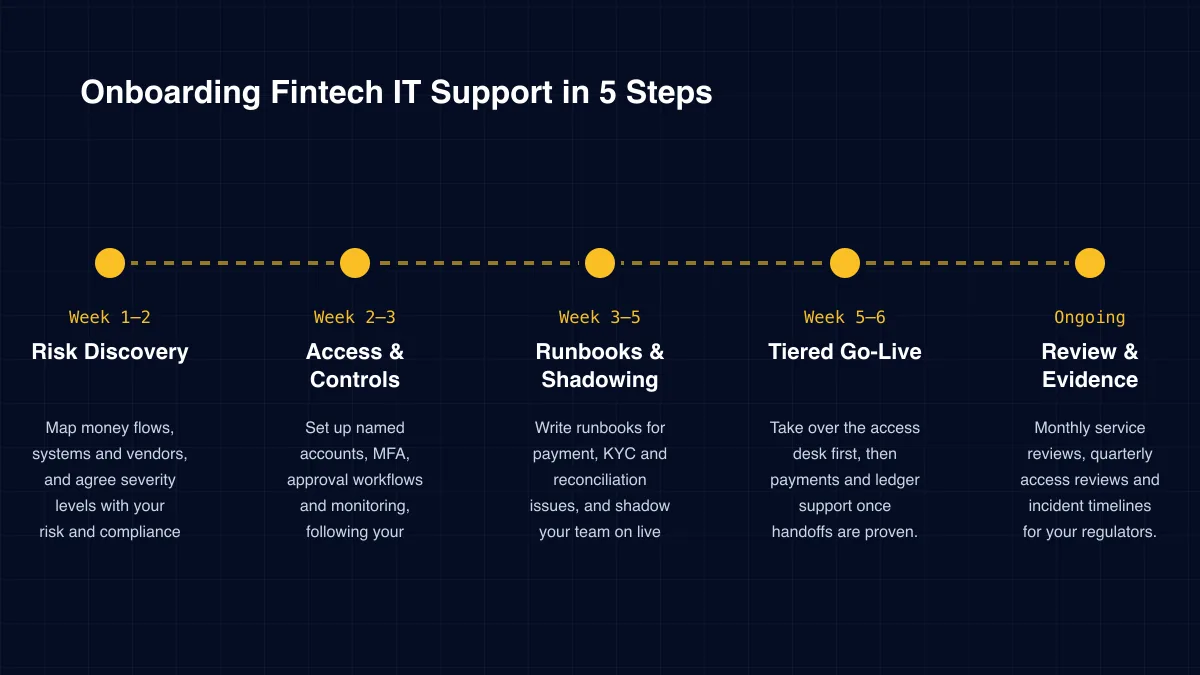
Week 1–2
Map money flows, systems and vendors, and agree severity levels with your risk and compliance teams.
Week 2–3
Set up named accounts, MFA, approval workflows and monitoring, following your security policies.
Week 3–5
Write runbooks for payment, KYC and reconciliation issues, and shadow your team on live incidents.
Week 5–6
Take over the access desk first, then payments and ledger support once handoffs are proven.
Ongoing
Monthly service reviews, quarterly access reviews and incident timelines for your regulators.
Case study
A wealth advisory firm ran on manual Excel processes. Reports were late, errors were a constant risk and there was no audit trail. Our team built a central workflow console with automated document processing, real-time dashboards, audit trails and a validation engine. Advisory team productivity rose by 75%, and the effective workweek fell from six days to five.
“In a regulated advisory practice, a spreadsheet is also the reason there is no audit trail.”Read the full case study →
Report generation
Reports produced quickly, replacing manual assembly that caused delays.
Real-time tracking
Managers see task progress and can reassign work across the team.
Audit trails · validation engine
Every report is traceable, and errors are caught before a client sees them.
Your support partner will touch production money. We recommend checking five things carefully.
The third point is often skipped and later regretted. Fintech IT support that cannot explain an incident clearly leaves you exposed, however quickly it was fixed.
ICANIO runs support under ISO 9001 and ISO 27001 certified processes. Engineers use named accounts with MFA. Access to production is time-bound, logged and reviewed.
Where card data is in scope, our fintech IT support works within your PCI DSS controls and keeps engineers out of the cardholder data environment unless a ticket requires it. For EU clients, our incident timelines and third-party records are designed to feed your DORA reporting and oversight processes.
Our SOC watches identity systems, endpoints and API traffic for unusual behaviour. Suspected fraud signals are passed to your fraud team with context, not acted on alone.
Start with the value of payments processed per hour and the revenue lost for each point of card approval rate. Then count the incidents last year that hit either one.
Add the hours finance spends on reconciliation breaks, the cost of audit findings and the engineering time lost to night callouts. Those are the baselines for fintech IT support. We agree them with you during discovery and report against them every month.
Technology stack
Our fintech IT support team works with the platforms you already run. These are the most common groups.
Payments
Payment gatewaysCard processingWebhooksPayouts
Banking Core
Core banking platformsLedgersISO 20022 messagingSettlement jobs
Risk & Identity
KYC providersAML screeningFraud toolsCustomer MFA
Back Office
ReconciliationReportingWealth consolesData lakes
Monitoring
AlertmanagerSynthetic checks
Security
SIEMEndpoint protectionSecrets vaultsPrivileged access
Fintech IT support covers payment gateways, card processing, core banking and ledgers, KYC and onboarding flows, reconciliation jobs, back-office tools and customer apps. It also includes the infrastructure, NOC and SOC monitoring behind those systems.
We check balances and transaction state before and after every payment or ledger fix. Sensitive changes need a second approver. Engineers use named, time-bound access, and every session is logged.
DORA duties sit with the regulated entity, so no provider can meet them for you. Our fintech IT support is designed to help. Incident timelines, root causes and third-party records are written so your risk team can use them in reporting.
Yes. We treat vendors as part of your system. Their response times and error rates are monitored, and we escalate to named contacts with evidence when they degrade.
Yes. Back-office tools matter as much as customer apps. Our wealth management automation work replaced spreadsheets with an audited console and lifted advisory productivity by 75%.
Most clients reach full fintech IT support in about six weeks. Access controls and approvals come first, then runbooks and shadowing, then go-live tier by tier.
Money-moving systems leave no room for guesswork. Fintech IT support keeps payments, ledgers and onboarding running, and records every step so you can explain it later.
ICANIO delivers fintech IT support as a 24/7, L1–L3 service under ISO 27001 certified processes. Our wealth management automation work shows how supported, audited tools change a finance team's week. To discuss your systems and obligations, contact our team.
By ICANIO Support Engineering Team · Published · Updated
Book a free discovery call. We will map your money flows, systems and vendors, then propose a support model with clear response targets and evidence built in.
Contact Our Support Team