ATM Fleet Health and Cash Planning
A digital twin in banking tracks dispenser retries, card reader errors and cash levels across the fleet. It predicts faults and cash-outs before customers find a dead machine.
40% less unplanned downtime
Digital Twin for Fintech & Banking
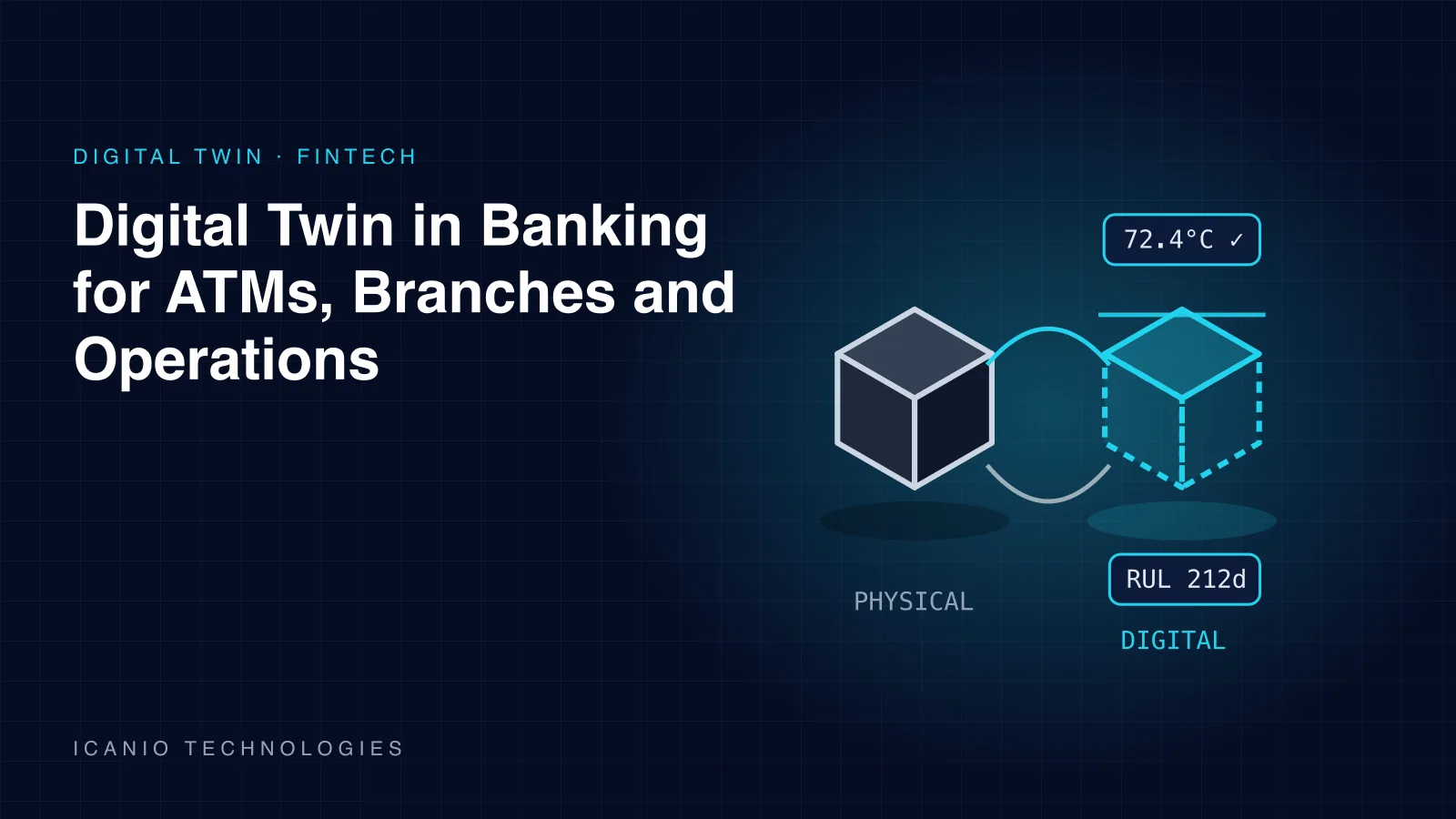
We build a digital twin in banking that mirrors your ATM fleet, branches, data centres and payment operations. It predicts faults, tests resilience scenarios and supports network decisions with live data.
ATM 4417
Branch 062 · Lobby
Remaining life
212 days
Cash level
64%
Dispense retries
1.2/h
Card reader errors
0.4/h
✓ All signals within physics baseline
A digital twin in banking is a live model of the physical and operational estate behind every transaction: ATMs, branches, data centres and payment operations. It updates from device, facility and process data as the working day unfolds.
Banks already monitor each piece separately. ATM faults go to a vendor portal, data centre alarms go to facilities and payment exceptions sit in an operations queue. What is missing is a view of how these connect and what happens next.
Our team joins those feeds into one digital twin in banking, then adds simulation and predictive AI. The twin warns of ATM and infrastructure faults early, shows where processes will back up and lets resilience teams test disruption scenarios safely.
A digital twin in banking is a virtual replica of a bank asset, site or operational process that stays synchronised with reality. Device telemetry, facility sensors and process events stream in continuously. The model reflects the current state of the estate, not yesterday's report.
It helps to be precise about scope. Banks do not run heavy machinery, so the twin rarely models physics the way a factory twin does. Instead it models ATM fleets, branch networks, data centre infrastructure and the flow of work through operations.
A digital twin in banking is not a model of customers or markets, and it does not make credit or trading decisions. It is an operations tool. It helps teams keep services available, test change safely and understand how a failure in one place spreads.
Banking operations definition
“A banking digital twin is a continuously updated virtual model of ATMs, branches, infrastructure and operational processes. It combines live device, facility and process data with simulation and AI to predict disruption and test responses.”
Foundations
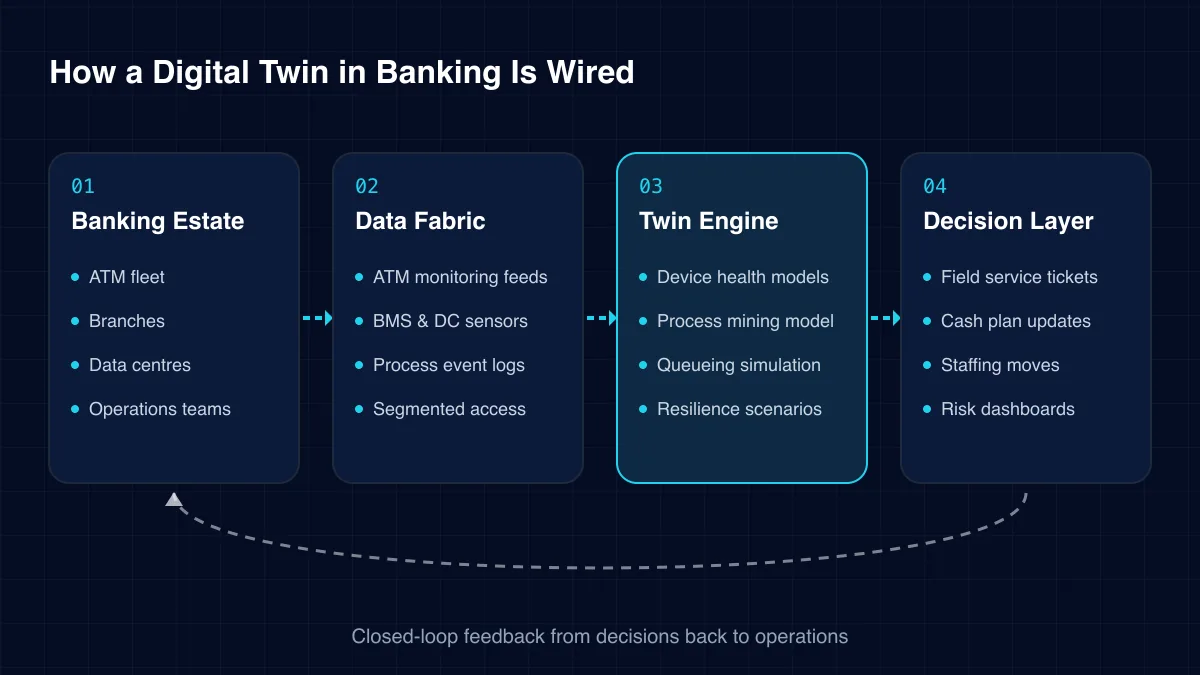
ATM status messages, branch sensors and data centre readings form the live feed. We read them from the monitoring tools and building systems you already run.
Timestamps from payments, onboarding and exception queues show how work actually flows. Process mining turns those logs into a model of each journey.
Queueing and discrete-event models describe how branches and operations absorb demand. Machine learning spots device wear and process drift early.
Alerts become field service tickets, cash plan changes or staffing moves. Operations and risk owners approve each action, keeping clear accountability.
Core capabilities
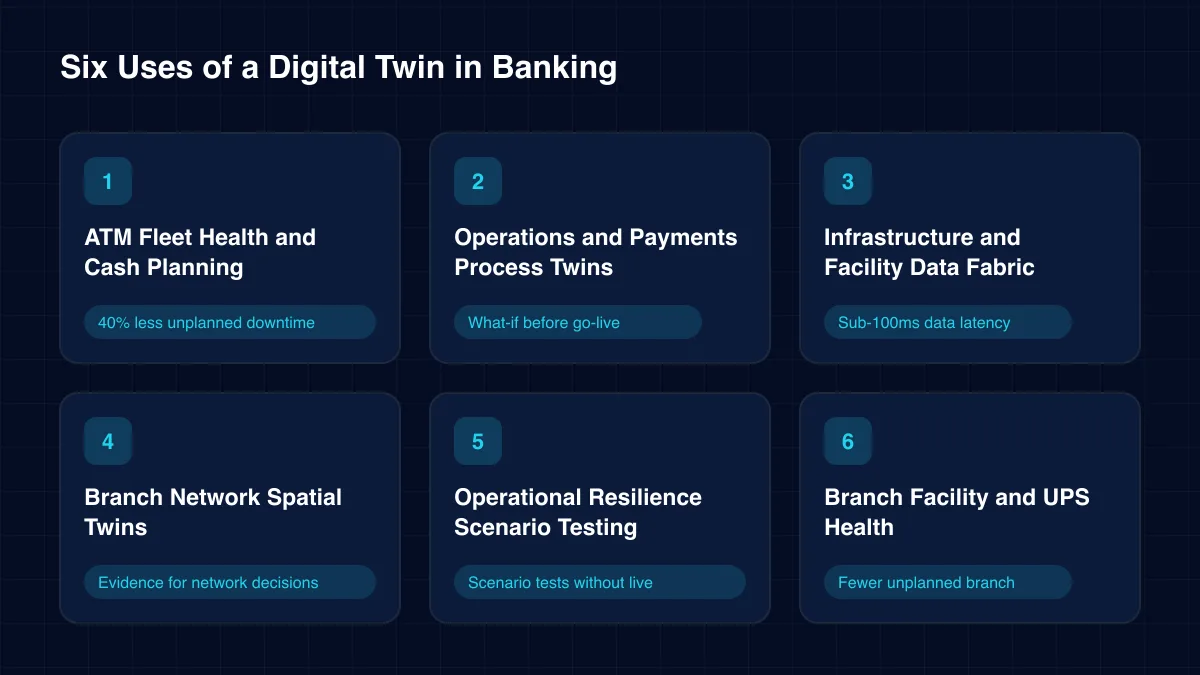
These are the places where a digital twin in banking delivers value today. Most banks start with the ATM fleet or one operations process, then widen.
A digital twin in banking tracks dispenser retries, card reader errors and cash levels across the fleet. It predicts faults and cash-outs before customers find a dead machine.
40% less unplanned downtime
Model how payments, onboarding and exception work flows through teams and systems. Test a cut-off change or staffing plan on the twin first.
What-if before go-live →Unify ATM monitoring, building management and data centre sensors into one real-time stream. Sensitive systems stay segmented from the twin.
Sub-100ms data latency
A map-based model of branches, ATMs and footfall shows where capacity sits against demand. Network teams test a closure, merger or new site virtually.
Evidence for network decisions
Simulate a data centre cooling failure, a regional outage or a payment surge. See which important business services breach tolerance first.
Scenario tests without live risk
Track HVAC, UPS batteries and power across the branch estate. The twin flags a weakening battery or failing unit before a branch has to close its doors.
Fewer unplanned branch closures
Architecture
Each digital twin in banking we build follows four layers. Device and process data rises into the model, and governed actions flow back to operations teams.
01
02
03
04
Challenges we solve
These are the issues we hear most from banking operations, infrastructure and resilience leaders. Each one comes from data that exists but is rarely joined.
A machine that fails or runs out of cash on a Friday evening frustrates customers. Fixed service visits miss faults that build between rounds.
A slowly failing cooling unit can go unnoticed until racks overheat. The first sign is often a service outage.
Payment repairs and onboarding checks back up after cut-offs. Teams find out when service levels are already missed.
ATM portals, facilities systems and process queues are watched by different teams. Nobody sees how one failure affects the others.
Regulators expect banks to show they can stay within impact tolerances. Tabletop exercises alone cannot show how systems really interact.
Closing or reshaping a branch based on last year's footfall is risky. Customers and access obligations can be affected.
Scope grows in stages. We usually start with one asset class or process and widen once the model earns trust.
Banks often ask why they need a digital twin in banking when they already have monitoring tools and documented process maps. The table shows the difference.
| Capability | Monitoring tools | Process maps | Banking digital twin |
|---|---|---|---|
| Live device and site data | ✓ Yes | No | ✓ Yes |
| Predicts faults and backlogs | Partial | No | ✓ Yes |
| Reflects how work really flows | No | Partial | ✓ Yes |
| Joins ATM, facility and process data | No | No | ✓ Yes |
| Tests disruption scenarios | No | No | ✓ Yes |
The value of a digital twin in banking grows as more devices, sites and processes join the model.
Delivery
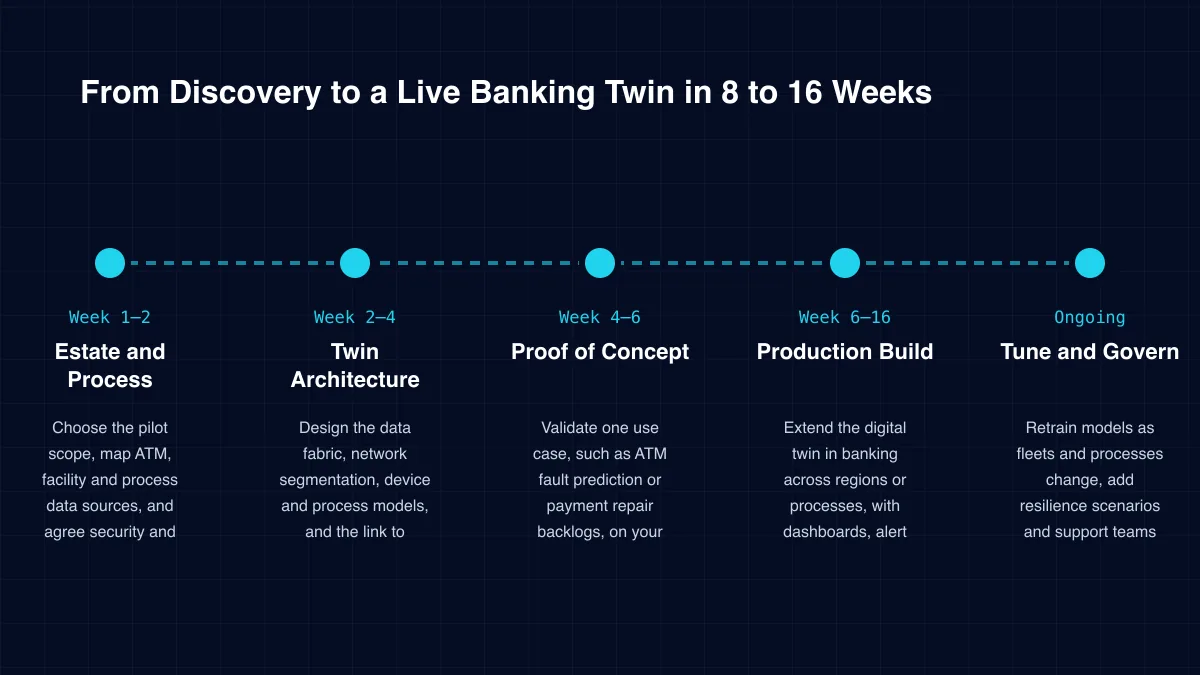
Week 1–2
Choose the pilot scope, map ATM, facility and process data sources, and agree security and data handling with your risk team.
Week 2–4
Design the data fabric, network segmentation, device and process models, and the link to service and staffing tools.
Week 4–6
Validate one use case, such as ATM fault prediction or payment repair backlogs, on your real data before a full build.
Week 6–16
Extend the digital twin in banking across regions or processes, with dashboards, alert rules and approval workflows.
Ongoing
Retrain models as fleets and processes change, add resilience scenarios and support teams under an SLA.
Many vendors pitch grand visions for a digital twin in banking. Far fewer are clear about what it can and cannot do. We recommend checking five things.
Our experience is that risk and audit sign-off decides adoption in a bank. That is why governance is designed into every twin from week one.
A digital twin in banking needs operational signals, not customer account data. We keep cardholder data out of the twin, so it stays outside your PCI DSS scope. All work follows ISO 9001 and ISO 27001 certified processes.
The twin runs in your cloud tenancy or data centre with segmented, read-only access to source systems. Resilience scenarios can support evidence for frameworks such as the EU Digital Operational Resilience Act and Basel Committee principles, reviewed with your compliance team.
Start with the cost of ATM downtime and emergency service call-outs last year. Add the cost of missed operations service levels. Together they set the ceiling your digital twin in banking works against.
Then add fewer infrastructure incidents, better-targeted cash deliveries and stronger evidence for resilience reviews. We agree these baselines in discovery, so results are measured against your own figures.
Technology stack
We choose tools per bank. These are the layers we most often assemble for an operational banking twin.
Estate Data
ATM monitoring feedsBuilding management systemsData centre sensors
Process Data
Payment event logsWorkflow and case toolsCore banking extracts
Data Fabric
Real-time streamingTime-series storage
Simulation & AI
Process miningQueueing modelsXGBoostMLOps retraining
Visualisation
Network mapsOperations dashboardsRisk views
Enterprise Integration
ITSM toolsField service systemsWorkforce planning
 Free white paper · Digital TwinThe Industrial Digital Twin PlaybookA practical, vendor-neutral guide to taking an industrial digital twin from first idea to a production system your operators trust.Get the white paper →
 Free white paper · FintechFintech & BankingEnterprise Solutions for the Digital Financial Services EraGet the white paper →
It models physical and operational assets: ATM fleets, branches, data centre infrastructure and processes such as payments and onboarding. A digital twin in banking does not model individual customers or make credit decisions.
No. It uses device telemetry, facility sensors and process timestamps. Customer and card data stay in your core and payment systems, outside the twin.
It links important business services to the sites, systems and teams behind them. Resilience teams can then simulate an outage and see which services breach tolerance first.
Yes, when the fleet reports status and error data. Rising dispense retries or reader errors often precede a failure. The twin flags them so a visit can be planned.
In your cloud tenancy or data centre. Access to source systems is read-only and segmented, and every model decision is logged for audit.
Most projects reach production in eight to sixteen weeks. A proof of concept on one use case runs in weeks four to six, using your real data.
A digital twin in banking turns scattered monitoring data into foresight. It shows which ATM will fail, which cooling unit is drifting and which operations queue will breach its service level.
ICANIO combines secure data engineering, simulation and predictive AI in one delivery team. We take a digital twin in banking from discovery to production in eight to sixteen weeks, then keep it accurate and governed as your estate changes.
By ICANIO Digital Twin Engineering Team · Published · Updated
Book a free 30-minute discovery call with our digital twin engineers. We will map your ATMs, sites and processes to a scoped twin with clear milestones. Contact us to get started.
Contact Our Digital Twin Team