Clinical Documentation Assistants
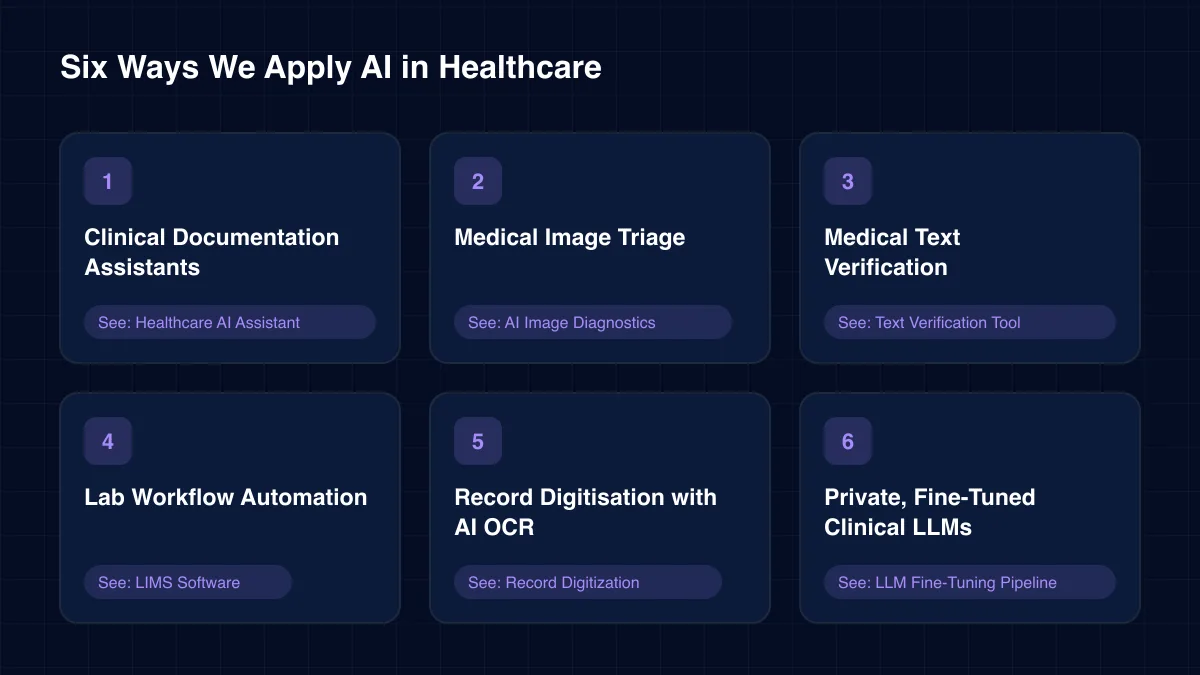
LLM assistants turn consultations into structured notes ready for review in the EHR. AI in healthcare delivers some of its fastest wins in this area.
See: Healthcare AI Assistant →Data & AI for Healthcare & Life Sciences
We build clinical AI that drafts notes, triages images, verifies medical text and runs lab workflows. Every model supports clinical judgment, logs its reasoning and respects patient privacy.
Consult audio, 11 min, OPD room 4
Transcribe
Structure
Code
Draft note
⟳ Model running…
AI in healthcare should hand time back to clinicians, not add another screen. Doctors lose hours to notes. Radiologists face growing worklists. Lab staff key the same results into three systems.
Our team builds AI in healthcare that sits inside those workflows. We draft clinical notes from consultations, triage medical images, verify clinical text and automate lab reporting. Each system supports a qualified professional, who stays in charge of the final decision.
This page explains where AI in healthcare works today, how we architect it for privacy and safety, and what to ask before you trust a vendor with patient data.
AI in healthcare is the use of machine learning, computer vision and language models on clinical and operational data. It reads images, text, lab values and records to surface findings, draft documents and prioritise work.
The key word is support. Clinical AI suggests, drafts and flags. A clinician reviews, edits and signs. That design keeps accountability where regulators and patients expect it.
AI in healthcare also covers the back office: coding, prior authorisation, lab operations and record digitisation. These use cases carry lower clinical risk and often pay back first.
Life sciences teams use the same building blocks differently. Research groups search papers and trial documents with RAG. Labs automate sample tracking and reporting. Quality teams verify regulated text before submission. The data rules are just as strict, so the same privacy and evaluation discipline applies.
Working definition
“AI in healthcare is clinical and operational decision support built on patient data, designed so every output is reviewable, traceable and privacy-safe.”
Foundations
Models draft and flag. Clinicians review and sign. The interface makes that review fast, with evidence shown next to each suggestion.
De-identification, encryption, role-based access and audit logs are built in from the first sprint, not added before a security review.
We read and write through HL7 FHIR, DICOM and national health ID systems, so AI outputs land in the record correctly.
Every model passes an evaluation gate on local data before go-live, and is monitored for drift afterwards.
Core capabilities
Each capability draws on a clinical AI system our engineers have already taken to production for a healthcare partner.
LLM assistants turn consultations into structured notes ready for review in the EHR. AI in healthcare delivers some of its fastest wins in this area.
See: Healthcare AI Assistant →Deep learning models detect and classify abnormalities, then reorder the worklist so urgent studies reach a specialist first.
See: AI Image Diagnostics →NLP models check clinical documents for terminology, dosage and medical code errors before they reach the patient record.
See: Text Verification Tool →Digital LIMS platforms track samples, automate report generation and add QR-verified results for accredited labs.
See: LIMS Software →AI OCR converts paper and scanned records into structured data linked to the patient's health ID, so history is searchable.
See: Record Digitization →Tenant-isolated fine-tuning with automated evaluation gates, proven on an enterprise legal AI pipeline. Using AI in healthcare at scale often needs the same per-client isolation.
See: LLM Fine-Tuning Pipeline →Architecture
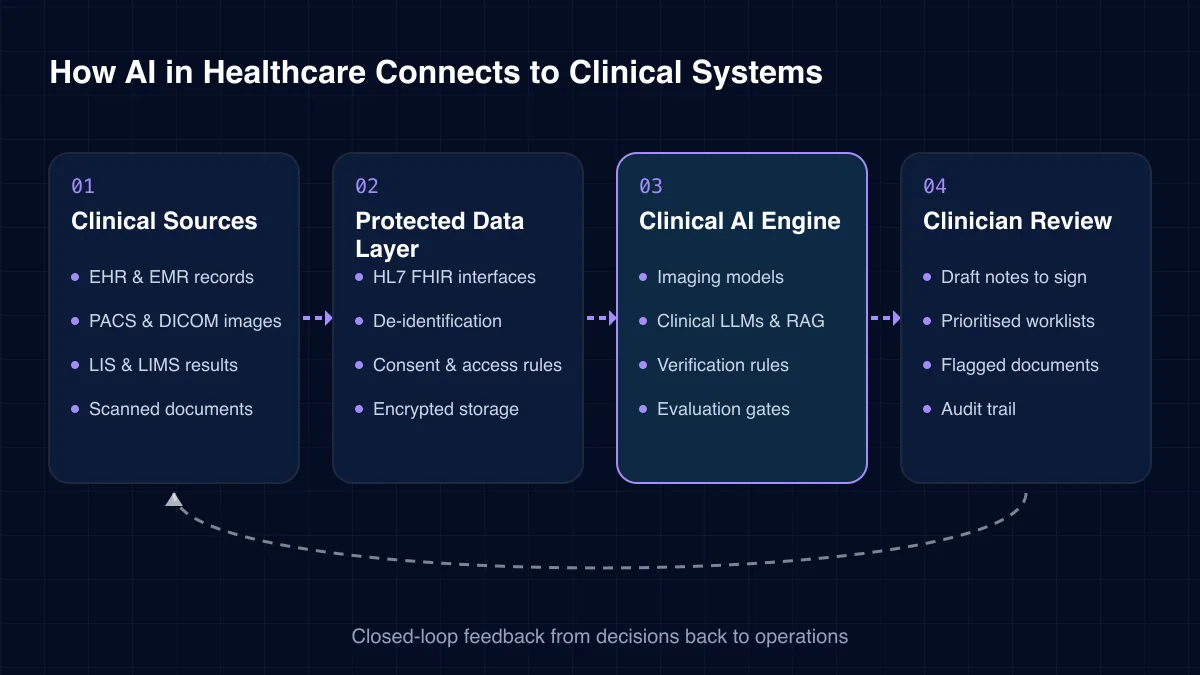
Our reference design keeps patient data inside a protected boundary. Models sit between clinical sources and the clinician review screen.
01
02
03
04
Challenges we solve
Healthcare punishes shortcuts. These are the problems we plan for from day one.
A model tuned on one population can underperform on another. We validate on your local data before any clinical use.
If a draft note lives in a separate tool, clinicians copy and paste. AI in healthcare must write into the record through proper interfaces.
General LLMs can invent findings or doses. We ground outputs in source records and verify them before a clinician sees them.
Security and legal review at the end can stop a finished build. We bring them in at scoping.
Without a named clinical lead, nobody signs off thresholds or reviews errors. Governance has to be staffed.
New scanners, templates or case mixes shift inputs. Monitoring catches the drop before it reaches patients.
Clinical AI falls into four broad families, each with its own risk level and review needs.
Hospitals already use manual checks and rule-based alerts. Here is what AI in healthcare adds.
| Capability | Manual review | Rule-based alerts | Clinical AI |
|---|---|---|---|
| Reads free-text notes | ✓ Yes | No | ✓ Yes |
| Scales with case volume | No | ✓ Yes | ✓ Yes |
| Spots subtle image patterns | Partial | No | ✓ Yes |
| Consistent across shifts | No | ✓ Yes | ✓ Yes |
| Needs clinician sign-off | ✓ Yes | Partial | ✓ Yes |
The benefits reach clinicians, operations teams and patients alike.
Delivery
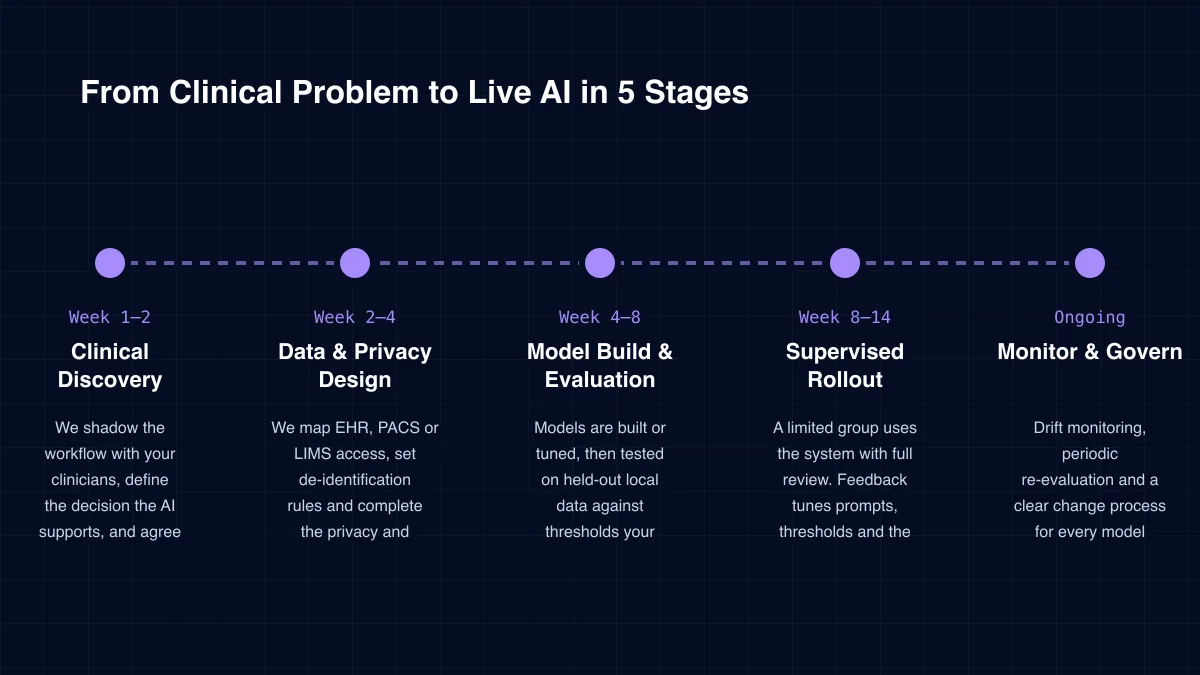
Week 1–2
We shadow the workflow with your clinicians, define the decision the AI supports, and agree success measures.
Week 2–4
We map EHR, PACS or LIMS access, set de-identification rules and complete the privacy and security design.
Week 4–8
Models are built or tuned, then tested on held-out local data against thresholds your clinical lead signs off.
Week 8–14
A limited group uses the system with full review. Feedback tunes prompts, thresholds and the interface.
Ongoing
Drift monitoring, periodic re-evaluation and a clear change process for every model update.
Case study
A healthcare partner faced diagnostic delays from manual image interpretation and limited specialist availability. Our team built a deep learning system that detects abnormalities, classifies normal and abnormal conditions, and returns feedback right after upload. It cut image analysis time by 60% and tripled triage speed, while specialists kept the final read.
“A specialist's time is the scarcest resource in medical imaging.”Read the full case study →
Deep learning · Computer vision
Finds abnormalities directly in medical images for a fast first read.
Multi-class models
Labels normal and abnormal conditions to give reviewers a structured start.
Web interface · Scalable inference
Returns preliminary insights the moment an image is uploaded, at high volume.
We recommend five questions before you share a single patient record.
The last point decides whether AI in healthcare stays safe after go-live. Every ICANIO engagement includes structured monitoring and support.
We design HIPAA-ready architectures for US providers and align with GDPR and India's DPDP Act where they apply. Patient data is encrypted in transit and at rest, access is role-based, and every read of protected data is logged.
Models run in your cloud tenancy or on premises, and training data can be de-identified before it leaves the clinical boundary. ICANIO works under ISO 9001 and ISO 27001 certified processes. Where a product may qualify as a medical device, we work with your regulatory team from the start.
Start with clinician time. Measure minutes spent on notes, image reads or lab reports per case, then multiply by annual volume. That is the capacity AI in healthcare can return to patient care.
Add turnaround time, error rates and staff overtime. We baseline these with you during discovery and track them after rollout, so the result is measured in your own operational data.
Some gains resist a price tag, such as lower clinician burnout or faster answers for anxious patients. We still track them through staff surveys and turnaround data, and report them beside the financial case.
Technology stack
We pick tools that fit clinical data rules. These appear in most of our builds.
Clinical Interfaces
HL7 FHIRDICOMABHA integrationEHR APIs
Language AI
GPT-4.1-mini fine-tuningRAG pipelinesDeepEval gates
Imaging AI
Deep learning modelsMulti-class classifiersGPU inference
Document AI
AI OCRField extractionText verification rules
Data & MLOps
Lineage trackingDrift monitoring
Security
Encryption at restRole-based accessAudit loggingDe-identification
 Free white paper · Data & AIData & Artificial IntelligenceTransforming Enterprise Operations Through Advanced Analytics & Intelligent AutomationGet the white paper →
 Free white paper · HealthcareHealthcare Technology SolutionsDigital Transformation, Clinical Excellence, and Patient-Centric InnovationGet the white paper →
No. Our systems draft, flag and prioritise. A qualified clinician reviews every output and makes the final decision. The aim is to remove repetitive work so specialists spend time where judgment matters.
Data stays in your tenancy or on premises. We encrypt it, restrict access by role, log every read and de-identify training data where possible. Our architectures are HIPAA-ready and ICANIO works under ISO 27001 certified processes.
Yes. We integrate through HL7 FHIR APIs, vendor interfaces or integration engines. Draft notes, flags and scores appear inside the clinician's existing screens, not in a separate tool.
We ground every output in the source record with retrieval, restrict the model to structured templates and run automated verification before display. Evaluation gates block a release if accuracy drops below agreed thresholds.
Documentation and lab or record automation usually start fastest, because risk is lower and time savings are easy to measure. Imaging triage follows once data access and clinical governance are in place.
Performance monitoring, drift alerts, periodic re-evaluation on fresh local data and a controlled release process. AI in healthcare must be governed for its full life, not just at launch.
AI in healthcare is ready for real clinical and operational work. It already drafts notes, triages images, verifies documents and runs lab workflows for providers who deploy it carefully.
ICANIO has built these systems in production, from a Gemini-based documentation assistant to deep learning image triage and a digital LIMS. We bring that experience, plus privacy engineering and evaluation discipline, to every engagement. That is how AI in healthcare stays useful and safe long after launch.
By ICANIO Data & AI Engineering Team · Published · Updated
Book a free 30-minute discovery call with our team. We will review one clinical or lab workflow and scope the AI that fits it. You will leave with a clear plan, privacy design and milestones.
Contact Our Data & AI Team