RAG Knowledge Assistants
Chat over policies, manuals, contracts and tickets with cited answers. This generative AI development pattern suits HR, legal, support and operations teams.
Cited answers →Data & AI · Generative AI
ICANIO builds LLM chatbots, copilots and document assistants that answer from your approved sources. Every release passes automated evaluation, and access follows the permissions you already have.
"Top 5 regions by Q3 margin?"
Intent
Write SQL
Run
Explain
⟳ Model running…
Generative AI development is no longer about proving that a chatbot can talk. Every team has seen that demo. The real question is whether an assistant can answer from your contracts, tickets and databases without inventing facts or leaking data.
Our team builds those assistants. We connect large language models to your approved sources through retrieval, tools and fine-tuning. Then we measure them like any other software: test sets, release gates, cost budgets and audit logs.
This page explains the patterns we use, the risks we design around, the costs to expect and how to pick a delivery partner. It includes a real ICANIO enterprise chatbot that gave business teams plain-language access to their own data.
Generative AI development is the engineering of applications that use large language models, or LLMs, to produce text, code, summaries or structured data. The model is a component. The application around it decides what the model sees, what it may do and how its output is checked.
Most enterprise builds combine three ingredients. Retrieval-augmented generation feeds the model relevant passages from your documents. Tool calling lets it query a database or open a ticket. Prompt and output guardrails keep it inside policy.
Fine-tuning is a fourth option, used when a task needs a consistent format or vocabulary that prompting cannot reach. We choose the lightest approach that meets the quality bar, because each step up adds cost and maintenance.
Working definition
“Generative AI development is the practice of building LLM-powered applications that are grounded in approved data, constrained by permissions and guardrails, and released only after automated evaluation proves they meet a quality bar.”
Foundations
Responses draw on retrieved company sources and show citations. If the sources do not cover a question, the assistant says so.
Retrieval filters by the user's role, so the assistant never reveals a document the person could not open directly.
Golden question sets and automated scoring run on every change to prompts, models or data. A failing score blocks the release.
Caching, smaller models and prompt trimming keep cost per answer predictable as usage grows.
Core capabilities
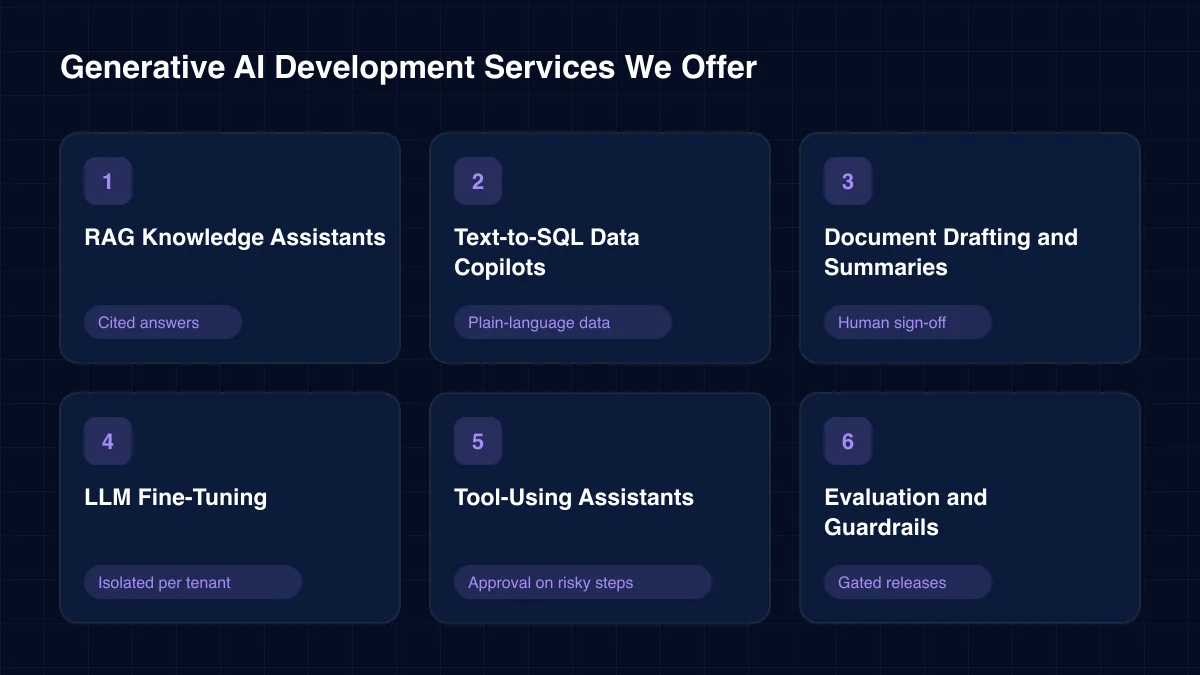
Our generative AI development work covers six patterns. Most programmes start with one assistant and reuse its retrieval and evaluation layers for the next.
Chat over policies, manuals, contracts and tickets with cited answers. This generative AI development pattern suits HR, legal, support and operations teams.
Cited answers →Business users ask questions in plain language and get answers from live SQL and NoSQL databases. Queries are read-only and shown for review.
Plain-language data
First drafts of reports, clinical notes, proposals and replies, built from templates and records. A person always approves the final version.
Human sign-off →Per-task or per-client tuning when prompting is not enough. We isolate data by tenant and gate every tuned model with automated evaluation.
Isolated per tenant →Assistants that call APIs to check order status, book slots or create tickets, using function calling or the Model Context Protocol. Risky actions need approval.
Approval on risky steps →Test suites for faithfulness, relevance, toxicity and prompt injection. Every generative AI development release we ship carries an evaluation report.
Gated releases →Architecture
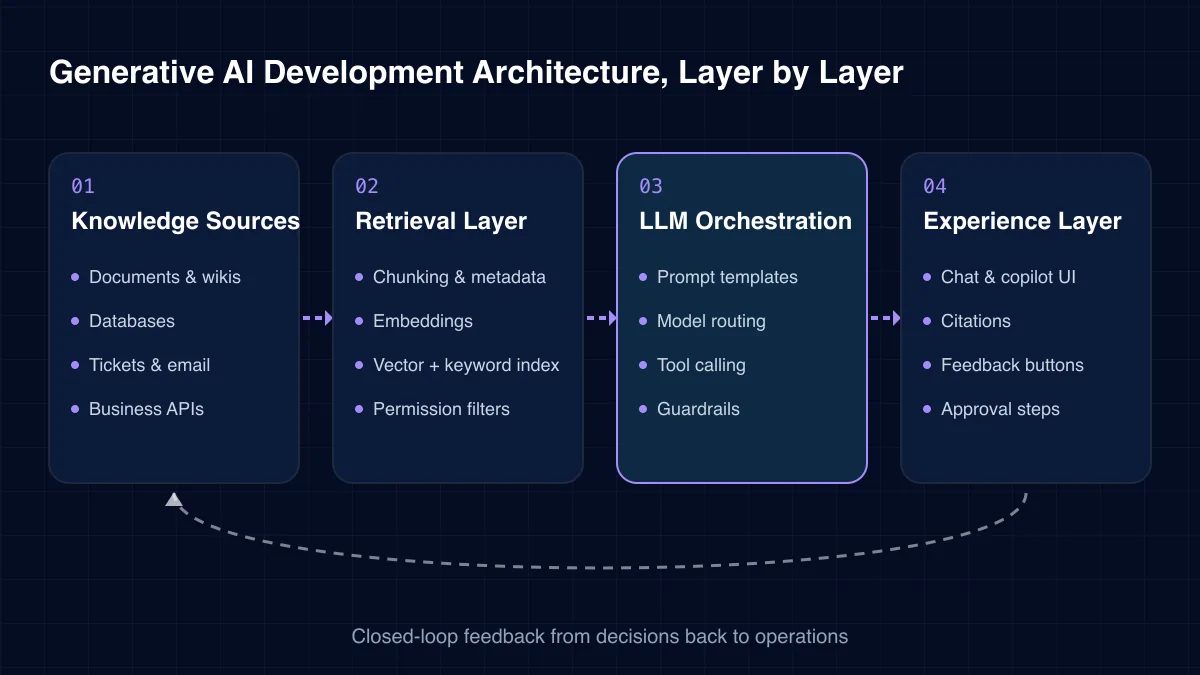
Every generative AI development project we run follows four layers. Sources are prepared once, the orchestration layer assembles context, and the interface keeps people in charge.
01
02
03
04
Challenges we solve
Language models fail in ways traditional software does not, so generative AI development needs extra care. These are the six risks we design around from the first sprint.
Models fill gaps with plausible fiction. Retrieval, citation checks and a clear 'I don't know' path keep answers honest.
Hidden instructions in a document or email can hijack the assistant. We isolate untrusted content and test against the OWASP Top 10 for LLM applications.
A naive index lets anyone ask about salary files. Document-level access filters run before retrieval, not after.
Long prompts and large models get expensive fast at scale. Model routing and caching keep the bill in line with value.
A new model version or prompt tweak can break answers that worked last week. Automated evaluation catches it before users do.
Staff stop using an assistant after a few bad answers. We launch with a narrow, well-covered scope and grow it with feedback.
Generative AI development spans four solution types. They differ in risk, autonomy and how much data preparation they need.
Three techniques shape how a model behaves. We recommend starting at the left and moving right only when tests show the need.
| Criterion | Prompt only | RAG | Fine-tuning |
|---|---|---|---|
| Uses private knowledge | No | ✓ Yes | Partial |
| Updates when data changes | No | ✓ Yes | No |
| Shows sources | No | ✓ Yes | No |
| Upfront effort | Low | Medium | High |
| Best for | Simple tasks | Knowledge Q&A | Format & style |
The gains are real when assistants are grounded, measured and placed inside existing workflows.
Delivery
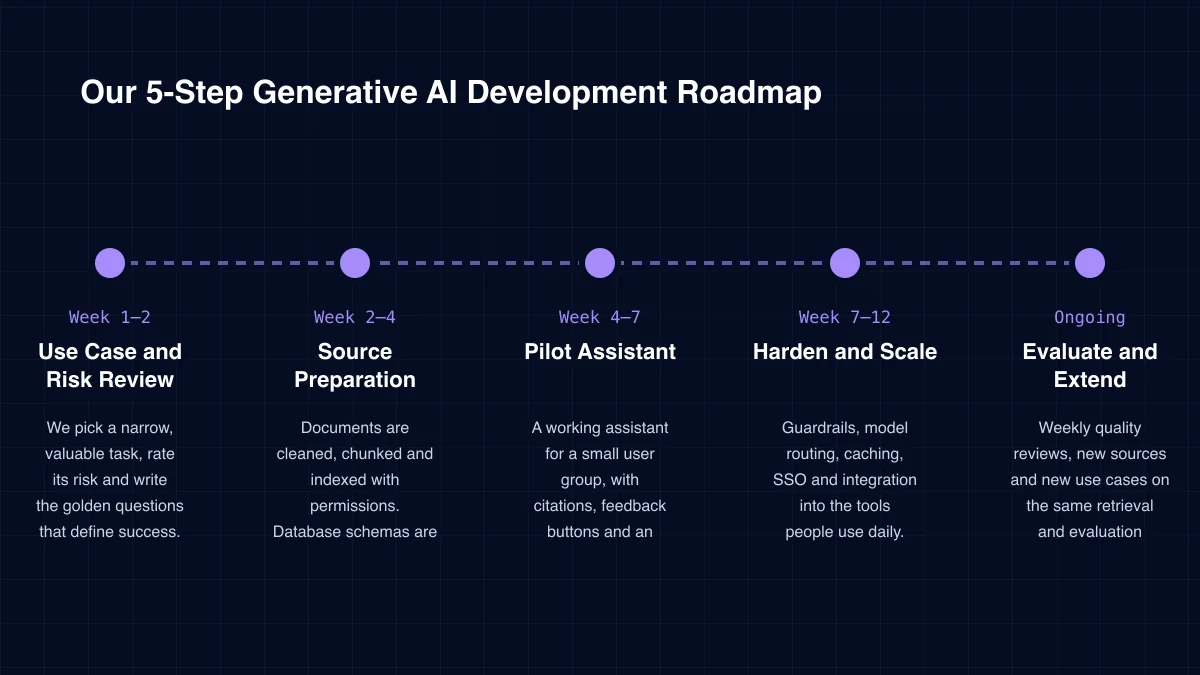
Week 1–2
We pick a narrow, valuable task, rate its risk and write the golden questions that define success.
Week 2–4
Documents are cleaned, chunked and indexed with permissions. Database schemas are mapped for safe queries.
Week 4–7
A working assistant for a small user group, with citations, feedback buttons and an evaluation dashboard.
Week 7–12
Guardrails, model routing, caching, SSO and integration into the tools people use daily.
Ongoing
Weekly quality reviews, new sources and new use cases on the same retrieval and evaluation layers.
Case study
Business teams relied on technical staff for every data request, and documents and emails were hard to query. ICANIO built an LLM-powered chatbot with direct SQL and NoSQL access plus RAG over PDFs, emails and reports, all behind role-based access. Data accessibility rose 30%, decisions came 40% faster and employee productivity tripled.
“The fastest database query in the world is still too slow if a business user has to file a ticket and wait.”Read the full case study →
LLM · Context awareness
Interprets plain-language questions and what the user actually means.
SQL & NoSQL · RAG
Answers from live databases and unstructured documents in one conversation.
Role-based access control
Widens access to data without bypassing existing governance.
Specialist services within our data & artificial intelligence practice.
Anyone can wrap an API in a chat window. These five tests separate production engineers from prompt tinkerers.
Our generative AI development engagements include all five by default. Skipping any of them tends to surface as a trust problem a month after launch.
ICANIO works under ISO 9001 and ISO 27001 certified processes. We deploy through private endpoints such as Azure OpenAI or Amazon Bedrock, or host open models in your cloud, so prompts are not used to train public models.
Personal data is masked before it reaches the model where the task allows. Every prompt, retrieved source and response is logged with the user's identity for audit.
Our controls follow the NIST AI 600-1 generative AI profile and the OWASP Top 10 for LLM applications. High-impact outputs, such as clinical or credit text, always pass through human review before use.
Pick a task with volume. Count how often staff search, draft or answer the same kind of question each month, and how long each takes. That baseline makes savings measurable.
Then track adoption and quality together. Weekly active users, answer acceptance rate and escalations show whether the time saved is real or just shifted to fixing bad drafts.
On the cost side, tokens, hosting and retrieval infrastructure scale with use. We route simple questions to smaller models and cache frequent answers, which keeps the economics of generative AI development healthy as more teams join.
Technology stack
Our generative AI development stays model-neutral. We pick tools per use case, cloud and data sensitivity.
Models
OpenAI GPT models
Hosting
vLLM
Orchestration
LlamaIndex
Retrieval
OpenSearchPineconeRerankers
Evaluation
DeepEvalRagasGolden test setsRed-team suites
Apps
Python & FastAPIMicrosoft Teams botsSlack apps
Our generative AI development covers use case selection, source preparation, retrieval design, model choice, prompt and tool orchestration, guardrails, evaluation, user interface and ongoing operations. You get a working assistant, not a slide deck.
We ground answers in retrieved sources and show citations. Automated checks score faithfulness on every release. When sources do not cover a question, the assistant is designed to say it does not know.
No. We use enterprise endpoints with training opt-out, or host open models inside your cloud. Data stays within your tenancy and access is logged.
Start with RAG for knowledge questions, because it stays current and shows sources. Fine-tuning helps when you need a fixed format, tone or classification behaviour. Many mature systems use both.
A pilot assistant for one team usually takes four to seven weeks. Hardening, integration and scale-out typically add another five weeks. Source quality is the biggest variable.
We apply generative AI development in healthcare for clinical documentation, in banking for policy and data copilots, in manufacturing for maintenance manuals and in education for tutoring support. Each needs its own guardrails.
How we deliver generative ai development and the wider data & ai practice in each sector.
Large language models are powerful, but on their own they are unreliable narrators. Generative AI development turns them into dependable tools by adding your data, your permissions and rigorous tests.
ICANIO builds assistants that teams keep using after the novelty fades. Contact us to choose a first use case and plan generative AI development that is safe, measured and genuinely useful.
By ICANIO Data & AI Engineering Team · Published · Updated
Book a free 30-minute discovery call. We will review your sources and workflows, pick a first use case and outline a pilot with clear quality targets.
Contact Our Generative AI Team