Demand and Time-Series Forecasting
Machine learning development for sales, volume and capacity forecasts at SKU, store or route level. We combine gradient boosting with seasonal baselines and publish prediction intervals.
Intervals, not guesses →Data & AI · Machine Learning
ICANIO builds predictive models for forecasting, risk scoring and anomaly detection. Each one is trained on your history, tested against a baseline and wired into the system where the decision is made.
SKU 20418, 3 years of weekly sales
Features
Train
Backtest
Predict
⟳ Model running…
Machine learning development is how a business turns its own history into a forecast, a score or an early warning. The goal is never a clever notebook. It is a model that someone uses every day to order stock, approve a loan or plan maintenance.
Our team handles the full path. We frame the decision, prepare features, train and compare candidate models, then deploy the winner behind an API or inside an existing app. Every release must beat the method you use today, measured on data the model has never seen.
This page covers the model families we build, how we work, the traps that sink most projects and how to judge a partner. It closes with a real ICANIO build where an XGBoost model flags developing engine faults.
Machine learning development is the engineering work of building models that learn patterns from labelled or historical data and apply them to new cases. Typical outputs are a number, such as next week's demand, a class, such as fraud or not fraud, or a ranked list.
The craft sits in the details. Which rows count as training data? Which features would leak the answer? How do you split time-ordered records fairly? Those choices decide whether accuracy in testing survives contact with live traffic.
It differs from generative AI work. Large language models write and summarise text. Classic supervised models predict structured outcomes with tight error bars, low running cost and clear explanations. Many firms need both, but structured prediction still drives most measurable savings.
Working definition
“Machine learning development is the practice of framing a business decision as a prediction task, training models on governed data and shipping the best one into a live workflow with monitoring and an owner.”
Foundations
We ask who acts on the output and what they do differently. A model nobody can act on is a research project, not a product.
Last year's average, a moving window or an existing rule set. If the model cannot beat it clearly, we say so before you invest more.
Time-based splits, held-out customers and backtests mirror how the model will meet new data. Random splits often flatter results.
SHAP values and feature importance travel with each prediction. Reviewers see why a case was flagged, not just that it was.
Core capabilities
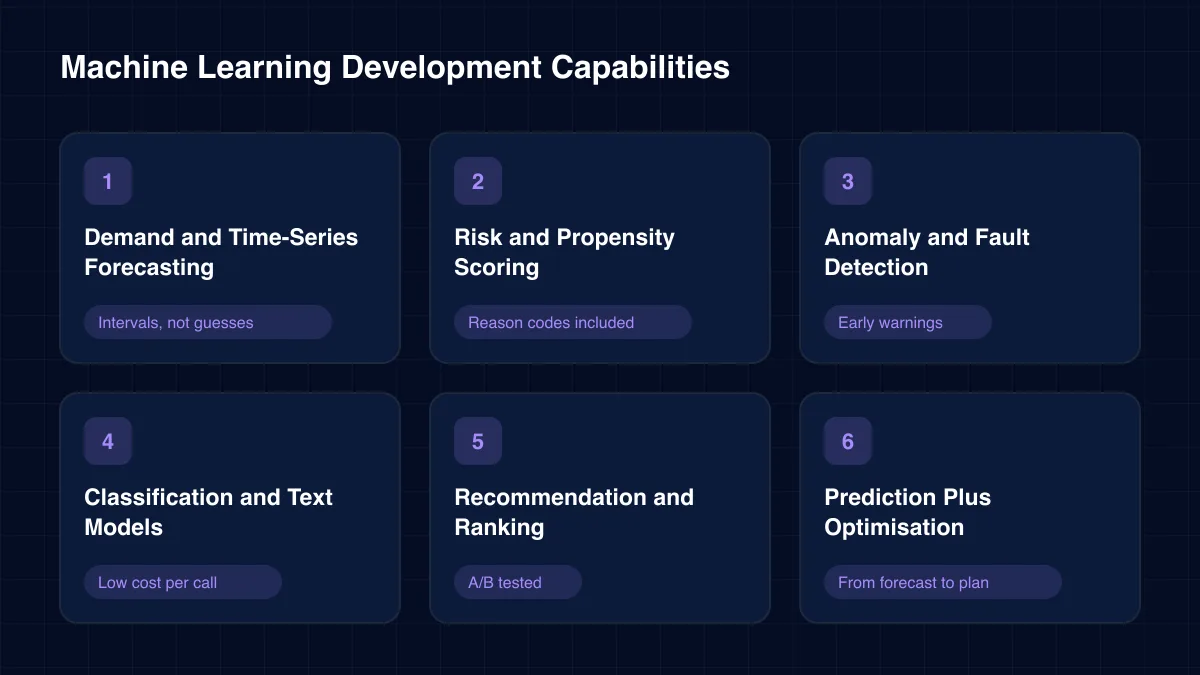
Our machine learning development work falls into six families. Most clients start with one high-value use case and reuse the same features for the next.
Machine learning development for sales, volume and capacity forecasts at SKU, store or route level. We combine gradient boosting with seasonal baselines and publish prediction intervals.
Intervals, not guesses →Credit, fraud, churn and lead scores with reason codes. Thresholds are tuned to your real cost of a false alarm versus a missed case.
Reason codes included →Isolation forests, autoencoders and supervised fault models for sensor, transaction and log data. This is the core of predictive maintenance on IoT streams.
Early warnings →Routing tickets, tagging documents and classifying claims with compact transformer or linear text models. They run cheaply at high volume.
Low cost per call
Next-best product, content or job match models using collaborative filtering and learning-to-rank. We test changes with controlled A/B experiments.
A/B tested
Machine learning development rarely stops at a forecast. We pair predictions with solvers for pricing, staffing and routing so the output is a plan, not a chart.
From forecast to plan →Architecture
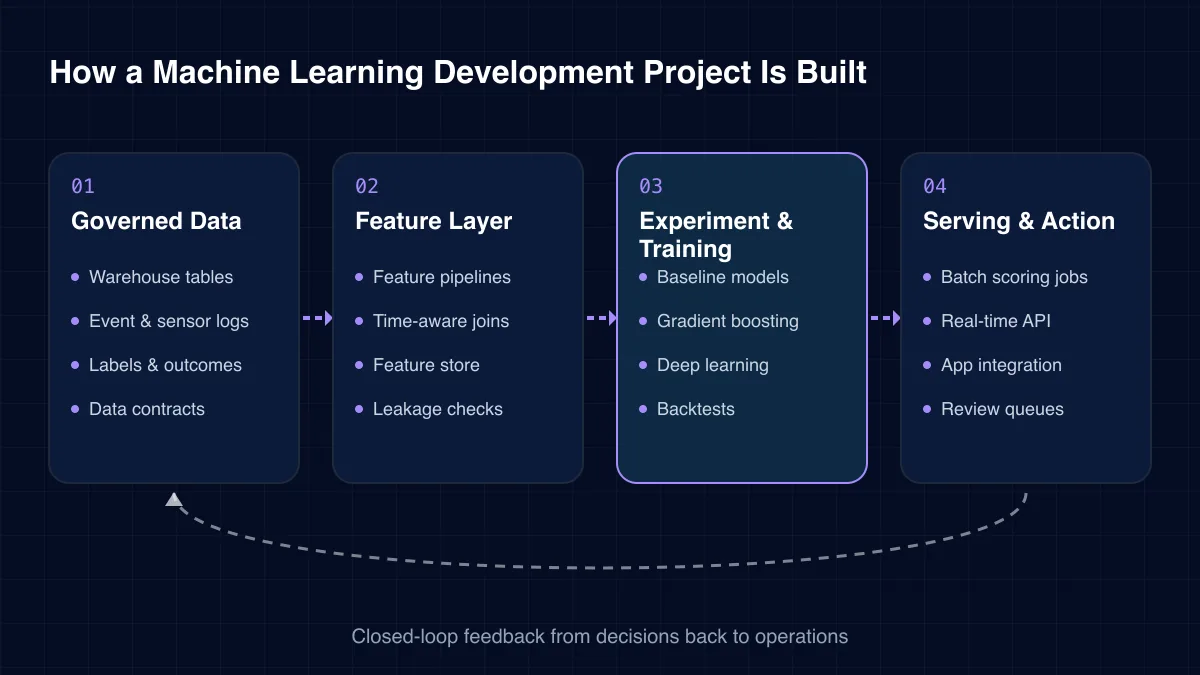
Our machine learning development work sits on four layers. Data is shaped into features, candidates compete in an experiment layer, and the winner serves predictions into daily work.
01
02
03
04
Challenges we solve
In machine learning development the algorithm is rarely the problem. These six issues cause most of the failures we are asked to fix.
A feature quietly contains the answer, such as a refund flag used to predict refunds. Test scores look superb and production collapses.
Without a benchmark, nobody can say whether 82% accuracy is good. We set the bar with business owners before training begins.
Historic outcomes are incomplete or coded inconsistently. We audit labels and fix the worst sources before modelling.
A model works on a laptop but nobody packaged it. We build the serving path in parallel with the experiments.
Fraud or failure is rare, so a model that always says no looks accurate. We use the right metrics, sampling and cost-weighted thresholds.
Scores land in a report no one reads. We integrate them into the CRM, ERP or maintenance system where people already work.
Machine learning development covers four main learning styles. The data you hold decides which one fits.
Choosing the model family is a trade-off between accuracy, cost and explainability. This is how the common options compare on tabular business data.
| Criterion | Rules engine | Gradient boosting | Deep learning |
|---|---|---|---|
| Works on tabular data | ✓ Yes | ✓ Yes | Partial |
| Needs large datasets | No | Partial | ✓ Yes |
| Easy to explain | ✓ Yes | ✓ Yes | Partial |
| Handles images and audio | No | No | ✓ Yes |
| Typical use | Fixed policy | Scores, forecasts | Signals, perception |
Off-the-shelf scores are trained on someone else's customers. Models built on your own history fit your reality.
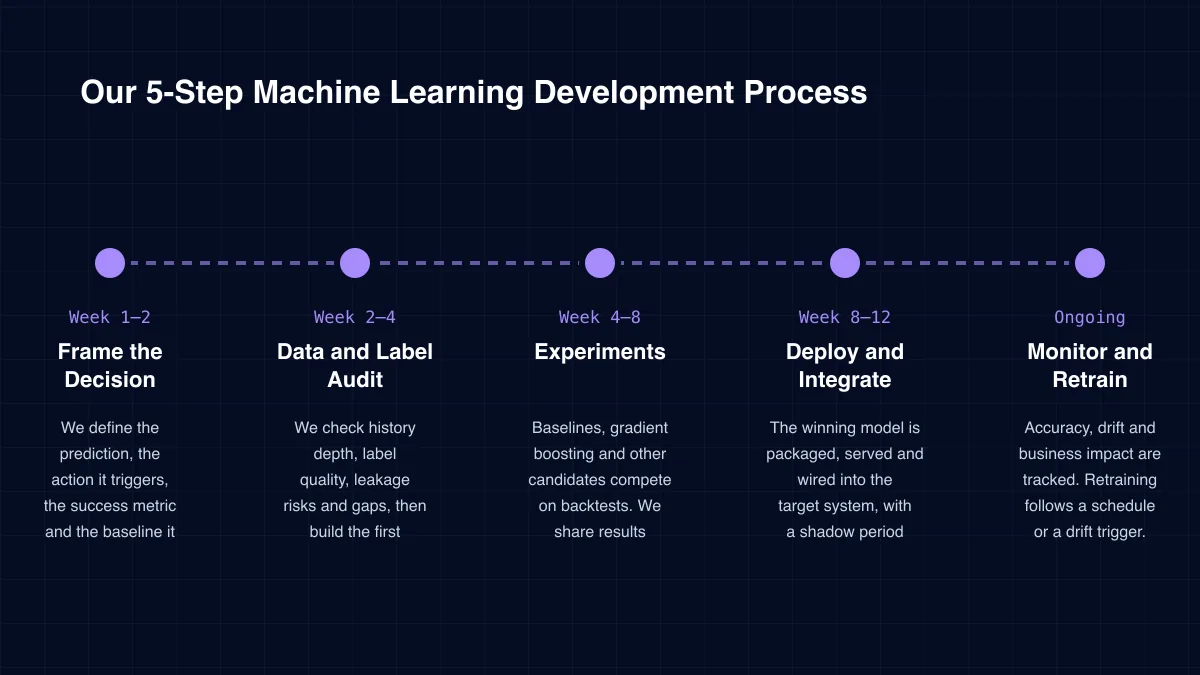
Delivery
Week 1–2
We define the prediction, the action it triggers, the success metric and the baseline it must beat.
Week 2–4
We check history depth, label quality, leakage risks and gaps, then build the first feature pipelines.
Week 4–8
Baselines, gradient boosting and other candidates compete on backtests. We share results openly, including failures.
Week 8–12
The winning model is packaged, served and wired into the target system, with a shadow period before it acts.
Ongoing
Accuracy, drift and business impact are tracked. Retraining follows a schedule or a drift trigger.
Case study
A fleet management technology partner wanted to catch engine faults before breakdowns. ICANIO paired a CARLA and OpenModelica physics model of a healthy engine with an XGBoost model and a rule engine. The model compares live sensor readings against that baseline. The proof of concept detected two real-world faults, carbon buildup and a stuck VVT actuator, on a simulated mid-size petrol sedan.
“The goal was never just an alert. It was an alert an operator could actually trust and act on.”Read the full case study →
CARLA · OpenModelica FMU
Models how a healthy engine should behave under current driving conditions.
XGBoost · Rule engine
Reads ten engine signals every second, with valve timing weighted as the key signal.
NVIDIA Omniverse
Shows the affected component on a 3D vehicle model instead of a generic warning.
Specialist services within our data & artificial intelligence practice.
Strong demos are easy to produce. We recommend checking five things that demos hide.
Our machine learning development teams are measured on adoption, not just accuracy. A model that people ignore has delivered nothing.
ICANIO works under ISO 9001 and ISO 27001 certified processes. Training runs in your own cloud account, and personal data is pseudonymised before it reaches a data scientist's workspace.
Models that affect people get fairness checks. We test outcomes across groups, remove proxies for protected attributes where we can and document known limits in a model card.
For regulated lending and insurance work, we keep versioned training data, code and parameters so any score can be reproduced. Controls map to the NIST AI Risk Management Framework, and human review stays in place for high-impact decisions.
Value starts with the decision the model improves. Fewer stock-outs, fewer bad loans or fewer unplanned stoppages can each be counted and priced. We agree that formula during framing.
Next we run the new model in shadow mode beside the current method. The gap between them, over several weeks of real traffic, is the most credible ROI evidence you can give a finance team.
Costs stay modest. Tabular models usually train in minutes and serve on standard cloud instances. That keeps machine learning development affordable for mid-sized firms, not just tech giants.
Technology stack
We choose machine learning development tools for your data shape and platform. These are the ones our engineers reach for most.
Data Prep
Polars
Classic ML
XGBoostLightGBMCatBoost
Deep Learning
Keras
Time Series
ProphetstatsforecastDartssktime
Explainability
SHAPFeature importancePartial dependenceModel cards
Tracking & Serving
FastAPI
Cost depends on data readiness and integration depth. Most clients begin with a fixed-scope discovery and proof of value on one use case. That limits early spend and produces a measured result before any larger commitment.
Less than people expect for tabular problems. One to three years of clean history is often enough for forecasting and scoring. Rare events, such as fraud or machine failure, need more history or careful sampling.
Yes. Machine learning development here means predictive models that output numbers, classes or rankings. Generative AI produces text or images. Predictive models are usually cheaper to run and easier to explain.
Yes. We attach SHAP-based reason codes to each score. Reviewers see the top factors that pushed a case up or down, which supports audits and builds trust with staff.
Wherever suits you: AWS, Azure, Google Cloud or on premises. Batch models write scores to your warehouse. Real-time models sit behind a secured API that your apps call.
We apply machine learning development in manufacturing for predictive maintenance, in banking for risk scoring, in retail for demand forecasting and in logistics for arrival time prediction. The method stays the same while features change.
How we deliver machine learning development and the wider data & ai practice in each sector.
Predictive models remain the workhorses of practical AI. They forecast, score and warn at low cost, and they can explain themselves. Machine learning development done well turns that potential into decisions people trust.
ICANIO frames the problem, proves value against your baseline and ships the model into the system where work happens. Contact us to pick your first use case and plan machine learning development that pays for itself.
By ICANIO Data & AI Engineering Team · Published · Updated
Book a free 30-minute discovery call. We will review your data, pick the decision with the clearest payback and outline a model plan with milestones.
Contact Our Machine Learning Team