Experiment Tracking and Model Registry
MLflow or cloud-native registries that record every run, metric and artefact. Our MLOps services tag each run with data hash and parameters.
Every run recorded
Data & AI · MLOps
ICANIO builds the pipelines that train, test, ship and watch your models. Every release passes an evaluation gate, every prediction is traceable, and drift triggers retraining before users notice.
credit-score-v14, last 7 days traffic
Sample
Compare
Test
Flag
⟳ Model running…
MLOps services answer the question every data team meets after its first launch: now what? A model that scored well in testing starts to slip within weeks. Customer behaviour shifts, sources change and nobody notices until a manager asks why the forecasts are off.
Our team builds the machinery that prevents that slide. We version data and code, automate training, gate releases with evaluation, deploy safely and monitor live predictions. When drift appears, retraining starts from a pipeline rather than a scramble.
This page explains what MLOps covers, the maturity levels, the tools we use and how to choose a partner. It includes a real ICANIO pipeline that fine-tunes isolated language models per client, with automated quality gates and full lineage.
MLOps services apply DevOps discipline to machine learning. They cover the full model lifecycle: data versioning, experiment tracking, automated training, testing, packaging, deployment, monitoring and retraining.
Models differ from ordinary software in one key way. Their behaviour depends on data, and data keeps changing. So MLOps watches inputs and outputs, not just uptime, and treats retraining as a routine release rather than an emergency.
The same ideas now extend to large language models. LLMOps adds prompt versioning, evaluation suites for faithfulness and safety, fine-tuning pipelines and token cost tracking. We run both under one set of practices.
Working definition
“MLOps services are the engineering practices and platforms that make model training, release and monitoring automated, reproducible and auditable, so models stay accurate and accountable in production.”
Foundations
Any model version can be rebuilt from its exact data snapshot, code commit and parameters. Audits stop being archaeology.
A candidate must beat the current champion on agreed tests before it reaches users. No manual sign-off by gut feeling.
Input drift, prediction drift and data quality checks run on live traffic. Accuracy problems show up as alerts, not complaints.
Canary and shadow releases, with instant rollback. A bad model is a short incident, not a lost quarter.
Core capabilities
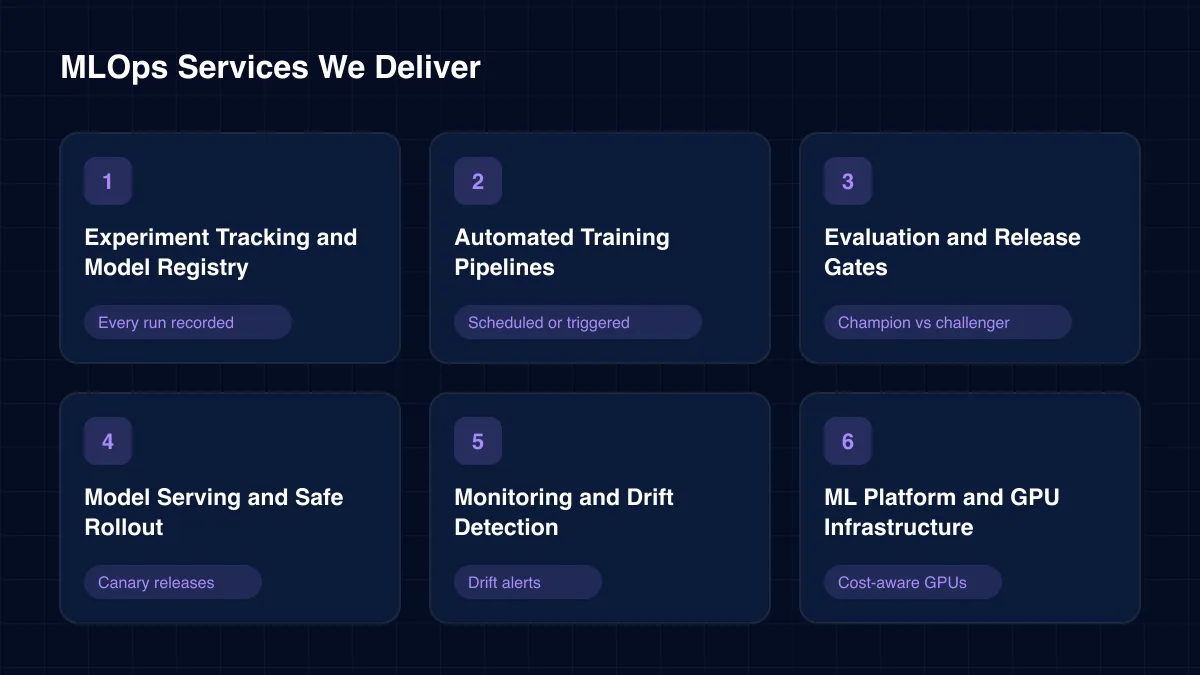
Our MLOps services cover six building blocks. Teams with no tooling start with tracking and deployment, while mature teams add monitoring and automated retraining.
MLflow or cloud-native registries that record every run, metric and artefact. Our MLOps services tag each run with data hash and parameters.
Every run recorded
Kubeflow, SageMaker Pipelines or Airflow jobs that rebuild datasets, train and evaluate on a schedule or trigger. No more retraining from a laptop.
Scheduled or triggered
Automated tests compare candidates with the champion on accuracy, fairness and latency. For LLMs we use DeepEval scoring, as in our multi-tenant fine-tuning pipeline.
Champion vs challenger →Containerised serving on Kubernetes with KServe, BentoML or managed endpoints. Canary, shadow and blue-green releases keep risk small.
Canary releases →Dashboards and alerts for input drift, prediction drift, data quality, latency and business KPIs. MLOps services are only as good as what they watch.
Drift alerts
Infrastructure as code for training clusters, feature stores and vector pipelines, with GPU cost controls. It supports every model in our Data & AI practice.
Cost-aware GPUs →Architecture
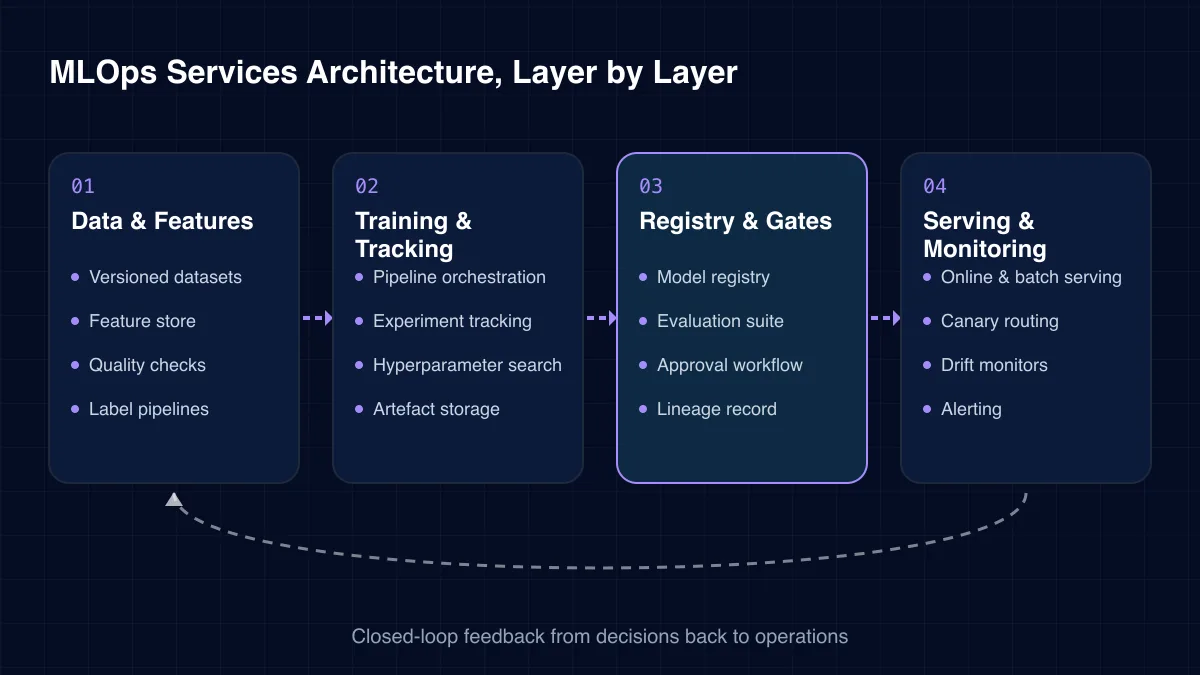
A mature platform has four layers. Data and code enter at the bottom, pass through automated training and gates, and reach users through monitored serving.
01
02
03
04
Challenges we solve
Teams usually call us after a model has quietly let them down. These are the patterns we see most.
The world changed and the model did not. Drift monitoring spots it within days instead of a quarter later.
The data scientist who trained it has left, and so has the notebook. Versioned data, code and registries fix that.
Someone copies a model file to a server on a Friday. Automated pipelines and canary releases make deployment routine.
Features are calculated one way in training and another in production. A shared feature pipeline removes the mismatch.
Regulators ask which data trained a decision model. Lineage records answer by run ID in seconds.
Idle clusters and oversized endpoints burn money. Autoscaling, spot capacity and right-sized models bring costs down.
MLOps services meet teams where they are. Most organisations sit at one of four levels.
The three disciplines share tools but watch different risks. This table shows where MLOps services add to classic DevOps.
| Concern | DevOps | MLOps | LLMOps |
|---|---|---|---|
| Versions data | No | ✓ Yes | ✓ Yes |
| Monitors drift | No | ✓ Yes | Partial |
| Release test | Unit & integration | Metric vs champion | Eval suite & red team |
| Main cost driver | Compute | Training compute | Tokens & GPUs |
| Retraining loop | No | ✓ Yes | Fine-tune or re-prompt |
The value is less drama and more models in production per data scientist.
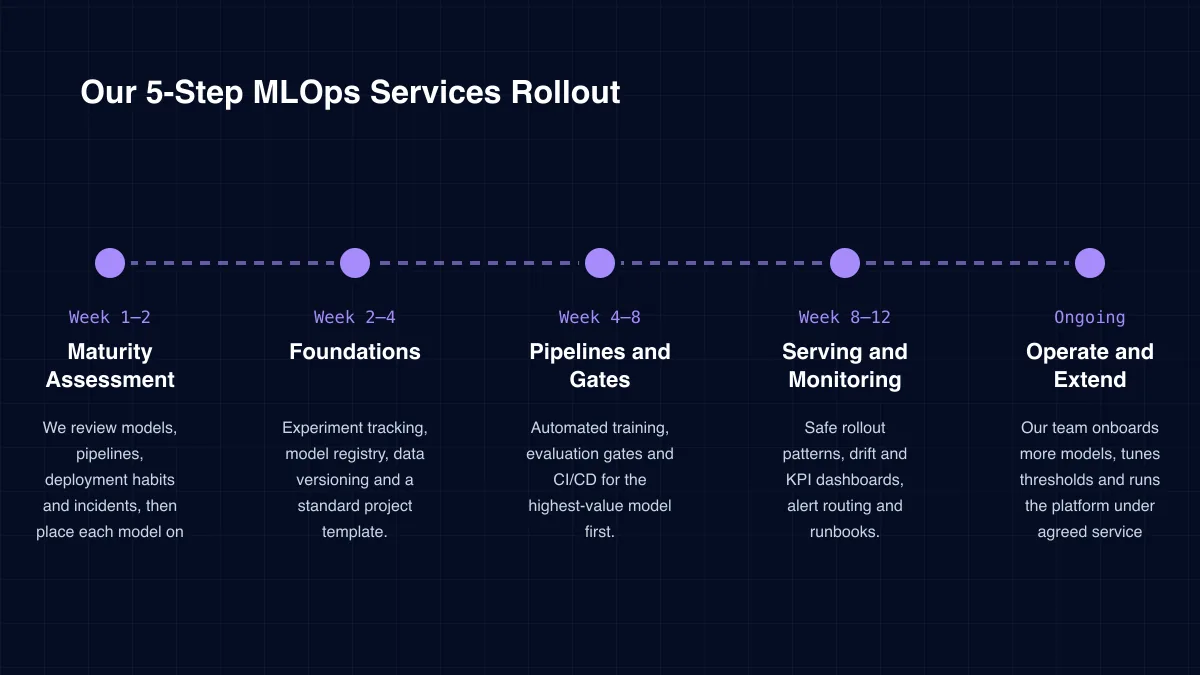
Delivery
Week 1–2
We review models, pipelines, deployment habits and incidents, then place each model on the maturity scale.
Week 2–4
Experiment tracking, model registry, data versioning and a standard project template.
Week 4–8
Automated training, evaluation gates and CI/CD for the highest-value model first.
Week 8–12
Safe rollout patterns, drift and KPI dashboards, alert routing and runbooks.
Ongoing
Our team onboards more models, tunes thresholds and runs the platform under agreed service levels.
Case study
Legal teams needed document classification models trained only on each client's own files, with no cross-tenant leakage. ICANIO built a six-stage pipeline on Azure OpenAI that gives every tenant its own storage, deployment and registered GPT-4.1-mini model. MLflow tracks each run, DeepEval gates promotion and a lineage record links every dataset version to its model and score.
“A shared model that blends two clients' legal documents is not a shortcut, it is a confidentiality breach waiting to happen.”Read the full case study →
Azure Blob Storage · Azure OpenAI
Separate containers and deployments per client make isolation part of the architecture.
MLflow · SHA256 dataset versions
Each run is tagged with tenant, dataset hash, base model and hyperparameters.
DeepEval
Only models that clear the accuracy threshold on held-out data are promoted.
Specialist services within our data & artificial intelligence practice.
Tool installs are easy. Running models well for years is not. We recommend asking about five areas.
Our MLOps services include post-launch operations by design. The platform is only valuable while someone is watching it.
ICANIO works under ISO 9001 and ISO 27001 certified processes. Pipelines run in your cloud account, secrets live in managed vaults and every artefact is stored with access controls.
Registries record who trained, approved and deployed each version. Combined with dataset hashes and evaluation results, that gives regulators and internal model risk teams a complete trail.
Our governance maps to the NIST AI Risk Management Framework. Multi-tenant designs isolate data and models per client, and high-impact models keep a human approval step before promotion.
Look first at the cost of model failure. A degraded fraud or demand model costs money every day it goes unnoticed. Shortening detection from months to days is the biggest single return.
Then measure delivery speed. Time from trained model to production, releases per month and engineer hours spent on manual deployment all improve with automation.
Finally, track infrastructure spend per model. Autoscaling, batch scoring and right-sized GPUs typically lower it. Together these figures make the case for MLOps services in plain financial terms.
Technology stack
We fit MLOps services tooling to your cloud and existing CI/CD rather than forcing a new platform.
Tracking & Registry
Weights & BiasesSageMaker Registry
Pipelines
Kubeflow PipelinesSageMaker Pipelines
Data Versioning
DVClakeFSFeast feature store
Serving
KServeBentoML
Monitoring
Evidently AIArize
LLMOps
DeepEvalPrompt registriesToken cost tracking
Our MLOps services include experiment tracking, model registries, automated training pipelines, evaluation gates, serving, safe rollout, drift monitoring, retraining and platform operations. We can deliver the full stack or fill specific gaps.
As soon as a model affects customers or money. If you cannot say which data trained the live model, or how you would know it degraded, you need MLOps services now.
Drift is a change in input data or in the link between inputs and outcomes. We track statistics such as population stability index on features and predictions, and compare live accuracy once labels arrive.
Yes. LLMOps adds prompt versioning, evaluation suites, fine-tuning pipelines and token cost tracking. Our multi-tenant fine-tuning pipeline is one example of that work.
We often use MLflow, Kubeflow, Airflow, KServe and Evidently AI. We also work with SageMaker, Azure ML and Vertex AI. We recommend building on what your team already runs.
Banking relies on MLOps services for model risk evidence, healthcare for traceable clinical AI, manufacturing for predictive maintenance models on IoT data, and retail for forecasts that must adapt to seasons.
How we deliver mlops services and the wider data & ai practice in each sector.
Launching a model is the start of its life, not the end of the project. MLOps services provide the pipelines, gates and monitors that keep it useful as the world changes.
ICANIO assesses where your models stand, builds the missing pieces and runs the platform with you. Contact us to review your models and plan MLOps services that make production ML routine.
By ICANIO Data & AI Engineering Team · Published · Updated
Book a free 30-minute discovery call. We will review your live models and pipelines, rate their maturity and outline the next steps to production-grade MLOps.
Contact Our MLOps Team