Retrieval augmented generation has become the dominant architecture for enterprise AI chatbot development, and for good reason. It addresses the two problems that made early LLM chatbots unreliable in production. The first is hallucination, where a model generates a confident answer that is not grounded in fact. The second is knowledge currency, where a model trained on data with a fixed cutoff gives outdated answers about products, policies and procedures.
Retrieval augmented generation tackles both by connecting a language model to a live, organization-specific knowledge base at inference time. It retrieves relevant content first, then generates a response from it. The model no longer relies only on what it absorbed during training.
What RAG does not solve automatically is the decision layer around it. Our team has built RAG chatbot systems for retail, fintech and other clients, and one pattern repeats. The retriever and the model are rarely the limiting factors. Data preparation, knowledge base governance, evaluation and integration decide success, and the architecture itself prescribes none of them.
Key Takeaways
- Retrieval augmented generation grounds model answers in your own current content, reducing hallucination and stale answers.
- Retrieval quality, not generation quality, is the main driver of RAG chatbot performance.
- Production systems add hybrid search, reranking, metadata and access control on top of basic retrieval.
- Knowledge base ownership and freshness matter as much as the technology.
- Security must cover retrieval permissions, prompt injection and output filtering from day one.
- Systematic evaluation against real queries is what keeps quality from silently degrading.
What Is Retrieval Augmented Generation?
Retrieval-augmented generation is a technique that combines a search step with a language model. The idea was formalized in a 2020 research paper by Lewis and colleagues. Instead of answering from memory, the model is given relevant passages retrieved from an external store.
For enterprises, this means one general model can answer questions about private, frequently changing content. There is no need to retrain the model every time a policy changes. The knowledge lives in the index, and the model reasons over it.
How Retrieval Augmented Generation Works
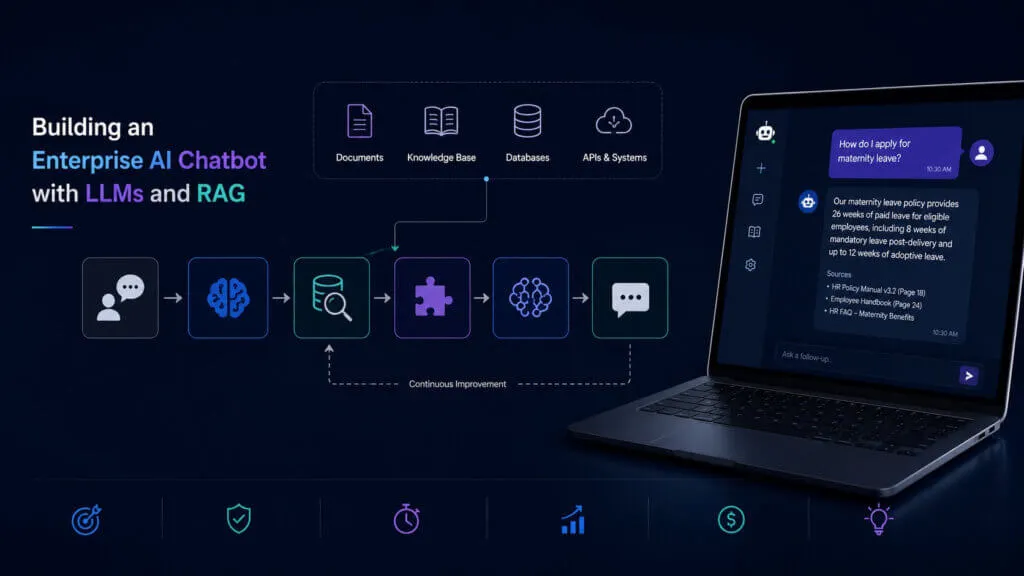
A retrieval augmented generation system runs in three quick stages when a user sends a query:
- The query is converted into a vector embedding and used to search a vector store for similar content chunks.
- The retrieved chunks are assembled into a context block and passed to the model with the query.
- The model generates a response grounded in that retrieved context.
The response is only as good as what gets retrieved. That is why retrieval quality is the primary determinant of RAG chatbot performance in production. Vendor documentation, such as the Azure AI Search RAG overview, describes the same core pattern.
Basic Versus Production Retrieval Augmented Generation
A basic setup proves the concept in a demo. A production-grade system handles the full variety of real queries at scale. Basic RAG retrieves documents. Production RAG retrieves, ranks, filters and validates.
Modern retrieval augmented generation implementations usually use hybrid retrieval. It combines semantic vector search with keyword search such as BM25. Keyword search catches cases where exact product codes or legal terms matter as much as meaning.
Reranking layers then score and reorder retrieved chunks before the model sees them. Without reranking, quality drops when user phrasing differs from the wording in the source content. In real usage, that happens constantly.
| Capability | Basic RAG | Production RAG |
|---|---|---|
| Search | Vector only | Hybrid vector and keyword |
| Ranking | Similarity score | Dedicated reranker |
| Access control | None | Per-user filtering |
| Fallback | Always answers | Declines when unsure |
| Evaluation | Ad hoc testing | Automated test sets |
The Knowledge Base Behind Retrieval Augmented Generation
The most underestimated challenge in ai chatbot development is not the architecture. It is the knowledge base the architecture depends on. LLM chatbot architecture is only as reliable as the content it retrieves.
A technically excellent RAG system on top of an outdated knowledge base produces confidently wrong answers. Arguably that is worse than hallucination, because the answers sound authoritative and cite real documents.
Chunking Strategy and Context Preservation
In retrieval augmented generation, how source documents are split into chunks matters more than most teams expect. Chunks that are too small lose the context needed to answer. Chunks that are too large dilute precision with irrelevant text.
A widely adopted technique stores contextual metadata with each chunk. This is a short description of the document section the chunk came from. Anthropic's write-up on contextual retrieval reported that adding such context reduced failed retrievals in its tests by 35%, and by 49% when combined with keyword search. The step happens once, during ingestion.
Practical chunking guidelines our team follows include:
- Split on natural boundaries such as headings and sections.
- Keep a modest overlap between neighbouring chunks.
- Attach document title, section and date as metadata.
- Store tables and code blocks as whole units.
- Test chunk sizes against real queries, not intuition.
Five Best Practices for Retrieval Augmented Generation
The five practices below separate RAG systems that hold up in production from those that only work in demos. Each one maps to a component that pilots commonly skip.
1. Design Fallback and Confidence Handling
Every enterprise AI chatbot built on retrieval augmented generation will meet queries its knowledge base cannot answer reliably. The topic may not be covered, or the retrieved content may be ambiguous. A production RAG chatbot needs a defined fallback for these cases.
The system should say it cannot answer confidently and offer a next step, such as a human handover. Systems without explicit fallbacks fail silently. They produce weak answers in a confident tone, which is the failure mode that damages trust most.
2. Manage the Context Window Deliberately
Every model has a finite context window. In retrieval augmented generation, that window must hold the query, the retrieved chunks, conversation history and the system prompt. These compete for space.
Managing them requires explicit decisions, not luck. Exceeding token limits without a pruning or compression strategy degrades answer quality sharply. Common tactics include limiting chunk count, summarizing older turns and trimming boilerplate from sources.
3. Build Memory for Multi-Turn Conversations
Retrieval augmented generation also has to handle dialogue. Enterprise users rarely ask isolated questions. They hold conversations where each message builds on earlier ones. A chatbot that treats every message as independent feels disjointed and forces users to repeat themselves.
Good LLM chatbot architecture separates short-term session context from longer-term user context. Follow-up questions are often rewritten into standalone queries before retrieval. Many pilots defer this layer until complaints force the issue.
4. Secure Retrieval, Prompts and Outputs
Security in retrieval augmented generation cannot be retrofitted once the core works. It must be embedded at the prompt, retrieval and tool-calling layers from the first design decision. A RAG chatbot that can be tricked into surfacing confidential documents creates liability far beyond its efficiency gains.
This means access control at the retrieval layer, so users only retrieve what they are authorized to see. It means defences against prompt injection, where crafted inputs try to override instructions. It also means output filtering to block personal or confidential data. The OWASP Top 10 for LLM Applications is a useful checklist here. Our DevOps and cloud engineering practice treats these as first-class components.
5. Evaluate Continuously Against Real Queries
Many projects launch a system that seems to work based on informal testing. Without systematic evaluation, accuracy problems accumulate silently. Then a user catches a consequential error in a high-stakes context.
We build evaluation pipelines into every retrieval augmented generation engagement as a standing deliverable. They track retrieval accuracy, answer correctness and hallucination rate against a representative query set. Our guide to LLM evaluation before deployment shows how to automate this gate.
Retrieval Augmented Generation in Retail Versus Fintech
The retrieval augmented generation pattern is consistent across industries. The design requirements vary by context, and understanding them before architecture is final avoids costly rework.
Retail Enterprise AI Chatbot Requirements
Retail ai chatbot development usually needs real-time product catalogue integration, live inventory and pricing, and order system connectivity. A customer asking whether an item is in stock needs the current answer, not yesterday's. The RAG layer must therefore connect to live operational systems, not just static documents. Our retail and ecommerce solutions page covers related work.
Fintech Enterprise AI Chatbot Requirements
Financial services deployments carry compliance and audit requirements that retail often does not. Every answer about a product, rule or account may need a link to a specific, auditable source. Regulators reviewing a complaint will expect to see exactly what the chatbot drew on.
A standard model does not provide source attribution by default. Retrieval augmented generation does, because each answer is built from identifiable documents. That requirement shapes both the knowledge base structure and the response logic.
| Requirement | Retail | Fintech |
|---|---|---|
| Live data | Inventory, pricing | Account status |
| Source citation | Helpful | Often required |
| Audit trail | Basic logs | Full retention |
| Guardrails | Brand and claims | Advice and compliance |
Guardrails for Sensitive Topics
Both sectors benefit from explicit guardrails on what the chatbot should and should not address. A retail assistant should not make safety or regulatory claims it cannot support. A fintech assistant should not drift into personalized advice. Guardrails work at the system prompt level and at output validation, catching problems before users see them.
Operating Retrieval Augmented Generation Over Time
A system that performed well at launch needs ongoing operational discipline. The knowledge base grows, query patterns shift, and products and policies change. Our MLOps practice applies the same monitoring principles to RAG chatbot deployments that it applies to predictive machine learning models.
This matters most when a chatbot spans several product lines or business units. Coverage grows organically and introduces new retrieval issues without anyone deciding to change anything. Regular evaluation runs, scheduled knowledge base audits and a structured feedback loop keep quality rising rather than falling. The same data engineering and automation habits apply whether the content comes from manuals, tickets or IoT maintenance logs.
Common Pitfalls in Enterprise RAG Chatbot Projects
Across retrieval augmented generation engagements, our team sees the same pitfalls appear again and again. Most stay hidden during the demo and surface only in production.
Treating the Knowledge Base as a One-Time Setup
The knowledge base behind retrieval augmented generation is not a static artifact. Products change, policies update and regulations evolve. A chatbot answering from outdated content becomes a liability.
Assign clear ownership of each content area before launch. Technical teams often leave this unresolved because it feels like a non-technical problem. It is one of the most important organizational decisions in the whole project.
Skipping Systematic Evaluation
In retrieval augmented generation projects, the absence of evaluation is the main reason production quality degrades unnoticed. Build a test set from real user questions, refresh it regularly and run it on every change. Treat a drop in scores like a failing build.
Ignoring Cost and Latency
Every retrieval augmented generation step adds overhead. Retrieval, reranking and generation each add latency and cost. Long contexts are expensive. Measure both from the first prototype so the design stays affordable at production volume.
When to Choose Retrieval Augmented Generation or Fine-Tuning
Retrieval augmented generation is usually the first choice when knowledge changes often or must be cited. Fine-tuning suits cases where you need a consistent style, format or specialized vocabulary. Many mature systems combine both. Our comparison of RAG vs fine-tuning walks through the trade-offs in detail.
Where ICANIO Fits in RAG Chatbot Projects
ICANIO retrieval augmented generation engagements usually begin with an architecture scoping phase. It maps knowledge sources, integration needs and compliance constraints before implementation starts. Typical deployments include customer service automation, internal knowledge assistants and compliance inquiry handling.
Our Data and AI services team combines data engineering, application development, cloud and MLOps skills for this work. Knowledge base governance and ongoing evaluation are core deliverables, not afterthoughts. For related reading, see our overview of gen AI use cases.
Conclusion
Retrieval augmented generation gives enterprise chatbots a way to answer from current, trusted content. Yet the architecture alone does not guarantee reliability. Knowledge base quality, hybrid retrieval, security, fallbacks and continuous evaluation make the difference.
Treat the knowledge base as a living product with owners, and treat evaluation like automated testing. Do that, and a RAG chatbot keeps earning user trust long after launch.
If you are planning an enterprise AI chatbot, contact ICANIO to discuss your content, systems and requirements with our team.
References
- Retrieval-augmented generation, Wikipedia
- Lewis et al., Retrieval-Augmented Generation for Knowledge-Intensive NLP Tasks (arXiv)
- Okapi BM25, Wikipedia
- Prompt injection, Wikipedia
- OWASP Top 10 for LLM Applications
- Azure AI Search: RAG overview, Microsoft Learn
- Introducing Contextual Retrieval, Anthropic
Frequently asked questions
What does retrieval augmented generation actually solve?
Retrieval augmented generation reduces hallucination and stale answers by grounding model responses in an organization's own current content. The system retrieves relevant passages at query time and passes them to the model, instead of relying only on what the model learned during training. It also makes answers traceable, because each response can be linked back to the source documents it used.
How is a RAG chatbot different from a standard LLM chatbot?
A standard LLM chatbot answers from its training data alone, which may be outdated or missing your private information. A RAG chatbot first searches a specific knowledge base, then generates an answer from the retrieved content. This makes answers grounded in your documents and data, and it lets you update knowledge by changing the index rather than retraining the model.
What is the most common reason enterprise RAG chatbots fail?
Poor knowledge base quality and missing systematic evaluation are the most common causes. Even a well-built system gives unreliable answers if the content is outdated, inconsistent or never tested against real user questions. Unclear content ownership makes it worse, because nobody updates the sources when products or policies change, so errors creep in quietly.
Does retrieval augmented generation work without fine-tuning?
Yes. Retrieval augmented generation can deliver strong domain-specific answers without fine-tuning, because the knowledge comes from retrieved content. Fine-tuning may still help when you need a particular tone, output format or specialized vocabulary. Many teams start with RAG alone, measure results, and add fine-tuning only where evaluation shows a clear gap.
How do retail and fintech RAG requirements differ?
Retail deployments usually need real-time links to inventory, pricing and order systems so answers reflect the current state. Fintech deployments carry stronger requirements for source citation, audit trails and guardrails against giving financial advice. Both need access control and evaluation, but fintech systems typically keep fuller logs to satisfy regulatory and complaint reviews.
How do you keep a RAG chatbot secure?
Apply access control at the retrieval layer so users only see content they are authorized for. Add defences against prompt injection, filter outputs for personal or confidential data, and log every interaction. Review the OWASP Top 10 for LLM Applications during design and testing. Security should be designed in from the start rather than added after launch.