Connectors and Indexing Pipelines
Enterprise AI search connectors for SharePoint, Confluence, Google Drive, CRMs, ticketing tools and databases. Incremental sync keeps the index current without full rebuilds.
Incremental sync
Data & AI · Enterprise Search
ICANIO builds search that understands what people mean. Hybrid keyword and vector retrieval, NLP intent detection and permission filters return the right passage from every system you connect.
"warranty terms for pumps sold in 2023"
Parse
BM25 + Vector
Rerank
Answer
⟳ Model running…
Enterprise AI search solves a familiar frustration. The answer exists somewhere in a shared drive, a ticket, a CRM note or a database, yet nobody can find it. Keyword boxes return hundreds of files and none of them is the one you need.
Our team builds search that reads the question the way a colleague would. We blend classic keyword ranking with vector similarity, add NLP to detect intent and apply each user's permissions before a single result is shown. The output is a short list of passages, often with a direct answer on top.
This guide covers how enterprise AI search works, the retrieval patterns we use, the pitfalls that hurt relevance and how to evaluate a partner. It also walks through SmartSearch, a real ICANIO AI search platform.
Enterprise AI search is search across an organisation's own content that uses machine learning to understand meaning, not just matching words. It indexes documents, records and messages from many systems and ranks them by relevance to the user's intent.
Classic enterprise search relies on inverted indexes and scoring such as BM25. That still works well for part numbers, names and exact phrases. AI adds dense vector embeddings that capture meaning, so a query about 'leave policy' also finds 'annual holiday entitlement'.
The best systems combine both, then rerank the top candidates with a stronger model. The same retrieval layer often feeds a generative assistant, which turns the top passages into a cited answer.
Working definition
“Enterprise AI search is permission-aware retrieval across company content that combines keyword ranking, semantic vector matching and learned reranking to return the most relevant passage for each user's intent.”
Foundations
Good chunks, titles, dates and owners matter as much as the model. We enrich content with metadata at index time.
Keyword and vector scores together beat either alone. Exact codes and fuzzy concepts both find their match.
Access control lists travel with every document. Results are filtered for the user before ranking, not after.
Judgement lists and click data score each change. Tuning is driven by numbers, not opinions.
Core capabilities
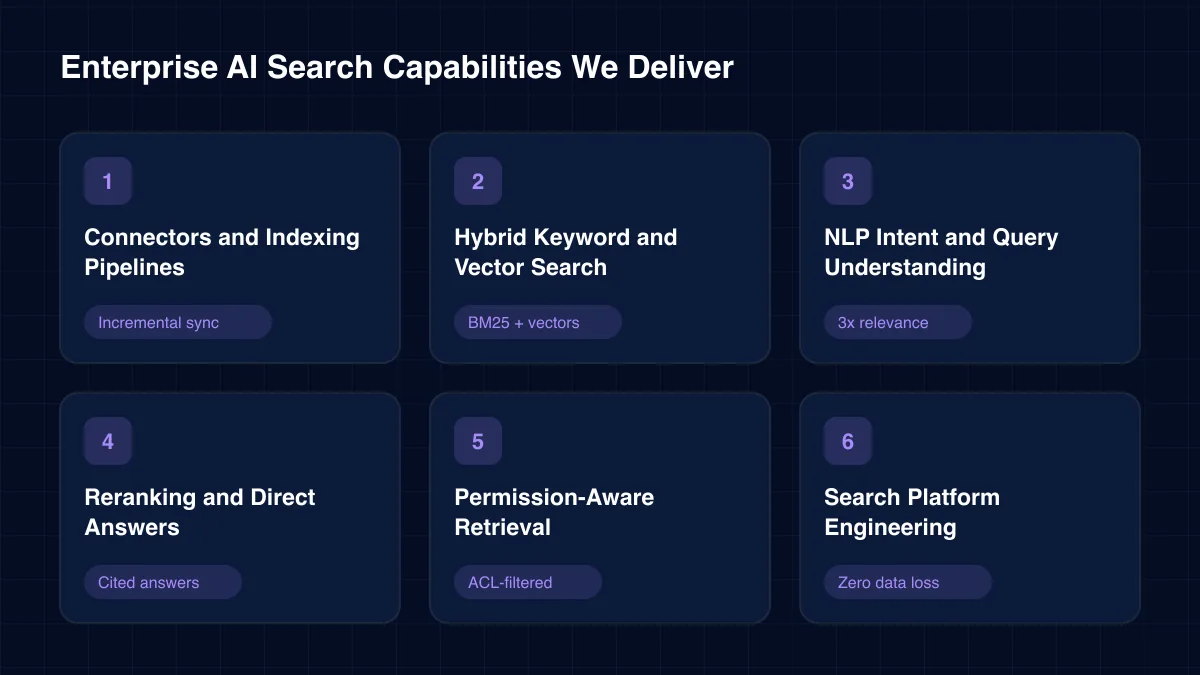
Our enterprise AI search work spans six capabilities. Together they take a company from scattered keyword boxes to one trusted place to find answers.
Enterprise AI search connectors for SharePoint, Confluence, Google Drive, CRMs, ticketing tools and databases. Incremental sync keeps the index current without full rebuilds.
Incremental sync
BM25 plus dense embeddings in Elasticsearch, OpenSearch or a vector database. Reciprocal rank fusion blends both lists into one ranking.
BM25 + vectors
Spelling correction, synonym expansion, entity extraction and intent detection. Our SmartSearch build used built-in NLP to lift relevance threefold.
3x relevance →Cross-encoder rerankers sort the top results, and an LLM can draft a cited answer from them. This links enterprise AI search with generative assistants.
Cited answers →Document-level and field-level security mirrored from source systems. Every query is logged, which supports audits in banking and healthcare.
ACL-filtered →Cluster sizing, upgrades and migrations for Elasticsearch and OpenSearch. We moved one fintech cluster from v7.15 to v8.8.1 with zero data loss.
Zero data loss →Architecture
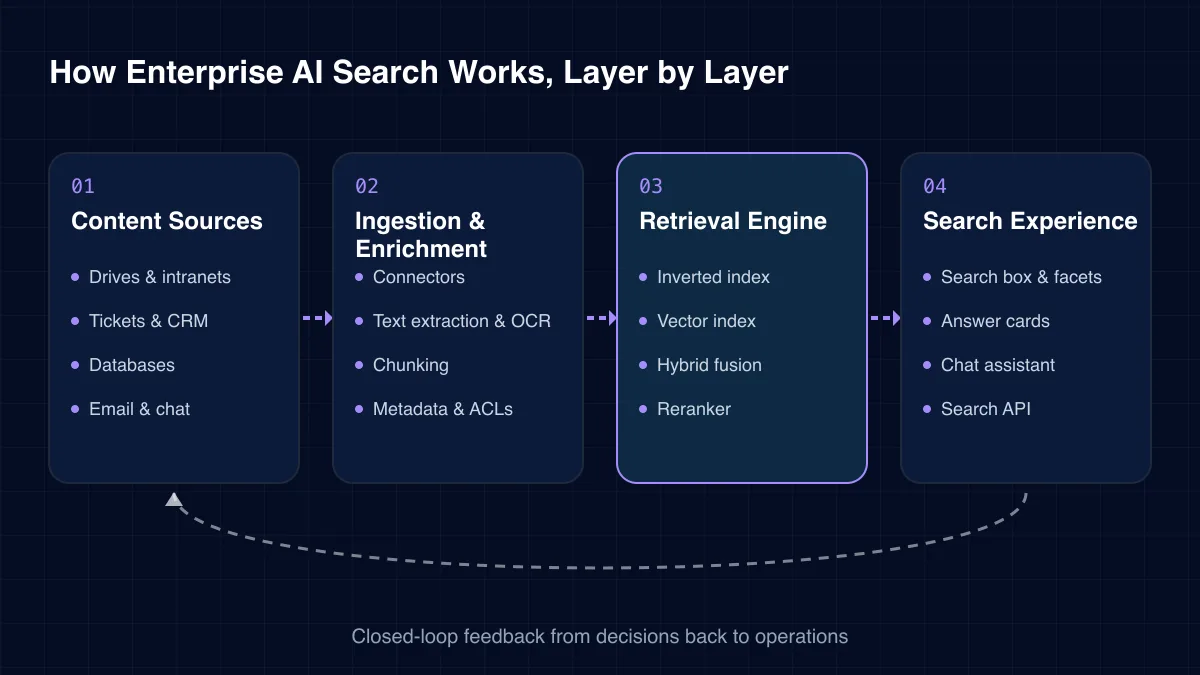
Every enterprise AI search platform we build has four layers. Content flows up into the index, and ranked, filtered answers flow back to people.
01
02
03
04
Challenges we solve
Most firms already own a search tool. The trouble is what happens when people use it.
Keyword match ranks long, generic documents first. Semantic ranking and passage-level results bring the specific answer forward.
Staff type 'sick leave' but the policy says 'medical absence'. Embeddings and synonym expansion bridge the vocabulary gap.
Each tool has its own search box, so people check five places. One index across systems gives one place to look.
A new search tool exposes files people should never see. We mirror source permissions and test them before launch.
Tuning Elasticsearch queries needs rare skills. A configuration layer lets product teams adjust relevance without code.
Nobody knows if search got better or worse after a change. Judgement lists and click metrics make relevance visible.
Enterprise AI search takes four main forms. They share a retrieval core but serve different users.
The retrieval method shapes what users find. This table compares the three approaches used in enterprise AI search.
| Criterion | Keyword (BM25) | Vector only | Hybrid |
|---|---|---|---|
| Exact codes and names | ✓ Yes | Partial | ✓ Yes |
| Matches meaning | No | ✓ Yes | ✓ Yes |
| Easy to explain ranking | ✓ Yes | No | Partial |
| Index cost | Low | Higher | Higher |
| Best for | Known items | Fuzzy questions | Most enterprises |
Better search pays back quietly across every team that looks things up.
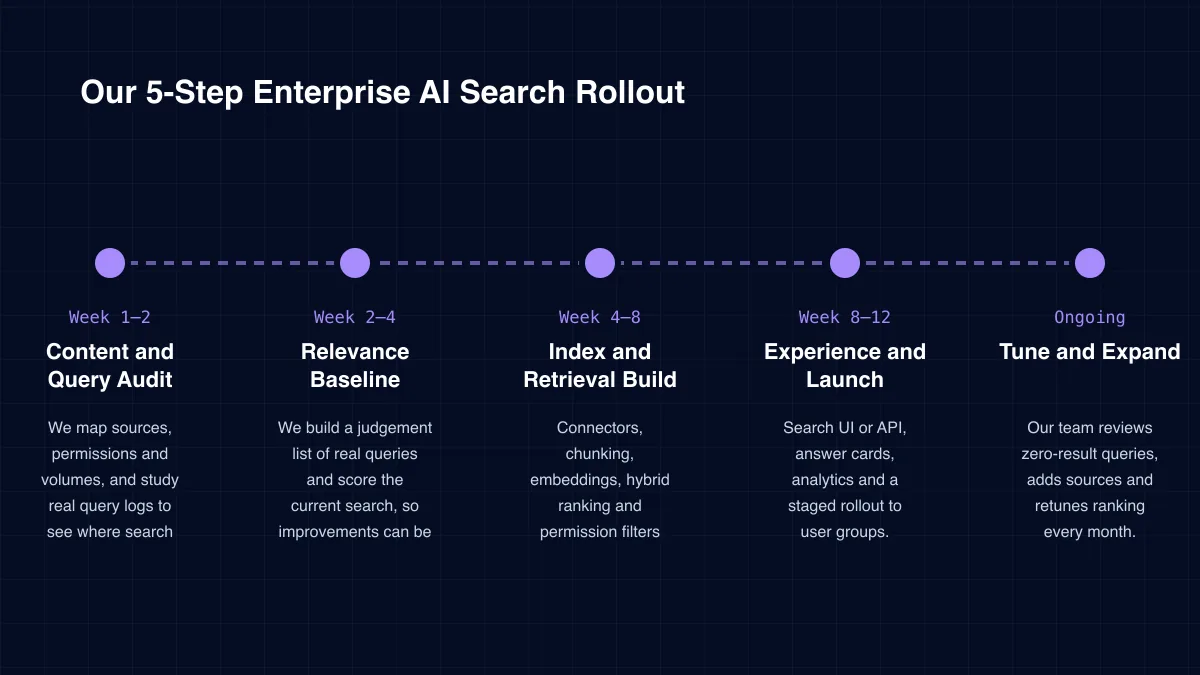
Delivery
Week 1–2
We map sources, permissions and volumes, and study real query logs to see where search fails today.
Week 2–4
We build a judgement list of real queries and score the current search, so improvements can be proven.
Week 4–8
Connectors, chunking, embeddings, hybrid ranking and permission filters for the priority sources.
Week 8–12
Search UI or API, answer cards, analytics and a staged rollout to user groups.
Ongoing
Our team reviews zero-result queries, adds sources and retunes ranking every month.
Case study
Teams struggled with complex query syntax, poor configuration gave irrelevant results and custom search builds took weeks or months. ICANIO built SmartSearch on one architecture that supports both Elasticsearch and AWS OpenSearch. A simplified search language, a no-code web interface and built-in NLP made setup accessible. Deployment cycles fell 50% and search relevance improved threefold.
“A search bar that returns the wrong results quietly convinces every user after them that search cannot be trusted.”Read the full case study →
Elasticsearch · AWS OpenSearch
One configuration runs on either engine, avoiding lock-in.
Simplified search language · Web UI
Teams tune search without writing raw query syntax.
NLP intent · Vector search pipeline
Intent recognition and an ML Ops pipeline for vector search lift relevance.
Specialist services within our data & artificial intelligence practice.
Search vendors love live demos on tidy data. We recommend probing five areas instead.
Every ICANIO enterprise AI search project includes a relevance baseline and a tuning cadence. Without them, nobody can tell if search is getting better.
ICANIO works under ISO 9001 and ISO 27001 certified processes. Indexes run in your cloud tenancy, encrypted at rest and in transit, with private network access only.
Permissions are synchronised from source systems and applied as query-time filters. We test them with real role accounts before go-live, including edge cases such as revoked access and shared links.
For regulated content we add retention rules, redaction of personal data at index time and full query logs. That supports GDPR deletion requests and internal audit reviews.
Start with time spent looking. Survey or sample how long staff spend searching each week and how often they give up and ask someone. Even small savings multiply across a large workforce.
Then measure outcome metrics. Click-through on the first result, zero-result rate and support deflection show whether the new engine is doing its job.
Running costs depend on index size and vector dimensions. We size clusters to real query load and use compact embedding models where they score well. That keeps enterprise AI search affordable as more content and users arrive.
Technology stack
We pick enterprise AI search engines and models to suit your scale, cloud and skills.
Search Engines
Apache Solr
Vector Stores
PineconeWeaviate
Embeddings & Rerank
OpenAI embeddingsSentence TransformersCohere RerankCross-encoders
Ingestion
Apache TikaOCR enginesCustom connectors
NLP
spaCyIntent classifiersSynonym graphs
Evaluation
Judgement listsnDCG & MRRClick analyticsA/B tests
Regular enterprise search matches words. Enterprise AI search also matches meaning using vector embeddings, detects intent with NLP and reranks results with learned models. It finds the right passage even when the wording differs.
Usually not. Both engines support vector fields and hybrid queries. We often add semantic retrieval and reranking to an existing cluster, which protects your investment and skills.
Yes, and it must. We sync access lists from source systems and filter at query time. Users only see results they could open directly in the original tool.
We build a judgement list of real queries with graded results, then track metrics such as nDCG and click-through. Every ranking change is tested against that list before release.
Yes. The same retrieval layer feeds an LLM with the best passages, which it turns into a cited answer. Good retrieval is the main driver of chatbot accuracy.
Banking and insurance search policies and case files. Healthcare searches protocols and records. Manufacturing teams search maintenance manuals and IoT incident logs. Any firm with large document estates benefits from enterprise AI search.
How we deliver enterprise ai search and the wider data & ai practice in each sector.
Knowledge that cannot be found might as well not exist. Enterprise AI search turns scattered files and records into answers people reach in seconds, with permissions intact.
ICANIO builds the connectors, retrieval engine and experience, then tunes relevance with you over time. Contact us to benchmark your current search and plan enterprise AI search your teams will actually rely on.
By ICANIO Data & AI Engineering Team · Published · Updated
Book a free 30-minute discovery call. We will review your sources and query logs, score your current relevance and outline a plan to improve it.
Contact Our Search Team