Adaptive Learning Paths
Models estimate mastery per skill and pick the next exercise, hint or review. AI in education feels most personal to learners here.
Per-skill mastery →Data & AI for Education & E-Learning
We build learning AI that adapts content, scores skills fairly, spots students who need help and matches graduates to jobs. It plugs into your LMS and SIS, and educators stay in charge.
Learner 20418, Algebra unit 3 quiz
Ingest
Diagnose
Plan
Assign
⟳ Model running…
AI in education should give teachers more time for teaching and give every learner a path that fits. Classes are large. Feedback is slow. Struggling students are often noticed only after they fail a test.
Our team builds AI in education around those problems. We adapt practice to each learner, score skills consistently, flag students who need support early and match graduates to the right roles. Every system connects to your LMS and SIS, and educators review what the models suggest.
This guide covers the use cases that work, the architecture behind them, the risks to manage and how to choose a partner you can trust with student data.
AI in education is the use of machine learning, language models and computer vision on learning data. That data includes quiz results, LMS activity, assignments, recorded speech and career outcomes.
It helps in three places. Before class, it prepares content and practice. During learning, it adapts difficulty and gives instant feedback. After learning, it assesses skills and connects students to opportunities.
The goal is not to replace teachers. AI in education handles repetitive marking, sorting and scheduling, so educators can spend time on mentoring and explanation.
Schools, universities, corporate academies and EdTech platforms all use it differently. A school worries about young learners and parents. A university worries about retention and placements. An EdTech company worries about engagement at scale. We shape each design around the institution's real goals.
Working definition
“AI in education is learner-level decision support that turns learning and assessment data into personalised practice, fair feedback and timely help, with educators in control.”
Foundations
Teachers see and can override every recommendation, grade suggestion and alert. The model assists; the educator decides.
Scoring models are tested across groups of learners, so accent, background or device do not change a result.
Minimal data, clear consent, role-based access and retention limits, aligned with FERPA, GDPR or local law.
LTI, xAPI and SIS APIs let AI tools run inside the platforms students and staff already use.
Core capabilities
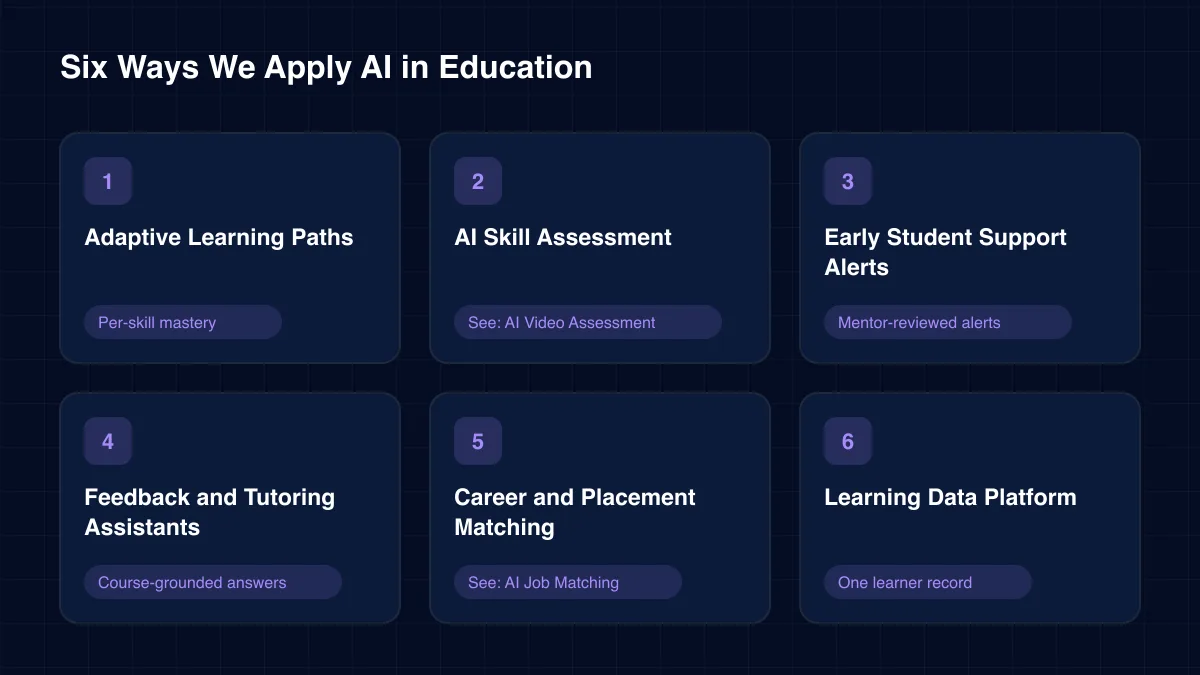
Each capability is a production pattern our engineers deliver, from learning data pipelines to the screen a student or teacher sees.
Models estimate mastery per skill and pick the next exercise, hint or review. AI in education feels most personal to learners here.
Per-skill mastery →Speech, vision and NLP models score communication skills from video responses with one consistent standard for every candidate.
See: AI Video Assessment →Learning analytics combine LMS activity, attendance and grades to flag learners who may need help while there is time to act.
Mentor-reviewed alerts
Grounded AI tutors explain concepts from approved course material and draft feedback on written work for teachers to edit.
Course-grounded answers
Matching models connect student skills and profiles to roles and recruiters. Using AI in education this way links learning to outcomes.
See: AI Job Matching →A governed store joins LMS, SIS, assessment and placement data on one learner ID, which every other model depends on.
One learner record
Architecture
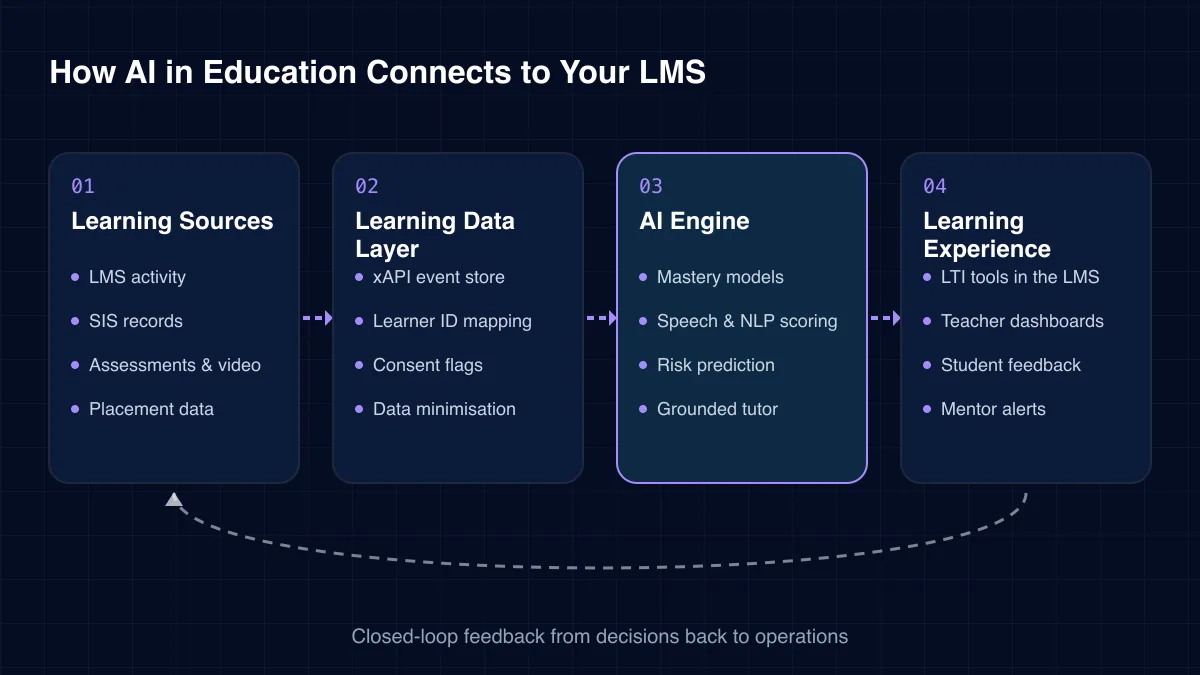
Our reference design sits beside your LMS and SIS. It reads learning events, scores them and returns guidance inside the tools learners already use.
01
02
03
04
Challenges we solve
Education has its own failure modes. These are the ones we plan for.
Students will not log into yet another app. AI in education has to live inside the LMS through LTI or native plugins.
Speech or writing models trained on narrow data can penalise accents or dialects. Fairness testing is mandatory.
An at-risk flag helps no one if no mentor owns it. Each alert needs a named person and a suggested next step.
A general chatbot will simply solve the homework. Tutoring AI must guide, hint and stay within the course.
LMS, SIS and assessment tools each hold part of the picture. Without one learner ID, predictions are weak.
Student data, especially for minors, needs consent and limits from the start. Late fixes stall rollouts.
Learning AI falls into four families, each serving a different moment in the learner journey.
Institutions already mark by hand and read LMS reports. Here is what AI in education adds.
| Capability | Manual marking | LMS reports | Learning AI |
|---|---|---|---|
| Instant feedback | No | No | ✓ Yes |
| Same standard every time | No | ✓ Yes | ✓ Yes |
| Adapts to each learner | Partial | No | ✓ Yes |
| Predicts who needs help | No | Partial | ✓ Yes |
| Educator makes final call | ✓ Yes | ✓ Yes | ✓ Yes |
The benefits reach learners, teachers, administrators and employers.
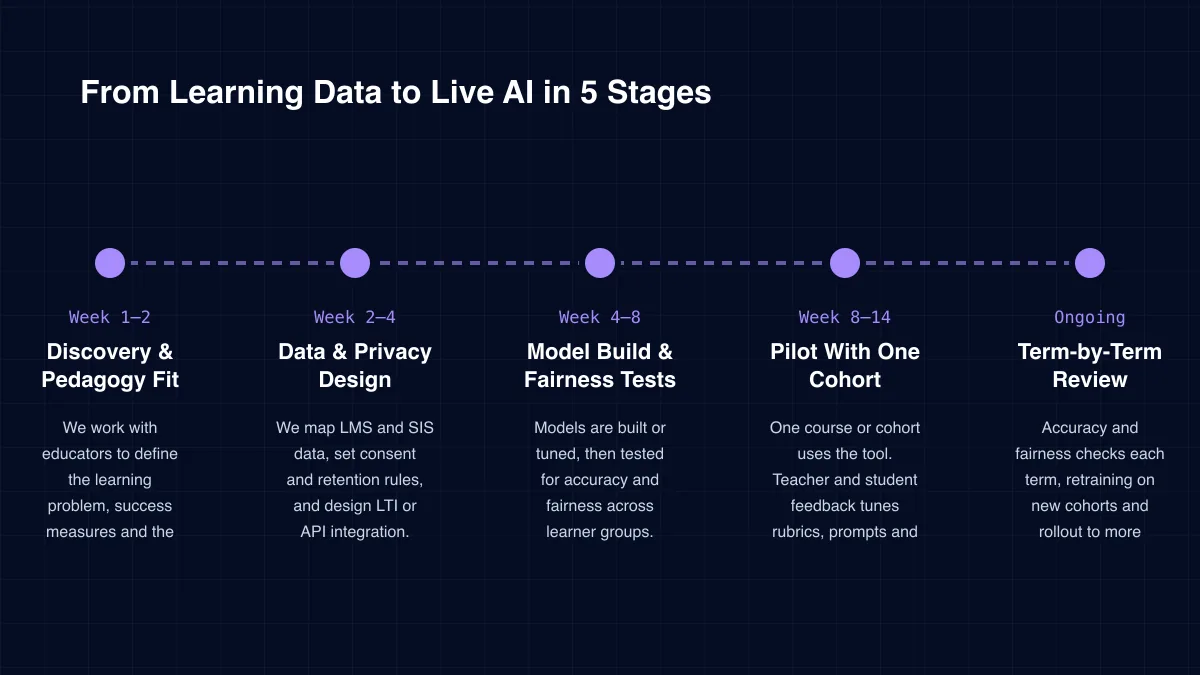
Delivery
Week 1–2
We work with educators to define the learning problem, success measures and the role of teacher review.
Week 2–4
We map LMS and SIS data, set consent and retention rules, and design LTI or API integration.
Week 4–8
Models are built or tuned, then tested for accuracy and fairness across learner groups.
Week 8–14
One course or cohort uses the tool. Teacher and student feedback tunes rubrics, prompts and thresholds.
Ongoing
Accuracy and fairness checks each term, retraining on new cohorts and rollout to more courses.
Case study
An EdTech partner needed recruiters to evaluate candidate communication skills consistently across high applicant volumes. Our team built an assessment engine that converts speech to text, tracks presence and iris movement, and analyses grammar, speech rate and keywords. Every signal combines into one communication skill score, giving faster, standardised feedback without subjective bias.
“A recruiter reviewing a hundred videos in a row will not score the first and the hundredth the same way.”Read the full case study →
AWS Transcribe
Converts spoken responses into text the engine can analyse.
MediaPipe · Computer vision
Tracks iris movement and presence to capture engagement signals.
NLTK · MongoDB
Scores grammar, speech rate and keywords into one unified skill score.
We recommend five checks before you share learner data with any vendor.
The last point decides whether AI in education stays accurate and fair after year one. Every ICANIO engagement includes structured post-launch support.
We design student data flows to align with FERPA for US institutions, GDPR in Europe and India's DPDP Act, with extra care for minors. Personal data is minimised, encrypted and access-controlled by role.
Learner data stays in your cloud tenancy and is never used to train shared models without consent. Generative tools are restricted to approved content with safety filters. ICANIO works under ISO 9001 and ISO 27001 certified processes.
Start with what you already measure: marking hours per term, course completion, dropout rates or placement rates. The gap between today and your target is the value AI in education works against.
We baseline these with you and compare a pilot cohort with a similar group. Add teacher time saved and learner satisfaction, so the case covers both efficiency and learning quality.
For EdTech companies the lens is commercial as well. Track course completion, subscription renewals and the cost of human review per learner. When AI in education lifts completion and cuts review cost together, the business case usually speaks for itself.
Technology stack
We choose tools that fit your learning platform. These appear in most of our education builds.
Learning Platforms
LMS pluginsLTI 1.3SIS APIsxAPI
Speech & Vision
MediaPipeComputer vision models
Language AI
NLTKLLMsRAG over course contentSafety filters
Analytics & ML
Knowledge tracing modelsRisk predictionXGBoost
Data Platform
Cloud data warehouseConsent management
Delivery
Teacher dashboardsStudent mobile appsMentor alerts
 Free white paper · Data & AIData & Artificial IntelligenceTransforming Enterprise Operations Through Advanced Analytics & Intelligent AutomationGet the white paper →
 Free white paper · EducationEducation & E-LearningDigital Transformation Solutions for the Global EdTech LandscapeGet the white paper →
No. Our systems handle repetitive marking, sorting and practice selection. Teachers review suggestions, adjust grades and keep every decision that matters. The aim is more time for teaching, not less teaching.
Yes. We integrate through LTI, xAPI and platform APIs, so tools appear inside Moodle, Canvas or your own LMS. Students and staff do not need a separate login.
We score against clear rubrics, test results across learner groups, accents and devices, and let educators override any score. Our video assessment engine was built to apply one consistent standard to every candidate.
We collect the minimum data, respect consent, encrypt everything and restrict access by role. Designs align with FERPA, GDPR or local law, and data stays in your tenancy.
Our tutors are designed to guide rather than hand over answers. They use hints and questions, stay within approved course material and log sessions for teacher review.
Start with one course or cohort and one clear problem, such as slow feedback or late support for struggling learners. Prove the result against a similar group, then expand.
AI in education can give every learner faster feedback, a path that fits and earlier help when they struggle. It can also connect learning to real careers.
ICANIO has built AI assessment, job matching and placement platforms for education and career partners. We bring that experience, plus LMS integration and student data protection, to every engagement. That is how AI in education becomes a trusted part of teaching rather than another tool to manage.
By ICANIO Data & AI Engineering Team · Published · Updated
Book a free 30-minute discovery call with our team. We will review one course or learner journey and scope the AI that fits it. You will leave with a clear plan, privacy design and milestones.
Contact Our Data & AI Team