DIGITAL TWIN · PREDICTIVE MAINTENANCE · AUTOMOTIVE AI
This vehicular health monitoring digital twin gives fleet operators and automotive service providers a live, physics-based mirror of a vehicle’s engine, built to flag developing faults weeks before a breakdown.
Quick Answer
What is a Vehicular Health Monitoring Digital Twin?
A vehicular health monitoring digital twin is a live virtual model of a vehicle’s engine that continuously compares real sensor readings against physics-based expected behavior to catch developing faults early. Icanio built this proof of concept for a fleet management technology partner, layering CARLA and OpenModelica physics simulation, XGBoost fault detection, and NVIDIA Omniverse 3D visualization into one explainable, audit-ready system.
Executive Summary
A Live Engine Model That Catches Faults Before the Warning Light Does
Vehicle faults rarely happen without warning. They build up gradually, through subtle shifts in engine behavior that go unnoticed until a breakdown finally occurs. For a fleet management technology partner, that gap was costing real money: unplanned downtime that disrupted operations and eroded customer trust, reactive maintenance driven by breakdowns rather than early signals, high repair costs from faults that could have been caught weeks earlier, and no real visibility into engine health until a warning light appeared on the dashboard. The partner needed a way to see developing problems before they became expensive ones, without waiting years to collect real-world fault data first.
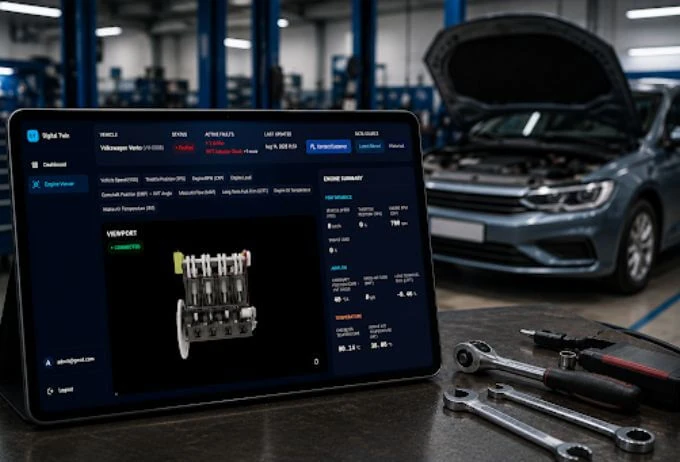
Icanio Technologies responded by building a vehicular health monitoring digital twin: a live, intelligent mirror of a physical vehicle’s engine. A physics simulation layer built on CARLA and OpenModelica FMU continuously models how a healthy engine should behave under current driving conditions. An AI fault detection layer, combining XGBoost with a rule engine, compares live sensor readings against that healthy model and raises an alert the moment readings deviate beyond safe thresholds. A 3D visualization layer built on NVIDIA Omniverse pinpoints exactly which component is affected on an interactive vehicle model.
This proof of concept validated the full pipeline end to end on a simulated mid-size petrol sedan, detecting two distinct, real-world engine faults before any deployment on physical vehicles was attempted.
“The goal was never just an alert. It was an alert an operator could actually trust and act on.”
The Challenge
Four Barriers Between Fleet Operators and Early Fault Detection
Vehicle faults do not happen without warning. They build up gradually through subtle shifts in engine behavior that go unnoticed until a breakdown occurs, leaving fleet operators and automotive service providers with four recurring problems.
Unplanned Downtime Erodes Trust
Breakdowns disrupt fleet operations and damage customer trust, and they tend to happen at the worst possible moment rather than a convenient one.
Reactive, Breakdown-Driven Maintenance
Maintenance is triggered by failures instead of early signals, which means the vehicle is already broken by the time anyone acts.
High Repair Costs From Late Detection
Faults caught only after they escalate turn what could have been a simple, low-cost fix into a major repair bill.
No Visibility Until the Warning Light
Operators have no view into developing engine problems until a dashboard warning light appears, by which point the damage is often already done.
Vehicular Health Monitoring Solutions Provided
A Three-Layer Vehicular Health Monitoring Digital Twin
Icanio Technologies built a real-time vehicular health monitoring digital twin: a live, intelligent mirror of a physical vehicle that continuously monitors engine health, detects emerging faults early, and presents everything through a clear operator dashboard. The system layers three technologies together, then validates two specific, real-world fault types on top of that foundation.
Physics Simulation Layer
CARLA and OpenModelica FMU maintain a continuously updated physics-based engine simulation of how a healthy engine should behave under current driving conditions, giving the AI layer a reliable baseline instead of guesswork.
AI Fault Detection Layer
An XGBoost model paired with a rule engine compares live sensor readings against the healthy baseline and raises an alert the moment readings deviate beyond safe thresholds, forming the core of this vehicular health monitoring digital twin’s explainable AI fault detection approach.
3D Visualisation Layer
NVIDIA Omniverse pinpoints exactly which component is affected on an interactive 3D vehicle model, so an operator sees the specific part at risk instead of a generic warning.
Carbon Buildup Detection
The vehicular health monitoring system checks whether incoming air matches what is expected for the current speed and driving conditions, alongside whether fuel use is running higher than normal. A fault is confirmed only when both signs are present and sustained, so a single one-off reading never triggers a false alert.
VVT Actuator Stuck Detection
A machine learning model analyzes ten engine readings every second, with valve timing position weighted as the most important signal, and is trained to tell a genuinely stuck actuator apart from situations that look similar. A built-in safety check holds back the alert when engine oil is simply too hot, avoiding a false notification.
Physics-First, Explainable by Design
Every alert shows its evidence: the sensor readings, the deviation from expected values, and a confidence level, so operators are never asked to trust a black box. Every reading and fault event is stored with a timestamp and sensor snapshot, supporting maintenance records, warranty claims, and compliance reporting.
Business Outcomes
What This Proof of Concept Validated
Rather than measuring the vehicular health monitoring system against a single accuracy number, this engagement validated that a physics-first, explainable predictive vehicle maintenance system is achievable end to end, from raw sensor comparison through to a 3D operator dashboard, before a single real vehicle was involved.
3-Layer Architecture
Physics, AI, and 3D visualisation layers.
2 Fault Types Detected
Engine fault types validated in this PoC.
Mid-Size Petrol Sedan
Vehicle segment validated.
Dual-Signal & Oil-Temp Checks
False-positive safeguards built in.
Full Sensor Evidence & Confidence Score
Alert explainability.
Every Reading & Fault Event Logged
Audit trail coverage.
Key learnings
What This Engagement Proves for Predictive Vehicle Maintenance
Physics-First Beats Waiting for Years of Fault Data
Pure machine-learning systems need years of real fault data before they become reliable. Anchoring detection in a physics-based engine simulation gave this vehicular health monitoring system a reliable baseline from day one, with the AI layer adding precision on top rather than starting from zero.
Explainability Is What Earns Operator Trust
An alert an operator can’t verify is an alert they’ll eventually ignore. Showing the sensor readings, the deviation from expected values, and the confidence level behind every alert is what turns a fault detection system into one operators actually act on.
Built-In Audit Trails Turn Alerts Into Defensible Records
Storing every sensor reading and fault event with a timestamp and snapshot by default, rather than bolting on logging later, is what lets this vehicular health monitoring system’s alerts double as maintenance records, warranty evidence, and compliance documentation.
Conclusion
From a Warning Light to an Early, Explainable Signal
A dashboard warning light might be workable for a single vehicle owner who can pull over immediately, but for fleet operators and automotive service providers running vehicles at scale, it is the last and most expensive place to learn about a developing fault. This engagement demonstrates that a vehicular health monitoring digital twin can catch subtle, gradual engine problems long before that warning light appears, using a physics-based engine simulation, explainable AI fault detection, and an audit trail built in by default.
By validating both a carbon buildup fault and a stuck VVT actuator on a mid-size petrol sedan, this vehicular health monitoring proof of concept shows a predictive vehicle maintenance system that turns expensive, reactive repairs into simple, low-cost fixes caught weeks earlier, and gives operators evidence they can trust rather than a black-box score.
Related Resources
This vehicular health monitoring proof of concept is part of ICANIO's digital twin work. It also draws on artificial intelligence. Our team delivers this kind of system through digital twin solutions. Model building and data engineering sit within our data and artificial intelligence services. Fleet operators can explore our transportation and logistics solutions. For related reading, see digital twin simulation. Also see real-time monitoring with IoT data. To plan a similar pilot, contact ICANIO.
- Digital Twin Solutions
- Transportation and Logistics Solutions
- Manufacturing Digital Transformation: 60% Boost
- Digital Twin Simulation: Sensor Data Pipeline
- Industrial Digital Twin Solutions: 5 Proven Wins
References
- CARLA Simulator: the open-source simulator for driving research.
- OpenModelica: the open-source Modelica modeling and simulation environment.
- Functional Mock-up Interface: the FMI standard behind FMU model exchange.
- XGBoost Documentation: official docs for the gradient boosting library.
- Digital twin: Wikipedia overview of digital twin concepts.
Frequently asked questions
Common Questions About This Vehicular Health Monitoring Digital Twin
What is a vehicular health monitoring digital twin?
A vehicular health monitoring digital twin is a live virtual model of a vehicle's engine that continuously compares real sensor readings against physics-based expected performance, flagging developing faults at the earliest possible stage rather than after a warning light appears.
How does the system detect carbon buildup on intake valves?
The vehicular health monitoring system checks whether incoming air matches what is expected for current speed and driving conditions, alongside whether fuel consumption is running higher than normal. A fault is only confirmed when both signs appear together and persist, ruling out a single one-off reading.
How does it detect a stuck VVT actuator without false alarms?
A machine learning model analyzes ten engine readings every second, weighting valve timing position most heavily, and is trained to distinguish a genuinely stuck actuator from similar-looking normal conditions. It also holds back the alert when engine oil is simply too hot, avoiding a false notification.
Why use physics simulation instead of a pure machine-learning model?
A pure machine-learning system needs years of real fault data before it becomes reliable. Anchoring detection in a physics-based engine simulation gives vehicular health monitoring a trustworthy, explainable baseline immediately, with the AI layer adding precision on top.
What makes the fault alerts explainable rather than a black box?
Every fault alert shows the sensor readings behind it, the deviation from expected values, and a confidence level, so operators can verify an alert instead of being asked to trust an opaque score.
What vehicle segment was this proof of concept validated on?
The proof of concept was scoped to the mid-size petrol sedan segment, 2.0L-2.5L inline-4, naturally aspirated, front-wheel drive engines such as those in the Toyota Camry, Honda Accord, and Hyundai Sonata, chosen for their prevalence in fleets and well-documented fault patterns.