Enterprise AI deployment is where most AI initiatives succeed or quietly fail. Across enterprises, the AI PoC (proof of concept) has become the default starting point for AI innovation. A small team builds a model, trains it on curated data and shows its potential in a controlled demo. The results look compelling: faster decisions, automation opportunities and visible efficiency gains. For a brief moment, the hardest part feels complete. A few months later, many of these proofs of concept stall. They stay disconnected from real users and never reach production workflows. Then they are quietly abandoned. This pattern is common. The journey from a working demo to a reliable production system is where many enterprise AI initiatives break down.
The root cause is rarely model failure. Most AI PoC programs prove that AI can work under ideal conditions. The real challenge begins in production, where systems are interconnected, data is inconsistent and expectations are much higher. ICANIO's Data and AI practice helps enterprise clients navigate this transition. Our team builds production-ready AI system architecture and AI infrastructure from the ground up, rather than retrofitting them onto a demo-first build.
Key Takeaways
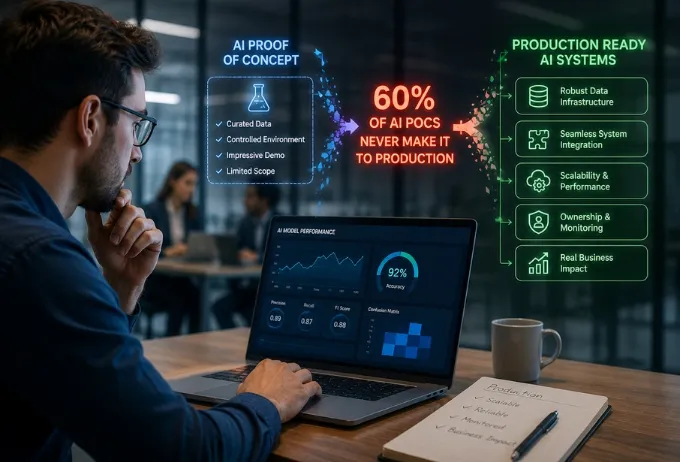
- Enterprise AI deployment fails more often from incomplete systems than from inaccurate models.
- An AI PoC proves feasibility on curated data, while production demands integration, scale and ownership.
- A production AI system architecture has five layers: data, model, serving, integration and governance.
- AI infrastructure and integration should be designed in parallel with the model, from the first sprint.
- Success should be measured by adoption, uptime, latency and business impact, not demo accuracy.
Why AI PoC Programs Fail to Scale
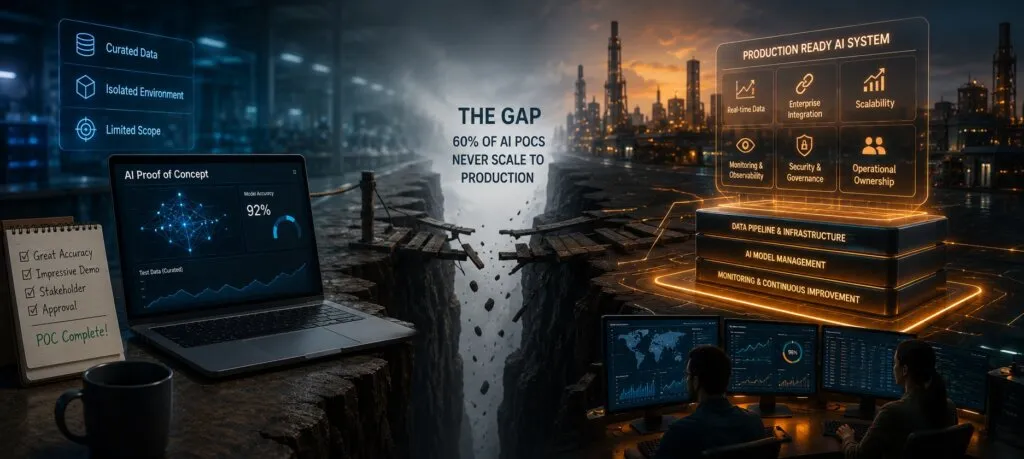
Most teams begin enterprise AI deployment with one question: does the model work? In controlled environments, the answer is often yes. That success rarely carries over to production. The conditions under which the model was built bear little resemblance to production reality.
| Dimension | AI PoC | Enterprise AI deployment |
|---|---|---|
| Focus | Accuracy on curated data | End-to-end reliability |
| Data | Clean and static | Messy and changing |
| Integration | Standalone | ERP, CRM, APIs, databases |
| Success metric | Demo approval | Adoption and impact |
| Load | Low, controlled | High, unpredictable |
| Ownership | Project team | Named operational owner |
Data Gaps Between AI PoC and Production
An AI PoC relies on curated, structured datasets chosen to showcase the model. In production, systems must handle missing values, inconsistent formats and noisy real-time streams. What works on static data often fails on unpredictable inputs. Weak data engineering is one of the most underestimated causes of failed enterprise AI deployment. It is rarely visible during the proof-of-concept phase. The demo dataset is selected precisely to make the model look capable.
The Integration Complexity Gap
Proof-of-concept systems are usually standalone, which hides the real work of enterprise AI deployment. They do not need to interact deeply with enterprise infrastructure. In production, AI systems must connect with ERP systems, CRM platforms, APIs, microservices and legacy databases. This integration layer adds complexity that teams routinely underestimate. In many cases it proves harder than building the model itself.
Our team often finds integration planning to be one of the highest-risk gaps between a proof of concept and a production-ready release. Organisations that treat integration as a downstream concern set themselves up for delays and rework. Those delays are a common reason AI scaling stalls.
Scalability and Ownership as Afterthoughts
An AI PoC operates under limited usage with controlled inputs. Production systems must handle high concurrency, unpredictable user behaviour and strict performance targets. Without scalability planning in the AI infrastructure from the start, AI scaling breaks under real-world pressure.
Ownership is the second overlooked factor in enterprise AI deployment. AI systems are not static. They need continuous monitoring, maintenance, model updates and operational support. Without clear ownership, systems degrade and lose relevance as business conditions change. A proof of concept is usually owned by a project team with a fixed timeline. Production needs ongoing stewardship. That mismatch explains many failed enterprise AI deployment efforts.
AI Scaling Through System-Centric Design
Successful enterprise AI deployment requires a shift from model-first to system-first thinking. Instead of asking only whether a model can be built, teams must answer four questions:
- Where will the system operate, and under what constraints?
- How will it integrate into existing workflows?
- Who will own it after go-live?
- How will it evolve as data and needs change?
This shift separates initiatives that deliver operational value from those that stay at the demo stage.
In enterprise AI deployment, integration must be planned from the first sprint. Map system dependencies, validate API contracts and align with infrastructure constraints early. This reduces surprises at the production boundary. Success measurement must also go beyond model accuracy. Adoption, reliability and business impact show whether a system has achieved its purpose. When AI is designed as part of a broader system, AI scaling becomes a natural extension of the architecture rather than an emergency retrofit.
The discipline behind this is often called MLOps. It applies DevOps practices such as automation, versioning and continuous delivery to machine learning systems. Google's guide to MLOps continuous delivery pipelines is a solid reference for teams designing their pipelines.
AI System Architecture: 5 Layers for Enterprise AI Deployment
Production-grade enterprise AI deployment is not just about a trained model. It requires a well-designed AI system architecture with several connected layers. A weakness in any layer can compromise the whole system.
- Data layer: ingestion, validation, transformation and consistency across real-world sources.
- Model layer: training, versioning, evaluation and retraining pipelines.
- Serving layer: inference tuned for latency, concurrency and cost under production load.
- Integration layer: reliable connections to enterprise platforms, APIs and downstream systems.
- Governance layer: monitoring, alerting, audit logging, access control and compliance.
Why the Governance Layer Is Not Optional
For organisations under regulatory frameworks such as GDPR and ISO 27001, the governance layer of the AI system architecture is essential. It defines the documentation and audit trail that regulated enterprise AI deployment must satisfy before sign-off. A system built without it cannot be deployed in regulated environments, however well the model performs.
ICANIO treats governance as a first-class layer from the initial architecture review. Production readiness is then built in rather than added later. The NIST AI Risk Management Framework is a useful structure for mapping these controls.
How the Layers Work Together
In enterprise AI deployment, each layer depends on the ones around it. A fast serving layer is useless if the data layer feeds it stale values. A strong model is wasted if the integration layer cannot deliver its predictions to the right application. Our team recommends assigning a clear owner and success metric to every layer. That makes gaps visible early, when they are cheap to fix.

Industry Failure Patterns in Enterprise AI Deployment
The same failure shape appears in very different sectors. The table below lists common patterns.
| Industry | Typical failure | Root cause |
|---|---|---|
| Financial services | Credit model fails on live data | Bias, weak real-time scoring |
| Healthcare | Diagnostic AI rejected by clinicians | No EMR integration or explainability |
| Manufacturing | Predictive maintenance misses failures | Inconsistent sensor data |
| Retail | Recommender gets low adoption | No catalogue or user data integration |
| Logistics | Route model never used | No owner, no dispatch integration |
Despite different use cases, the underlying enterprise AI deployment problem is consistent. The AI system architecture and AI infrastructure were not designed for real production conditions. The AI PoC validated the model in isolation. Production required the model to work within a complete operational system, and that system was never designed.
Our team recommends starting each engagement with a production readiness assessment. It identifies infrastructure, integration and governance gaps before model development begins. This prevents the familiar proof-of-concept-to-production failure before it starts.
KPIs for Enterprise AI Deployment Success
Demo metrics do not tell you whether an enterprise AI deployment is delivering value. These KPIs do.
| KPI | What it measures | Why it matters |
|---|---|---|
| Adoption rate | Share of intended users active | Unused systems add no value |
| Uptime | Availability under load | Shows infrastructure reliability |
| Time to deploy | Model ready to live release | Shows integration efficiency |
| Integration success | Working connections | Tests what a PoC never tests |
| Inference latency | Response time at real load | Confirms AI scaling |
| Business impact | Measurable operational change | Justifies the investment |
What This Means for Enterprise AI Strategy
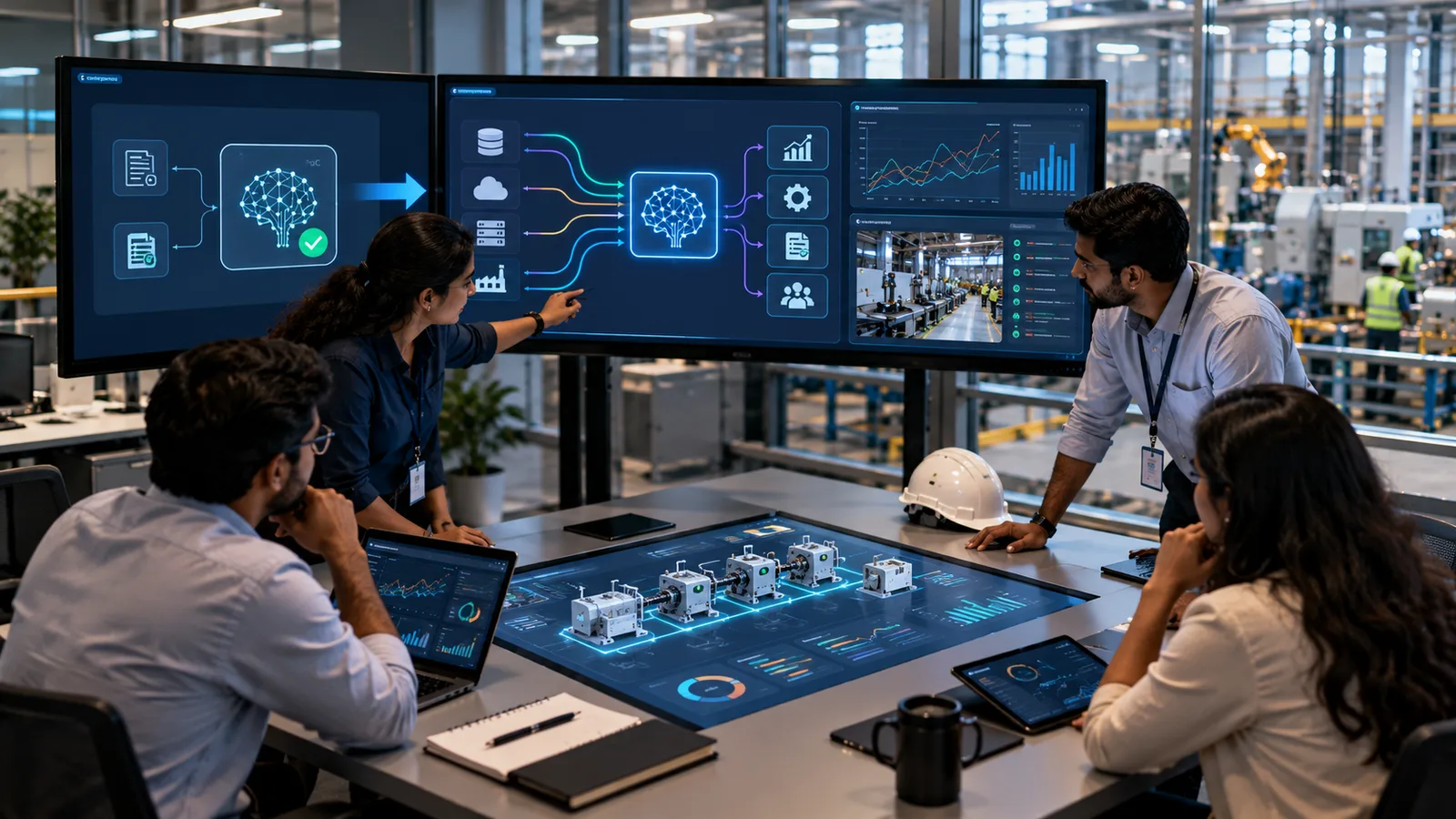
Enterprise AI teams must rethink how they evaluate enterprise AI deployment success. A proof of concept is an early validation step, not a milestone. The real effort begins in the move to production. AI scaling needs sustained investment in AI infrastructure, integration architecture, ownership and continuous improvement.
It also needs a change in mindset. Teams must move from celebrating isolated technical wins to building systems that run reliably every day. Production AI rarely fails because models are inaccurate. It fails because systems are incomplete. A system-centric approach to AI system architecture tends to bring faster AI scaling, higher adoption and greater operational impact.
How to Build a Production-Ready Enterprise AI Program
Enterprises that complete an enterprise AI deployment, crossing the gap from proof of concept to production, tend to share a set of practices. Here are the ones we see matter most.
Treat Production as an Engineering Program
Research projects optimise for discovery. Engineering programs optimise for reliability, maintainability and continuity. Treating enterprise AI deployment as an engineering program changes every design decision from the first sprint.
Define Operational Ownership Early
Every enterprise AI deployment needs a named team or person responsible for monitoring, maintenance and retraining. Without one, systems gather technical debt silently. Eventually, degraded performance forces an unplanned fix. ICANIO asks clients to define operational ownership before a production AI engagement starts. Missing ownership is one of the clearest warning signs of post-deployment trouble.
Build the Stack in Parallel With the Model
For a smooth enterprise AI deployment, design the data pipeline, serving infrastructure, integration layer and monitoring stack alongside model development. Sequential work produces a familiar problem. The model is ready, but the surrounding stack is weeks behind. Good models then miss deployment windows and lose executive confidence.
Scope Each AI PoC Deliberately
A well-scoped AI PoC answers a specific question about feasibility or business value. It is not a minimum viable product. It should not be pushed toward production without the architecture layers production requires. Define what the proof of concept is meant to prove, and what it is not. Clear boundaries lead to better decisions about whether and how to proceed.
Invest in the Transition Itself
The most successful teams give the production transition the same rigour as the original proof of concept. In practice, that means:
- Dedicated engineering time for integration architecture.
- Monitoring and alerting in place before the first user arrives.
- An operational runbook with retraining triggers, data quality gates and escalation steps.
- Business outcomes measured from the first production week.
Engineering discipline, not model sophistication alone, is what bridges the gap. The investment in transition is how the original proof-of-concept spend earns a return. You can see this approach in our enterprise AI chatbot case study. For a step-by-step view, read our guide on scaling AI from PoC to production.
Why Enterprise AI Deployment Needs Post-Launch Care
Go-live is not the finish line for enterprise AI deployment. Data drifts, user behaviour shifts and upstream systems change their APIs. Each of these can erode model performance quietly. Monitoring should track input data quality, prediction distributions and business outcomes together. When any of them moves outside agreed limits, the owner should know within hours, not weeks.
Retraining needs a defined cadence and a safe release process in any enterprise AI deployment. New model versions should pass the same evaluation gates as the first release. Rollback must be fast and tested. Cloud platforms make this easier, but only if the AI infrastructure was built with versioning from the start. Our article on AI project failure after launch explores these risks in more detail.
Conclusion
Enterprise AI deployment succeeds when organisations design complete systems, not just accurate models. The AI PoC phase answers whether AI can work. Production asks whether it can work reliably, at scale, inside real workflows and under real governance.
For enterprise AI deployment, the five-layer AI system architecture, early integration planning, named ownership and outcome-based KPIs are the foundations. Teams that invest in the transition with real engineering discipline turn demonstrations into lasting business value. ICANIO's Data and AI services are built around this approach.
If your AI pilots are stuck before production, contact ICANIO to discuss a production readiness review.
References
- MLOps (Wikipedia)
- Google Cloud: MLOps continuous delivery and automation pipelines
- NIST AI Risk Management Framework
Frequently Asked Questions
Why do AI PoC programs fail even after successful demos?
AI PoC programs fail because they are built in controlled environments that ignore real-world complexity, including system integration, data inconsistency and user behaviour. Enterprise AI deployment needs far more than a well-performing model. It needs production-ready AI infrastructure, a sound AI system architecture and defined operational ownership, none of which the proof-of-concept phase usually establishes.
What is the biggest challenge in AI scaling to production?
The biggest challenge in AI scaling is integrating AI systems with existing enterprise infrastructure and setting clear ownership beyond the build phase. Integration work is often the largest share of the total enterprise AI deployment effort. AI scaling also requires scalability planning, data quality governance and monitoring that most AI PoC programs never design for.
How should enterprises measure enterprise AI deployment success?
Adoption rate, system uptime, time to deploy, integration success rate, inference latency and business impact show true success. Model accuracy is a necessary engineering benchmark but an insufficient business measure for enterprise AI deployment. A system that is technically accurate but unused or unreliable has delivered no value to the organisation.
How can enterprises improve AI scaling outcomes?
Design the AI system architecture and AI infrastructure with production requirements from the first sprint, rather than treating them as post-model concerns. Align enterprise AI deployment with real operational workflows. Ensure reliability through robust governance. Define operational ownership before development begins. These practices most often decide whether AI scaling succeeds or stalls.
What are the layers of a production AI system architecture?
A production AI system architecture usually has five layers. The data layer handles ingestion and validation. The model layer manages training, versioning and retraining. The serving layer delivers fast, cost-efficient inference. The integration layer connects to enterprise systems. The governance layer covers monitoring, audit logging, access control and compliance across the whole system.
Should an AI PoC become the production system?
Usually not. An AI PoC is designed to answer a narrow question about feasibility or value. It typically lacks the data pipelines, integration, monitoring and governance that production needs. Our team recommends treating the PoC as evidence, then designing the production system properly. Reusing selected components is fine, but the architecture should be built for production from the start.