AI in logistics has reached an interesting point. Most logistics leaders now accept that machine learning can forecast demand and flag risk earlier than traditional methods. Far fewer have solved the harder problem inside that promise: catching disruptions before they cascade through a supply network. By the time a disruption reaches a company's own tier-1 suppliers, it has often been building for days or weeks further upstream. It compounds quietly before anyone with visibility even knows to watch.
In AI in logistics, building a model that forecasts volume or flags an obvious risk is no longer the hard part. Predictive analytics in logistics has matured a lot. The hard part is visibility deep enough into the network, and a data architecture fast enough, to catch a disruption while it is still small and local. This guide explains what that takes, and why integration matters as much as the model.

Key Takeaways
- AI in logistics delivers the most value when it catches disruptions early, not just when it forecasts volume.
- Many disruptions start beyond tier-1 suppliers, so multi-tier visibility and external signals are essential.
- Supply chain disruption forecasting needs event-driven data infrastructure, not only nightly batch jobs.
- A forecast only matters if it reaches the systems and people who can act on it.
- Lead time often matters more than marginal gains in prediction accuracy.
- Models must be monitored and retrained as networks change.
Why Disruptions Cascade Before Most Companies Notice
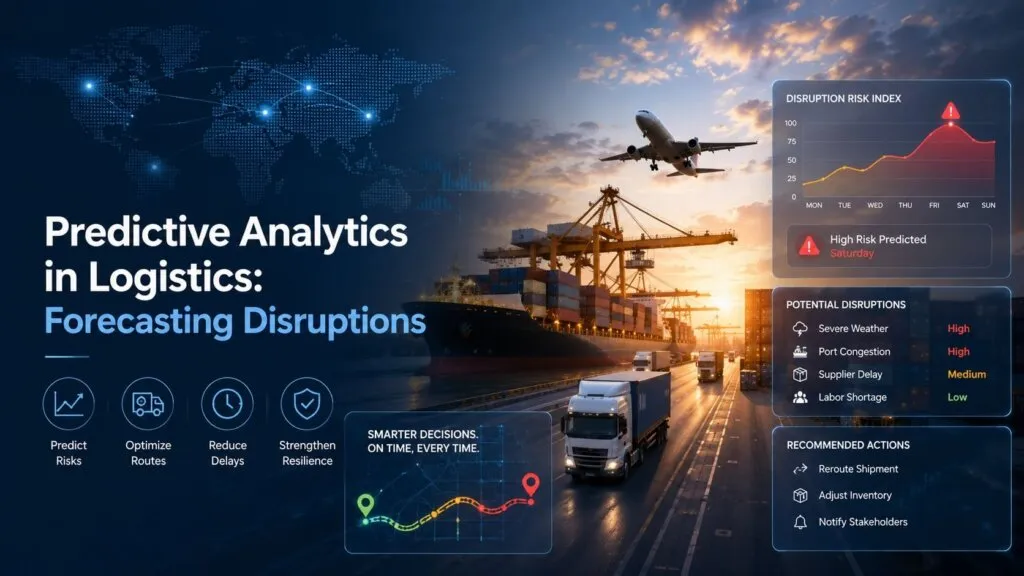
For AI in logistics, the first lesson is that many supply chain disruptions start several layers deep in the network, not at direct suppliers. Typical sources include a sub-tier component maker, a shared logistics hub, or a raw material producer hit by a regulatory change. Nobody downstream was tracking any of them.
This changes what AI in logistics has to solve. A model trained only on a company's own shipments, its direct supplier performance and its own demand history will miss these signals. They never appear in the data the model watches.
By the time the effect reaches a tier-1 supplier and shows up in monitored data, much of the damage is locked in. The company reacts to a cascade instead of catching the small event that started it. Small delays upstream can also amplify as they move through the chain, a pattern related to the well-known bullwhip effect.
What AI in Logistics Needs to Catch Disruption Early
Closing this gap requires a different AI in logistics data architecture from the standard demand forecasting use case. This is where many predictive analytics in logistics initiatives quietly underdeliver against their ambitions. Three building blocks matter most.
Multi-Tier Visibility
Real disruption forecasting with AI in logistics requires mapping supply relationships beyond tier 1. This is difficult work. Deeper networks include far more entities. They shift as suppliers merge, fail or get replaced. Their data rarely sits in any system the company owns.
Multi-tier visibility usually combines internal procurement and logistics data with external signals. Useful sources include news monitoring, port and customs data, weather feeds, geopolitical risk feeds and carrier status updates. IoT telematics from trucks and containers adds live position and condition data. Together these can surface risk at suppliers the company has no direct data relationship with. The discipline of supply chain risk management provides useful frameworks for prioritising which tiers to map first.
Event-Driven Data Infrastructure
Weekly or daily batch processing is fine for long-horizon demand forecasting. Supply chain disruption forecasting needs an event-driven architecture instead. Live feeds must surface a developing risk within hours, not at the next scheduled refresh. Streaming platforms such as Apache Kafka are common building blocks.
This decision belongs early in a project. It is hard to bolt onto a batch-oriented system later without major rework. Our team treats real-time ingestion as a foundation of any AI in logistics project aimed at disruption forecasting. It is not an optional extra after a demand pilot succeeds. This is core data engineering and cloud work.
Models That Explain Their Signals
The third block of AI in logistics is explainability. A planner needs to see why a supplier or lane was flagged. That means showing the contributing signals, such as a port delay, a weather warning or a supplier news event. Black-box scores rarely earn the trust needed for action.
From Detection to Action: Why Integration Depth Matters
A model that flags a disruption three weeks early adds little value if the insight never reaches the people who can act. This integration problem separates AI in logistics deployments that change outcomes from those that only produce accurate dashboards.
Real adoption means the signal feeds capacity planning, alternate routing and procurement systems directly. Ideally it reaches decision makers without someone noticing a dashboard alert and relaying it through several steps. Typical integration points include:
- Transport management systems, to propose alternate carriers or routes.
- Procurement and ERP systems, to trigger buffer orders or alternate sourcing.
- Warehouse systems, to adjust inbound schedules and labour plans.
- Customer service tools, to warn affected customers early.
A model that stays disconnected from the systems that move freight remains a reporting tool at best. Our guide to route optimization software covers one of the most common places these signals land. Workflow automation then turns an alert into a concrete proposed action.
Demand Forecasting vs Supply Chain Disruption Forecasting
Marketing content often blurs two different problems. Demand forecasting and supply chain disruption forecasting are related, but they need different data, models and integration points.
| Aspect | Demand forecasting | Disruption forecasting |
|---|---|---|
| Core question | How much volume, and when? | Will something stop it moving? |
| Typical horizon | Weeks to months | Hours to weeks |
| Main data | Internal sales and shipments | External signals plus internal data |
| Refresh cadence | Daily or weekly batch | Event-driven, near real time |
| Main consumer | Planning and inventory teams | Operations, procurement, routing |
Demand forecasting draws mainly on a company's own sales and shipment history. Disruption forecasting often needs a much shorter detection window and external data that a demand model never touches.
Many companies assume disruption forecasting is a simple extension of their demand model. In practice it needs multi-tier visibility and event-driven ingestion layered on top. Our team usually treats these as related but distinct phases of one predictive analytics roadmap. Success in one does not guarantee the other.
Measuring Whether AI in Logistics Is Actually Working
Demand forecasting has a clean measure: accuracy against actual sales. Disruption forecasting is harder to evaluate. The clearest sign of success is often a disruption that never visibly cascaded, because the company acted early.
That makes return-on-investment conversations about AI in logistics harder. A combination of leading and lagging indicators gives a more honest picture:
- How many flagged disruptions were acted on before they cascaded.
- The average lead time the system gave, compared with normal monitoring.
- The share of alerts that proved relevant, which tracks false positives.
- Over a longer horizon, whether exposure to supply chain volatility has fallen.
None of these is as simple as one accuracy percentage. Together they show whether AI in logistics is preventing cascades or just producing forecasts that look sensible in hindsight.
The Gap Between a Working Model and a Trusted Input
Many predictive analytics in logistics projects succeed at modelling and then underperform after deployment. The forecasts were not wrong. The gap between a working model and a trusted, routinely used decision input never closed.
Closing that gap in AI in logistics is as much change management as engineering. It is easy to underinvest in. It often decides more of the real-world impact than further tuning of the algorithm.
A Representative Disruption Pattern
A common AI in logistics scenario starts with something minor. Examples include a labour dispute at a regional port, a regulatory change at one raw material supplier, or a storm at one node of a larger network. The event compounds over days or weeks. It becomes visible only later to companies that monitor tier-1 suppliers alone.
AI in logistics built to watch for early signals can flag the event while it is still local. Operations teams then gain time to reroute, adjust procurement or build buffer stock. Without that warning, they react after the cascade has turned into late shipments and stockouts.
Demand forecasting asks how much volume is coming. Disruption forecasting asks whether something will stop that volume arriving as planned. The second question requires watching signals well outside a company's own history. Companies often underestimate how much relevant risk lives outside the data they already collect.
Why Lead Time Matters More Than Accuracy Alone
A moderately accurate warning with three weeks of lead time can be more useful than a precise warning three days out. Three weeks gives procurement and operations room to act. They can switch suppliers, change routes or build buffer inventory. Three days mostly allows damage control.
This is why multi-tier visibility matters so much for supply chain disruption forecasting. Signals that start deep in the network take time to arrive. Those are exactly the events where extra lead time pays off most. Our team recommends optimising AI in logistics for useful lead time, not only for precision on historical test data.
Building Organisational Trust in AI in Logistics
A sound AI in logistics system still fails if planners do not trust its output enough to change plans. This trust problem is easy to underestimate during evaluation. A forecast that is ignored delivers the same value as no forecast.
Trust grows when experienced planners can see why a disruption was flagged. A structured rollout helps:
- Run the system in shadow mode and review forecasts against real outcomes.
- Share results openly, including misses and false alarms.
- Let planners act on high-confidence alerts first.
- Expand autonomy gradually as the track record builds.
This mirrors the human-in-the-loop principles in our guide to human in the loop AI governance. The NIST AI Risk Management Framework also offers useful guidance on transparency and oversight for AI systems.
Keeping AI in Logistics Models Accurate as Networks Change
Supply networks are not static. Suppliers come and go, shipping lanes shift, and new geopolitical risks appear. A model that performed well at launch can lose accuracy as the network it models changes shape. Data scientists call this concept drift.
Ongoing monitoring and retraining matter more here than in many AI use cases. The whole value of predictive analytics in logistics depends on staying current with a shifting risk landscape. A model trained once and left alone for a year will likely miss new risk patterns. The most consequential disruptions often look unlike anything in the training data.
Good MLOps practice for AI in logistics includes drift monitoring, scheduled retraining, versioned data and clear rollback paths. Google Cloud's guide to MLOps pipelines is a solid technical reference. Our article on AI project failure after launch covers the governance side.
Other AI in Logistics Use Cases Worth Knowing
Disruption forecasting is not the only place AI in logistics adds value. Many teams start elsewhere and build the data foundation along the way. Common use cases include:
- Route and load optimisation. Machine learning and solvers plan routes and loads around traffic, time windows and vehicle capacity.
- Warehouse automation. Models forecast inbound volume and help schedule labour, slotting and picking.
- Predictive maintenance for fleets. IoT sensor data from vehicles flags likely component failures before breakdowns.
- Estimated time of arrival prediction. Models combine live telematics with historical lane data for more reliable ETAs.
- Document processing. AI extracts data from bills of lading, invoices and customs forms.
Each of these shares the same foundation as disruption forecasting: clean, timely data and tight integration with operational systems. That is why our team recommends planning AI in logistics as a platform rather than a set of disconnected pilots. Data pipelines, feature stores and monitoring built for one use case can then serve the next. Over time, the investment in multi-tier visibility and event-driven ingestion supports every AI in logistics initiative on the roadmap, not just one.
Where ICANIO Fits in AI in Logistics Projects
ICANIO logistics engagements usually begin with an assessment of current visibility gaps. Is the company watching tier 1 only, part of tier 2, or nothing beyond direct suppliers? The answer decides how much multi-tier mapping is needed before disruption forecasting can improve on existing early warnings.
We favour a staged approach. Build event-driven infrastructure and multi-tier visibility step by step rather than mapping the whole supply base on day one. ICANIO teams combine data and artificial intelligence, DevOps and cloud engineering, application development and MLOps for this work. A digital twin of the network can follow once the data foundation is stable. You can learn more about our data and AI services and our transportation and logistics solutions.
Conclusion
AI in logistics is most valuable when it buys time. Demand forecasting is now a solved starting point for many companies. Catching disruptions early is harder. It needs multi-tier visibility, event-driven data, explainable signals and deep integration with the systems that move freight.
The organisational side matters just as much. Build trust through shadow runs and honest reporting. Keep models current as the network changes.
If you are exploring supply chain disruption forecasting and want to discuss the data foundation it needs, contact ICANIO to talk with our team.
References
- Microsoft Azure: Event-driven architecture style
- Apache Kafka documentation
- NIST AI Risk Management Framework
- Google Cloud: MLOps continuous delivery and automation pipelines
- Wikipedia: Supply chain risk management
- Wikipedia: Bullwhip effect
- Wikipedia: Demand forecasting
- Wikipedia: Concept drift
Frequently asked questions
Why do disruptions go undetected until they cascade?
Many disruptions begin beyond a company's direct tier-1 suppliers, in parts of the network it does not monitor. The early signal never reaches its systems. By the time effects show up in tier-1 data, the disruption has often spread. AI in logistics that adds external signals and multi-tier visibility can surface these events much earlier.
How is disruption forecasting different from demand forecasting?
Demand forecasting predicts how much volume will move over weeks or months, mostly from internal sales and shipment history. Disruption forecasting predicts whether something will stop that volume moving as planned. It needs faster detection, external data sources and visibility deeper into the supply network than a typical demand model uses.
What data infrastructure does predictive analytics in logistics need?
Disruption forecasting generally needs event-driven, near real-time ingestion rather than only batch processing. Streaming platforms collect signals from carriers, ports, IoT telematics, news and weather feeds. Catching a developing risk early depends on surfacing those signals within hours. Batch pipelines remain useful for long-horizon demand forecasting alongside the streaming layer.
Why does multi-tier visibility matter so much?
Many disruptions start at sub-tier suppliers that a company has no direct data relationship with. Early warning therefore depends on combining internal data with external signals that reveal risk beyond tier 1. Multi-tier visibility also gives longer lead time, because problems deep in the network take longer to reach the company's own operations.
Does an AI in logistics model stay accurate without maintenance?
No. Supply networks change as suppliers, lanes and risk factors shift, so models suffer from concept drift. Disruption forecasting models need drift monitoring, scheduled retraining, versioned data and rollback paths. A model left unmonitored for a long period is likely to miss new risk patterns, which are often the ones that matter most.
How do you get planners to trust AI forecasts?
Show why each alert was raised, using the signals behind it. Run the system in shadow mode first and compare forecasts with real outcomes. Share misses and false alarms openly. Let planners act on high-confidence alerts before widening autonomy. Trust built this way leads to forecasts actually changing routing and procurement decisions.