Generative AI in healthcare has moved from research prototype towards production in 2026. It is reshaping how organisations manage documentation, support clinical decisions, speed up pharmaceutical research and engage patients. Two pressures drive the investment. The first is the administrative burden that takes clinicians away from patients. The second is diagnostic complexity that demands pattern recognition across huge volumes of data.
Generative AI in healthcare addresses both. It can draft clinical notes, radiology summaries and discharge letters. It can also support diagnosis by highlighting patterns in imaging and records. However, it brings real challenges around privacy, accuracy, regulation and ethics. Responsible programmes deal with these alongside the benefits.

ICANIO builds artificial intelligence and application development solutions for healthcare organisations. This guide covers what the technology is, its main use cases, the risks to manage and the practices that help deployments succeed.
Key Takeaways
- Generative AI in healthcare creates new content, such as notes, summaries and molecule ideas, rather than only classifying data.
- AI clinical documentation is usually the most practical starting point, because it is high volume and lower risk.
- AI medical diagnosis tools work as decision support, with clinicians keeping final responsibility.
- Synthetic medical data can help research and testing while protecting patient privacy.
- Privacy, hallucination, bias and regulation must be designed in from day one, not added later.
What Is Generative AI in Healthcare?
Generative AI in healthcare refers to generative artificial intelligence systems applied to medical work. These systems create new content and synthesise information by learning patterns from large collections of records, clinical notes, images and research. Traditional AI mostly classifies existing data or predicts an outcome. Generative models produce new outputs, such as a draft note, a patient summary or a candidate molecule.
The landscape includes several model families:
- Large language models adapted for clinical text and medical question answering.
- Medical imaging models that analyse radiology, pathology and cardiology scans.
- Conversational systems for triage, scheduling and chronic disease support.
- Molecular models that propose compounds and predict protein interactions.
Most providers focus first on documentation, imaging support and patient engagement. Life sciences firms focus more on research and drug discovery AI.
| Use case | Main users | Risk level |
|---|---|---|
| Clinical documentation | Clinicians, coders | Lower |
| Diagnostic support | Radiologists, pathologists | High |
| Drug discovery | Research scientists | Medium |
| Virtual assistants | Patients, care teams | Medium |
| Synthetic data | Data scientists | Lower |
| Education | Students, trainees | Lower |
AI Clinical Documentation: Reducing the Admin Burden
AI clinical documentation is the most widely deployed form of generative AI in healthcare. It also has the most immediate effect on daily work. Clinicians spend a large share of their time on notes, EHR entries, discharge summaries and coding. This load contributes to burnout and reduces time for direct care.
In practice, generative AI in healthcare documentation tools help in three ways:
- Converting doctor-patient conversations into structured notes, often called ambient scribing.
- Suggesting medical codes from encounter data for coder review.
- Pre-filling EHR fields so clinicians check rather than type.
The value case centres on restored clinician time, less after-hours charting and more consistent notes. Clinicians must still review and sign every note. Our team recommends measuring documentation time before and after a pilot, so the organisation sees its own results rather than relying on vendor claims.
For generative AI in healthcare, integration matters as much as the model. Notes must land in the right EHR fields, in a standard format. The HL7 FHIR standard is the usual way to exchange this data. Our article on electronic health records software explains the wider EHR picture.
AI Medical Diagnosis: Pattern Recognition at Scale
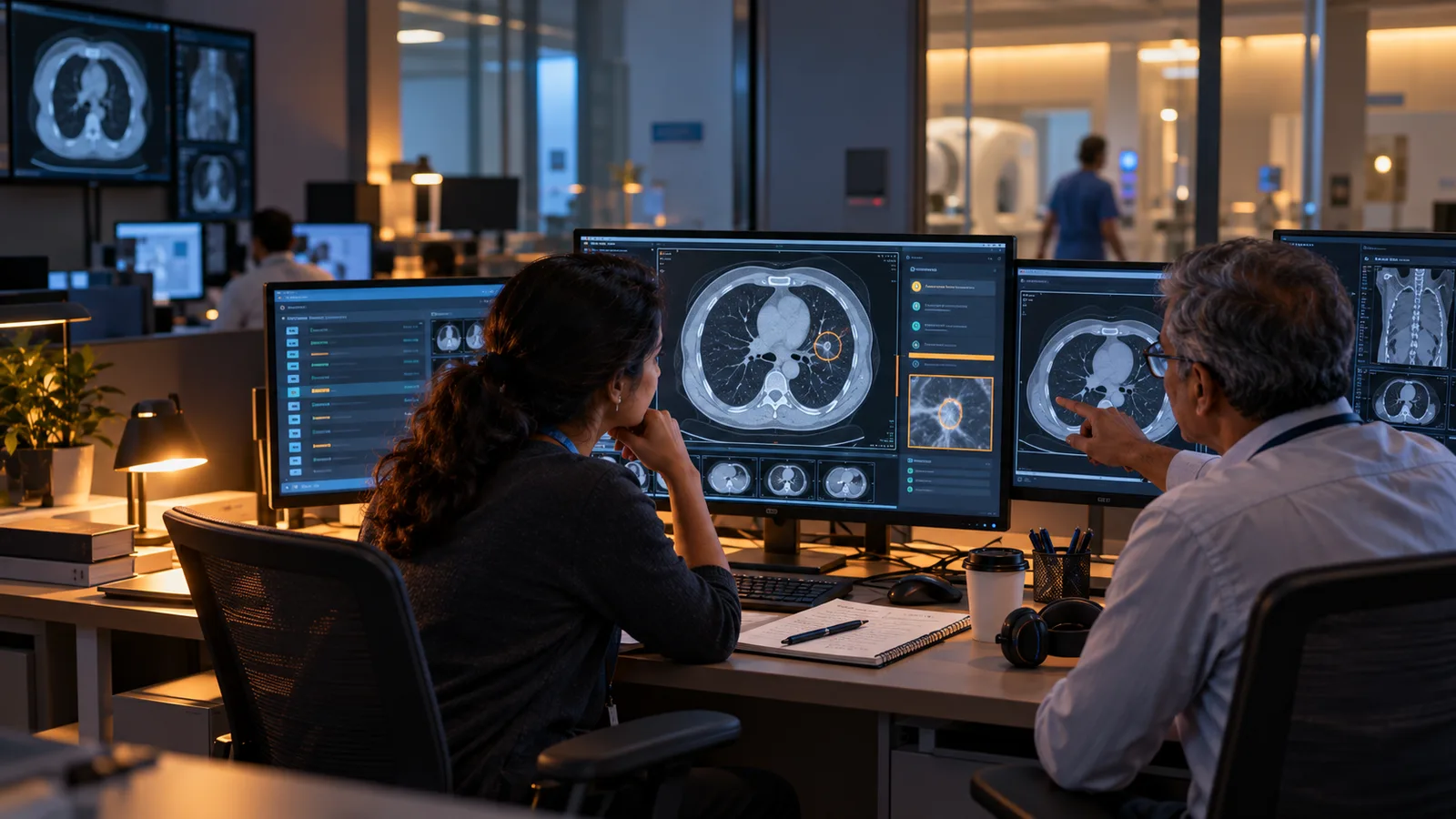
AI medical diagnosis support is one of the highest-stakes uses of generative AI in healthcare. Diagnostic work is demanding. Clinicians review large numbers of images, lab results and signals, often under time pressure. Imaging models can analyse radiology scans, pathology slides and cardiac images. They can flag possible tumours, fractures, lung disease patterns and other abnormalities for review.
In 2026, AI medical diagnosis works mainly as decision support, not as an autonomous engine. Typical patterns include:
- Radiologists using AI to highlight regions of interest in CT and MRI scans.
- Systems suggesting differential diagnoses for the clinician to consider.
- Worklists that prioritise studies where the model detects likely abnormalities.
- Pathologists using AI-assisted analysis of digital slides.
- Cardiologists using AI to review ECG and echo data for possible arrhythmias.
Our data and artificial intelligence practice connects imaging models to PACS and EHR systems. The goal is decision support inside existing workflows, without a separate login. Our AI medical image diagnostic system case study shows one example of this kind of work.
Drug Discovery AI: Speeding Up Research
Drug discovery AI is changing early pharmaceutical research. Traditional development, from compound identification to approval, typically takes many years. Generative models help compress the earliest stages. They can:
- Screen very large numbers of molecular candidates computationally.
- Predict protein structures and molecular interactions.
- Suggest repurposing opportunities among approved drugs.
- Generate new compound ideas for scientists to test in the lab.
Several companies have publicly reported AI-designed compounds entering clinical trials. Insilico Medicine, for example, has reported an AI-generated candidate for idiopathic pulmonary fibrosis progressing into Phase 2 study. These are important milestones, but clinical success still has to be proven through normal trial processes.
Drug discovery AI does not replace laboratory science. It helps researchers decide which experiments to run first. Scientists still own experimental design, interpretation and regulatory work.
Virtual Health Assistants and Patient Engagement
Generative AI in healthcare also powers virtual assistants and patient chatbots. Clinical staff work limited hours. Patient questions, medication needs and appointment changes arise at any time.
Virtual assistants can run triage conversations, ask clarifying questions based on clinical protocols and produce structured pre-visit summaries. They can also handle scheduling, medication reminders and post-treatment check-ins through links to EHR and scheduling systems.
Safety design is critical. Triage assistants must recognise red-flag symptoms, such as chest pain, sudden neurological changes or signs of sepsis. These should trigger immediate escalation, not a routine booking. Multilingual support can help organisations serve diverse populations. Every escalation path should be tested with clinicians before launch.
Synthetic Medical Data and Research Support
Synthetic medical data is a growing use of generative AI in healthcare. It addresses a real tension. Model development needs large, varied datasets. Using real patient records raises privacy, consent and regulatory concerns.
Synthetic data generation produces realistic records, images or scenarios that mirror the statistical properties of a real population. Done well, it does not expose any individual's information. Teams can use synthetic medical data to:
- Train and test models on rare clinical scenarios.
- Build edge cases that are hard to find in real records.
- Share research datasets between institutions with less governance overhead.
Synthetic medical data is not automatically safe. Poorly generated data can leak details from the source records or carry the same biases. Privacy testing and expert review remain essential, and legal requirements such as HIPAA in the USA and GDPR in Europe still apply to the source data.
Medical Education and Simulation
Generative AI in healthcare is also expanding training options. Virtual patient simulations let students and junior clinicians practise diagnostic reasoning and communication without risk to patients. Scenarios can cover rare conditions, complex presentations and emergencies.
AI-generated case studies can be adjusted to each learner's level. They can present progressively harder cases that build judgement across specialties. Simulation complements supervised clinical training. It does not replace it.
Challenges of Generative AI in Healthcare
The potential of generative AI in healthcare is large, but five challenges need attention.
Privacy and security. Health information is among the most sensitive data under any regulation. Organisations need encryption, role-based access and strong data governance that meets HIPAA, GDPR and local rules. Our team treats these as design constraints from the first workshop.
Accuracy and hallucination. A wrong output in healthcare can harm a patient. That might be a missed anomaly, an incorrect medication detail or an invented finding. Human oversight is not optional. Diagnostic suggestions, treatment recommendations and medication information must be reviewed by a clinician before they affect care.
Bias and fairness. Models trained on unrepresentative data may perform worse for some patient groups. Fairness testing across demographics should be routine.
Regulation. Some tools qualify as medical devices. The FDA's guidance on AI-enabled software as a medical device and the EU regulatory framework for AI both shape what is required.
Integration. Legacy EHR systems, PACS infrastructure and clinical tools need careful architecture planning. Our application development and DevOps and cloud engineering teams handle this alongside the data science work.

Best Practices for Generative AI in Healthcare
Organisations that move generative AI in healthcare beyond pilots tend to follow similar practices. Global guidance, such as the WHO guidance on ethics and governance of AI for health and the NIST AI Risk Management Framework, points in the same direction.
Start with lower-risk, high-volume work. Administrative workflows build confidence and infrastructure before clinical decision support. Documentation automation is a common first step.
Build for explainability. Choose or design tools that show the evidence behind each suggestion. Clinicians need to check AI reasoning, not accept an opaque answer. Trust depends on that.
Set governance before deployment. Define data handling, review requirements, incident reporting and accountability. When errors occur, a documented response process should already exist. Our guide to human in the loop AI covers this in detail.
Monitor continuously. Audit accuracy against outcomes, test for bias across groups and review compliance regularly. Models can drift as data changes.
Choose the right adaptation method. Retrieval over approved clinical content often reduces hallucination risk compared with relying on a model's memory. Our article on RAG vs fine-tuning explains the trade-offs.
How to Evaluate Generative AI in Healthcare Solutions
Choosing a tool or partner is a major decision. Our team uses a short set of questions when evaluating generative AI in healthcare solutions for clients:
- What clinical problem does it solve, and how will success be measured?
- Where does patient data go, and who can access it?
- How are outputs reviewed, and by whom?
- Can the system show the sources or evidence behind each answer?
- How is performance monitored after launch, including for bias?
- Which regulations apply, and does the tool qualify as a medical device?
Clear answers to these questions separate mature generative AI in healthcare products from early prototypes. Vague answers on data handling or review are a warning sign.
Running a Safe Pilot
A pilot should be small, time-boxed and measured. Pick one department and one workflow. Agree baseline metrics before starting, such as documentation time or report turnaround. Involve clinicians in design, testing and review from the first week.
Run the pilot long enough to see real patterns, not just early enthusiasm. Collect feedback on accuracy, usability and workload. Review every reported error and near miss. At the end, decide whether to scale, adjust or stop. Stopping is a valid result. A disciplined pilot protects patients and builds the evidence base that generative AI in healthcare programmes need to grow responsibly.
How ICANIO Supports Healthcare AI Programmes
Our team works across the full delivery chain for generative AI in healthcare. That includes data engineering, model integration, secure cloud or on-premises deployment, and EHR integration. We help clients pick a sensible first use case, define success measures and build the governance to scale safely.
Many healthcare clients need sensitive data to stay inside their own environment. In those cases, we design architectures where models run on-premises or inside a private cloud network. Learn more on our healthcare and life sciences solutions page.
The Future of Generative AI in Healthcare
The direction of generative AI in healthcare points towards deeper clinical integration and more personalised care. Preventive care is one promising area. Continuous patient monitoring could feed risk models that alert care teams earlier.
Multimodal systems may combine genomic data, biomarkers, clinical history and lifestyle factors to support personalised treatment. Drug discovery AI will keep feeding candidates into trials, and the results will show where it truly helps. Hospital operations, such as bed allocation and staffing, may also benefit. In every case, clinical validation and human oversight will remain central.
Conclusion
Generative AI in healthcare offers real benefits, from lighter documentation to faster research and better patient engagement. It also carries real risks. The organisations that succeed start with practical, lower-risk use cases. They design for privacy, explainability and oversight from the start.
AI clinical documentation and decision support are good places to begin. Synthetic medical data and drug discovery AI can follow as data foundations mature. If you are planning a healthcare AI initiative, contact ICANIO to discuss a safe and practical first step with our team.
References
- Generative artificial intelligence (Wikipedia)
- HL7 FHIR standard
- Synthetic data (Wikipedia)
- HIPAA (Wikipedia)
- FDA: Artificial Intelligence in Software as a Medical Device
- European Commission: Regulatory framework for AI
- WHO: Ethics and governance of artificial intelligence for health
- WHO: Guidance on large multi-modal models
- NIST AI Risk Management Framework
Frequently asked questions
What is generative AI in healthcare?
Generative AI in healthcare refers to AI systems that create new content from medical data. Examples include clinical notes, diagnostic summaries, compound ideas and patient messages. Unlike traditional AI, which mostly classifies data, it produces new outputs in response to clinician queries and patient data. Clinicians must review those outputs before they affect care.
How is generative AI used in hospitals?
Hospitals use it for AI clinical documentation that turns encounters into structured notes, for diagnostic support in imaging, for triage chatbots and for administrative tasks such as scheduling and discharge summaries. Documentation is usually the first area hospitals adopt, because it is high volume and lower risk than direct clinical decision support.
What are the benefits of generative AI in healthcare?
The main benefits are reduced administrative burden, support for faster diagnostic review, quicker early-stage research through drug discovery AI, better patient engagement through virtual assistants, and richer medical education through simulation. The size of each benefit varies, so organisations should measure results against their own baseline during a pilot.
What are the risks of AI in healthcare?
Key risks include privacy and security failures, inaccurate or hallucinated outputs, bias against under-represented patient groups, unclear accountability and complex regulation. Tools that qualify as medical devices face extra requirements. These risks are manageable with strong governance, human oversight, fairness testing and continuous monitoring after launch.
Can generative AI replace doctors?
No. Generative AI in healthcare is designed to assist professionals, not replace them. Human oversight remains essential for diagnosis, treatment planning and medication decisions. The technology reduces administrative load and surfaces patterns in data, but accountability for patient care stays with qualified clinicians who review and act on its suggestions.
How does drug discovery AI work?
Drug discovery AI uses models trained on chemical and biological data. They screen large numbers of compounds against target proteins, predict interactions, suggest repurposing options and generate new structures that meet set criteria. Scientists then test the most promising candidates in the lab. The approach helps teams focus experimental resources where they are most likely to pay off.
Is healthcare AI secure?
Healthcare AI can be secure when encryption, role-based access, data governance and regulatory controls are built in from the start. HIPAA governs patient data in the USA, while GDPR applies in Europe. For strict data residency needs, models can run on-premises or in a private cloud network, so sensitive records never leave the organisation's control.