
Imaging and Critical Equipment Health
A digital twin in healthcare tracks MRI chillers, CT tubes, sterilisers and ventilator fleets against their expected behaviour. It flags drift before a failure cancels a list.
40% less unplanned downtime
Digital Twin for Healthcare & Life Sciences
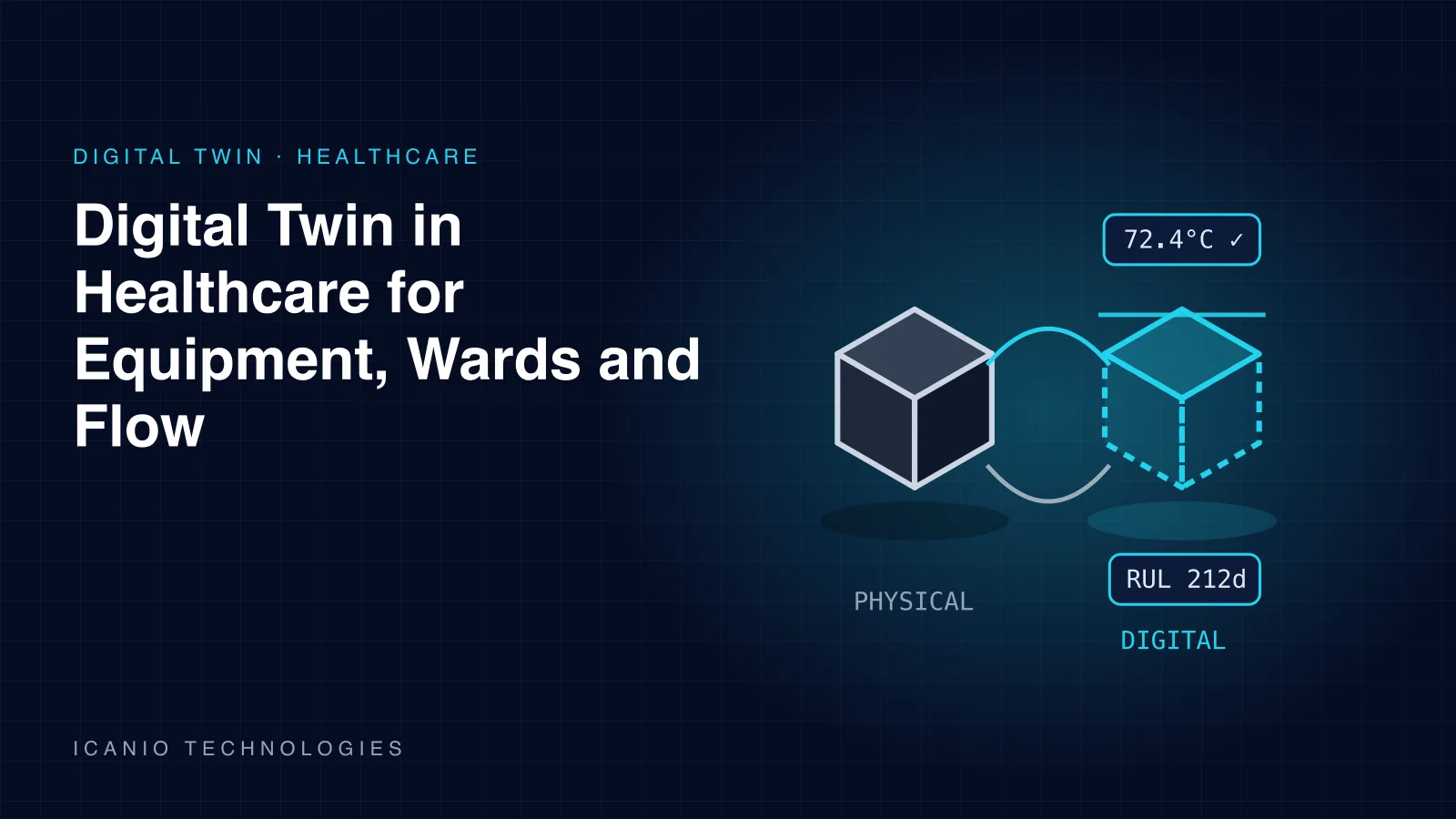
We build a digital twin in healthcare that mirrors imaging equipment, hospital buildings and patient flow in real time. It helps teams prevent downtime, ease bottlenecks and plan capacity without touching care.
MRI Scanner MR-2
Radiology · Level 1
Remaining life
212 days
Helium level
78.1%
Chiller temp
16.4°C
Cold head
4.19K
✓ All signals within physics baseline
A digital twin in healthcare is a live model of the physical side of care: scanners, theatres, cold stores, wards and the flow of patients between them. It updates from equipment, building and admission data as events happen.
Hospitals already generate this data, but it sits in different places. Imaging uptime lives with the vendor, air handling lives with estates and bed status lives in the EHR. When a scanner fails or a ward fills, nobody sees the knock-on effect early enough.
Our team links those sources into one digital twin in healthcare, then adds physics models and predictive AI. The twin warns of equipment faults, shows where patient flow will jam and lets planners test changes before they affect patients.
A digital twin in healthcare is a virtual replica of a medical asset, building or care process that stays synchronised with reality. Sensor data, device logs and admission events stream in. The model reflects the current state of the hospital, not last month's report.
It helps to separate two ideas. Operational twins model equipment, facilities and patient flow. Patient or physiological twins model the human body for diagnosis or treatment planning, and remain largely a research and regulated-device field.
This page is about operational twins, which hospitals can deploy today. They sit beside clinical systems rather than inside care decisions. Where a model would influence a clinical decision, we scope it with your clinical and regulatory teams first. A digital twin in healthcare earns trust by staying honest about that line.
Hospital operations definition
“A healthcare digital twin is a continuously updated virtual model of clinical equipment, facilities or patient pathways. It combines live device, building and EHR event data with simulation and AI to predict problems and support planning.”
Foundations
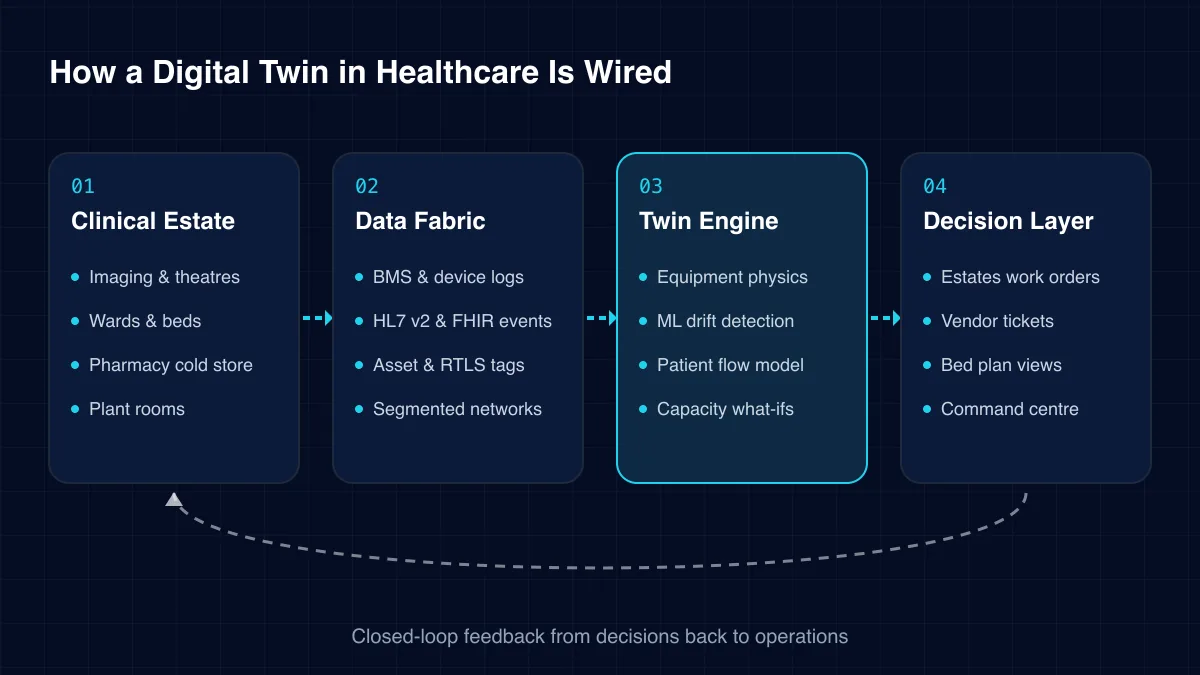
Scanner logs, chiller readings, theatre air pressure and fridge probes form the live feed. We read them from the building management system and device interfaces already installed.
Admission, transfer and discharge events arrive as HL7 v2 messages or FHIR resources. We use them to model flow, with only the minimum patient data required.
Physics models describe healthy equipment and room behaviour. Queueing and discrete-event models describe patient flow. Machine learning spots drift in both.
Alerts become estates work orders, vendor tickets or bed plan suggestions. Clinical and operations staff approve each change, so the twin supports people rather than overriding them.
Core capabilities
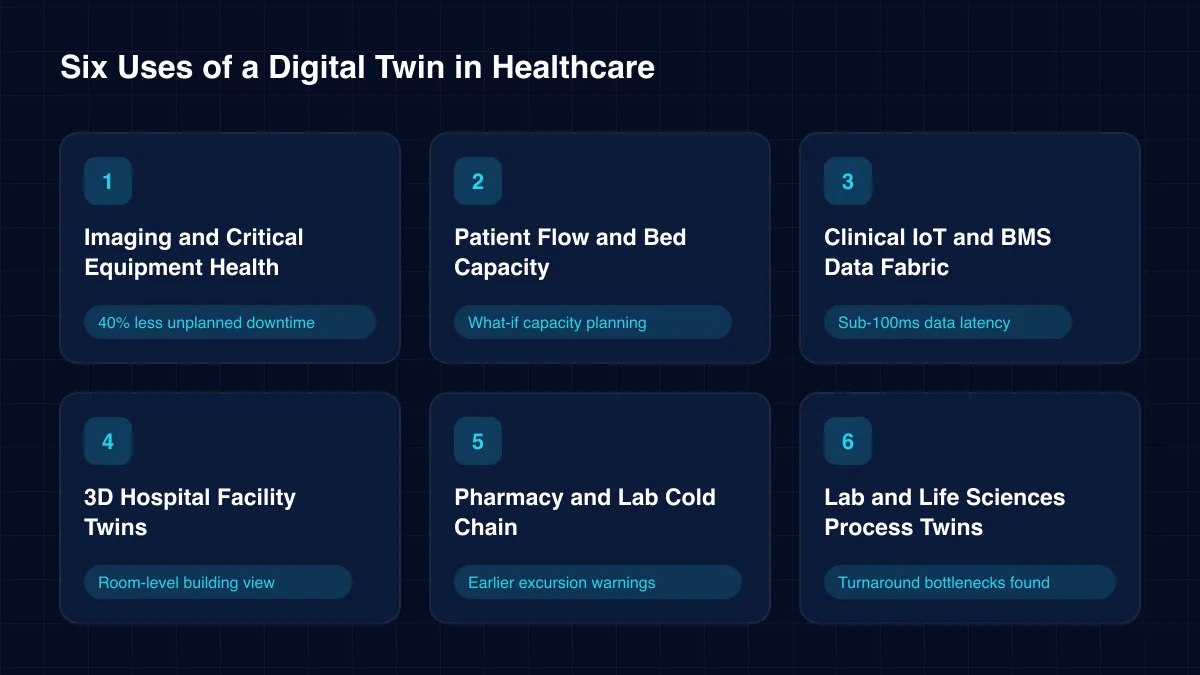
These are the places where a digital twin in healthcare pays back fastest. Most hospitals start with one critical asset class, then widen the model.
A digital twin in healthcare tracks MRI chillers, CT tubes, sterilisers and ventilator fleets against their expected behaviour. It flags drift before a failure cancels a list.
40% less unplanned downtime
Model the emergency department, theatres and wards as one flow. See where delays will build tomorrow and test changes to discharge timing or theatre lists first.
What-if capacity planning
Unify building management points, device logs and asset tags into one real-time layer. Clinical networks stay segmented while the twin reads what it needs.
Sub-100ms data latency
A spatial model of the hospital overlays live status on theatres, plant rooms and wards. Estates teams see air pressure, temperature and alarms room by room.
Room-level building view
Track fridges, freezers and blood bank storage continuously. The twin spots a failing unit from rising compressor effort before temperature goes out of range.
Earlier excursion warnings
Model analyser capacity, sample routes and turnaround time in clinical and research labs. Find the bottleneck before adding another instrument.
Turnaround bottlenecks found →Architecture
Every digital twin in healthcare we deliver follows four layers. Signals rise from equipment and pathways into the model, and staff-approved actions flow back.
01
02
03
04
Challenges we solve
These are the issues we hear most from hospital operations and estates leaders. Each one comes from data that exists but is never viewed together.
When a scanner or steriliser fails, patients are rebooked and waiting lists grow. Planned servicing misses faults that build between visits.
Theatre ventilation and pressure must stay within specification. A slowly clogging filter can close a theatre with little warning.
Crowding often starts upstream, with late discharges and blocked beds. Teams see the queue only once it has formed.
Device data, building data and patient flow data sit with different teams. Nobody sees how one failure affects the others.
A failing vaccine or blood fridge can hold temperature until a busy day. Then stock is lost and clinics are disrupted.
New theatre schedules or ward layouts are usually trialled live. Mistakes show up as longer waits for real people.
Operational scope grows in stages. We usually start with equipment and widen once the first model earns trust.
Hospitals often ask why they need a digital twin in healthcare when they already have a building management system and bed reports. The table shows the difference.
| Capability | BMS screens | Capacity reports | Hospital digital twin |
|---|---|---|---|
| Live equipment and room data | ✓ Yes | No | ✓ Yes |
| Predicts equipment failure | No | No | ✓ Yes |
| Forecasts patient flow | No | Partial | ✓ Yes |
| Joins estates, devices and EHR events | No | No | ✓ Yes |
| Tests changes before go-live | No | No | ✓ Yes |
The value of a digital twin in healthcare grows as more equipment, rooms and pathways join the model.
Delivery
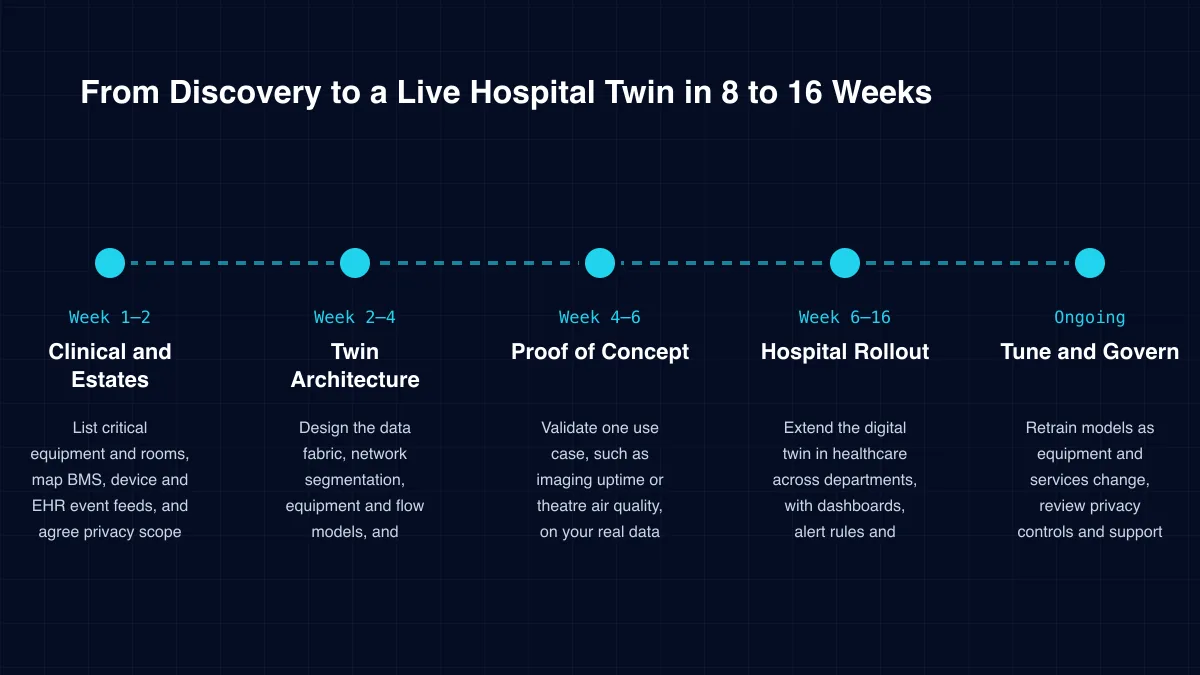
Week 1–2
List critical equipment and rooms, map BMS, device and EHR event feeds, and agree privacy scope with your governance team.
Week 2–4
Design the data fabric, network segmentation, equipment and flow models, and integration with estates and EHR systems.
Week 4–6
Validate one use case, such as imaging uptime or theatre air quality, on your real data before a full build.
Week 6–16
Extend the digital twin in healthcare across departments, with dashboards, alert rules and staff approval workflows.
Ongoing
Retrain models as equipment and services change, review privacy controls and support teams under an SLA.
Many vendors can render a 3D hospital. Far fewer can keep a digital twin in healthcare accurate, private and trusted by clinicians. We recommend checking five things.
In our experience, clinician and estates trust decides adoption. That is why every alert we design shows its evidence and needs human approval.
A digital twin in healthcare can touch protected health information through admission and transfer events. We design for HIPAA safeguards where US data is involved and follow ISO 9001 and ISO 27001 certified processes.
Flow models use pseudonymised events wherever possible. Clinical networks stay segmented, access is role-based and every model decision is logged. Data stays in your cloud tenancy or on premises.
Start with the cost of one cancelled imaging list or closed theatre session. Multiply it by last year's equipment and building-related cancellations. That is the ceiling your digital twin in healthcare works against.
Then add avoided stock losses, fewer emergency call-outs and better use of existing beds before new capacity is bought. Vendor service contracts can also be renegotiated once equipment health is measured, not assumed. We agree these baselines in discovery, so results are measured against your own figures.
Technology stack
We choose tools per hospital. These are the layers we most often assemble for an operational healthcare twin.
Estate & Device Data
Building management systemsBACnetDevice logsRTLS tags
Clinical Events
HL7 v2 ADTHL7 FHIREHR integration engines
Data Fabric
Real-time streamingTime-series storage
Simulation & AI
Discrete-event flow modelsXGBoostAnomaly detectionMLOps retraining
3D & Visualisation
Command centre dashboardsEstates views
Operations Integration
CMMSVendor service portalsBed management systems
 Free white paper · Digital TwinThe Industrial Digital Twin PlaybookA practical, vendor-neutral guide to taking an industrial digital twin from first idea to a production system your operators trust.Get the white paper →
 Free white paper · HealthcareHealthcare Technology SolutionsDigital Transformation, Clinical Excellence, and Patient-Centric InnovationGet the white paper →
Our work focuses on operations: medical equipment, hospital rooms and plant, cold storage and patient flow. A digital twin in healthcare of this kind supports estates, operations and capacity teams.
An operational twin that predicts equipment faults or bed demand is usually not. Software that informs diagnosis or treatment may be regulated. We scope any clinical use with your regulatory team before building it.
Flow models need events, not full records. We use pseudonymised admission, transfer and discharge events wherever possible, and keep all data in your environment.
Yes. It reads admission and transfer events through HL7 v2 feeds or FHIR APIs, usually via your existing integration engine. It does not write clinical data back to the EHR.
Often not. Building management systems and modern equipment already log useful signals. Discovery shows where extra probes, such as on fridges, would sharpen predictions.
Most projects reach production in eight to sixteen weeks. A proof of concept on one use case runs in weeks four to six, using your real data.
A digital twin in healthcare turns scattered equipment, building and flow data into foresight. It shows which scanner is drifting, which theatre is at risk and where tomorrow's queue will form.
ICANIO combines healthcare integration, simulation and predictive AI in one delivery team. We take a digital twin in healthcare from discovery to production in eight to sixteen weeks, then keep it accurate and governed as your hospital changes.
By ICANIO Digital Twin Engineering Team · Published · Updated
Book a free 30-minute discovery call with our digital twin engineers. We will map your equipment, buildings and flow data to a scoped twin with clear milestones. Contact us to get started.
Contact Our Digital Twin Team