LIMS · LAB AUTOMATION · DIGITAL TRANSFORMATION
A full-stack digital platform for automated sample tracking, report generation, QR verification, and scalable infrastructure. It is purpose-built for NABL-accredited testing laboratories.
Quick Answer
What is a LIMS and How does LIMS work?
A laboratory information management system is a digital platform that automates sample tracking, data collection, analysis, and report generation for NABL-accredited testing laboratories. It eliminates paper-based workflows entirely. ICANIO’s LIMS software delivered a 70% reduction in manual operational effort, 3x faster report turnaround cycles, and QR-verified report authenticity for a NABL lab software client operating across environmental, food, and quality assurance testing disciplines. ICANIO Technologies delivered this engagement as a full-stack custom software engineering project. It replaced every manual touchpoint in the laboratory with an automated, auditable, and scalable lab management software system.
Executive Summary
Transforming a NABL-Accredited Lab into Digital-First Testing
NABL-accredited testing laboratories carry institutional trust in India’s quality assurance ecosystem. Yet the internal workflows that sustain that accreditation are often still paper-driven and manually intensive. The gap between the compliance standard a lab must meet and the operational tools available to meet it consistently is where laboratories lose time, accuracy, and client confidence. Laboratory managers know this from experience. Every delayed report, every sample misrouted through a manual log, and every audit that requires reconstructing a paper trail from handwritten records reflects one structural absence: a digital platform built specifically for their environment.
ICANIO approached this as a full-stack engineering challenge, not a software configuration exercise. The objective was to build a lab management software system that could absorb the full operational complexity of a multi-discipline NABL-accredited laboratory. It also had to replace every manual touchpoint with an automated and auditable workflow and deliver a cloud LIMS software infrastructure capable of scaling with growing sample volumes without proportional growth in staffing overhead. The result was a laboratory information management system that converted a compliance-heavy, manual operation into a digital-first facility generating QR-verified reports at three times its previous speed.
“Manual lab workflows were treated as an unavoidable cost of running a NABL-accredited facility not as a systems engineering problem that could be solved. That assumption had to change before any real progress was possible.”
The Challenge
The Compliance and Efficiency Gap in NABL Testing Laboratories
Without LIMS software, every operational gap in the laboratory compounds every other. Manual laboratory sample tracking software processes produce traceability errors that undermine report accuracy. Report inaccuracies create compliance risk in a NABL lab software environment that demands full auditability at every stage. Compliance risk increases audit preparation time, reducing the capacity available for testing. Six distinct failure modes defined the pre-deployment state for this engagement, each reinforcing the others.
Manual Data Collection
Manual data entry in LIMS software was absent, causing inconsistent records, slower workflows, and increased human errors.
Sample Tracking Errors
Without laboratory sample tracking software, samples were managed manually, leading to misrouting, delays, and poor traceability.
Report Accuracy Failures
Manual reporting without lab management software resulted in calculation errors, inconsistent reports, and reduced data reliability.
Turnaround Time Delays
The lack of cloud LIMS software slowed sample processing, report generation, and overall laboratory turnaround times.
Scalability Ceiling
Without cloud LIMS software, growing sample volumes required more staff, limiting operational scalability and efficiency.
Each of these failure modes reinforced the others. Manual data collection produced inconsistent records. Paper-based sample tracking added misrouting and weak traceability on top. Manual calculations then carried those errors into reports, which raised compliance risk in a lab that must stay audit-ready for NABL. Every extra check slowed turnaround, and growing sample volumes could only be met by adding staff. The lab was built around human effort rather than LIMS software, and the cost showed up in analyst hours, report delays and audit preparation time.
LIMS Software Solutions Provided
A Six-Component LIMS Software Platform for Lab Digitization
ICANIO designed and delivered LIMS software that replaces every manual workflow in the laboratory with an automated, auditable, and scalable digital process. Rather than addressing individual pain points in isolation, ICANIO engineered a six-component lab management software architecture in which each module feeds directly into the next ensuring that laboratory sample tracking software, data collection, reporting, and compliance functions operate as a single connected system. The platform was built from day one on a cloud LIMS software foundation, giving the laboratory the infrastructure flexibility to scale without rebuilding core workflows.
Integrated LIMS Platform
Unified LIMS software for multiple testing disciplines with a single, centralized data source.
Automated Sample Tracking
Implemented laboratory sample tracking software to automate sample movement, status updates, and traceability.
Automated Report Validation
Enabled NABL lab software workflows with automated calculations, validation, and error-free report generation.
QR-Based Report Verification
Added secure QR-enabled report authentication for instant online verification and complete audit traceability.
Real-Time Analytics Dashboard
Deployed cloud LIMS software dashboards for live monitoring of samples, reports, turnaround time, and laboratory performance.
Scalable Cloud Infrastructure
Built lab management software on a scalable cloud platform to support higher sample volumes with improved operational efficiency.
Business Outcomes
Results Across Operational Efficiency, Accuracy and Compliance
The cloud LIMS software platform fundamentally changed how the laboratory runs its daily operations. It converted a manually intensive, paper-driven testing process into a fully automated, auditable, and scalable workflow that consistently meets NABL lab software compliance requirements at any sample volume.
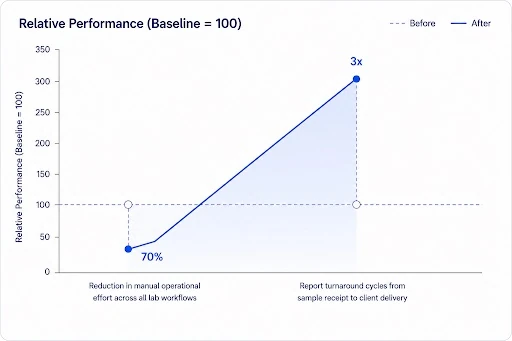
LIMS software outcomes: 70% less manual lab effort and report cycles three times faster, with QR verification on every issued report.
70%
Reduction in manual operational effort across all lab workflows
3x
Report turnaround cycles from sample receipt to client delivery
Improved Accuracy
Laboratory result integrity through automated validation and rounding
Enhanced Trust
Secure QR verification on every issued lab report
Scalable Platform
Cloud infrastructure for high-volume processing capability
Better Decisions
Centralized data visibility through real-time operational dashboards
Key learnings
What This Engagement Proves for Laboratory Technology Leaders
Compliance Is a Systems Engineering Problem, Not an Audit Checkbox
NABL accreditation defines what a laboratory must produce, but it does not define how the internal systems that produce it should work. Most NABL lab software compliance failures in manual environments are not caused by a lack of intent. They are caused by the absence of automated enforcement mechanisms that make the correct process the only available process. Building compliance logic directly into the LIMS software, rather than relying on staff discipline to execute manual procedures correctly, is what converts a compliance obligation into a sustained operational standard. Laboratory technology leaders commissioning lab management software should treat automated compliance enforcement as a primary architecture requirement from the outset, not as an optional enhancement added after deployment.
Laboratory Sample Tracking Software is Backbone of Report Integrity
No report can be trusted if the sample it documents cannot be traced end-to-end without ambiguity. The laboratory sample tracking software layer in ICANIO’s LIMS software is not a convenience feature. It is the structural foundation on which report accuracy, auditability, and client trust are built. Every automated validation in the report generation workflow and every QR verification code issued to a client depends on the integrity of the sample tracking record that precedes it. Leaders evaluating platforms should treat laboratory sample tracking software capability as a primary quality gate. A system that generates accurate reports from inaccurate sample records is not a compliant system. It is an operational liability.
Cloud LIMS Software Breaks the Manual Scalability Ceiling
The most significant constraint in a manual laboratory is not accuracy. It is scalability. Every increase in sample volume in a manual system requires a proportional increase in staff time. This creates a cost curve that eventually makes growth economically unsustainable. Cloud LIMS software breaks that curve by absorbing volume growth within existing infrastructure, giving laboratory managers the ability to expand their client base without rebuilding their operational model. For NABL-accredited laboratories operating in high-growth testing segments, the difference between a cloud-based infrastructure and an on-premise or manual system is the difference between scalable growth and operational gridlock.
Conclusion
From Manual Compliance Risk to Digital-First Laboratory Excellence
Laboratory information management is not an administrative function. It is the operational foundation on which every result, every report, and every client relationship a NABL-accredited laboratory holds is built. This engagement demonstrates that with the right LIMS software, laboratories can eliminate manual compliance risk entirely, achieve verifiable report accuracy at any sample volume, and fundamentally shift operations from reactive paper-based administration to proactive, data-driven lab management.
By treating the laboratory information management system as a full-stack engineering challenge rather than a software procurement decision, ICANIO helped this NABL lab software client build a robust NABL lab software platform that will continue to deliver compounding operational advantage as testing volumes and compliance obligations grow. The 70% reduction in manual effort, the 3x report turnaround acceleration, and the QR-verified report authenticity layer are not one-time outcomes. They are the baseline from which every future improvement in this laboratory operation will be measured.
Related Resources
This lab platform sits within ICANIO's software development practice, built on cloud infrastructure and workflow automation. Our team delivers systems like this through application development services and data and artificial intelligence services, including data engineering for dashboards. Related digitization work includes healthcare record digitization and sanitation data management. To plan a similar platform, contact ICANIO.
- Application Development Services
- Industries We Serve
- Healthcare Record Digitization: 4x Faster
- Sanitation Data Management Cuts Processing 40%
- Document Approval System: Enterprise Workflow
References
- Laboratory information management system: overview of LIMS functions such as sample tracking and reporting.
- NABL: official site of India's National Accreditation Board for Testing and Calibration Laboratories.
- National Accreditation Board for Testing and Calibration Laboratories: background on NABL accreditation in India.
- QR code: overview of the QR code format used for report verification.
Frequently asked questions
Questions About the LIMS Platform for NABL-Accredited Laboratories
What is LIMS software and how does it work for NABL labs?
LIMS software is a laboratory information management system that automates sample tracking, data collection, analysis, report generation, and compliance documentation for accredited testing laboratories. ICANIO's LIMS software automates the full sample lifecycle from receipt through testing to verified report dispatch. It replaces manual data entry and paper-based processes with an integrated digital system that enforces NABL lab software compliance requirements at every workflow stage and produces QR-verified reports that clients and auditors can authenticate instantly.
How does laboratory sample tracking software reduce errors?
Laboratory sample tracking software reduces errors by assigning a unique digital identity to every sample at the point of receipt and maintaining a fully automated status trail through every stage of the testing workflow. ICANIO's laboratory sample tracking software engine uses automated exception alerts to flag misrouting, delays, or missing data before they propagate into report errors. This eliminates the manual reconciliation cycles that create traceability gaps in paper-based lab management software environments.
Why is cloud LIMS software better than on-premise for growing labs?
Cloud LIMS software provides scalable infrastructure that absorbs sample volume growth without requiring proportional investment in servers or hardware, allowing laboratory managers to scale their testing operations within existing infrastructure budgets. ICANIO's cloud architecture was built to handle high-volume processing periods without performance degradation making it the right foundation for NABL-accredited laboratories in fast-growing environmental, food, and quality assurance testing markets.
How does QR verification work in the laboratory platform?
QR verification works by embedding a unique tamper-evident code in every issued report that links to a secure verification record held within the cloud infrastructure. When a client, auditor, or regulator scans the code, they reach a verified digital record confirming the report content matches the original laboratory data and has not been altered. This meets the NABL lab software auditability requirements for all issued testing reports.
What types of laboratories can use ICANIO's lab management software?
ICANIO's lab management software platform was designed for multi-discipline NABL-accredited testing laboratories operating across environmental, food, quality assurance, and calibration testing verticals. The unified platform architecture handles multiple testing types within a shared data environment, eliminating inter-system errors that occur when separate applications are used for different disciplines. The cloud infrastructure scales with any laboratory size, making it suitable for both single-site NABL labs and multi-location testing networks.
How long does a laboratory management platform take to implement?
Implementation timelines depend on the number of testing disciplines, sample volumes, existing digital infrastructure, and the degree of custom workflow configuration required. ICANIO's lab management software delivery follows a phased model that prioritises core laboratory sample tracking software and report generation workflows first. This enables measurable efficiency gains from early deployment, while advanced modules including the analytics dashboard and cloud LIMS software infrastructure are brought online progressively.