
Prior Authorization Packets
Agents check whether a service needs authorization, pull the relevant notes and map them to payer criteria. The ordering clinician reviews and signs the request.
FHIR + payer rules
AgenticOps · Healthcare & Life Sciences
We design and operate multi-agent systems for the administrative load around care: prior authorizations, documentation, referrals and denials. Agents gather and draft from EHR, FHIR and payer data. Licensed clinicians and revenue cycle staff approve every consequential step.
⟳ Orchestrating agents…
every step traced · guardrails on · reversible
AI agents in healthcare are software workers that gather records, check policies and draft paperwork around patient care. They read the EHR, payer rules and FHIR resources that staff now search by hand. Then a clinician or coder reviews a finished draft instead of starting from a blank screen.
Clinicians spend a large share of their day on documentation and administrative tasks. Prior authorizations, discharge paperwork and denial appeals all repeat the same pattern. Someone finds the right notes, matches them to a rule and writes it up.
Our team builds AI agents in healthcare that take on that pattern, never the clinical judgement. Agents collect, cross-check and draft. Licensed people decide and sign. This page covers how we design these systems, how we keep them safe and how to begin.
An AI agent is a program that pursues a goal by planning steps, using tools and checking its own work. In a hospital or clinic, those tools are the EHR, HL7 and FHIR interfaces, payer portals, scheduling systems and document stores.
AI agents in healthcare are different from a chatbot. A chatbot answers a question. An agent completes a task, such as building a prior authorization packet from several sources. It then stops at the point where a clinician must decide.
Most useful systems combine several narrow agents. One reads the chart, one knows payer rules and one drafts letters. AgenticOps keeps that team traced, bounded and auditable, which is exactly what a compliance officer will ask to see.
Care-setting definition
“AI agents in healthcare are governed software agents that gather clinical and administrative data, reason across EHR, FHIR and payer sources, and prepare work that a licensed clinician or authorised staff member reviews and signs.”
Foundations
AI agents in healthcare never diagnose, order or change treatment. They prepare material for clinicians who hold that authority.
Each agent sees only the PHI its task needs. Scopes follow the HIPAA minimum necessary standard, and every access is logged.
The approver matches the task: the ordering clinician for prior auths, the attending for summaries and a coder for appeals.
Every sentence in a draft links to the note, result or policy it came from, so reviewers can verify it in seconds.
Core capabilities
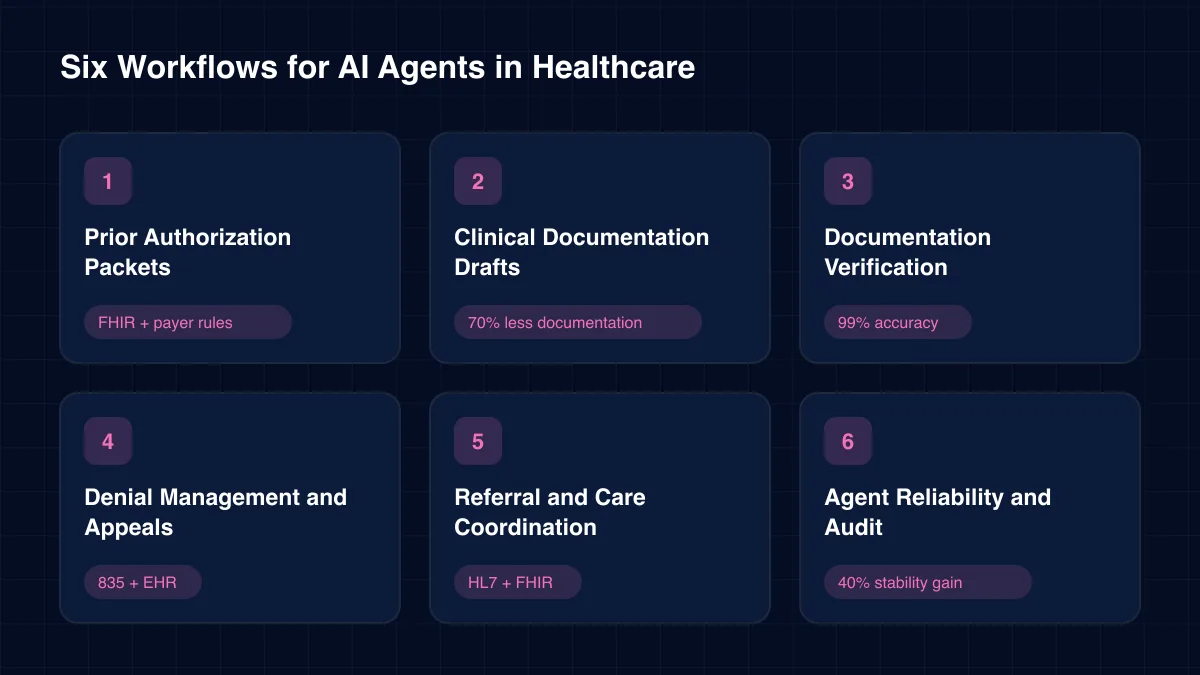
These are the administrative workflows where AI agents in healthcare usually help first. Every one ends with a human signature.
Agents check whether a service needs authorization, pull the relevant notes and map them to payer criteria. The ordering clinician reviews and signs the request.
FHIR + payer rules
AI agents in healthcare draft visit notes and discharge summaries from the encounter record. Our healthcare AI assistant build cut documentation effort by 70%.
70% less documentation →A checking agent compares drafts with source records and flags gaps before sign-off. Our medical text verification tool reached 99% accuracy.
99% accuracy →Agents read remittance codes, find supporting documentation and draft appeals. Coding and clinical staff approve each appeal before it is filed.
835 + EHR
Agents prepare referral packets, check that required results are attached and track responses. Care coordinators approve and follow up.
HL7 + FHIR
We trace every tool call and PHI access, evaluate drafts against signed outcomes and recover from failed steps, building on our agentic AI framework work.
40% stability gain →Architecture
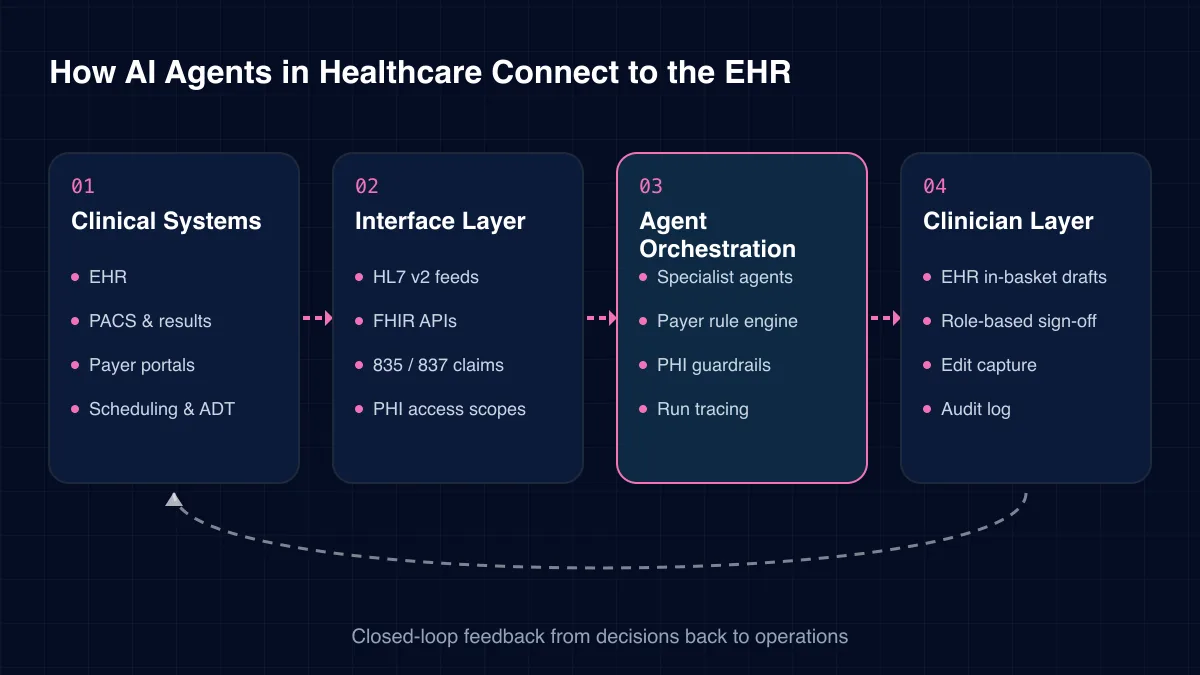
Agents work beside the EHR, not inside the clinical decision path. Data comes in through standard interfaces, and drafts return to the clinician's queue.
01
02
03
04
Challenges we solve
Healthcare has automated billing rules for years. The judgement-heavy admin around them is still manual, and that is where AI agents in healthcare fit.
Requests bounce back for missing notes or wrong criteria. Agents check payer policy up front and assemble complete packets the first time.
Clinicians finish notes after hours. Draft summaries built from the encounter record give them something to edit rather than write.
Appeals have deadlines, and many are never filed. Agents triage denials by value and deadline and draft the appeal with evidence.
Results, notes and images live in different places. Agents use HL7 and FHIR interfaces to gather them into one view for the task.
Referrals stall when a result is missing or no one follows up. Agents check completeness and chase responses on schedule.
Leaders rightly fear software acting on patient care. We keep agents out of clinical decisions and require a named signer on every output.
AI agents in healthcare typically grow through four levels of responsibility.
Health systems often run RPA bots and pilot chatbots already. Here is where agents differ.
| Capability | RPA bots | Chatbots | AI agents |
|---|---|---|---|
| Reads unstructured clinical notes | No | Partial | ✓ Yes |
| Completes a multi-step task | Partial | No | ✓ Yes |
| Works across EHR and payer systems | Partial | No | ✓ Yes |
| Cites sources for each claim | No | Partial | ✓ Yes |
| Requires clinician sign-off | Rarely | Rarely | Always |
Returns grow as more admin workflows share one governed agent platform.
Delivery
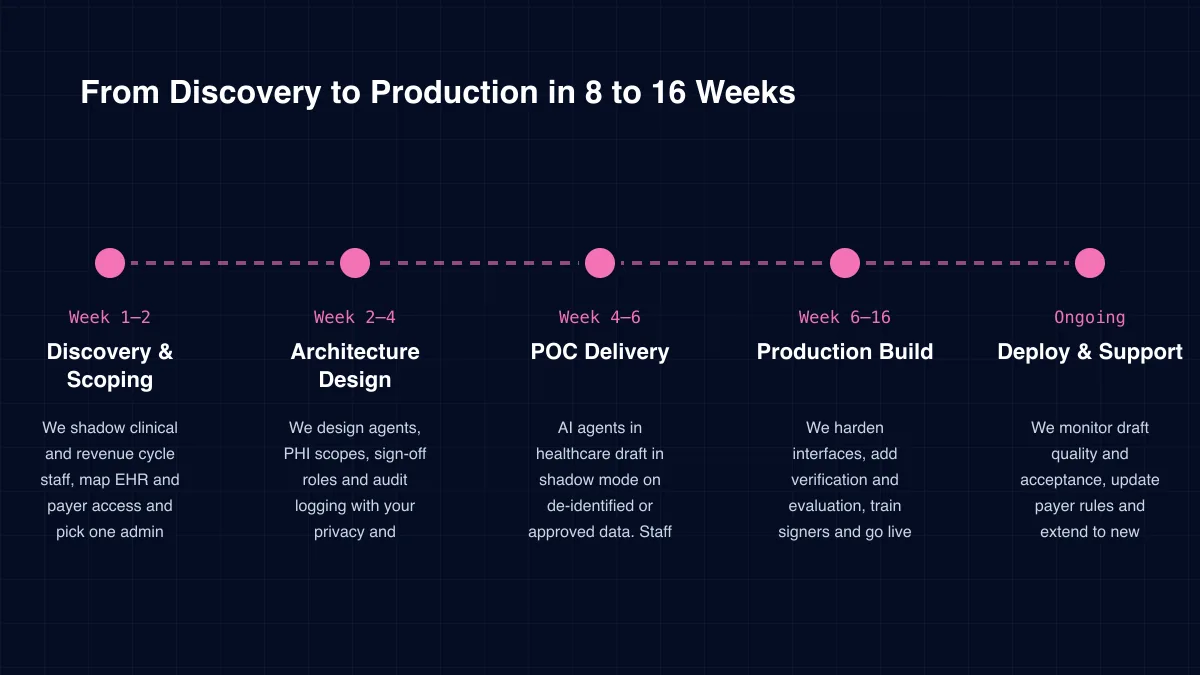
Week 1–2
We shadow clinical and revenue cycle staff, map EHR and payer access and pick one admin workflow.
Week 2–4
We design agents, PHI scopes, sign-off roles and audit logging with your privacy and compliance teams.
Week 4–6
AI agents in healthcare draft in shadow mode on de-identified or approved data. Staff compare drafts with their own work.
Week 6–16
We harden interfaces, add verification and evaluation, train signers and go live department by department.
Ongoing
We monitor draft quality and acceptance, update payer rules and extend to new workflows.
Case study
An enterprise AI platform needed its agents to behave the same way every time. We audited and debugged existing workflows first, then redesigned reasoning and tool use and added reflective agents. Stability improved 40%, reasoning capability improved 3x and agents ran on local or cloud LLMs. Predictable behaviour is non-negotiable for AI agents in healthcare.
“Audit and debugging are a prerequisite, not a parallel activity.”Read the full case study →
Stability debugging
Unstable components were found and fixed before new features were built.
Self-correcting reasoning
Agents check and correct their own outputs, which suits draft verification.
Multi-LLM support
Models can run in your own environment when PHI must stay inside it.
Clinical data raises the bar for any agent vendor. We recommend asking about these five areas.
In our experience, clinicians adopt agents that save them edits. Measure edit distance from day one.
ICANIO operates under ISO 9001 and ISO 27001 certified processes. We design for HIPAA from the start: encryption in transit and at rest, role-based access, PHI audit logs and a business associate agreement where required.
AI agents in healthcare only reach PHI through scoped tools. Models can run inside your cloud tenancy or on premises. No PHI goes to a model provider without an agreement that covers it.
Agents stay on the administrative side. They do not diagnose, triage or recommend treatment. We map risks against the NIST AI Risk Management Framework, and each workflow has an owner and an off switch.
Start with one workflow. Count staff minutes per prior authorization, returned requests and days to decision. For denials, measure the value of claims that were never appealed. For documentation, track after-hours charting time.
We agree those baselines with your team during discovery. Shadow mode then shows how many drafts staff accept with light edits. The return on AI agents in healthcare is measured against your own records.
Technology stack
We choose tools for AI agents in healthcare per organisation and workflow. These are typical choices.
Clinical Systems
EHR platformsPACSPractice managementPayer portals
Interoperability
HL7 v2HL7 FHIR R4X12 835 / 837SMART on FHIR
Agent Frameworks
Custom orchestrators
Models
Private cloud LLMsOn-premise LLMsClinical NLP models
Retrieval
Payer policy indexChart retrievalVector databases
Observability
Draft evaluationPHI access log
 Free white paper · AgenticOpsThe AgenticOps PlaybookA practical, framework-neutral guide to engineering, governing and running AI agents in production, from the first workflow to a trusted agent estate.Get the white paper →
 Free white paper · HealthcareHealthcare Technology SolutionsDigital Transformation, Clinical Excellence, and Patient-Centric InnovationGet the white paper →
No. In our designs, AI agents in healthcare handle administrative and documentation work only. They draft, retrieve and check. Diagnosis, orders and treatment stay with licensed clinicians, who review and sign every clinical output.
Through the interfaces your EHR already supports, usually HL7 v2 feeds and FHIR APIs, plus X12 for claims. Where an API is missing, we agree a safe integration path with your IT team. Each connection has its own scoped credentials.
The person who owns that task today. Ordering clinicians sign prior authorization requests, attending physicians sign summaries and coding specialists approve appeals. The sign-off happens in the tools staff already use.
Compliance depends on the whole system, not the model alone. We build HIPAA safeguards into the architecture: minimum necessary access, encryption, audit logs and BAAs with any vendor that touches PHI. Your compliance team reviews the design before go-live.
Yes. Our agentic framework work supports local and cloud LLMs. Many health systems keep models in their own cloud tenancy or data centre so PHI never leaves it.
Most engagements reach production in eight to sixteen weeks. About six weeks cover discovery, design and a shadow-mode proof of concept. The production build adds verification, monitoring and signer training.
AI agents in healthcare can return time to clinicians by carrying the paperwork that surrounds care. They find the records, check the rules and write the first draft, then wait for a signature.
ICANIO brings AgenticOps discipline to that work: scoped PHI access, verification agents, role-based sign-off and full tracing. We take care teams from one workflow in shadow mode to production in eight to sixteen weeks, then keep agents safe as rules and systems change.
By ICANIO AgenticOps Engineering Team · Published · Updated
Book a free 30-minute discovery call. We will map one admin workflow, its systems and its signers to a safe agent design. You will leave with a clear scope and a shadow-mode plan.
Contact Our AgenticOps Team

