
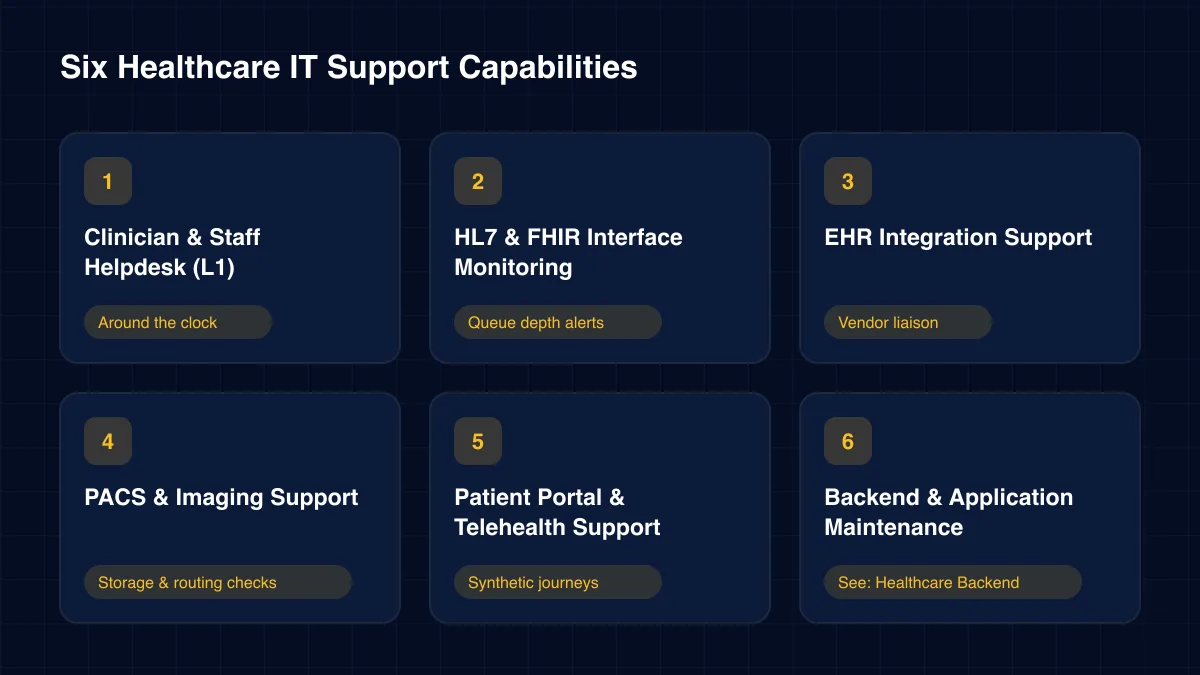
Clinician & Staff Helpdesk (L1)
Our L1 desk handles single sign-on problems, workstation faults, printer issues and telehealth device setup. This is where healthcare IT support meets clinicians, so answers are short and quick.
Around the clock
Support Engineering · Healthcare
24/7 engineers for the systems clinicians and patients rely on: EHR integrations, HL7 and FHIR interfaces, imaging archives, patient portals and telehealth platforms.
128
Resolved today
100%
Within SLA
24/7
On shift
When a lab results feed stalls, a clinician waits for data they need to treat a patient. Healthcare IT support is the team that notices first and gets that feed moving before it becomes a clinical risk.
Our team runs healthcare IT support as a 24/7, tiered service for providers, digital health companies and health tech vendors. L1 engineers handle clinician access and devices. L2 engineers own EHR integrations, HL7 and FHIR interfaces and patient-facing apps. L3 engineers work on databases, cloud platforms and imaging systems.
This page covers what that service includes, the failures it prevents, how we protect patient data, and how to pick a partner you can trust with clinical systems.
Healthcare IT support is the ongoing operation of the systems that clinical and administrative work depends on. At the centre is the electronic health record. Around it sit interface engines, lab and imaging systems, patient portals, telehealth tools and billing platforms.
Much of the risk lives in the connections. HL7 v2 messages carry admissions, orders and results between systems. HL7 FHIR APIs expose data to apps and partners. DICOM moves images into the archive. When any of these slow down, the problem is felt at the bedside.
The sector also carries strict duties. In the United States, the HIPAA Security Rule sets safeguards for electronic protected health information. Healthcare IT support has to follow them in every ticket, not only in the policy binder.
Working definition
“Healthcare IT support is a tiered, always-on service that monitors, maintains and restores clinical, patient-facing and integration systems, with response targets set by patient-care impact and access controls built for protected health information.”
Foundations
A stalled results interface outranks a slow billing report. Priority follows what a delay means for care.
Engineers see only the data a ticket requires. Access is time-bound, logged and reviewed.
Message queues and API error rates are watched as closely as servers, because that is where outages start.
Clinical teams need to know what happens when a system is down. We help keep those procedures current.
Core capabilities
Each capability focuses on a point where a system failure can delay care or expose patient data.
Our L1 desk handles single sign-on problems, workstation faults, printer issues and telehealth device setup. This is where healthcare IT support meets clinicians, so answers are short and quick.
Around the clock
L2 engineers watch interface engine queues, message errors and FHIR API health. Failed ADT, order and result messages are fixed and replayed in the right sequence.
Queue depth alerts
We support the custom integrations, extensions and data flows around your EHR. When the EHR vendor must act, we open the case with evidence and track it to closure.
Vendor liaison
We monitor imaging archives, storage growth and study retrieval times. L3 engineers resolve DICOM routing problems and storage issues before radiology notices.
Storage & routing checks
Healthcare IT support for patient-facing apps covers logins, appointment flows, video sessions and API performance. Synthetic checks test the journey the way a patient would.
Synthetic journeys
Continuous performance tuning and fixes for clinical backends and APIs. Our healthcare backend engagement paired a dedicated team with ongoing support to double delivery speed.
See: Healthcare Backend →Architecture
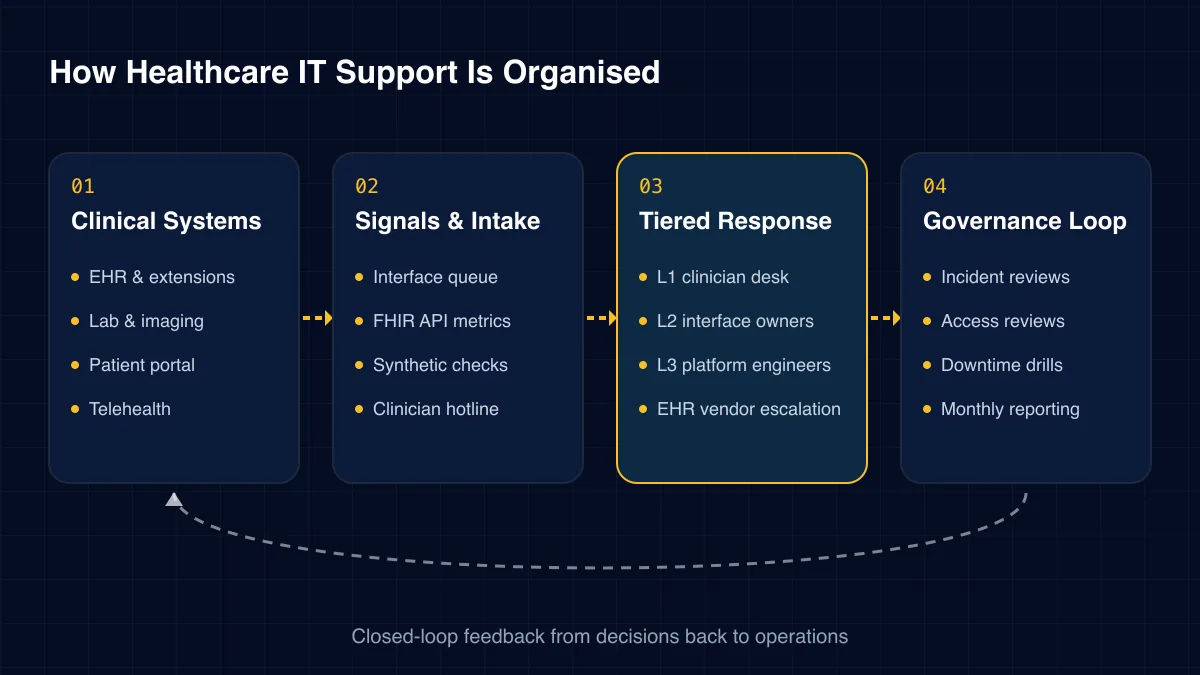
Our healthcare IT support model has four layers. Signals come from clinical and patient systems, tiered engineers resolve them, and reviews prevent repeats.
01
02
03
04
Challenges we solve
Healthcare systems rarely fail in one dramatic crash. More often, a small fault spreads quietly across connected systems.
A downstream system slows, messages pile up, and results reach the chart hours late. Nobody sees it until a clinician asks.
Single sign-on breaks on shared workstations as a new shift starts. Clinicians lose minutes they do not have.
Archive storage fills faster than planned. Study retrieval slows and radiology reports fall behind.
A portal login error affects only some users. Patients give up, call the front desk, and staff are swamped.
Shared admin accounts and permanent access make it hard to show who viewed what. That is an audit risk.
Internal IT is spread across many projects. Support work competes with new features, and both slow down.
Hospitals, clinic groups and health tech vendors need different things. Healthcare IT support usually takes one of four forms.
This table shows how specialist healthcare IT support compares with a general provider and an internal team alone.
| Capability | Generic MSP | In-house only | ICANIO clinical support |
|---|---|---|---|
| 24/7 engineer coverage | Partial | Partial | ✓ Yes |
| HL7 and FHIR skills | No | Partial | ✓ Yes |
| Time-bound PHI access | Partial | Partial | ✓ Yes |
| Imaging system support | No | Partial | ✓ Yes |
| Root-cause reporting | Partial | Rarely | ✓ Yes |
The value of healthcare IT support is measured in time returned to clinicians and risk removed from the organisation.
Delivery
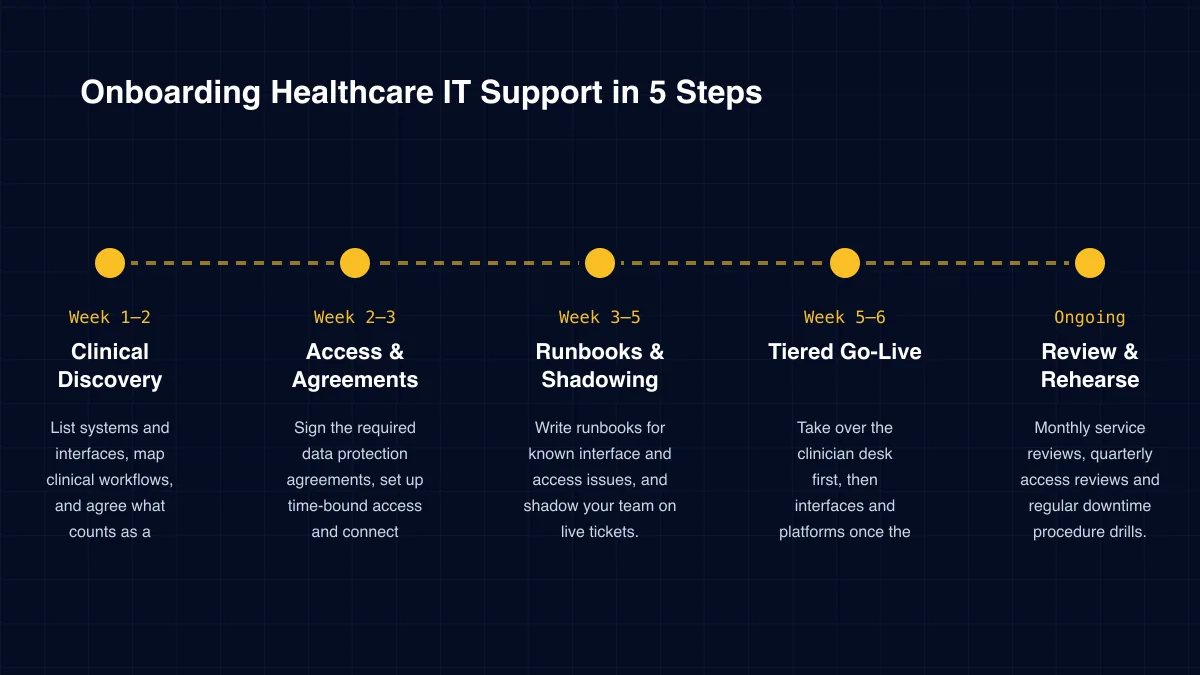
Week 1–2
List systems and interfaces, map clinical workflows, and agree what counts as a patient-impacting incident.
Week 2–3
Sign the required data protection agreements, set up time-bound access and connect monitoring.
Week 3–5
Write runbooks for known interface and access issues, and shadow your team on live tickets.
Week 5–6
Take over the clinician desk first, then interfaces and platforms once the handoffs are proven.
Ongoing
Monthly service reviews, quarterly access reviews and regular downtime procedure drills.
Case study
A healthcare partner was managing several clinical and patient-facing applications at once. Internal IT was stretched and integrations were fragile. Our team provided a dedicated backend team, secure APIs to third-party healthcare systems and continuous support for performance tuning. The result was 2x faster healthcare service delivery and a 30% reduction in operational risk exposure.
Read the full case study →Third-party integrations
Robust APIs connected applications with external healthcare systems securely.
Clinical and patient data flows
A single layer streamlined data movement across clinical and patient systems.
Performance tuning
Ongoing tuning and enhancements shipped quickly instead of waiting for release cycles.
Clinical systems deserve a careful choice. We recommend checking five points before you sign.
The second point is not negotiable. Healthcare IT support that cannot prove who accessed patient data is a liability, however fast it answers.
ICANIO runs support under ISO 9001 and ISO 27001 certified processes. For US clients, our healthcare IT support is designed to operate within the HIPAA Security Rule, and we sign the data protection agreements your compliance team requires.
Engineers use named accounts with multi-factor authentication. Access to systems holding protected health information is granted per ticket and expires automatically. Every session is logged, so your privacy officer can see who did what and when.
Our SOC monitors endpoints and identity systems for unusual activity. Where possible, we troubleshoot with de-identified data or metadata rather than live patient records.
Start with clinician time. Count the minutes lost to login problems, slow systems and missing results across a typical week. Multiply by the number of clinicians affected.
Then add internal engineering hours spent on routine support instead of projects, and the cost of any audit findings on access control. Those numbers form the baseline for healthcare IT support. We agree them with you during discovery and report against them each month.
Technology stack
Our healthcare IT support team works with the platforms you already run. These are the most common groups.
Clinical Core
EHR integrationsLab systemsPharmacy interfacesClinical documentation
Interoperability
HL7 v2 interface enginesHL7 FHIR APIsDICOM routingPartner APIs
Patient Facing
Patient portalsTelehealth platformsAppointment appsNotification services
Imaging
PACSVendor-neutral archivesImage viewersStorage tiers
Monitoring
AlertmanagerSynthetic checks
Security
Single sign-onMFAEndpoint protectionAccess logging
 Free white paper · Support EngineeringSupport EngineeringEnsuring Operational Excellence and Business Continuity Through Proactive, Intelligent OperationsGet the white paper →
 Free white paper · HealthcareHealthcare Technology SolutionsDigital Transformation, Clinical Excellence, and Patient-Centric InnovationGet the white paper →
Healthcare IT support covers the systems around clinical and patient work. That includes EHR integrations, HL7 and FHIR interfaces, lab and imaging systems, patient portals, telehealth tools, identity and devices. It also includes the cloud platforms, databases and security monitoring behind them.
HIPAA compliance belongs to your organisation as a whole, so no vendor can make you compliant alone. Our support is designed to work within the HIPAA Security Rule. We use time-bound, logged access and sign the agreements your compliance team requires.
We support the integrations, interfaces and custom extensions around your EHR, plus the infrastructure it runs on where you host it. Core EHR code stays with the vendor. We raise and manage vendor cases for you with full logs.
We monitor interface engine queues and error counts around the clock. When messages fail, we fix the cause, then replay them in order so the chart stays accurate. Patterns that repeat become engineering fixes.
Yes. Health tech vendors use our healthcare IT support as their product support desk. We handle L1 for their customers, L2 for configuration and integrations, and L3 for the cloud platform.
Most organisations reach full coverage in about six weeks. Data protection agreements and access setup come first, then runbooks and shadowing, then go-live tier by tier.
Clinical work depends on systems that talk to each other without delay. Healthcare IT support keeps those conversations flowing, from HL7 results feeds to patient portal logins.
ICANIO delivers healthcare IT support as a 24/7, L1–L3 service under ISO 27001 certified processes, with access controls built for patient data. Our backend engagement for a healthcare partner shows what dedicated engineering and continuous support can do. To discuss your systems, contact our team.
By ICANIO Support Engineering Team · Published · Updated
Book a free discovery call. We will map your clinical systems and interfaces, review your current support gaps, and propose a model with clear response targets.
Contact Our Support Team
