AI fraud detection in financial services has a document problem. Most fraud prevention conversations skip past it too quickly. Transaction monitoring, behavioral analytics and real-time anomaly detection all receive heavy investment, and rightly so. But a meaningful share of financial fraud does not start with a suspicious transaction. It starts with a document.
A forged identity record, a synthetic KYC file or a manipulated proof of address can pass onboarding undetected. It then establishes a fraudulent identity as a legitimate customer. By the time transaction-level monitoring flags the account, the damage is often done and hard to reverse.

ICANIO builds NLP in financial services and document processing systems designed to close this upstream gap. We treat KYC automation and claims document processing as more than efficiency projects. They are the first line of AI fraud detection in a complete financial crime prevention architecture. Done well, they catch fraud at the point of entry, before a fraudulent identity reaches the transaction layer.
Key Takeaways
- AI fraud detection works best when it starts at onboarding documents, not only at transactions.
- NLP in financial services adds semantic checks that basic OCR cannot provide.
- KYC automation adds the most value when fraud checks are built into the pipeline, not bolted on.
- Automated claims processing applies the same document intelligence to insurance fraud.
- Explainability, integration and ongoing model monitoring decide whether a system can be used in production.
What Is AI Fraud Detection?
AI fraud detection is the use of machine learning, natural language processing and rules to identify fraudulent activity in data. Classic approaches focus on transactions, using anomaly detection to spot unusual patterns. The wider field of data analysis techniques for fraud detection also covers documents, networks and behavior.
This article focuses on AI fraud detection at the document layer. That is where identity is first established, and where many fraud schemes begin.
Why Document Intelligence Is the Foundation of AI Fraud Detection
Financial institutions process documents constantly. Loan applications, KYC packets, insurance claims, account opening forms, trade finance contracts and compliance filings all flow through their systems. Each is a potential fraud entry point. Documents can be forged, manipulated or synthesized in ways that manual review and basic OCR miss.
Synthetic identity fraud shows the link most clearly. It begins with a know your customer document that looks legitimate enough to pass initial review. The fraudster then behaves like a normal customer until the identity is trusted.
KYC automation that only extracts and stores data faster does nothing for fraud detection. The value comes from AI fraud detection built into the document pipeline itself. That means:
- Checking document metadata against known forgery patterns.
- Cross-referencing extracted identity data against authoritative external sources.
- Flagging internal inconsistencies that a rushed manual review would miss.
How NLP in Financial Services Processes Documents
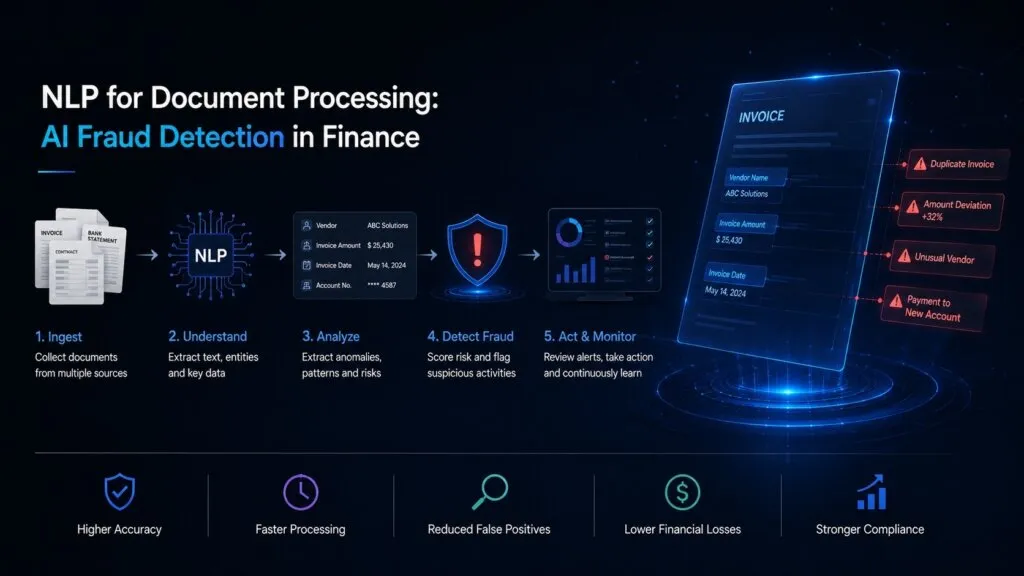
Modern NLP in financial services involves more than optical character recognition, though OCR remains the foundation. A complete intelligent document processing pipeline has several layers:
- OCR extracts text from scanned or photographed documents.
- NLP adds semantic understanding and context-aware classification.
- Machine learning models identify document types and detect anomalies.
- Validation logic checks extracted data against compliance rules and fraud pattern libraries.
- Human review handles the flagged edge cases and feeds decisions back.
This layered approach lets a system handle many formats, layouts and languages. It does not need a hand-built template for every document variant.
Semantic Understanding Beyond Text Extraction
The gap between basic OCR and real NLP matters for AI fraud detection. OCR extracts the text on a page. NLP understands what that text means in context. It can ask whether a stated income is consistent with other figures in the same document. It can check whether an address format matches the jurisdiction it claims. It can also compare linguistic patterns with those of genuine records.
Document fraud detection at this semantic level catches forgeries that look visually plausible. Models trained on genuine and fraudulent examples can learn the subtle inconsistencies those forgeries contain. This is what separates document intelligence from legacy systems that digitize text without understanding it.
Comparing Fraud Detection Layers
Different layers catch different kinds of fraud. The table shows where document-level AI fraud detection fits.
| Layer | What it checks | Typical fraud caught |
|---|---|---|
| Document intelligence | IDs, forms, claims | Forged and synthetic identities |
| KYC screening | Identity, sanctions lists | Known bad actors |
| Transaction monitoring | Payments, transfers | Money laundering, account takeover |
| Behavioral analytics | Sessions, devices | Bots, credential abuse |
No single layer of AI fraud detection is enough. The strongest designs share signals between all of them.
KYC Automation: From Document Extraction to Fraud Prevention
KYC automation built purely for speed captures only part of the available value. Faster processing and fewer manual data entry errors are real benefits. Teams spend less time retyping data and more time on judgment calls.
From a fraud standpoint, though, the bigger benefit is consistency. A human reviewer under time pressure applies varying scrutiny. Workload, fatigue and personal judgment all shift from day to day. An AI fraud detection model in the KYC automation pipeline applies the same logic to every document, every time. Synthetic identity patterns that a reviewer might miss on a busy day still get flagged.
Our team recommends designing KYC automation with three outcomes in mind:
- Clean, structured data that downstream systems can trust.
- Fraud signals with clear reasons attached to every flag.
- Routing rules that send uncertain cases to trained reviewers.
Automated Claims Processing and Document Fraud Detection
The same capabilities that power KYC automation apply to automated claims processing in insurance and financial services. Claims fraud often relies on documents that look legitimate at first glance. Examples include staged accidents with supporting paperwork, inflated medical bills with fabricated records, and duplicate claims under slightly varied identities.
For AI fraud detection, these documents tend to share the same weaknesses. They contain metadata anomalies, internal inconsistencies and cross-reference failures. Those are exactly the signals that document fraud detection models are good at finding.
Where Automated Claims Processing Catches What Manual Review Misses
At scale, claims volume makes consistent manual fraud review impractical. An AI fraud detection pipeline in the claims workflow can check every document against fraud pattern libraries. It can cross-reference claimant identity against earlier KYC records. It then flags anomalies for an investigator rather than making final decisions on its own.
This human-in-the-loop model tends to work better than either extreme. AI handles volume and consistency. Experienced investigators handle the nuanced calls that edge cases require. Our guide to human in the loop AI explains how to design that handoff. For a related build, see our insurance management software case study.
The Integration Challenge That Determines Real Value
NLP in financial services and KYC automation only deliver fraud prevention value when they connect to existing systems. Those include identity management, case management, regulatory reporting and transaction monitoring.
Picture a document fraud detection system that drops flags into a disconnected queue. Investigators check it by hand, separate from the system watching the same customer's transactions. That setup misses cross-system correlation, which often provides the strongest fraud signal.
Our application development teams treat integration depth as a first-class deliverable. We connect KYC document intelligence and automated claims processing into core banking systems, CRM platforms and compliance reporting. The goal is one view of a customer's risk across documents and transactions. Disconnected detection tools that never talk to each other leave gaps.
Explainability: Why AI Fraud Detection Must Show Its Work
Financial regulators in many markets have become more explicit about AI explainability in fraud and credit decisions. An AI fraud detection system that flags a KYC document without an auditable reason creates compliance risk. The institution may be unable to defend a customer rejection or a suspicious activity report filing. In the US, those reports go to FinCEN, and their reasoning must stand up to review.
ICANIO builds explainable AI into document fraud detection from the start. The system surfaces the specific anomalies, cross-reference failures and pattern matches behind each flag. It presents them in plain language that compliance officers can review. Explainability is a core capability, not a feature added after the model works.
The NIST AI Risk Management Framework is a useful reference for this work. It covers transparency, accountability and ongoing risk measurement for AI systems.
Keeping AI Fraud Detection Current as Fraud Evolves
Fraud tactics change constantly, and AI fraud detection must keep pace. Generative AI tools now make it easier to produce convincing synthetic identity documents. These can defeat earlier detection approaches. A model trained once and left unmonitored will slowly lose effectiveness as fraudsters adapt.
That is why our team treats monitoring and retraining as mandatory parts of every document fraud detection engagement. They are not optional add-ons. Good MLOps practice for AI fraud detection includes:
- Tracking detection rates and false positives over time.
- Reviewing investigator feedback on flagged cases.
- Retraining on newly confirmed fraud examples.
- Testing models against new forgery techniques before release.
This matters most for KYC automation serving high-risk segments or products. Those are the contexts where sophisticated attempts concentrate. A model that worked well at launch may need retraining within months.
AML and Document Intelligence: Connecting Both Layers
The strongest design combines document intelligence at onboarding with transaction monitoring downstream. Imagine a customer whose documents passed KYC automation but generated a low-confidence alert. That customer deserves closer scrutiny at the transaction layer. A marginal KYC signal plus an unusual transaction pattern is stronger evidence than either alone.
Building this AI fraud detection signal sharing requires decisions at the integration design stage. Make them before KYC and transaction monitoring systems are built or bought separately. Our approach maps how document-level risk signals should flow downstream. A simple pass or fail verdict throws useful context away.
How to Build Institutional Readiness for AI Fraud Detection
The technical parts of NLP document processing are increasingly well understood. Organizational readiness is often underestimated. Several teams must be ready before go-live:
- Compliance must understand and trust the flagging logic before relying on it for filings.
- Operations needs clear escalation procedures for flagged edge cases.
- Legal and privacy need confidence that document data handling meets obligations under GDPR, CCPA and regional rules.
- Engineering needs monitoring, data engineering pipelines and DevOps automation for safe model updates.
ICANIO builds these readiness steps into the project timeline. A common failure pattern is a technically complete system that compliance will not sign off on, because nobody involved them in design. Involving stakeholders early takes modest coordination. It avoids much larger rework and delay later.
Why Explainable Flags Speed Up Adoption
Teams adopt AI fraud detection tools they understand. When each flag shows its reasons, investigators learn to trust the system faster. They can also challenge wrong flags, which improves the model. That feedback loop is one of the main benefits of explainable AI fraud detection.
Benefits of AI Fraud Detection at Onboarding
Why move AI fraud detection upstream? The benefits are practical:
- Earlier stops. AI fraud detection at onboarding blocks fraudulent identities before they can transact.
- Consistent checks. Every document gets the same scrutiny, whatever the queue size.
- Better investigator focus. Reviewers spend time on flagged cases, not routine files.
- Richer context downstream. Document risk signals make transaction alerts more precise.
- Audit-ready records. Explainable flags create a clear trail for compliance teams.
Common Mistakes in AI Fraud Detection Projects
Our team sees the same mistakes repeat across AI fraud detection projects. The first is treating KYC automation as a speed project only. The second is buying a model before mapping where fraud actually enters. The third is leaving compliance out of design until the end. The fourth is deploying AI fraud detection without a plan for monitoring and retraining.
Each mistake is avoidable. A short discovery phase, clear ownership and explainable outputs address most of them. AI fraud detection is a long-term capability, so plan it like one.
Where ICANIO Fits in Financial Document Intelligence Projects
ICANIO's financial services engagements usually begin with an audit of existing KYC and claims workflows. We map where fraud enters, where current processes have blind spots and which document types carry the most risk. Projects in this space can span retail banking KYC, insurance claims automation and trade finance document verification.
Engagements bring together Data and AI, Application Development, DevOps and Cloud Engineering and Support Engineering. Document fraud detection at production scale is a data engineering and integration project. It is not only a question of which NLP model scores best on a benchmark. Learn more on our fintech and banking solutions page and our data and AI services page. You may also like our article on agentic AI in banking.
Conclusion
AI fraud detection is strongest when it starts at the document layer. Forged and synthetic identities often enter through onboarding paperwork long before any transaction looks unusual. NLP in financial services, KYC automation and automated claims processing give institutions a way to catch that fraud at the point of entry.
Technology alone is not enough. The systems must be explainable, integrated with transaction monitoring and kept current as fraud tactics evolve. If you are planning a document intelligence or KYC automation project, contact ICANIO to discuss your workflows with our team.
References
- Anomaly detection (Wikipedia)
- Data analysis techniques for fraud detection (Wikipedia)
- Know your customer (Wikipedia)
- Optical character recognition (Wikipedia)
- Explainable artificial intelligence (Wikipedia)
- NIST AI Risk Management Framework
- FinCEN filing information
Frequently Asked Questions
How does AI fraud detection work at the document level?
At the document level, AI fraud detection checks for metadata anomalies, internal inconsistencies and cross-reference failures. These can indicate forgery or synthetic identity construction. The goal is to stop a fraudulent identity at onboarding, rather than waiting for suspicious transaction patterns to appear after the account is already open and trusted by other systems.
What makes NLP better than basic OCR for KYC automation?
NLP understands the meaning and context of extracted text. That lets it detect details that look visually normal but are logically suspect, such as income figures that do not add up. Basic OCR only converts images of text into digital characters. It has no understanding of what that text means or whether it is consistent.
Can automated claims processing reduce insurance fraud?
It can help. By embedding document fraud detection in the claims pipeline, AI systems check every claim document against fraud pattern libraries and prior identity records. They do this at a volume and consistency manual review cannot match. Investigators still make the final decisions, but they spend their time on the cases that matter most.
Why does KYC automation need explainable AI outputs?
Regulated institutions must defend KYC rejections and suspicious activity report filings to regulators and auditors. That requires the reasoning behind each flag to be auditable and expressible in plain language. A numeric risk score on its own is not enough. Explainable outputs also help investigators trust and correct the system over time.
What systems does KYC automation need to integrate with?
Effective KYC automation usually connects to core banking systems, identity management platforms, AML screening databases, transaction monitoring and regulatory reporting tools. Fraud signals that span several systems give stronger evidence than any single system alone. Planning these integrations early avoids building a detection tool that sits isolated from the rest of the stack.
How often should AI fraud detection models be retrained?
There is no fixed schedule. Retraining should follow monitoring data, such as falling detection rates, rising false positives or newly confirmed fraud patterns. Because generative tools help fraudsters adapt quickly, our team recommends regular reviews and testing against new forgery techniques. Models serving high-risk products usually need closer attention than low-risk ones.