RAG vs fine-tuning is one of the most consequential decisions an enterprise AI team makes. Choose the wrong approach and you get one of two failures. Either the system cannot stay current with new information, or it forgets what it learned at the last update. Both are expensive. The confusion grows because RAG vs fine-tuning is rarely a binary choice in production. Many capable enterprise systems in 2026 use both. In RAG vs fine-tuning, the real question is where each approach belongs in the architecture and which problem each one solves.
This guide works through the RAG vs fine-tuning decision from first principles. It covers the risk of catastrophic forgetting during continuous fine-tuning, and what LLM retraining versus incremental tuning means in practice. It also looks at Azure OpenAI fine-tuning operations and ends with a decision framework. ICANIO's Data and AI and MLOps practices help enterprise teams make this choice and build production AI pipelines for legal, healthcare, fintech, and manufacturing use cases.
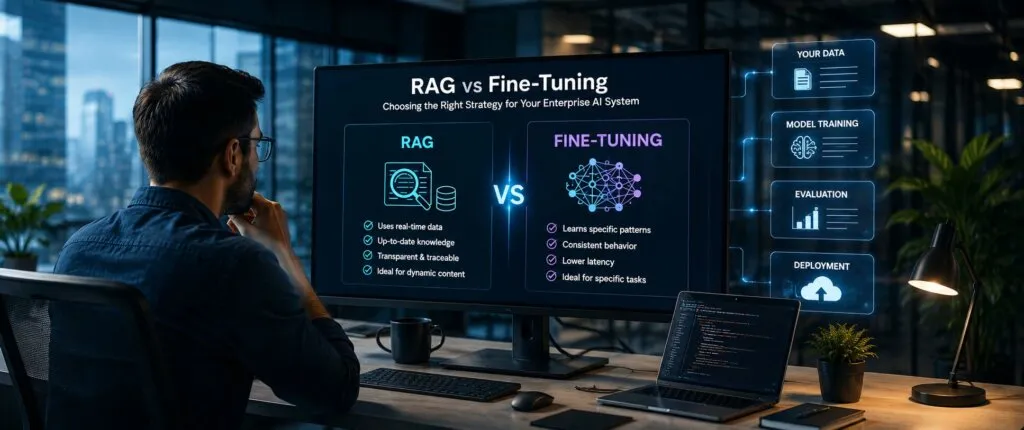
Key Takeaways
- RAG solves knowledge currency: it retrieves current documents at inference time without changing model weights.
- Fine-tuning solves behavioural consistency: it teaches a model formats, styles, and classification rules.
- Continuous fine-tuning on new data alone risks catastrophic forgetting of earlier patterns.
- For regulated industries, full LLM retraining from the base model on each update is the safest default.
- RAG vs fine-tuning is rarely either-or: many production systems combine both, with an automated evaluation gate before any model is promoted.
What RAG vs Fine-Tuning Are Actually Solving
RAG and fine-tuning address different problems. Treating RAG vs fine-tuning as interchangeable leads to architectures that are too complex or that fail in predictable ways. Understanding RAG vs fine-tuning at the problem level is the first step toward a decision that holds up in production.
What RAG Solves
Retrieval-augmented generation solves the knowledge currency problem. The approach was described in the original RAG paper by Lewis et al.. A base model's knowledge is frozen at training time. Some information changes often: policy documents, product catalogues, legal updates, or clinical guidelines. Without retrieval, a base model gives stale answers on these topics.
RAG retrieves relevant documents at inference time and injects them into the model's context window. The model reasons over current information without retraining. RAG works at the inference layer, not the training layer. That is the key architectural distinction in RAG vs fine-tuning.
RAG excels in three situations:
- The knowledge base changes frequently.
- Documents are long, domain-specific, and need to be cited.
- The team needs transparency about which sources produced an answer.
This is where RAG vs fine-tuning diverges: RAG does not fix behavioural consistency. Suppose a model must follow a specific output format, tone, or classification rule without long prompts. Retrieval alone cannot enforce that behaviour.
What Fine-Tuning Solves
Fine-tuning solves the behavioural consistency problem. This is a separate problem from knowledge currency. Fine-tuning teaches a model domain patterns, output schemas, or organisational conventions. It removes the need for long prompts that explain those rules every time.
In the RAG vs fine-tuning comparison, fine-tuning is right when a task needs consistent, low-latency behaviour that prompting cannot achieve. Classic use cases include document classification, structured output generation, domain tone and style, and multi-label tagging. Each requires the model to internalise a pattern, not just look up information.
Parameter-efficient methods such as LoRA make fine-tuning cheaper. They train small adapter weights rather than the full model. That makes per-client or per-task models more practical.
RAG vs Fine-Tuning at a Glance
| Factor | RAG | Fine-tuning |
|---|---|---|
| Solves | Knowledge currency | Behavioural consistency |
| Changes weights | No | Yes |
| Update method | Re-index documents | Retrain model |
| Source citations | Built in | Not native |
| Forgetting risk | None | Yes |
Catastrophic Forgetting: The Continuous Fine-Tuning Risk
Once a team settles RAG vs fine-tuning in favour of tuning, the next question is how to update the model as new training data arrives. The naive approach is continuous fine-tuning, also called sequential fine-tuning. You train the existing fine-tuned model on new data and deploy the result. It is faster and cheaper than retraining from scratch. It is also the approach most likely to cause quality regression in production.
What Catastrophic Forgetting Means
Catastrophic forgetting, also called catastrophic interference, is a well-documented effect in neural network research. When a model trains on a new dataset, gradient updates fit the new data. Those same updates also shift weights that supported performance on earlier data. The model improves on the new task but loses patterns it had learned before.
In an enterprise setting, catastrophic forgetting shows up in a specific way. The model handles new document types well but misclassifies documents it handled accurately months ago. The regression often appears in user complaints or a later audit. Aggregate accuracy may hide it if new data dominates the evaluation set.
What the Research Shows
An empirical study of catastrophic forgetting during continual fine-tuning (arXiv:2308.08747) found forgetting was generally observed in LLMs from 1B to 7B parameters. Within that range, severity increased as model scale increased. Teams should not assume larger hosted models are immune. This matters for anyone running Azure OpenAI fine-tuning or other hosted tuning on large models.
Continuous Fine-Tuning: Three Update Strategies
After the RAG vs fine-tuning choice, enterprise teams have three practical options for updating a production fine-tuned model. The trade-offs between them are the heart of the LLM retraining decision.
Strategy 1: Retrain From the Base Model
Every training run starts from the original base model. It trains on the full accumulated dataset. No previous fine-tuned weights carry over, so catastrophic forgetting from sequential updates does not occur. Reproducibility is strong: the same dataset and settings produce a comparable model. The cost is more training time and compute per run.
Strategy 2: Continuous Fine-Tuning on New Data Only
Each run starts from the previous checkpoint and trains only on documents added since the last run. This is the fastest and cheapest option. It is also the riskiest. Prior classification patterns are the most likely to degrade. Our team does not recommend this pattern for any production deployment where earlier performance must be preserved.
Strategy 3: Continuous Fine-Tuning on Combined Data
Each run starts from the previous checkpoint but trains on all accumulated data, old and new. This is the practical middle ground. Including prior data in every run reduces forgetting risk compared with Strategy 2. The remaining risk is cumulative weight drift. Across many sequential runs, weights move further from the base model, and reproducibility suffers.
| Strategy | Cost | Forgetting risk | Reproducible |
|---|---|---|---|
| 1. Retrain from base | High | Lowest | Yes |
| 2. New data only | Low | Highest | No |
| 3. Combined data | Medium | Moderate | Partly |
LLM Retraining vs Fine-Tuning: The Production Recommendation
The RAG vs fine-tuning decision is only half the story. Base the LLM retraining choice on three factors: acceptable training cost, required reproducibility, and tolerance for forgetting.
For most regulated use cases, Strategy 1 is our recommendation. Full LLM retraining from the base model avoids sequential forgetting and keeps results reproducible. It also creates a clean audit trail that links each model version to its exact training dataset. The higher per-run cost is justified by lower operational risk and a stronger compliance position.
Strategy 3 is an acceptable alternative in narrower cases. It fits when training cost is a hard constraint and new data closely resembles prior data in volume and distribution. Teams choosing it should add a rigorous evaluation gate. The gate should test each updated model against a held-out validation set covering the full historical distribution, not only recent data. That catches regressions before they reach production. At ICANIO, we record this choice as a documented architecture decision in every production fine-tuning engagement.
Azure OpenAI Fine-Tuning: Operational Considerations
Azure OpenAI fine-tuning supports a combined RAG vs fine-tuning architecture directly. A fine-tuned model can act as the classification and structure layer. A retrieval system supplies relevant documents for the context window at inference time. The two layers can be updated independently, which reduces operational overhead.
Multi-Tenant Deployments
In multi-tenant systems, each client organisation may have its own fine-tuned model. Azure OpenAI fine-tuning supports separate deployments that can update on independent schedules. This helps with the retraining decision. Strategy 1 can run for one tenant without affecting any other tenant's active model, because each model runs in isolation.
Our team has implemented per-tenant fine-tuning pipelines as part of production AI engagements. You can read about the design in our multi-tenant LLM fine-tuning pipeline post and the related multi-tenant LLM fine-tuning case study.
Practical Tips for Hosted Fine-Tuning
- Version every training dataset and store it with the resulting model ID.
- Keep a fixed, representative evaluation set and never train on it.
- Track runs in an experiment tool such as MLflow.
- Automate deployment so promotion only happens after the evaluation gate passes.
These habits apply to any cloud platform, not just Azure. They are standard machine learning and DevOps practice applied to LLMs.
RAG vs Fine-Tuning: The Combined Architecture
Many effective production systems resolve RAG vs fine-tuning by using both together. Each handles the problem it was designed for. Consider a document classification system for a legal team. It might use Azure OpenAI fine-tuning to train a per-client model that classifies documents consistently without long prompts. It then uses RAG to retrieve relevant precedents or policies when an output must reference current information.
In this combined RAG vs fine-tuning design, responsibilities split cleanly:
- Fine-tuning handles the interface layer: behavioural consistency, output schema, domain vocabulary, and classification accuracy.
- RAG handles the knowledge layer: current documents, frequently updated information, and source attribution.
The combined design also contains the forgetting risk. The RAG knowledge layer cannot forget, because it does not store knowledge in model weights. Only the fine-tuned layer carries that risk, and the update strategy manages it. Strong data engineering on the retrieval side, including chunking, metadata, and index refresh, keeps the knowledge layer reliable.
A Decision Framework for RAG vs Fine-Tuning
Use this checklist when making the RAG vs fine-tuning call. It condenses the guidance above:
- Choose RAG when the knowledge base changes often, documents are long and must be cited, or source transparency is required.
- Choose fine-tuning when behavioural consistency, output schemas, or classification accuracy cannot be reached through prompting.
- Choose both when the system needs current knowledge and consistent behaviour at the same time.
- For updates in regulated industries, default to Strategy 1, full LLM retraining from base.
- Use Strategy 3 only when cost is a hard constraint and new data resembles prior data closely.
- Always gate promotion with an automated evaluation over the full historical validation set.
Why the Evaluation Gate Matters
An automated evaluation gate is the main defence against regressions reaching production unnoticed. It matters whether you use Azure OpenAI fine-tuning, another hosted platform, or self-hosted training. Our post on LLM evaluation before deployment explains how to automate this gate.
For teams under GDPR, HIPAA, or sector-specific AI rules, the gate is a compliance asset as well as a technical control. An experiment record of every training run, linked to its evaluation score and dataset version, gives auditors the model governance evidence they ask for. The NIST AI Risk Management Framework provides helpful language for documenting these controls. The investment pays off the first time the gate stops a degraded model.
RAG vs Fine-Tuning by Use Case
Different enterprise workloads land in different places. These patterns are a useful starting point, not fixed rules:
- Policy and HR assistants: RAG, because policies change and answers need citations.
- Invoice or contract classification: fine-tuning, because labels and formats must stay consistent.
- Customer support copilots: both, with RAG for knowledge and a light fine-tune for tone.
- Manufacturing maintenance assistants: RAG over manuals and IoT logs, often feeding predictive maintenance workflows.
- Structured data extraction: fine-tuning for the output schema, sometimes with RAG for reference tables.
In every case, start by naming the problem. If the gap is missing knowledge, reach for retrieval. If the gap is inconsistent behaviour, reach for tuning. That framing resolves most RAG vs fine-tuning debates quickly.
Common RAG vs Fine-Tuning Mistakes to Avoid
Our team sees a few recurring mistakes when organisations approach RAG vs fine-tuning for the first time:
- Fine-tuning to add facts that change weekly, when retrieval would keep them current.
- Using RAG to enforce a strict output format that a small fine-tune would handle better.
- Running continuous fine-tuning on new data only and skipping regression tests.
- Evaluating only on recent data, which hides catastrophic forgetting of older patterns.
- Not versioning datasets, which makes LLM retraining results impossible to reproduce.
Each one comes from treating RAG vs fine-tuning as a single tool choice rather than an architecture choice. Avoiding these mistakes usually costs less than fixing them after a production incident.
Conclusion
The RAG vs fine-tuning decision comes down to the problem you are solving. Knowledge currency is solved by RAG. Behavioural consistency is solved by fine-tuning. When a system needs both, a combined architecture uses fine-tuning for the classification layer and RAG for the knowledge layer.
Within the fine-tuning layer, regulated industries should default to full retraining from the base model. An automated evaluation gate then enforces quality before anything reaches users. That combination gives you current answers, consistent behaviour, and an auditable history.
If you are weighing RAG vs fine-tuning for your own platform, our Data and AI services team can help. Contact ICANIO to discuss your architecture.
References
- Retrieval-augmented generation, Wikipedia
- Lewis et al., Retrieval-Augmented Generation for Knowledge-Intensive NLP Tasks (arXiv)
- Fine-tuning (deep learning), Wikipedia
- Catastrophic interference, Wikipedia
- An Empirical Study of Catastrophic Forgetting in LLMs During Continual Fine-tuning (arXiv)
- LoRA: Low-Rank Adaptation of Large Language Models (arXiv)
- Azure OpenAI fine-tuning, Microsoft Learn
- NIST AI Risk Management Framework
Frequently asked questions
What is the difference in RAG vs fine-tuning?
RAG solves the knowledge currency problem by retrieving relevant documents at inference time, so the model reasons over current information without retraining. Fine-tuning solves behavioural consistency by teaching a model domain patterns, formats, and rules. The right choice depends on whether your main need is access to current information or consistent behaviour on a task.
What is catastrophic forgetting in LLMs?
Catastrophic forgetting happens when training on new data shifts the weights that supported earlier patterns. The model improves on the new task but loses prior skills. In enterprise AI it often appears as a model that handles new document types well while misclassifying documents it once handled accurately. Research has observed it during continual fine-tuning.
When should teams retrain from base instead of fine-tuning further?
For regulated industries such as legal, healthcare, and fintech, retraining from the base model on each update is the safer default. It avoids sequential forgetting, keeps results reproducible, and creates a clean audit trail. Continuous fine-tuning on combined data is acceptable when training cost is a hard constraint and new data closely resembles earlier data.
How does Azure OpenAI fine-tuning support combined RAG architectures?
Azure OpenAI fine-tuning lets teams deploy fine-tuned models that update independently of the retrieval system. The classification layer and the knowledge layer can then evolve on separate schedules. In multi-tenant setups, each tenant's model can be retrained without affecting others. This reduces the operational overhead of running RAG and fine-tuning together.
Can RAG vs fine-tuning be combined in one system?
Yes, and many production systems do exactly that. Fine-tuning handles output format, tone, vocabulary, and classification accuracy. RAG supplies current documents and source citations at inference time. Because the retrieval layer stores knowledge outside model weights, only the fine-tuned layer carries forgetting risk, which a sound update strategy and evaluation gate can manage.
Is RAG cheaper in a RAG vs fine-tuning cost comparison?
It depends on the workload. RAG avoids training costs and updates by re-indexing documents, but it adds retrieval infrastructure and longer prompts at inference time. Fine-tuning has upfront training cost and periodic retraining, but it can shorten prompts. Compare total cost over the expected update frequency and query volume before deciding.