
Early Alerts and Student Outreach
Agents combine LMS activity, grades and SIS data to spot students at risk. They draft a personal check-in, and the advisor edits and sends it.
LMS + SIS
AgenticOps · Education & E-Learning
We design and operate multi-agent systems across your LMS, SIS, admissions CRM and support desk. Agents spot students who are slipping, prepare course shells and sort applications. Advisors, instructors and admissions officers make every decision that affects a learner.
⟳ Orchestrating agents…
every step traced · guardrails on · reversible
AI agents in education are software workers that read learning, enrolment and admissions data, then prepare the next task for staff. They connect what the LMS, SIS and admissions CRM each hold separately. An advisor or instructor then gets a ready draft instead of a report to decode.
Schools and universities have more learner data than ever. Yet advisors still find struggling students late, course setup still eats the week before term and admissions teams still chase missing transcripts by hand.
Our team builds AI agents in education that do the gathering, checking and drafting. Educators keep every decision that affects a learner: grades, admissions, interventions and accommodations. This page shows how we design those systems, protect student data and prove value.
An AI agent is a program that works toward a goal by planning steps, calling tools and checking results. In education, those tools are the LMS, SIS, admissions CRM, timetabling, library and student support systems.
AI agents in education are not tutors that replace teachers. They work behind the scenes. An agent can notice a student has gone quiet, check their enrolment and draft an email for an advisor. It does not decide what happens next.
Most useful systems combine several narrow agents that share context. AgenticOps keeps them traced and bounded, which matters when the data is a student record protected by law.
Campus definition
“AI agents in education are governed software agents that monitor learning and administrative events, reason across LMS, SIS and admissions data, and prepare work that an educator or authorised staff member approves.”
Foundations
AI agents in education never assign grades, admit students or apply sanctions. They prepare the material for people who do.
Agents see only the records their task needs. Access follows FERPA and local privacy law, and every read is logged.
We connect through LTI, OneRoster and published APIs, so agents work with your existing platforms rather than around them.
Content agents check materials against WCAG and flag gaps, so accessibility is built in rather than fixed later.
Core capabilities
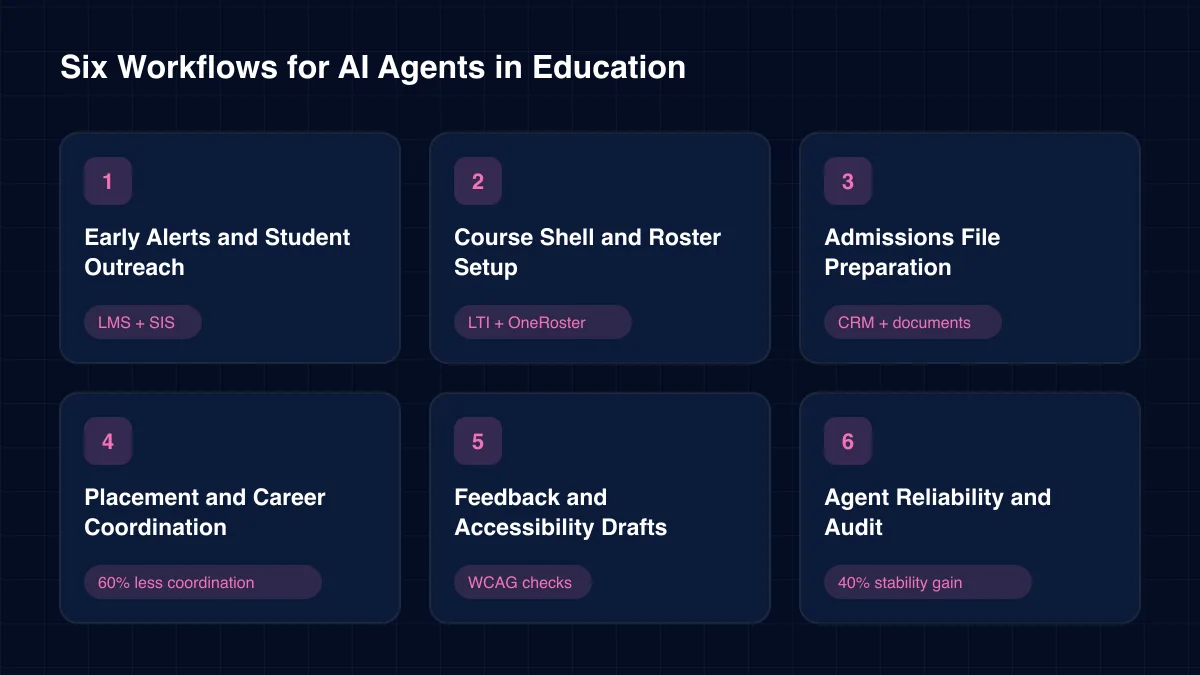
These are the workflows where AI agents in education usually help first. Each one keeps an educator or staff member in charge.
Agents combine LMS activity, grades and SIS data to spot students at risk. They draft a personal check-in, and the advisor edits and sends it.
LMS + SIS
AI agents in education build course shells, sync rosters and link LTI tools each term. Instructors review and publish their own courses.
LTI + OneRoster
Agents check documents, extract transcript data and chase missing items. Admissions officers and committees make every decision.
CRM + documents
Agents match students, recruiters and schedules across colleges. Our campus placement platform cut manual coordination effort by 60%.
60% less coordination →Agents draft rubric-aligned feedback and flag inaccessible files. Instructors review, change and own every comment and grade.
WCAG checks
We trace every tool call and record access, evaluate drafts against staff decisions and recover from failed steps, as in our agentic AI framework work.
40% stability gain →Architecture
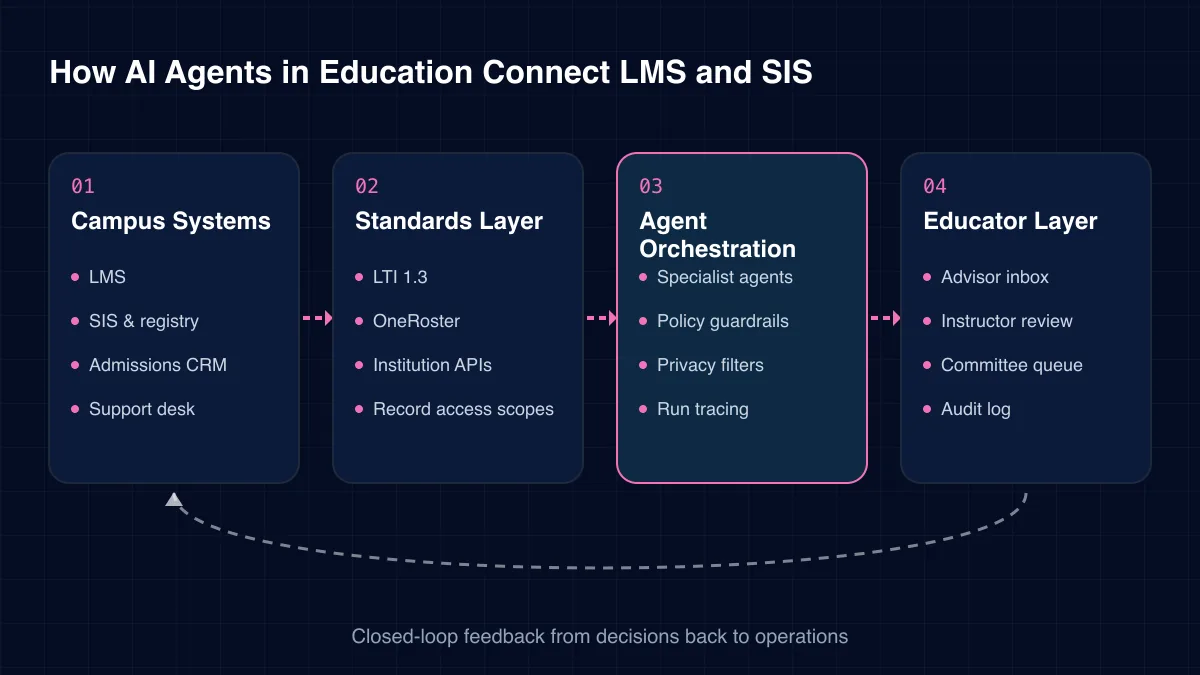
Agents sit above your learning and student systems. Data comes in through standards and APIs, and drafts go to the staff member who owns the decision.
01
02
03
04
Challenges we solve
Institutions already have analytics dashboards. The follow-up work they create is still manual, and that is where AI agents in education help.
Dashboards show risk, but someone has to act. Agents turn each signal into a drafted outreach so advisors reach students sooner.
Hundreds of course shells, rosters and tool links need setup in days. Agents prepare them from templates for instructors to check.
Incomplete files stall review. Agents check each file, list what is missing and draft reminders to applicants.
LMS, SIS and CRM data rarely line up. Agents read across them through standards like LTI and OneRoster.
Untagged PDFs and images without alt text slip into courses. Agents flag them before students run into them.
Staff worry about automated judgements on students. We keep every decision with educators and log what agents contributed.
AI agents in education usually expand across four stages as confidence grows.
Many institutions already run analytics and a chatbot. This shows where agents add something new.
| Capability | Analytics | Chatbot | AI agents |
|---|---|---|---|
| Flags at-risk students | ✓ Yes | No | ✓ Yes |
| Drafts the follow-up | No | No | ✓ Yes |
| Works across LMS, SIS and CRM | Partial | No | ✓ Yes |
| Sets up courses and rosters | No | No | ✓ Yes |
| Requires educator approval | No | Rarely | Always |
Gains grow as more workflows share the same governed agents and approval inbox.
Delivery
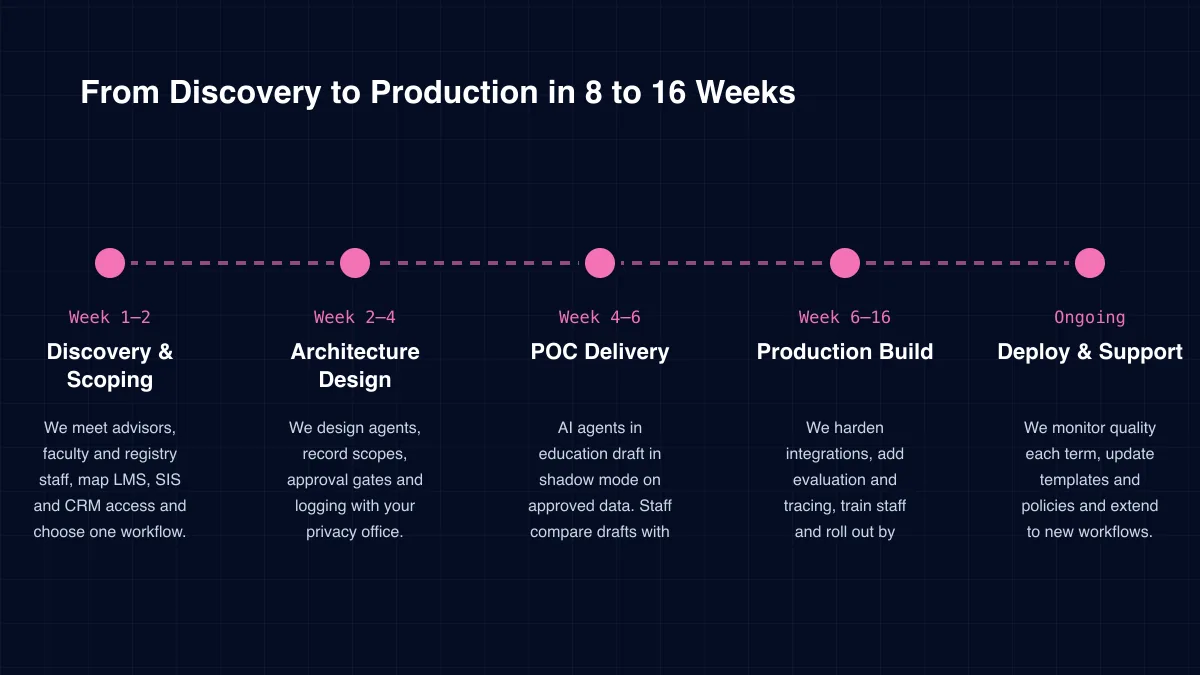
Week 1–2
We meet advisors, faculty and registry staff, map LMS, SIS and CRM access and choose one workflow.
Week 2–4
We design agents, record scopes, approval gates and logging with your privacy office.
Week 4–6
AI agents in education draft in shadow mode on approved data. Staff compare drafts with their own work.
Week 6–16
We harden integrations, add evaluation and tracing, train staff and roll out by faculty or department.
Ongoing
We monitor quality each term, update templates and policies and extend to new workflows.
Case study
An enterprise AI platform had accumulated agent instability that grew with every new use case. We audited and debugged each workflow, optimised reasoning and tool use and added collaborative, self-correcting agents. Stability rose 40%, reasoning capability rose 3x and agents ran on local or cloud LLMs. Institutions need that reliability before AI agents in education touch student work.
“Adding agents to an unstable foundation only makes it more complex.”Read the full case study →
Stability debugging
Every existing agent workflow was reviewed and fixed first.
Reflective reasoning
Agents share context and correct their own outputs across the pipeline.
Local & cloud LLMs
Models can run inside the institution when student data must stay there.
Student data and academic judgement raise the bar. We recommend checking these five things.
Faculty trust decides adoption. Involve instructors and advisors from discovery onward.
ICANIO operates under ISO 9001 and ISO 27001 certified processes. AI agents in education reach student records only through scoped tools, and every access is logged for your privacy office.
We design for FERPA in the US, GDPR where it applies and COPPA for services used by children under 13. Student data is not used to train shared models, and models can run inside your own cloud tenancy.
Agent risks are mapped against the NIST AI Risk Management Framework. Each workflow has an owner, a fairness review and an off switch.
Pick one workflow and measure it now. For student success, track days from first risk signal to contact. For course setup, count staff hours before each term. For admissions, measure time from application to complete file.
We agree those baselines in discovery. Shadow mode then shows how often staff accept agent drafts with light edits. The return on AI agents in education is measured on your own terms and cohorts.
Technology stack
We choose tools for AI agents in education per institution. These are typical choices, not a fixed bundle.
Campus Systems
SIS platformsAdmissions CRM
Standards
LTI 1.3OneRosterREST APIsSSO
Agent Frameworks
Custom orchestrators
Models
Private cloud LLMsSmall language modelsDocument extraction
Retrieval
Policy handbooksCourse catalogVector databases
Observability
Evaluation suitesAccess audit log
 Free white paper · AgenticOpsThe AgenticOps PlaybookA practical, framework-neutral guide to engineering, governing and running AI agents in production, from the first workflow to a trusted agent estate.Get the white paper →
 Free white paper · EducationEducation & E-LearningDigital Transformation Solutions for the Global EdTech LandscapeGet the white paper →
No. AI agents in education can draft rubric-aligned feedback for an instructor to review. The instructor decides every grade and owns every comment. Agents never post grades to the LMS on their own.
Usually the LMS, SIS, admissions CRM, timetabling and support desk. We use LTI 1.3, OneRoster and published APIs wherever possible. Each connection has scoped permissions and full logging.
The staff member who owns the decision. Advisors send outreach, instructors publish courses and grades, and admissions officers or committees decide applications.
Compliance comes from the whole design. We limit record access to legitimate educational interest, log every read and keep data in your environment. Your privacy office reviews the design before go-live.
Yes, with extra care. Services for children under 13 in the US also fall under COPPA, and parental rights apply. We scope data even more tightly for school settings.
Most engagements reach production in eight to sixteen weeks. Discovery, design and a shadow-mode proof of concept take about six weeks. We usually time go-live for the start of a term.
AI agents in education give time back to the people students rely on. They notice, gather and draft, then leave the conversation and the decision to an advisor or instructor.
ICANIO applies AgenticOps discipline to that work: standards-based integration, scoped student data, educator approval and full tracing. We take institutions from one workflow in shadow mode to production in eight to sixteen weeks, then keep agents reliable term after term.
By ICANIO AgenticOps Engineering Team · Published · Updated
Book a free 30-minute discovery call. We will map one campus workflow, its systems and its decision owners to an agent design. You will leave with a clear scope and a shadow-mode plan.
Contact Our AgenticOps Team


