AI ASSESSMENT · EDTECH HIRING · BIAS ELIMINATION
Icanio built an AI video interview assessment engine for an EdTech partner to help recruiters evaluate candidate communication skills consistently and without bias.
Quick Answer
What Is an AI Video Interview Assessment Engine?
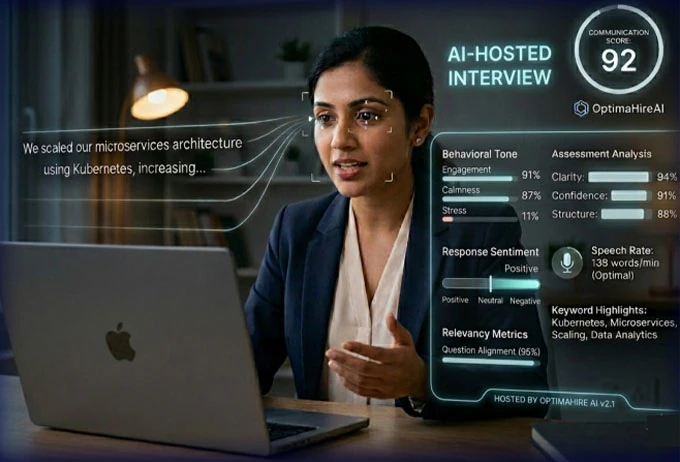
An AI video interview assessment engine uses speech-to-text, computer vision, and NLP to score a candidate’s communication skills objectively, replacing subjective manual review with a single, standardized communication skill score. ICANIO built this AI video interview assessment engine for an EdTech partner. It combines AWS Transcribe, iris and presence tracking, and grammar and speech-rate analysis to give recruiters faster decisions, eliminated bias, and standardized feedback at scale.
Executive Summary
Turning Subjective Interview Review Into Objective, Scalable Scoring
Manual video interview review might work for a handful of candidates, but it becomes a genuine liability once an EdTech partner needs to evaluate communication skills consistently across high applicant volumes. ICANIO’s partner was facing exactly that gap. Its manual review was highly time-consuming, subjective human evaluations introduced unconscious bias, and a lack of standardized metrics made cross-panel comparisons unreliable.
ICANIO addressed this by building a single AI video interview assessment engine rather than a narrow scoring tool. The objective was to convert speech to text with AWS Transcribe, track iris movement and candidate presence with computer vision, analyze grammar, speech rate, and keyword usage. Every signal would then combine into one unified communication skill score using MediaPipe, NLTK, and MongoDB. The result was faster recruiter decision-making, eliminated subjective bias, and standardized, quantifiable feedback at scale.
Every one of those outcomes traces back to the same design decision. ICANIO replaced a human reviewer’s inconsistent judgment with the same objective scoring model applied to every candidate, so speed and fairness improved together instead of trading off against each other.
“A recruiter reviewing a hundred videos in a row will not score the first and the hundredth candidate the same way, an objective model will.”
The Challenge
Five Bottlenecks in Manual Video Interview Review
Our EdTech partner needed a way to help recruiters consistently and objectively evaluate candidate communication skills during video interviews. Traditional manual reviews created several bottlenecks.
Manual Review Before This AI Video Interview Assessment
Manual review of video interviews is highly time-consuming, limiting how many candidates a recruiting team could realistically evaluate in depth.
Unconscious Bias in Evaluation
Subjective human evaluations introduce unconscious bias into hiring, with the same response scored differently depending on which recruiter watched it, making unconscious bias elimination a core requirement for this engagement.
Scale Gaps Before This AI Video Interview Assessment
Recruiters struggle to consistently assess communication skills at scale, since manual judgment naturally drifts across hundreds of interviews.
Applicant Volume This AI Video Interview Assessment Handles
High applicant volumes overwhelm traditional manual screening processes, forcing recruiters to choose between speed and thoroughness.
Lack of Standardized Metrics
The lack of standardized metrics leads to inconsistent assessment quality, making it difficult to compare candidates evaluated by different panels.
AI Video Interview Assessment Solutions Provided
A Six-Part AI Video Interview Assessment Engine
Icanio Technologies architected an Automated Communication Assessment Engine, utilizing advanced machine learning models to analyze candidate responses objectively. The solutions included:
Automated Communication Evaluation Engine
Developed an automated engine to evaluate video interview communication, replacing manual review with consistent, repeatable scoring.
AWS Transcribe Speech-to-Text Conversion
Integrated AWS Transcribe for accurate speech-to-text response conversion, giving the engine a reliable text layer to analyze.
Presence Tracking in This AI Video Interview Assessment
Tracked iris movement and candidate presence using AI models, capturing engagement signals a transcript alone cannot reveal.
Response Analysis in This AI Video Interview Assessment
Analyzed grammar, speech rate, and keywords for multidimensional scoring, evaluating communication quality from more than one angle at once.
Skill Scoring in This AI Video Interview Assessment
Combined all metrics into a unified communication skill score, giving recruiters one consistent number instead of scattered observations.
Scalable Processing With MediaPipe, NLTK, and MongoDB
Leveraged a MediaPipe NLTK MongoDB stack for scalable processing, letting the engine handle high interview volumes in parallel.
Business Outcomes
Measurable Results Across Speed, Fairness, and Scale
This AI video interview assessment engine delivered outcomes across every dimension of the original screening bottleneck, converting a slow, subjective manual process into a fast, standardized, and scalable evaluation system.
Faster Decision-Making
For processing high candidate application volumes
Eliminated Subjective Bias
Improving overall interview and evaluation fairness
Enhanced Diversity
Through unbiased, data-driven objective assessments
Highly Scalable
Automated communication and candidate screening process
Standardized Feedback
Delivered via highly quantifiable communication metrics
Significant Reduction
In time and manual recruiter effort
Key learnings
What This Engagement Proves for AI-Driven Hiring Assessment
This AI Video Interview Assessment Removes Bias, Not Nuance
Replacing subjective human judgment with an objective communication skill score does not flatten a candidate’s response into a single crude number, it combines multiple real signals, grammar, speech rate, keyword usage, and presence, into one consistent measure applied identically to every candidate.
Multimodal Signals Beat Transcript-Only Scoring
Speech-to-text alone would have missed how consistently a candidate engaged on camera. Pairing AWS Transcribe with iris movement and presence tracking gave the engine a fuller picture of communication quality than analyzing words alone could provide.
Standardization Is What Makes Scale Possible
The lack of standardized metrics, not raw volume, was the real reason cross-panel comparisons were unreliable. Once every candidate was scored against the same unified communication skill score, processing high applicant volumes became a scaling problem instead of a consistency problem.
Conclusion
From Subjective Manual Review to Objective AI Assessment
Manual video interview review might have been workable at a small scale, but for an EdTech partner facing high applicant volumes, it had become the primary source of inconsistency and bias in hiring decisions. This engagement demonstrates that a single AI video interview assessment engine can resolve speed, fairness, and consistency gaps within one structured programme rather than three separate initiatives.
ICANIO combined AWS Transcribe, iris and presence tracking, and multidimensional grammar and speech analysis into one unified communication skill score. This helped this partner deliver faster decision-making, eliminate subjective bias, and give recruiters standardized, quantifiable feedback at scale. The objective scoring model, multimodal signal processing, and scalable MediaPipe, NLTK, and MongoDB architecture delivered through this engagement are the foundation every future hiring assessment this team runs will depend on.
Related Resources
Our team builds assessment engines like this through ICANIO's data and artificial intelligence services. Such models rely on data engineering, cloud speech services and screening automation working together. Related work serves education and elearning teams, including a campus placement platform. To plan a similar AI video interview assessment, contact ICANIO.
- Data and Artificial Intelligence Services
- Education and Elearning Industry Solutions
- Cut Slow Hiring: AI Recruitment Software in 2026
- Stop Slow Hiring: AI Job Matching Platform
- Human in the Loop AI: Decision Making and Governance Guide
References
- Amazon Transcribe guide: official AWS speech-to-text docs.
- MediaPipe: Google docs for the MediaPipe vision framework.
- NLTK: official site of the Natural Language Toolkit.
- MongoDB documentation: official MongoDB docs.
- Speech recognition: overview of speech-to-text technology.
Frequently asked questions
Common Questions About This AI Video Interview Assessment Engine
How does an AI video interview assessment engine reduce bias?
An AI video interview assessment engine scores candidate communication objectively using speech-to-text, computer vision, and NLP analysis, applying the same evaluation criteria to every candidate instead of relying on a human reviewer's subjective, inconsistent judgment.
How does AWS Transcribe contribute to the communication skill score?
AWS Transcribe converts spoken responses into accurate text, giving the engine the reliable transcript it needs to analyze grammar, speech rate, and keyword usage as part of the unified communication skill score.
Why track iris movement and presence alongside speech analysis?
Iris movement and presence tracking capture engagement signals that a transcript alone cannot reveal, giving the engine a fuller view of how consistently a candidate engaged during the interview.
Why is the communication skill score more objective?
The communication skill score combines grammar, speech rate, keyword usage, and presence into one consistent metric applied identically to every candidate, removing the drift and unconscious bias that naturally creeps into manual evaluation.
How do MediaPipe, NLTK, and MongoDB support scalable processing?
MediaPipe handles the computer vision workload, NLTK supports the language analysis, and MongoDB stores results at scale, together letting the engine process high volumes of video interviews in parallel rather than one at a time.
Does automating assessment improve diversity in hiring outcomes?
Yes, by replacing subjective manual review with unbiased, data-driven objective assessments, the engine helped improve diversity by removing the unconscious bias that inconsistent human evaluation had previously introduced.