Adaptive learning has moved from a research concept discussed in academic circles to something institutions and EdTech companies are now expected to deliver. It is fast becoming a baseline capability rather than a differentiator. The promise is simple. Instead of every student moving through the same fixed curriculum at the same pace, AI in education adjusts content difficulty, sequencing and format in real time. Those adjustments are based on what each learner actually knows and where they genuinely struggle.
What is less simple is what it takes to build adaptive learning that works reliably beyond a small pilot. Most discussions skip past this quickly. ICANIO builds adaptive learning and personalized learning platform capabilities for education and e-learning organizations. The engineering reality looks quite different from how the benefits are usually described. Adjusting what content a learner sees next is now reasonably well understood. The harder problems are learner modeling, responsible data handling, and what breaks as a platform grows from a pilot class to an entire institution.
Key Takeaways
- Adaptive learning is a closed loop: observe the learner, model their knowledge, adapt the next step.
- The learner model is the heart of the system, and it is much harder to build than it sounds.
- Intelligent tutoring systems go beyond difficulty routing by diagnosing the reasoning behind errors.
- Learner data privacy must be a design constraint from day one, not a later compliance task.
- Measure learning outcomes, not just engagement, and plan infrastructure for full-scale use early.
What Is Adaptive Learning?
Adaptive learning is an approach to instruction in which technology adjusts the learning experience to each student. It changes what comes next based on evidence from the learner's own work. The idea is not new. Educators have long tried to tailor teaching to individuals. What is new is the ability to do it for thousands of learners at once, using artificial intelligence and machine learning.
Adaptive learning is closely related to mastery learning, where students advance only after demonstrating understanding. Technology makes mastery-based progression practical at scale. It tracks each learner's progress continuously, rather than relying on a single test at the end of a unit.
How Adaptive Learning Actually Works
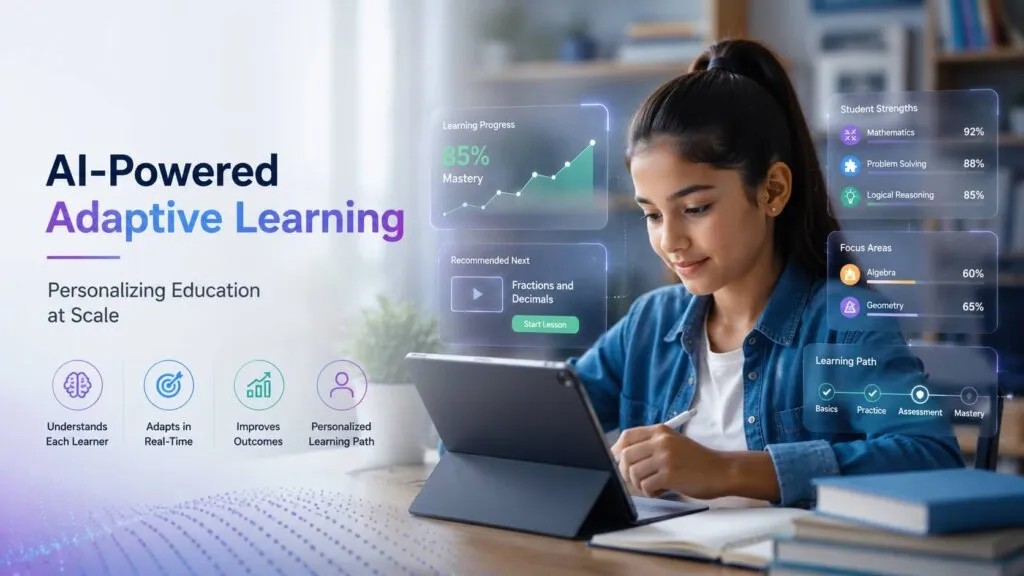
At its core, adaptive learning operates as a closed loop. The platform records how a learner interacts with content and assessments. It analyzes that data to detect patterns of understanding and struggle. Then it adjusts what comes next. This loop repeats continuously. That is what separates genuine adaptive learning from a course that simply lets students skip ahead after one placement test.
The quality of that loop depends on the learner model. This is the system's internal picture of what a student understands, where their gaps are and how they tend to learn. Building an accurate model is harder than it sounds. A wrong answer could mean the student does not understand the concept. It could also mean they misread the question, made a careless slip or guessed. A weak model treats all of these the same way. Its recommendations then feel generic rather than personal.
Techniques Behind the Learner Model
Several established techniques help. Item response theory estimates both question difficulty and learner ability from response data. Knowledge tracing models estimate how likely a student is to have mastered each skill over time. Machine learning models can combine these signals with behavior such as response time and hint usage. Our team recommends starting with interpretable models. Educators need to understand why the system made a recommendation.
Intelligent Tutoring Systems Versus Simple Content Adaptation
There is a real difference between basic adaptive content delivery and true intelligent tutoring systems. Both terms are used loosely in EdTech marketing. Basic adaptation adjusts difficulty and sequencing based on performance. It routes a student down an easier or harder branch of pre-built content.
Intelligent tutoring systems go further. They model a student's reasoning process, not just right or wrong answers. They give targeted hints and scaffolding that respond to the specific misconception behind an error. They do not simply serve an easier version of the same content.
| Capability | Basic adaptation | Intelligent tutoring |
|---|---|---|
| Adjusts difficulty | Yes | Yes |
| Diagnoses misconceptions | Rarely | Yes |
| Step-level hints | Limited | Yes |
| Build effort | Lower | Higher |
| Typical source | Off-the-shelf | Often custom |
This matters for investment decisions. Basic content adaptation is now common in off-the-shelf platforms. Intelligent tutoring systems that diagnose reasoning still need more sophisticated modeling. In many cases they also need custom development for a specific subject and student population.
Learner Data Privacy: What Most Adaptive Learning Coverage Skips
Adaptive learning depends on detailed data about how individual students learn. Every answer, hesitation and pattern of struggle is recorded. That makes learner data privacy a central design concern, not a compliance afterthought. Many deployments are built for a successful pilot first, with governance retrofitted later. That creates operational and compliance risk that is expensive to unwind once real student data is flowing.
In the United States, the Family Educational Rights and Privacy Act governs access to education records. The U.S. Department of Education's Student Privacy Policy Office publishes guidance for schools and vendors. Other regions have their own rules, such as GDPR in Europe.
What Responsible Learner Data Handling Requires
Getting learner data privacy right means more than generic security, although that matters too. It starts with data minimization:
- Collect only the data needed to power effective personalization.
- Avoid capturing data simply because it is technically possible.
- Give institutions, and where appropriate parents or students, clear visibility into what is collected.
- Explain how the data shapes each learner's experience.
- Set retention limits and delete data that is no longer needed.
Every extra data point is extra exposure if something goes wrong. ICANIO's Data and AI services treat learner data privacy as a design constraint that shapes the system. It is not a policy document written after development is finished.
Why Adaptive Learning Platforms Break as They Scale
A personalized learning platform that performs well in a small pilot can run into serious trouble at institution scale. The cause is rarely the personalization algorithm. Performance bottlenecks appear as interaction data grows by orders of magnitude. A system designed around batch processing for a small cohort often cannot keep up with real-time adaptation for a much larger population.
Infrastructure Decisions That Determine Success
ICANIO's DevOps and cloud engineering teams plan adaptive learning infrastructure with scale in mind from the first architecture decisions. Re-architecting a live learner modeling pipeline is far more costly than designing for scale at the outset. That holds even if the pilot never comes close to full volume. Event streaming, scalable storage and solid data engineering keep the adaptation loop responsive.
Integration depth matters just as much as raw capacity. An effective adaptive learning deployment must connect cleanly with the institution's learning management system, student information system and assessment tools. Otherwise it becomes another isolated data silo for busy faculty to manage by hand. Standards such as LTI from 1EdTech make these integrations much simpler. Our guide to LMS development covers this in more detail.
Where AI in Education Delivers the Clearest Value
Personalization is not equally valuable for every use case. In our education and e-learning work, a handful of applications of AI in education tend to deliver the clearest value.
Diagnostic Assessment and Gap Identification
Identifying exactly where a student's understanding breaks down is more useful than flagging a wrong answer. It gives educators actionable information. They can respond through automated remediation content. They can also flag specific students for human attention when a gap is large enough.
Pacing and Mastery-Based Progression
Adaptive learning lets students move at their own pace. They advance once they demonstrate mastery, not once a fixed time has passed. This addresses one of the most persistent limits of uniformly paced classrooms. Students are no longer held back by content they know, or pushed ahead before they are ready.
Reducing Instructor Administrative Burden
AI in education also takes on analysis work that once consumed instructor time. It can surface which students need attention and which concepts confuse a whole cohort. It can also show where curriculum content may need revision, based on aggregate performance data. This kind of automation frees teachers to spend more time teaching.
Measuring Whether Adaptive Learning Is Working
Institutions often default to engagement metrics such as time on platform, completion rates and login frequency. These are easy to pull from a dashboard. They matter, but they are a poor substitute for measuring whether students actually learn more effectively. An honest evaluation looks past engagement to learning outcomes.
| Metric type | Example | What it tells you |
|---|---|---|
| Engagement | Time on platform | Usage, not learning |
| Mastery | Skills mastered | Progress on goals |
| Speed | Time to proficiency | Efficiency of learning |
| Retention | Delayed quiz scores | Lasting understanding |
Comparing mastery rates, time to proficiency and retention weeks later gives a far clearer picture. It shows whether a personalized learning platform delivers real value or just keeps students busy. Our team helps education clients set up outcome-focused measurement early in a deployment. The field of learning analytics offers useful methods here.
The Gap Between Pilot Results and Sustained Outcomes
Pilots often show strong early results. Part of that reflects novelty and the close attention a pilot cohort receives. Sustained outcomes are the more honest signal. Measure them well after the launch excitement fades, when the system runs as routine infrastructure rather than a closely watched experiment.
Subject Domain Matters More Than Generic Features
The value of adaptive learning varies by subject. Treating every subject the same tends to produce mediocre results everywhere. Mathematics and other subjects with clear, hierarchical skill dependencies tend to suit adaptive learning well. A learner model can reasonably infer that trouble with a foundational concept predicts trouble with what builds on it.
Open-ended reasoning, extended writing and creative work are harder to model. Correctness is not binary in the same way. A system built around the clean logic of quantitative subjects often performs poorly when applied unchanged to humanities content. ICANIO's approach to intelligent tutoring systems starts by assessing which parts of a curriculum suit structured adaptation best. It does not assume one architecture will work equally well everywhere.
Building Adaptive Learning That Earns Trust
Successful deployments earn institutional trust gradually. They are transparent about how the system works. Teachers who can see why a system recommended an intervention are far more likely to act on it. An opaque suggestion with no visible reasoning is easy to ignore.
Our team builds explainability into the educator-facing side of adaptive learning platforms. The reasoning behind learner model assessments appears in plain language, not just as raw metrics. Accessibility matters too. Content and interfaces should follow the W3C Web Content Accessibility Guidelines, so every learner can benefit. Our article on human-in-the-loop AI explains why keeping educators in control matters.
How ICANIO Approaches Adaptive Learning Projects
ICANIO's education engagements usually begin with an assessment of existing systems and data infrastructure. Integration and scale decide far more of a deployment's success than the algorithm chosen at the start. Our teams bring together Data and AI, Application Development, DevOps and Cloud Engineering skills for these projects. Learner data privacy and scalability are treated as foundations, not afterthoughts.
One practical lesson stands out. Involve data privacy officers, IT teams and instructional staff early. Do not treat adaptive learning as a purely technical purchase. Projects that engage these stakeholders early tend to roll out more smoothly. Technical work only delivers value once an institution's people are ready and willing to act on what the system surfaces. Learn more on our education and e-learning industry page, or see our career development platform case study.
Conclusion
Adaptive learning can make education more personal, more efficient and more effective. The personalization itself is the easy part. The hard parts are accurate learner models, responsible data governance, scalable infrastructure and honest measurement.
Institutions that plan for these from day one see the benefits of AI in education hold up beyond the pilot. If you are planning an adaptive learning platform or intelligent tutoring system, contact ICANIO to discuss your goals with our team.
References
- Adaptive learning (Wikipedia)
- Intelligent tutoring system (Wikipedia)
- Mastery learning (Wikipedia)
- Item response theory (Wikipedia)
- Learning analytics (Wikipedia)
- FERPA (Wikipedia)
- U.S. Department of Education: Student Privacy
- 1EdTech: Learning Tools Interoperability
- W3C: WCAG Overview
Frequently asked questions
How is adaptive learning different from a regular online course?
Adaptive learning continuously adjusts content difficulty, sequencing and format based on real-time data about each learner's performance. A regular online course usually presents the same fixed path to every student, whatever their progress. The result is that adaptive learning can spend more time on a student's weak areas and less on topics they have already mastered.
How do adaptive learning and intelligent tutoring differ?
Basic adaptive learning adjusts difficulty and sequencing based on performance. Intelligent tutoring systems go further. They model the reasoning behind a student's errors and give targeted, misconception-specific guidance, often step by step. Intelligent tutoring usually needs more sophisticated modeling and, in many cases, custom development for a particular subject and learner group.
Why does learner data privacy matter so much in adaptive learning?
Adaptive learning depends on collecting detailed behavioral and performance data about individual students. That makes responsible data governance a core design requirement, not a step added after the system is built. Good practice includes data minimization, clear transparency for institutions and families, retention limits and compliance with laws such as FERPA or GDPR.
Why do adaptive learning platforms fail at larger scale?
Many platforms are designed and tested against a small pilot cohort. Infrastructure choices that worked at that size often cannot handle the data volume and integration demands of a full institution. Batch processing, weak integrations and missing monitoring are common causes. Designing for scale from the first architecture decisions avoids costly rework later.
How does AI in education reduce instructor workload?
AI in education can surface which students need attention and identify concepts causing widespread difficulty. It can also flag curriculum gaps based on aggregate performance data. That reduces the manual analysis instructors would otherwise do. Teachers can then spend more of their time on direct support, discussion and feedback for students.
Which subjects suit adaptive learning best?
Subjects with clear, hierarchical skill dependencies, such as mathematics, tend to suit adaptive learning best. A learner model can infer that gaps in foundational concepts will affect later topics. Open-ended subjects such as writing or creative work are harder to model, because correctness is not binary. They usually need different approaches and more human judgment.