Campus HVAC and Plant Health
A digital twin in education tracks air handlers, boilers and chillers against expected behaviour. It flags a stuck damper or failing pump before a lecture hall becomes unusable.
40% less unplanned downtime
Digital Twin for Education & E-Learning
We build a digital twin in education that mirrors your campus buildings, teaching spaces, labs and learning platforms in real time. It helps estates and IT teams cut waste, plan space and stay ready for exams.
Lecture Hall AHU-5
Science block · Hall 2
Remaining life
212 days
Room CO₂
725ppm
Supply air
17.4°C
Fan speed
62%
✓ All signals within physics baseline
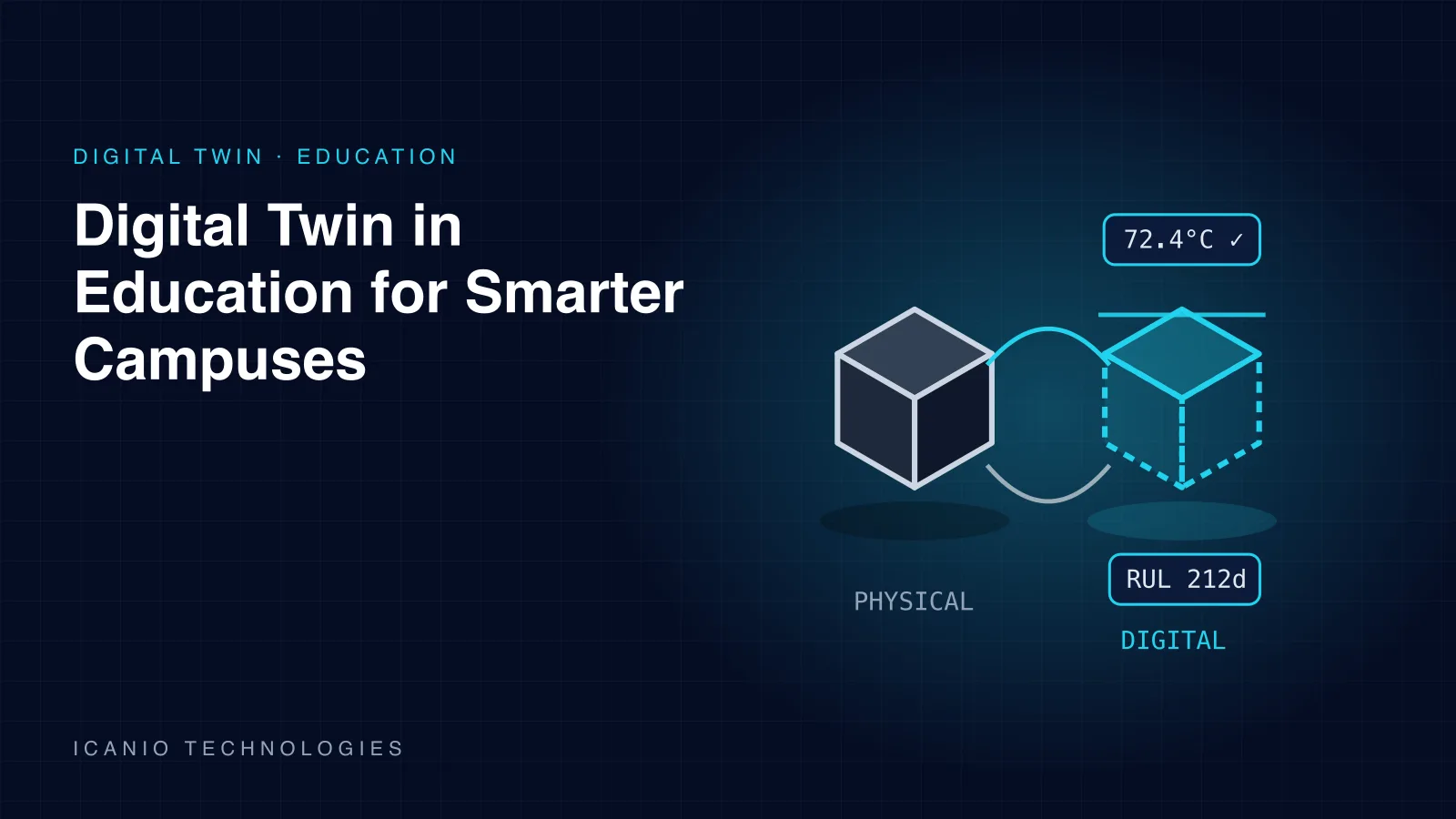
A digital twin in education is a live model of the places and platforms where learning happens: lecture halls, labs, residences, plant rooms and the online systems students log into. It updates from building, timetable and platform data as the term unfolds.
Universities and schools already hold this data in many places. Heating and ventilation sit in the building management system, room bookings in the timetable and learning platform health with IT. Estates teams often learn about a fault from a complaint.
Our team links those sources into one digital twin in education, then adds simulation and predictive AI. The twin flags failing equipment, shows which spaces are under-used and helps IT prepare the learning platform before exam week.
A digital twin in education is a virtual replica of a campus asset, building or service that stays synchronised with reality. Sensor readings, room bookings and platform metrics stream in continuously. The model reflects how the campus is running today.
Most real deployments are campus twins. They sit on top of building information models and building management data, then add occupancy and timetable context. The goal is safer, more efficient buildings and better use of space.
It is worth being clear about limits. A digital twin in education, as we build it, models buildings, equipment and platforms, not individual students. Personal learning analytics is a separate field with its own privacy duties, and we keep it out of scope unless you ask.
Campus operations definition
“An education digital twin is a continuously updated virtual model of campus buildings, spaces, equipment and learning platforms. It combines live building, timetable and system data with simulation and AI to predict issues and guide planning.”
Foundations
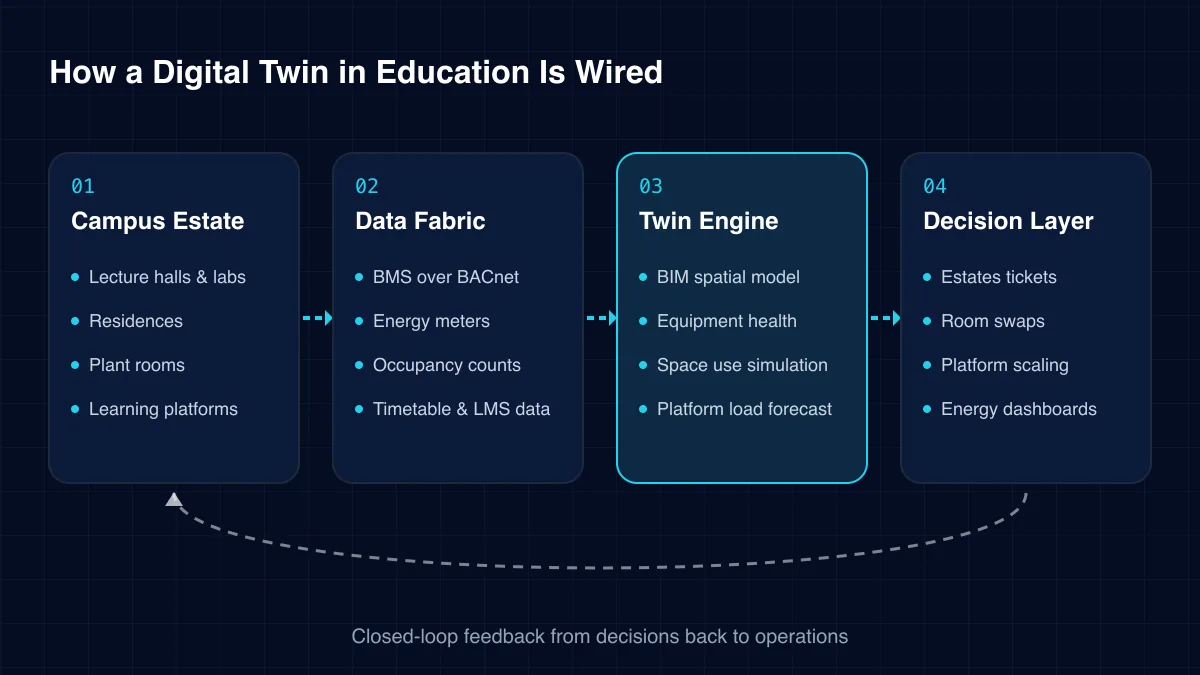
BIM files, floor plans and asset registers give the twin its shape. Where no BIM exists, we start from drawings and add detail over time.
BMS points over BACnet, meter readings and aggregated occupancy counts form the live feed. We read from the systems you already run.
Room bookings from the timetable and load data from the LMS explain why demand rises. They let the twin tell a busy lecture from a real fault.
Insights become maintenance tickets, room swaps or scaling actions. Estates, lab and IT managers approve each change, keeping people in charge.
Core capabilities
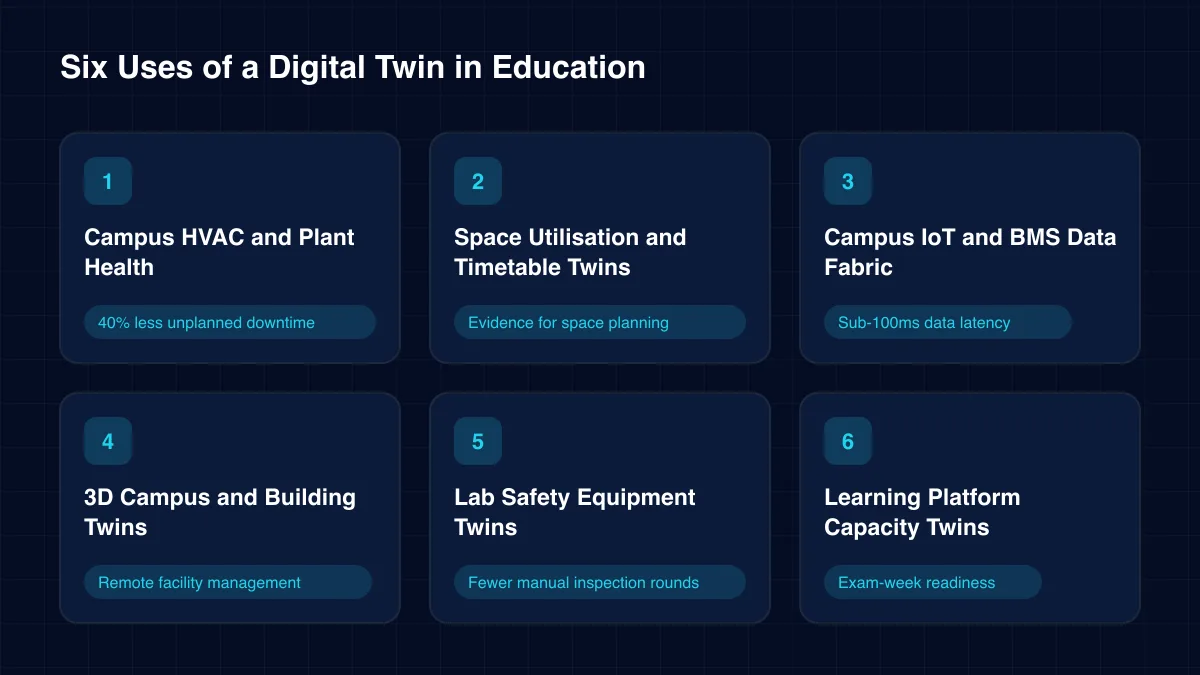
These are the places where a digital twin in education pays back fastest. Most institutions start with one building or one system, then widen the model.
A digital twin in education tracks air handlers, boilers and chillers against expected behaviour. It flags a stuck damper or failing pump before a lecture hall becomes unusable.
40% less unplanned downtime
Compare booked rooms with actual occupancy across the week. Planners see which spaces sit empty and test a new timetable before term starts.
Evidence for space planning
Unify BMS points, energy meters, lab sensors and occupancy counts into one real-time layer. Old and new buildings feed the same model.
Sub-100ms data latency
A spatial campus model overlays live status on each building and room. Estates teams inspect remotely and plan maintenance access without a site walk.
Remote facility management
Watch fume hoods, cold rooms and specialist equipment in teaching and research labs. The twin spots falling airflow or rising temperatures before they become a safety issue.
Fewer manual inspection rounds
Model LMS and assessment platform load against the exam calendar. IT teams see where capacity will run short and scale before students log in.
Exam-week readiness →Architecture
Every digital twin in education we build follows four layers. Building and platform data rises into the model, and approved tasks flow back to estates and IT.
01
02
03
04
Challenges we solve
These are the issues we hear most from estates, lab and IT leaders in education. Each one comes from data that exists but sits in separate systems.
A failing damper or fan leaves a lecture hall too hot or poorly ventilated. Staff notice only when students complain or leave.
Plant often runs to a fixed schedule, not to real occupancy. Empty rooms are heated and cooled through every holiday and quiet afternoon.
Timetables show rooms as booked, but many sit half empty. New buildings get planned while existing space is under-used.
Fume hood and cold room checks rely on periodic rounds. A fault that starts between checks can go unnoticed.
Online assessments put sudden load on the LMS. When it slows at 9am, thousands of students feel it at once.
Older buildings often lack drawings or sensors. Maintenance planning relies on memory and a few experienced staff.
Scope grows in stages. We usually start with one building or system and widen once the model earns trust.
Institutions often ask why they need a digital twin in education when they already run a BMS and a room booking system. The table shows the difference.
| Capability | BMS | Room booking | Campus digital twin |
|---|---|---|---|
| Live building data | ✓ Yes | No | ✓ Yes |
| Predicts equipment faults | No | No | ✓ Yes |
| Compares bookings with real use | No | No | ✓ Yes |
| Joins estates, timetable and LMS | No | Partial | ✓ Yes |
| Tests timetable or layout changes | No | No | ✓ Yes |
The value of a digital twin in education grows as more buildings, spaces and systems join the model.
Delivery
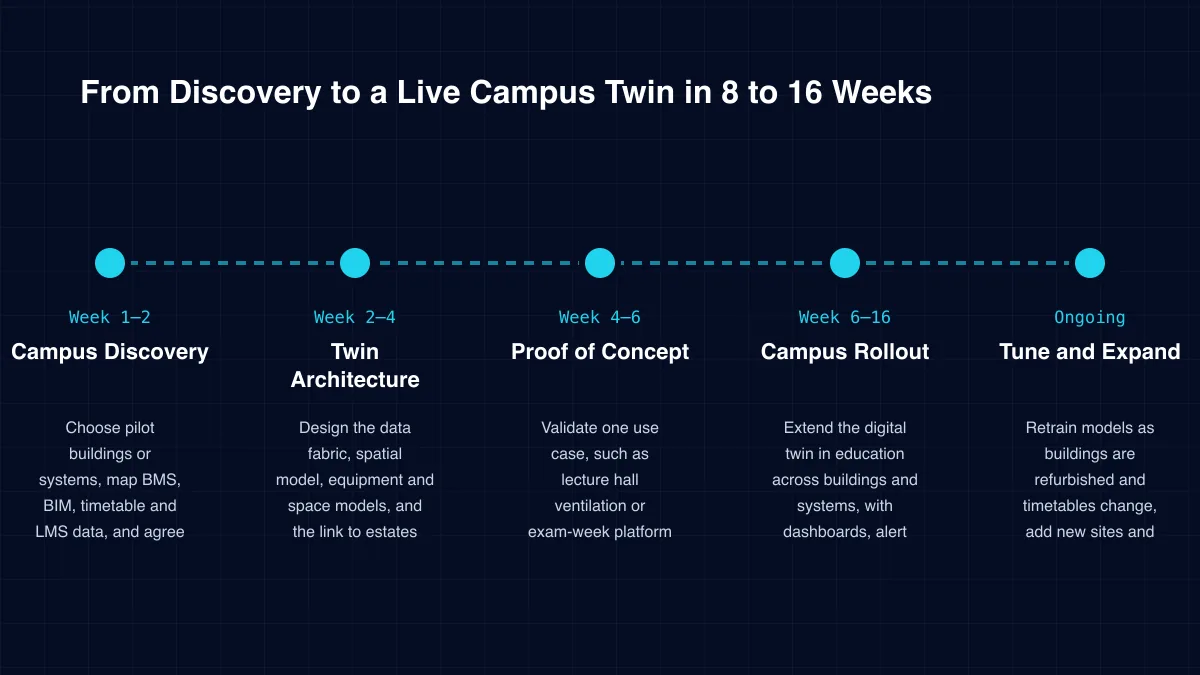
Week 1–2
Choose pilot buildings or systems, map BMS, BIM, timetable and LMS data, and agree privacy rules for occupancy data.
Week 2–4
Design the data fabric, spatial model, equipment and space models, and the link to estates and IT ticketing.
Week 4–6
Validate one use case, such as lecture hall ventilation or exam-week platform load, on your real data.
Week 6–16
Extend the digital twin in education across buildings and systems, with dashboards, alert rules and approval workflows.
Ongoing
Retrain models as buildings are refurbished and timetables change, add new sites and support teams under an SLA.
Many vendors can show a 3D campus flythrough. Far fewer can keep a digital twin in education useful for busy estates and IT teams. We recommend checking five things.
We have found that starting with one building and one clear problem is what wins long-term support from estates and finance teams.
A digital twin in education needs counts and conditions, not identities. Occupancy is aggregated per room, so no individual student is tracked. For US institutions we design with FERPA duties in mind, and all work follows ISO 9001 and ISO 27001 certified processes.
Building networks stay segmented from student systems. Data stays in your cloud tenancy or on premises, access is role-based and every model decision is logged. Local privacy rules are reviewed with your data protection team in discovery.
Start with last year's energy spend in the pilot buildings and the teaching hours lost to plant faults. Add emergency call-out costs. Together they set the ceiling your digital twin in education works against.
Then add space you can release or repurpose, fewer manual inspection rounds and avoided exam-day incidents. We agree these baselines in discovery, so results are measured against your own figures.
Technology stack
We choose tools per campus. These are the layers we most often assemble for a digital twin in education.
Building Data
BMSBACnetEnergy metersLab sensors
Spatial Models
BIMIFC filesFloor plansAsset registers
Academic Systems
TimetablingLMS metricsAssessment platforms
Data Fabric
Real-time streamingTime-series storage
Simulation & AI
Space use simulationXGBoostAnomaly detectionMLOps retraining
Visualisation
Campus mapsEnergy dashboards
 Free white paper · Digital TwinThe Industrial Digital Twin PlaybookA practical, vendor-neutral guide to taking an industrial digital twin from first idea to a production system your operators trust.Get the white paper →
 Free white paper · EducationEducation & E-LearningDigital Transformation Solutions for the Global EdTech LandscapeGet the white paper →
It models campus buildings, teaching spaces, lab equipment and learning platforms. A digital twin in education of this kind supports estates, lab and IT teams, not individual student profiling.
No. Many campuses have partial BIM or only drawings. We start from what exists and add detail building by building as the twin proves its value.
Occupancy is counted per room in aggregate, never per person. The twin holds no student records, and data stays in your environment under role-based access.
It can help. By comparing plant schedules with real occupancy, the twin shows where buildings are heated or cooled while empty. Savings depend on your buildings and are measured against your own baseline.
Yes. A platform twin models LMS and assessment load against the exam calendar. IT teams see pressure points in advance and scale capacity before students log in.
Most projects reach production in eight to sixteen weeks. A proof of concept on one building or system runs in weeks four to six, using your real data.
A digital twin in education turns scattered campus data into foresight. It shows which plant is failing, which rooms sit empty and when the learning platform will come under strain.
ICANIO combines building integration, simulation and predictive AI in one delivery team. We take a digital twin in education from discovery to production in eight to sixteen weeks, then keep it accurate as your campus changes.
By ICANIO Digital Twin Engineering Team · Published · Updated
Book a free 30-minute discovery call with our digital twin engineers. We will map your buildings, spaces and systems to a scoped twin with clear milestones. Contact us to get started.
Contact Our Digital Twin Team