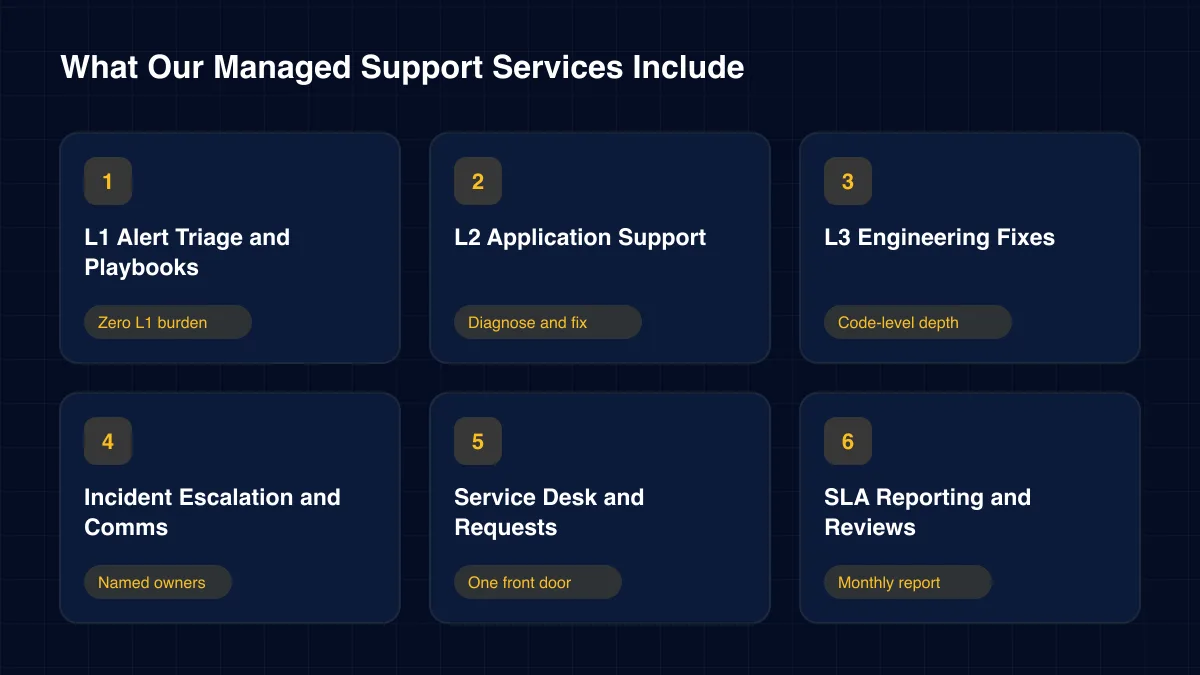
L1 Alert Triage and Playbooks
L1 engineers acknowledge alerts, run documented playbooks and close known issues. In our managed support services for a CDP, this layer removed alert triage from the core team.
Zero L1 burden →Managed Support Services
One accountable team takes every ticket from first alert to final fix. You get agreed response targets, a named escalation path and a monthly report that shows exactly what happened.
128
Resolved today
100%
Within SLA
24/7
On shift
Managed support services hand the daily care of your live software to a dedicated outside team. That team answers alerts, fixes faults and reports on every ticket. Your product engineers stop being the night shift.
Most companies reach this point the same way. The product grows, alerts multiply and the people who wrote the code become the people who watch it. Releases slow down. Burnout creeps in. Customers notice gaps before anyone inside does.
This guide covers how our managed support services are scoped, priced and run. It explains service levels, escalation, reporting and handover. It also shows how ICANIO took over 24x7 support for a customer data platform and removed its L1 alert load.
Managed support services are an ongoing contract in which a provider owns the run state of named applications. The scope, the hours and the response targets are written into a service level agreement. The provider staffs the desk, keeps the runbooks and answers for the results.
The key word is ownership. A staffing contract gives you people. A ticket-logging help desk gives you a queue. Managed support services give you an outcome: tickets closed within target, repeat faults removed and a steady platform.
A typical scope covers monitoring response, user issues, bug fixes, small changes, access requests and release support. Some clients add database care, security patching or reporting jobs. Each item gets a priority level and a response time.
ITIL gives the process vocabulary. Incidents restore service. Problems find root causes. Changes move fixes into production safely. Good managed support services use all three, so today's fix becomes next month's quiet night.
Plain-language definition
“Managed support services are an outsourced, SLA-backed operation that owns the monitoring, triage, fixing and reporting of live applications, so the client's own engineers can focus on building.”
Foundations
Priority levels, response targets and resolution targets agreed before day one and reported every month.
Every priority has a named owner at L1, L2 and L3, plus a client contact for business decisions.
Runbooks, known errors and system maps live in one place that both teams can read and edit.
A monthly review covers trends, breaches, root causes and the next set of improvements.
Core capabilities
Our managed support services are modular. You can start with one tier or one product, then add scope as trust builds.
L1 engineers acknowledge alerts, run documented playbooks and close known issues. In our managed support services for a CDP, this layer removed alert triage from the core team.
Zero L1 burden →L2 engineers read logs, check configuration and reproduce user faults. They fix data issues, restart failed jobs and write clear notes for the next shift.
Diagnose and fix
L3 engineers change code, tune queries and repair infrastructure. Fixes follow your branching and review rules, so nothing reaches production without approval.
Code-level depth →Severity rules decide who is paged and when. Status updates go to your stakeholders on a fixed rhythm while engineers work the problem.
Named owners →Access changes, report requests and how-to questions are logged, prioritised and closed. Users get one channel instead of chasing developers on chat.
One front door
Managed support services only earn trust when results are visible. We report response times, breaches, backlog age and root causes each month.
Monthly report →Architecture
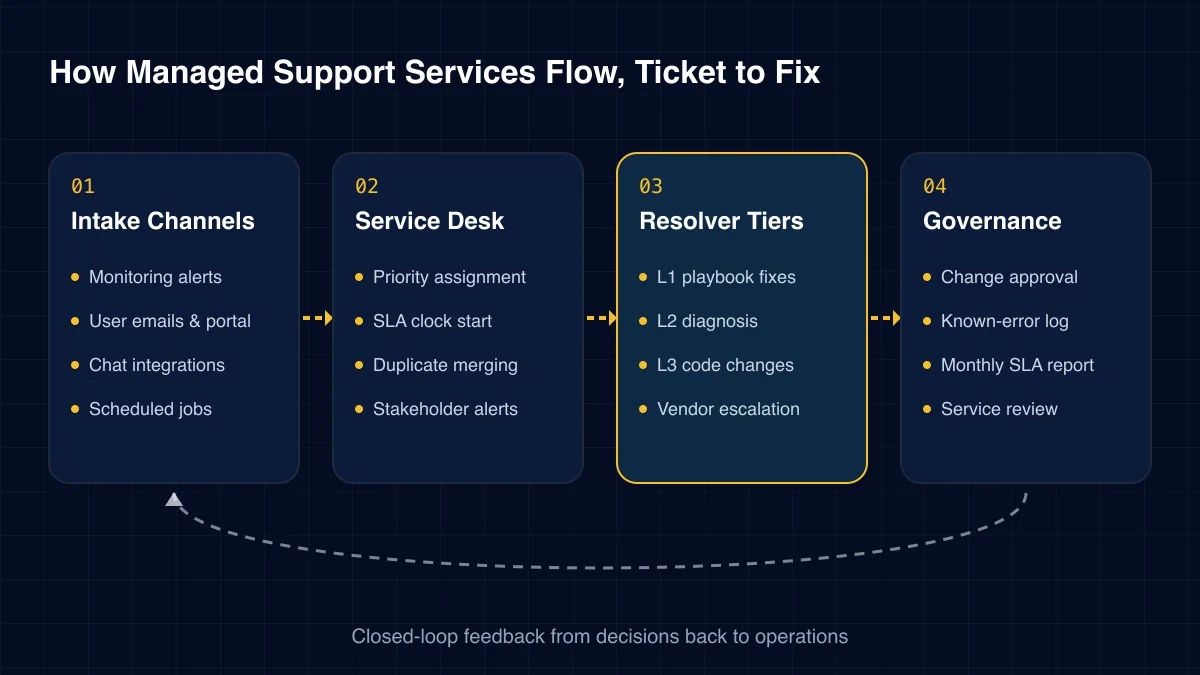
Every ticket follows the same path through our managed support services. Channels feed the desk, tiers resolve the work and reviews feed lessons back.
01
02
03
04
Challenges we solve
These symptoms tend to appear together. Each one costs focus, sleep or customer trust.
Sprint plans assume full capacity, yet a third of the week goes to tickets. Features arrive late and nobody can say exactly why.
Alerts land in a shared channel and everyone assumes someone else has it. Small warnings sit for hours and grow into outages.
One senior engineer knows how everything works. When they take leave, support quality drops and risk spikes.
Nobody can say how many tickets came in, how fast they closed or what caused them. Budget talks run on anecdotes.
Requests arrive by chat, email and hallway. Work is invisible, priorities clash and some requests are simply lost.
Your users are awake while your team sleeps. Faults found overnight wait until morning, and customers feel every hour.
Managed support services come in several shapes. The right one depends on coverage hours, system risk and in-house skills.
Buyers often compare three options. The difference is who owns the result.
| Factor | Staff augmentation | Help desk only | Managed support services |
|---|---|---|---|
| Owns SLA outcomes | No | Partial | ✓ Yes |
| Fixes code | ✓ Yes | No | ✓ Yes |
| Runbooks maintained | Partial | Partial | ✓ Yes |
| Monthly SLA reporting | No | Partial | ✓ Yes |
| Cover for leave and churn | No | ✓ Yes | ✓ Yes |
The benefits show up first in your engineers' calendars, then in your uptime numbers.
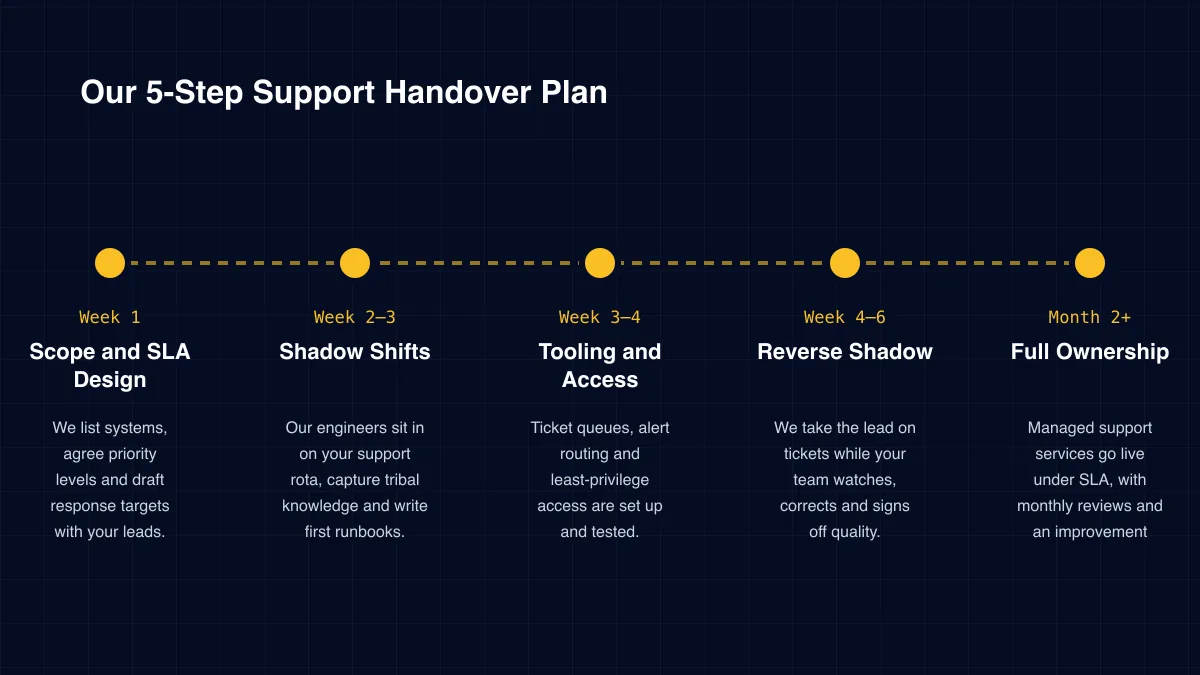
Delivery
Week 1
We list systems, agree priority levels and draft response targets with your leads.
Week 2–3
Our engineers sit in on your support rota, capture tribal knowledge and write first runbooks.
Week 3–4
Ticket queues, alert routing and least-privilege access are set up and tested.
Week 4–6
We take the lead on tickets while your team watches, corrects and signs off quality.
Month 2+
Managed support services go live under SLA, with monthly reviews and an improvement backlog.
Case study
A high-growth customer data platform had no dedicated first line. Global alerts landed on its core engineers, and incident logging was inconsistent. ICANIO set up a 24x7 managed support services framework with 23+ real-time dashboards, standard playbooks and defined escalation paths to L3 engineering. The platform reached 99.9% uptime, improved MTTR and carried zero L1 alert burden on the internal team.
Read the full case study →23+ real-time dashboards
Visibility across infrastructure, data pipelines and campaign delivery.
Standardised playbooks
Known alert patterns get the same fast response on every shift.
Defined escalation paths
Deeper issues reach qualified engineers instead of whoever is free.
Specialist services within our technical support engineering practice.
A proposal can promise anything. We recommend testing five points before you sign.
Strong managed support services feel boring to the client. Tickets close, reports arrive and the pager rarely rings. Our team aims for exactly that.
Support engineers touch production, so access is the first control. ICANIO grants least-privilege, time-bound access per role. Privileged sessions are logged, and credentials never sit in tickets or chat.
We work under ISO 9001 and ISO 27001 certified processes. Where your sector needs it, we align support workflows with SOC 2, HIPAA or PCI DSS controls, such as masked data in screenshots and approval before any data export.
Change control is the second control. No fix skips your review rules. Emergency changes are documented after the fact and reviewed at the next service meeting.
Count the hours your engineers spend on tickets, alerts and night calls each month. Price those hours at their real cost. That figure is the first baseline managed support services must beat.
Add the cost of slow response. Late fixes mean lost orders, missed campaigns or support calls. Even rough estimates show where faster response pays for itself.
Then watch the trend. In a healthy contract the ticket count per user falls over time, because repeat faults are removed. That falling curve is the clearest sign your managed support services are working.
Technology stack
We work inside your existing tools when they fit, and suggest proven options when they do not.
Ticketing & ITSM
ServiceNowFreshserviceZendesk
Alerting & On-Call
AlertmanagerSlack & Teams
Monitoring
Logs & Traces
Sentry
Knowledge
ConfluenceRunbook reposKnown-error log
Access & Security
SSO & MFASession recording
Our managed support services cover alert response, user tickets, bug fixes, small changes, access requests and release support. Scope is written per system, with a priority level and response target for each ticket type.
We agree priority levels with you first, usually P1 to P4. Each level gets a response target and a resolution target. Targets reflect business impact, so a payment outage is treated very differently from a report request.
Yes. Many clients start with out-of-hours cover while their own team handles the day. Because we have teams in India, Singapore and the USA, overnight for you is often daytime for us.
Contractors add hours. Managed support services add accountability. We own the SLA, keep the runbooks current, cover leave and report results. You manage one contract, not individual people.
Runbooks, the known-error log and system notes stay with you. We document as we go, so an exit handover is a planned step, not a scramble.
Most handovers take four to six weeks. That covers scoping, shadow shifts, tooling and a reverse-shadow phase. Urgent out-of-hours cover for one system can often start sooner.
How we deliver managed support services and the wider support engineering practice in each sector.
Your engineers should spend their best hours building, not watching dashboards at midnight. Managed support services make that possible by moving run work to a team built for it.
ICANIO brings a tested handover plan, L1 to L3 depth and honest monthly reporting. We start with a narrow scope, prove the results and grow from there. Contact us to scope managed support services for your platform.
By ICANIO Support Engineering Team · Published · Updated
Book a free discovery call. We will review your ticket history, alert volume and systems, then propose a support scope with clear service levels.
Contact Our Support Team