MANAGED SUPPORT · PLATFORM MONITORING · L1 SUPPORT
A proactive managed support services framework for high-velocity Customer Data Platforms, delivering proactive platform monitoring services and round-the-clock incident response across global campaign delivery infrastructure.
Quick Answer
What Is a 24x7 Managed Support Services Framework for CDPs?
A 24×7 managed support services framework is a structured L1 support services operation that monitors, triages, and resolves platform alerts around the clock, removing the operational burden from core engineering teams and ensuring continuous uptime for high-velocity platforms. ICANIO implemented a proactive managed support services engagement that delivered 99.9% uptime, significantly improved Mean Time to Resolution (MTTR), and zero L1 alert burden on the internal engineering team for a high-growth Customer Data Platform operating under constant global traffic. ICANIO Technologies delivered this as a full-stack engineering engagement, deploying 23+ real-time dashboards, standardized playbooks, and defined escalation paths. Together, these converted a reactive, fatigued support environment into a structured, transparent 24×7 IT support operation.
Executive Summary
Eliminating Alert Fatigue and Restoring Engineering Focus
High-growth Customer Data Platforms face a structural support challenge that becomes more acute as they scale. The same global traffic volumes that validate the platform’s commercial success generate a continuous stream of infrastructure alerts, data pipeline events, and system health signals that require monitoring, triage, and resolution around the clock. Without dedicated managed support services to absorb and process those signals, the internal engineering team becomes the de facto triage team, losing development capacity to alert triage, experiencing systematic fatigue, and degrading both platform reliability and product velocity simultaneously.
ICANIO approached this as a full-stack engineering challenge. The objective was to design and implement a 24×7 IT support framework that could take full ownership of L1 alert triage, deploy dashboard coverage across all infrastructure and data pipeline environments, execute standardized playbook-driven responses for known incident patterns, and define clean escalation paths to L3 engineering for issues requiring deeper intervention. The result was a managed support services operation that eliminated alert fatigue from the internal engineering team entirely, restored the engineering team’s capacity for development work, and delivered the 99.9% uptime that a global high-velocity CDP requires.
“Alert fatigue in a high-growth platform is not a monitoring problem. It is a structural gap where the absence of a dedicated managed support services layer forces your best engineers to do L1 triage instead of building product.”
The Challenge
Six Operational Failures Driving Alert Fatigue and Platform Risk
Without dedicated managed support services, every gap in a high-velocity platform’s support structure compounds the next. Unacknowledged alerts escalate to incidents. Incidents without defined escalation paths reach the wrong team. Engineers pulled into L1 triage lose development time. Development time lost to triage work slows product velocity. Slower product velocity increases competitive risk for a high-growth platform that depends on consistent delivery. Six distinct failure modes defined the operational state this engagement addressed.
Unstructured L1 Ownership Burdening Core Teams
No dedicated first-line triage layer existed to absorb platform alerts. Every alert requiring attention landed on the core engineering team, creating a structural conflict between development work and operational responsibilities that degraded both.
Alert Overload Without 24x7 Coverage
Frequent global alerts overwhelmed existing internal operations without round-the-clock coverage. High-volume alert streams from infrastructure, data pipelines, and campaign delivery systems generated more noise than any ad-hoc team could triage reliably across all time zones.
Slow Resolution from Absent Round-the-Clock Triage
The absence of continuous triage meant that alerts triggered outside business hours accumulated without response, allowing minor issues to escalate into platform incidents before any team could act.
No Escalation Structure for Critical Issues
The absence of defined escalation paths caused delays in critical issue handling. Without a structured escalation framework routing issues to the right team at the right level, resolution depended on whoever happened to be available rather than whoever was specifically qualified to resolve it.
Inconsistent Incident Logging Reducing Traceability
Inconsistent incident logging across informal channels hindered long-term platform reliability and traceability. Without structured documentation, audit trails were incomplete, root cause analysis was unreliable, and recurring patterns remained invisible.
Managed Support Services Solutions Provided
A Six-Component Managed Support Services Framework
ICANIO designed and deployed a proactive managed support services framework that addresses every failure mode in the client’s support operation. Each component of the managed support services architecture feeds directly into the next, ensuring that platform monitoring services coverage, playbook-driven triage, node scaling, escalation paths, and reporting operate as a single connected support system across all infrastructure and data pipeline environments.
Real-Time Monitoring Across 23+ Dashboards
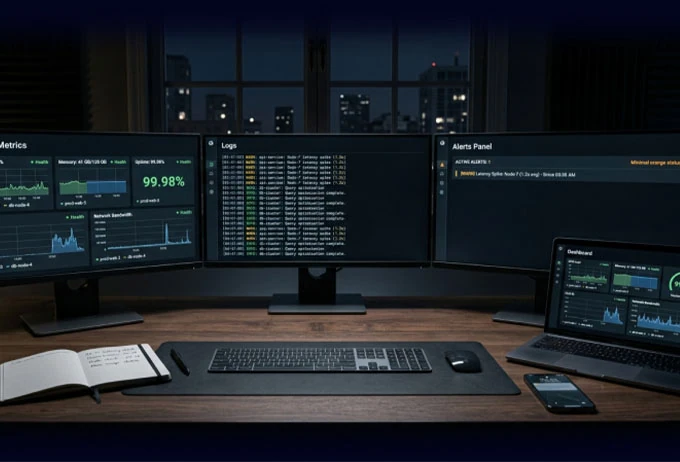
Deployed platform monitoring services across 23+ infrastructure and data pipeline dashboards, giving operations teams real-time visibility into system health and alert signals.
Rapid L1 Triage Using Standardized Playbooks
Implemented L1 support services triage using standardized playbooks for known incident patterns, enabling engineers to resolve most platform alerts without escalation.
Node Scaling and Proactive Job Management
Deployed proactive node scaling and job restart within the 24×7 IT support framework, enabling the team to address infrastructure health issues before they escalate.
Defined SOPs for L3 Escalation
Established structured incident management services escalation paths and SOPs for seamless handover from L1 support services teams to L3 engineering with full context and without delay.
Transparent Incident Reporting and Audit Trails
Implemented structured incident reporting with audit trails, shift reports, and incident logs, providing full traceability and root cause analysis support.
Continuous Infrastructure Health Checks
Deployed continuous 24×7 IT support health checks across global campaign delivery systems, ensuring monitoring coverage extends to every component of the CDP environment.
Business Outcomes
Measurable Results Across Uptime, Speed, and Engineering Capacity
The managed support services framework fundamentally changed how this CDP manages its operational support, converting a reactive, engineer-burdened alert environment into a structured 24×7 IT support operation where first-line ownership is clear, escalation workflows are defined, and monitoring coverage is continuous.
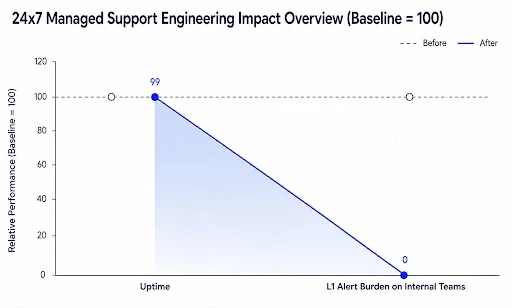
Managed support services outcomes: 99.9% uptime, faster resolution through playbook-driven triage and zero L1 alert burden on internal engineering teams.
Significantly Improved
Mean Time to Resolution through playbook-driven triage and rapid escalation.
Zero Burden
On internal engineering teams for L1 alerts through dedicated managed support services ownership.
Full Transparency
Through structured shift reports, audit trails, and incident logs.
99.9%Uptime
Via round-the-clock proactive platform monitoring services and managed support services coverage.
Automated Workflows
Via playbook-driven SOPs and incident management services escalation paths.
Seamless Scalability
For global high-velocity CDPs through continuous platform monitoring services coverage.
Key learnings
What This Engagement Proves for Platform Support Leaders
Managed Support Must Come Before a Platform Scales
The point at which a high-growth platform most needs a dedicated managed support services layer is precisely the point at which it is least likely to have one. Fast-growing platforms typically reach L1 support services crisis through gradual accumulation: a few engineers absorbing alert triage as a secondary responsibility, a few false positives accepted as manageable noise, a few delayed resolutions treated as acceptable latency. By the time the alert fatigue becomes operationally visible, the engineering team has already absorbed months of compounding productivity loss. Platform engineering leaders commissioning 24×7 IT support frameworks should treat managed support services as a foundational infrastructure requirement that is implemented before alert volume becomes a constraint, not after it becomes a crisis.
Playbook-Driven L1 Support Services Shifts from Reactive to Proactive
The most significant operational change this engagement delivered was not the managed support services coverage itself but the standardized playbook layer that made that coverage actionable. Without playbooks, 24×7 monitoring produces awareness of incidents without the ability to resolve them consistently. Monitoring teams that can detect every alert but cannot respond to most of them without escalation do not reduce the L3 engineering burden. They transfer it. ICANIO’s L1 support services playbook framework gave the support team the authority and the procedure to resolve known incident patterns immediately, at the point of detection, without touching the engineering team. Incident management services leaders evaluating support frameworks should treat playbook completeness as a primary quality metric, not an operational nice-to-have.
Incident Management Services Transparency Converts Support into Value
The shift reports, audit trails, and structured incident logs delivered through this engagement were not administrative overhead. They were the mechanism that converted managed support services from a cost centre into a strategic operational asset. When incident management services data is captured consistently, root cause patterns become visible, recurring platform issues surface as optimization targets, and the monitoring investment can be directed at the signal sources generating the highest incident volume. Platform leaders who treat support reporting as a compliance requirement rather than an intelligence source leave most of the strategic value of their support investment unrealized.
Conclusion
From Alert Fatigue to a Structured, Transparent 24x7 Operation
Alert fatigue in a high-growth Customer Data Platform is not a technical problem with a technical fix. It is an organizational gap where the absence of a dedicated managed support services layer forces engineering teams to absorb operational work that should be owned by a specialized L1 support services function. This engagement demonstrates that with the right monitoring infrastructure, playbook-driven triage, and structured escalation paths, any high-velocity platform can achieve 99.9% uptime, zero engineering burden from L1 alerts, and the operational transparency that long-term platform reliability requires.
By treating this challenge as a structural engineering problem rather than a staffing issue, ICANIO helped this CDP operator build an incident management services framework that will continue to deliver compounding operational advantage as global traffic volumes grow. The 99.9% uptime, the zero-burden engineering model, and the significantly improved MTTR are not one-time outcomes. They are the operational baseline from which every future platform scaling decision this team makes will be built.
Related Resources
These managed support services sit within ICANIO's support engineering practice. Our team delivers round-the-clock monitoring through support engineering services. Infrastructure work links to our cloud and DevOps engineering practice. Data pipeline support draws on our data engineering and automation services. Related work includes an infrastructure monitoring platform. See our industry solutions for other sectors. To plan similar coverage, contact ICANIO.
- Support Engineering Services
- Industry Solutions
- Best Infrastructure Monitoring Platform: 99.9% Uptime
- DevOps Observability Platform: 99.9% Uptime
- Structured Logging and Production Observability
References
- Incident management (ITSM): Wikipedia overview of IT incident handling.
- Mean time to repair: Wikipedia overview of the MTTR metric.
- Managing Incidents: Google SRE book chapter on incident response.
- Customer data platform: Wikipedia overview of CDP software.
Frequently asked questions
Common Questions About Managed Support Services for CDPs
What are managed support services and how do they cut alert fatigue?
Managed support services are a structured operation taking full ownership of platform alert monitoring, triage, and first-line resolution, removing the operational burden from core engineering teams. ICANIO's framework reduced alert fatigue by deploying platform monitoring services coverage across 23+ dashboards and giving the support team standardized playbooks to resolve known incident patterns immediately, without escalating to engineering for issues within defined response parameters.
How does 24x7 IT support improve uptime for Customer Data Platforms?
24x7 IT support improves platform uptime by ensuring that alerts generated outside business hours are monitored, triaged, and resolved immediately rather than accumulating until the next business day. ICANIO's 24x7 IT support framework achieved 99% uptime for this CDP by combining continuous monitoring coverage with escalation paths that route unresolved issues to the appropriate engineering team with full context before they become platform incidents.
What is L1 support services and how does it differ from L3?
L1 support services is the first-line alert response function that handles known, playbook-addressable incidents through standardized triage and resolution procedures, without requiring specialist engineering intervention. ICANIO's L1 support services framework resolved the majority of platform alerts through playbook-driven workflows, escalating only novel or complex issues to L3 engineering via defined incident management services paths, preserving engineering capacity for development work rather than operational triage.
How do incident management services escalation paths work?
Incident management services escalation paths define the conditions, procedures, and routing rules that determine when the first-line team escalates a platform issue to a higher support tier, which team receives the escalation, and what context is transferred at handover. ICANIO's incident management services framework established Standard Operating Procedures for every escalation scenario within scope, ensuring that issues requiring L3 engineering reach the right specialist with full incident history. This eliminates the context loss and resolution delays that characterize informal escalation in ad-hoc support environments.
What does platform monitoring services coverage include for CDPs?
Platform monitoring services coverage for a CDP includes real-time monitoring of infrastructure health, data pipeline status, job execution, node performance, and campaign delivery system signals across all environments in scope. ICANIO's platform monitoring services deployment covered 23+ dashboards across the full CDP infrastructure, providing the managed support services team with current health data for every system in scope and enabling proactive 24x7 IT support intervention before alerts escalate to incidents.
How long does managed support services implementation take?
Managed support services implementation timelines depend on platform complexity, the number of infrastructure and data pipeline environments in scope, the maturity of existing escalation documentation, and the volume of playbooks required to cover known alert patterns. ICANIO's platform monitoring services deployment follows a structured onboarding approach that prioritizes coverage of the highest-volume alert sources first, enabling measurable uptime and incident response outcomes from early deployment while playbook coverage and escalation path documentation are expanded progressively.