Bug Fixing and Root Cause
We reproduce reported faults, fix the cause and add a test so the bug cannot return. Corrective work in our application maintenance services always ends with that test.
Fix plus test
Application Maintenance Services
Bug fixes, patches, upgrades and small features on a steady cadence. Your applications stay current, secure and pleasant to work on, long after launch.
128
Resolved today
100%
Within SLA
24/7
On shift
Application maintenance services keep live software healthy after the launch party ends. They fix bugs, patch vulnerabilities, upgrade frameworks and add small improvements on a steady rhythm. Without them, even good code ages fast.
Every dependency in a modern app has its own release cycle. Runtimes reach end of life. Libraries publish security fixes. Browser and mobile platforms change their rules. Skip a year of updates and a simple patch becomes a risky project.
This page explains how ICANIO delivers application maintenance services. It covers the four types of maintenance, how we plan upgrades and how we keep changes safe. It also shows how we upgraded a healthcare frontend from React 16 to React 18 and fixed 186 outdated packages.
Application maintenance services are the ongoing engineering work that keeps a production application correct, secure and useful. The work is planned, prioritised and delivered in small, tested releases.
The international standard ISO/IEC 14764 describes four kinds of software maintenance. Corrective work fixes faults. Adaptive work keeps the software running as its environment changes. Perfective work improves performance or usability. Preventive work removes problems before they cause failures.
Healthy maintenance blends all four. A team that only fixes bugs falls behind on upgrades. A team that only upgrades ignores user pain. Good application maintenance services balance the backlog every month.
Maintenance is also where technical debt is paid down. Small refactors made alongside fixes keep the codebase readable, which makes every future change cheaper and safer.
The mix changes with the age of the product. A young app mostly needs perfective work as users ask for more. A mature app needs more adaptive and preventive work as its platforms age. Application maintenance services should shift their balance as the product moves through these stages.
Working definition
“Application maintenance services are a planned, ongoing engineering service that corrects defects, adapts software to platform change, improves it in small steps and prevents future failures.”
Foundations
Changes ship in small batches, so each one is easy to test and easy to roll back.
Every library and runtime is tracked against its support dates and known vulnerabilities.
Regression suites guard core journeys, so fixes never break what already works.
A fixed share of each cycle goes to refactoring and cleanup, not only new requests.
Core capabilities
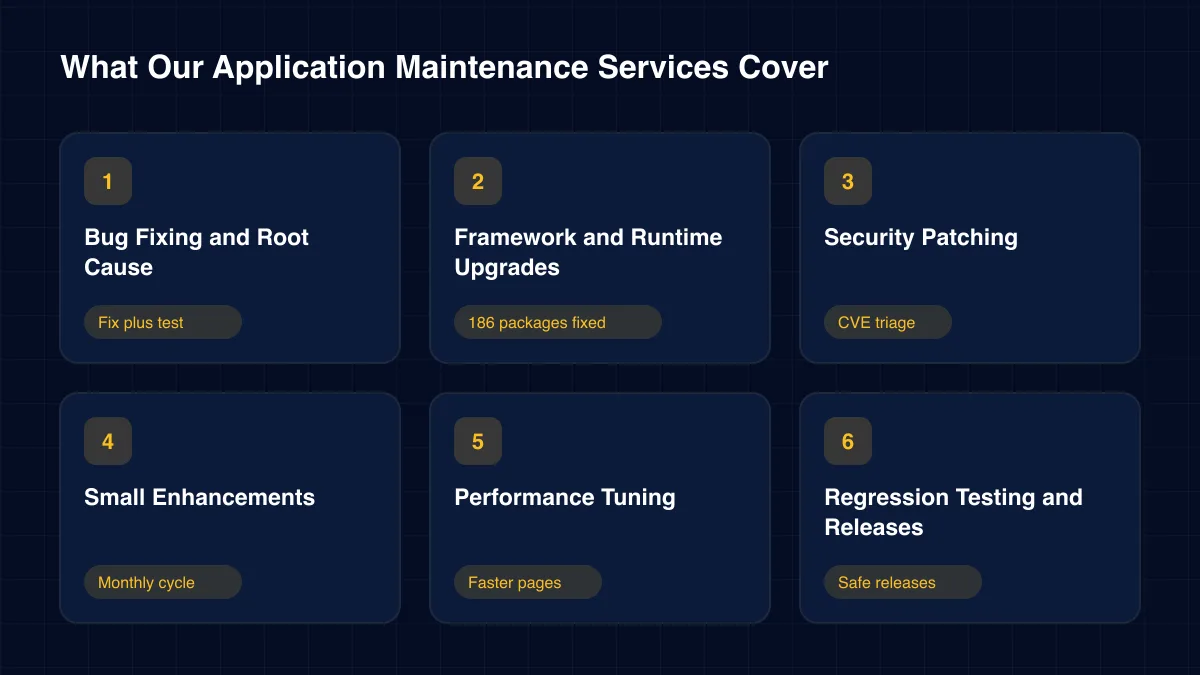
Our application maintenance services can cover one product or a portfolio of apps, with priorities agreed each month.
We reproduce reported faults, fix the cause and add a test so the bug cannot return. Corrective work in our application maintenance services always ends with that test.
Fix plus test
We plan staged upgrades of runtimes and frameworks. For a healthcare client we moved React from 16.3.1 to 18.3.1 and fixed 186 outdated packages.
186 packages fixed →Dependency scanners flag known CVEs. We triage them by severity and exposure, then patch, test and release on an agreed timeline.
CVE triage
Reports, fields, exports and workflow tweaks are scoped, estimated and delivered in the monthly cycle. Users see steady progress without a new project.
Monthly cycle
Slow pages and heavy queries are profiled and fixed. Perfective work in application maintenance services keeps the app fast as data grows.
Faster pages →Automated suites and CI pipelines check every change before release. This work sits inside our wider support engineering services.
Safe releases →Architecture
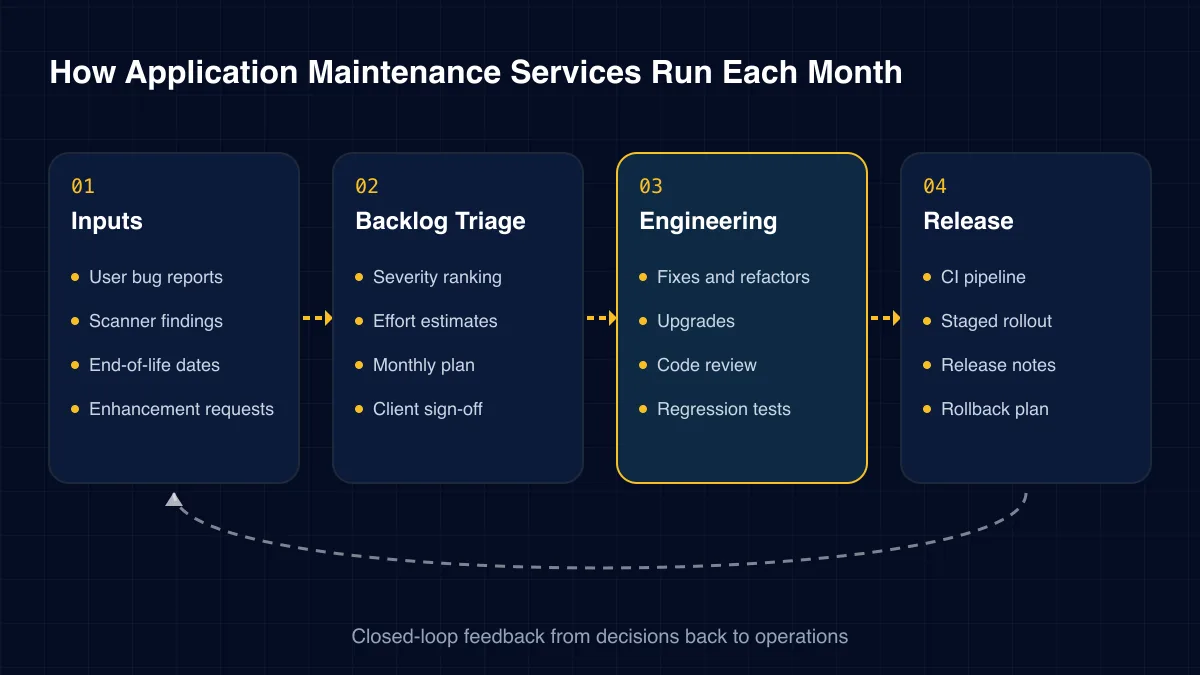
Our application maintenance services follow a monthly loop. Requests and signals come in, the backlog is ranked, changes are built and tested, then released.
01
02
03
04
Challenges we solve
These symptoms creep in slowly. By the time they are obvious, fixing them costs far more.
The framework is several major versions behind. Each delay makes the eventual jump harder and riskier.
Outdated packages conflict with each other. Developers lose hours fighting the build instead of shipping.
Scanners report known vulnerabilities, but nobody has time to triage them. Risk grows silently.
Simple changes sit behind big projects. Users find workarounds and lose faith in the team.
Knowledge walked out the door. Nobody wants to touch the code for fear of breaking it.
A runtime, payment SDK or app store rule is about to change. Missing the date means downtime or removal.
These categories come from ISO/IEC 14764. Our monthly plans balance all four.
Here is how three common approaches handle the same year of change.
| Factor | Ad hoc fixes | Hourly retainer | Managed maintenance |
|---|---|---|---|
| Planned upgrades | No | Partial | ✓ Yes |
| Security patch timeline | No | Partial | ✓ Yes |
| Regression testing | Partial | Partial | ✓ Yes |
| Monthly reporting | No | Partial | ✓ Yes |
| Technical debt reduction | No | No | ✓ Yes |
Steady maintenance pays off in security, speed and team morale.
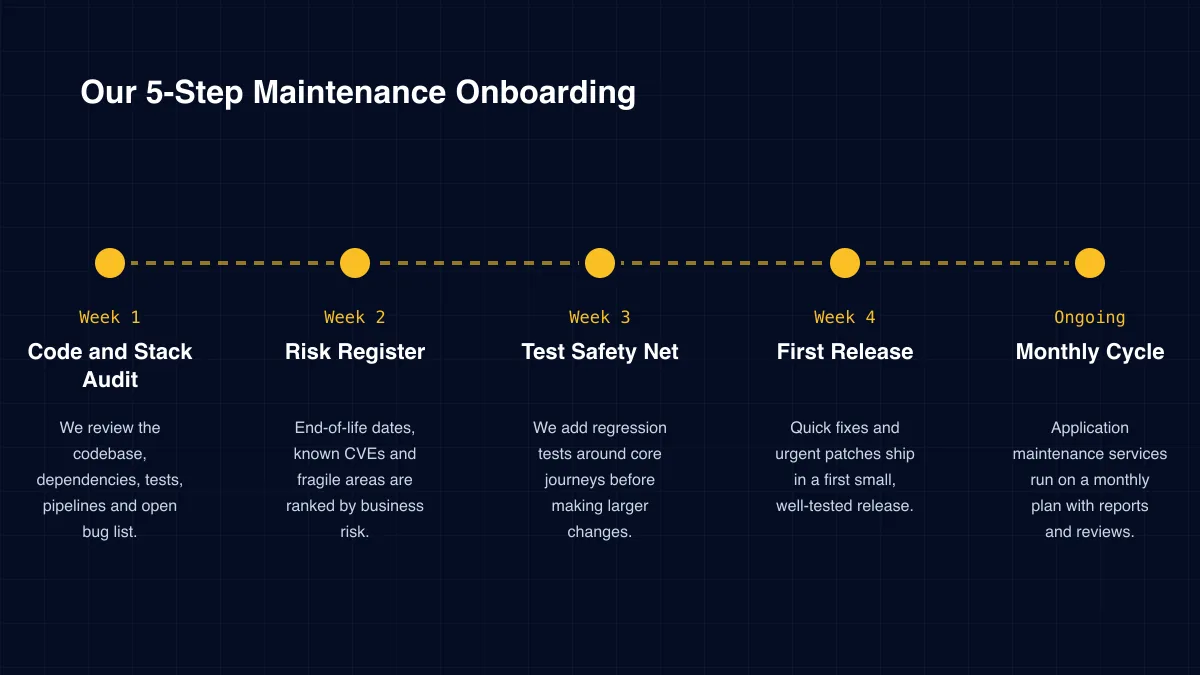
Delivery
Week 1
We review the codebase, dependencies, tests, pipelines and open bug list.
Week 2
End-of-life dates, known CVEs and fragile areas are ranked by business risk.
Week 3
We add regression tests around core journeys before making larger changes.
Week 4
Quick fixes and urgent patches ship in a first small, well-tested release.
Ongoing
Application maintenance services run on a monthly plan with reports and reviews.
Case study
A healthcare client's frontend ran React 16.3.1 with 186 outdated packages causing dependency conflicts and build instability. Deprecated APIs such as useHistory and Switch blocked progress. ICANIO upgraded React to 18.3.1 in stages, moved routing to React Router v6 hooks, refactored components and Storybook, and added regression testing and monitoring. Developer productivity tripled.
Read the full case study →React 16.3.1 to 18.3.1
Incremental steps avoided a risky big-bang cutover.
React Router v6 hooks
Deprecated routing APIs were replaced with current patterns.
Regression testing
Tests caught breakages before they reached users.
Specialist services within our technical support engineering practice.
Maintenance is a long relationship. We recommend checking these five points first.
Great application maintenance services are steady rather than heroic. Our team aims for small, safe releases every month.
Many breaches exploit known vulnerabilities in unpatched software. That makes patching one of the most valuable parts of application maintenance services. We scan dependencies continuously and track public advisories.
ICANIO works under ISO 9001 and ISO 27001 certified processes. Code changes follow review and approval rules, secrets stay out of repositories and production access is limited to named engineers.
Where your sector requires it, we keep evidence for audits. Patch timelines, test results and release approvals are recorded, which supports HIPAA, PCI DSS and SOC 2 reviews.
We also keep a software bill of materials for each application. It lists every library and version in use. When a new advisory is published, our team can see within minutes which of your apps are affected.
Deferred maintenance is a loan with high interest. Each skipped upgrade adds cost to the next one. Steady application maintenance services keep that interest low.
Measure open bug age, unpatched vulnerabilities, versions behind current and time spent fighting builds. These should all fall within a few cycles.
Compare the monthly fee with the cost of an emergency rewrite or a breach. In most portfolios, planned maintenance is far cheaper than the crisis it prevents.
Do not forget developer retention. Engineers leave teams that are stuck on old, fragile code. Well-run application maintenance services keep the codebase modern enough that people enjoy working on it.
Technology stack
Our engineers maintain applications across common web, mobile and backend stacks.
Frontend
Vue
Backend
Mobile
Testing
JestPlaywrightStorybook
Dependency Health
Renovate
Delivery
Our application maintenance services include bug fixes, security patches, framework and runtime upgrades, performance tuning, small enhancements and regression testing, delivered in planned monthly releases.
Yes. We start with a code and stack audit, add tests around core journeys and document what we learn. Then we take over changes safely.
Critical vulnerabilities skip the monthly cycle. We assess exposure, patch, test and release on an expedited path agreed in the contract.
Most clients choose a fixed monthly capacity sized to their portfolio. Larger upgrades can be scoped separately so the regular cycle is not disrupted.
Support keeps the app running day to day and restores service when it fails. Maintenance changes the code itself to fix, adapt and improve it. Many clients combine both.
Typically once or twice a month, plus urgent fixes when needed. Small, regular releases keep risk low and make rollbacks simple.
How we deliver application maintenance services and the wider support engineering practice in each sector.
Software does not stay finished. Platforms change, threats appear and users ask for more. Application maintenance services keep your applications ready for all three.
ICANIO brings stack depth, careful upgrade planning and a testing habit to every engagement. We maintain cloud apps for healthcare, fintech, retail and manufacturing clients. Contact us for a code and stack audit, and see how application maintenance services could lower your risk.
You can start with a single application and a short risk register. Once the first releases land safely, adding more apps to the same monthly cycle is straightforward.
Whichever path you choose, you keep full visibility. Every change, test and release is visible in your own repositories and tickets.
By ICANIO Support Engineering Team · Published · Updated
Book a free discovery call. We will review your stack and dependency health, then propose a maintenance plan with clear monthly priorities.
Contact Our Maintenance Team