Infrastructure monitoring services watch the machines, networks and platforms your software runs on. They collect health data every few seconds and raise an alert when something drifts. Done well, your team hears about a failing disk before a customer hears about a broken page.
The trouble is that most estates grow their monitoring in layers. One tool for servers, another for the cloud, a third for the network. Each one sends its own alerts. Soon nobody trusts any of them, and real failures hide in the noise.
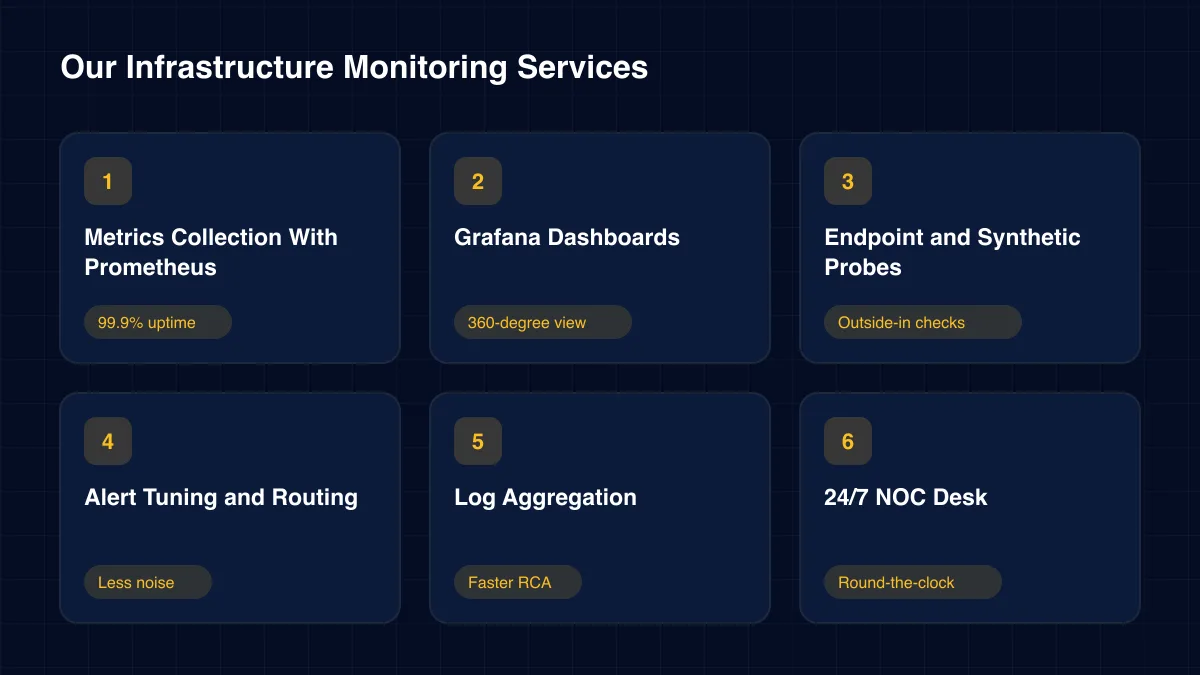
This page explains how ICANIO designs and runs infrastructure monitoring services. It covers what to measure, how to tune alerts and how a NOC desk responds. It also shows how one enterprise partner reached 99.9% uptime and 80% faster recovery on a Prometheus and Grafana platform we built.
What Are Infrastructure Monitoring Services?
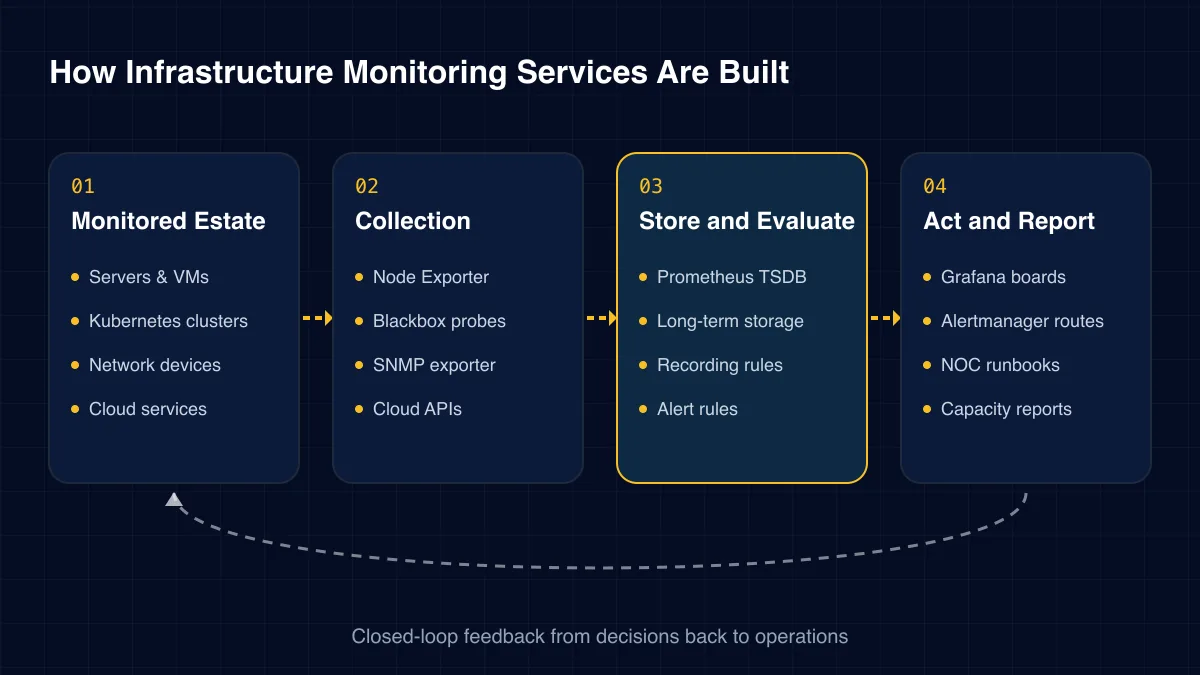
Infrastructure monitoring services are the tools, rules and people that track the health of compute, storage, network and platform layers. They cover physical servers, virtual machines, containers, cloud services and the links between them.
Two methods guide what we measure. The USE method checks utilisation, saturation and errors for every resource such as CPU, memory and disk. The RED method checks rate, errors and duration for every service endpoint. Together they cover both the box and the work running on it.
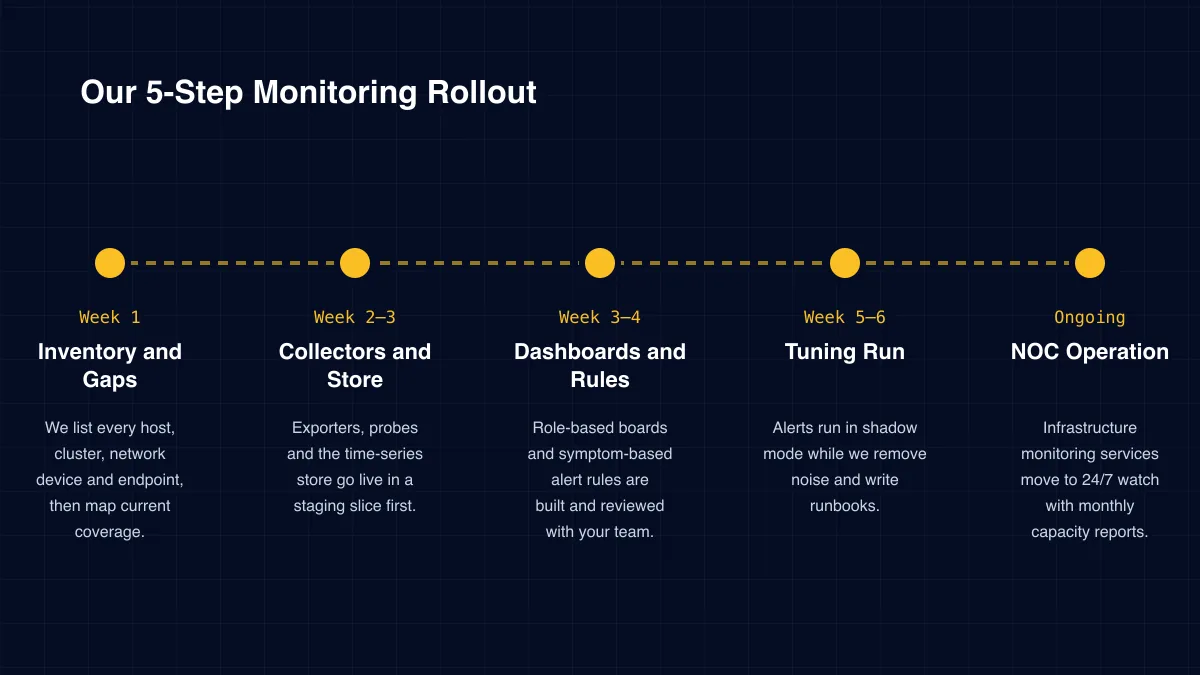
Monitoring is not only about collection. Data must be stored long enough for trend analysis and capacity planning. Alerts must route to the right person with a clear runbook. A NOC desk must watch the board around the clock.
Infrastructure monitoring services differ from application performance tools. They focus on the platform layer, though good setups link both, so an engineer can trace a slow API back to a saturated disk in minutes.
Industrial firms add one more layer. Manufacturing plants and logistics hubs often run edge servers and IoT gateways far from any data centre. We bring those devices into the same view, so a failing gateway on a factory floor is treated like any other host.
Working definition
“Infrastructure monitoring services continuously collect, store and alert on health data from servers, networks, containers and cloud resources, backed by a team that responds to what the data shows.”