SLI and SLO Design
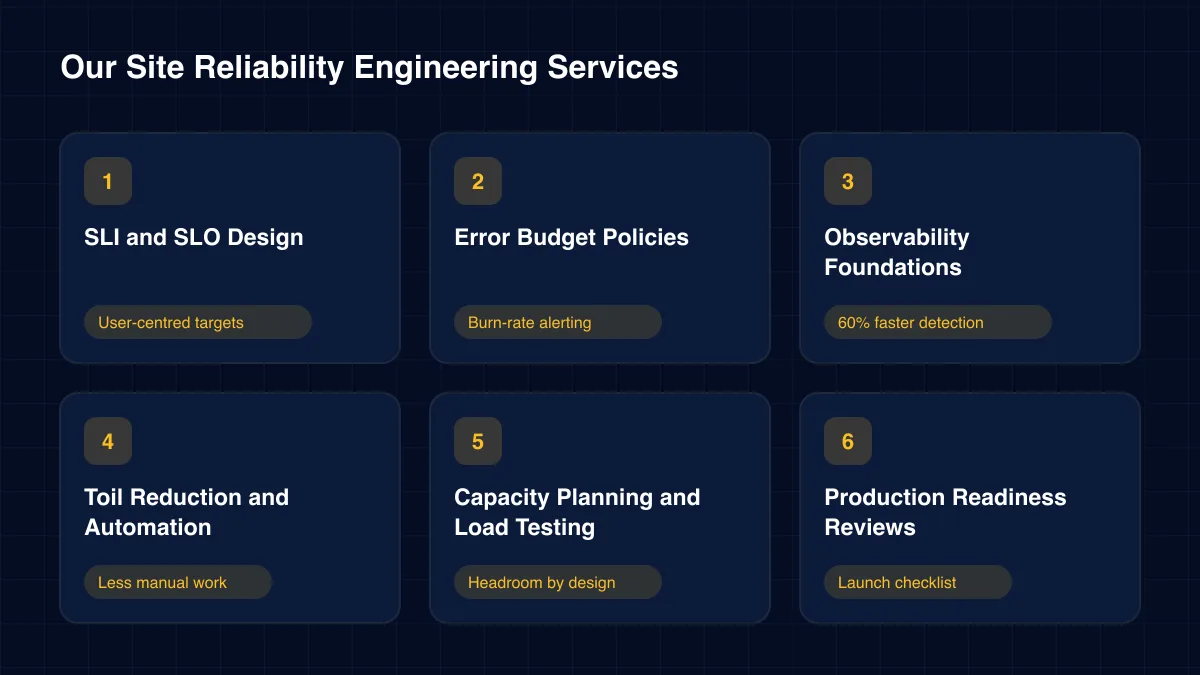
We map critical user journeys and choose SLIs for availability, latency and correctness. Then we set SLOs with product owners, so site reliability engineering targets match business impact.
User-centred targets
Site Reliability Engineering
We define what reliable means for your users, measure it every minute and spend engineering effort where the data says it matters. Fewer surprises, steadier releases.
128
Resolved today
100%
Within SLA
24/7
On shift
Site reliability engineering treats operations as a software problem. Instead of hoping systems stay up, you set a measurable target, track it and act when it slips. The result is reliability you can plan around.
Many teams already run monitoring and an on-call rota. Yet they still argue about whether a release is safe or whether a slow page matters. Without shared targets, every decision becomes a debate between speed and stability.
This page explains how ICANIO delivers site reliability engineering in practice. It covers service level indicators, error budgets, toil, capacity and production readiness. It also shows how a consolidated observability platform gave one partner 99.9% uptime and faster detection.
Site reliability engineering is a discipline that began at Google and is now used across the industry. Engineers with software skills own the reliability of production services. They write code to remove manual work and to make systems heal themselves.
The core tool is the service level objective, or SLO. An SLO states how often a user journey must succeed, for example how many checkout requests must complete under a latency limit. It is measured with a service level indicator, or SLI.
The gap between the SLO and perfection is the error budget. When the budget is healthy, teams ship faster. When it runs low, the focus shifts to stability work. This simple rule ends the old fight between developers and operations.
Site reliability engineering also caps toil. Toil is repetitive, manual work that grows with traffic and adds no lasting value. Good teams measure it and steadily automate it away.
Working definition
“Site reliability engineering is the practice of applying software engineering to operations, using SLOs, error budgets and automation to keep services as reliable as users need and no more.”
Foundations
SLIs track real journeys such as login, search and payment, not just CPU and memory.
A planned error budget makes risk explicit, so release decisions use data, not opinion.
Toil is logged and capped, and the biggest items become automation projects.
Postmortems focus on systems and signals, so people share what really happened.
Core capabilities
Our site reliability engineering work can start as a short assessment or run as an embedded team inside your platform group.
We map critical user journeys and choose SLIs for availability, latency and correctness. Then we set SLOs with product owners, so site reliability engineering targets match business impact.
User-centred targets
We write a policy that says what happens when budget burns fast. Multi-window burn-rate alerts page people only when an objective is truly at risk.
Burn-rate alerting
Metrics, logs and traces feed one view of each service. On a DevOps observability platform we built, this approach delivered 99.9% uptime and 60% faster incident detection.
60% faster detection →We log toil for a few weeks, rank it by hours lost and automate the top items. Typical targets include restarts, certificate rotation, scaling and data fixes.
Less manual work
Demand forecasts, load tests and headroom rules keep services ahead of growth. Site reliability engineering turns capacity from guesswork into a scheduled review.
Headroom by design
Before a new service goes live, we check alerts, runbooks, rollbacks and dependencies. This review sits inside our wider support engineering services.
Launch checklist →Architecture
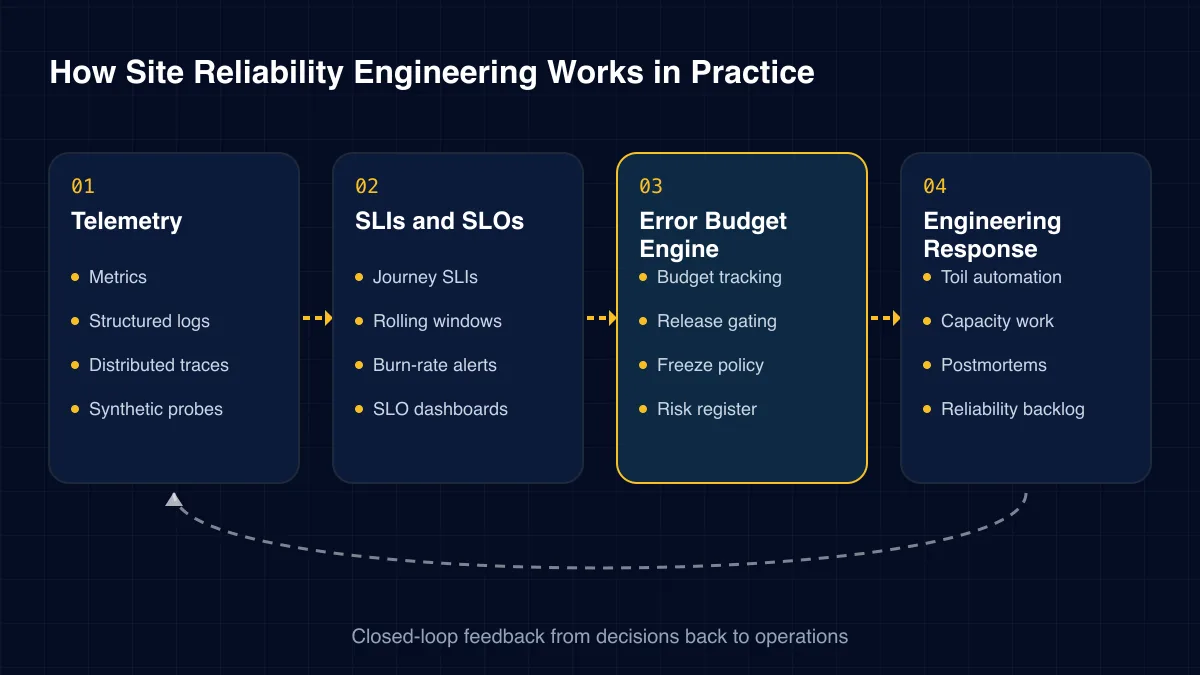
Our site reliability engineering model links user signals to decisions. Telemetry becomes SLIs, SLIs feed budgets, and budgets steer engineering time.
01
02
03
04
Challenges we solve
These problems appear in growing platforms of every size. Each one has a clear SRE answer.
Product wants releases, operations wants freezes. Error budgets give both sides one rule to follow.
Engineers wake up for a CPU spike that harms nobody. SLO-based alerts page only for real user pain.
Leaders ask how reliable the platform is and get anecdotes. SLIs turn that question into a number.
Every new customer adds restarts and fixes. Toil tracking shows where automation pays back fastest.
A busy season arrives and services fall over. Planned load tests and headroom rules catch limits early.
Incidents close without real learning. Blameless postmortems with owned actions stop repeats.
There is no single SRE team shape. These four models cover most of what we see.
SRE overlaps with DevOps but adds hard targets. Here is how the three approaches differ.
| Practice | Traditional ops | DevOps | Site reliability engineering |
|---|---|---|---|
| Measurable reliability targets | No | Partial | ✓ Yes |
| Error budget release policy | No | No | ✓ Yes |
| Toil tracked and capped | No | Partial | ✓ Yes |
| Blameless postmortems | Partial | ✓ Yes | ✓ Yes |
| Engineers write ops code | Partial | ✓ Yes | ✓ Yes |
The benefits of site reliability engineering compound as targets, alerts and automation mature.
Delivery
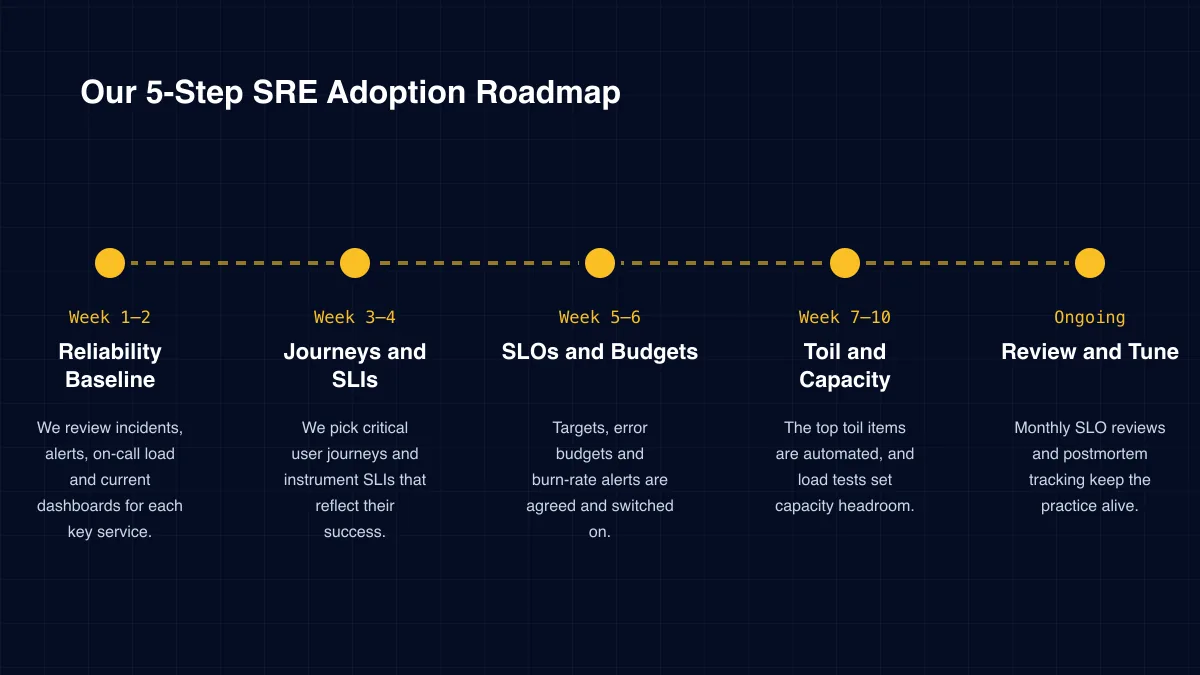
Week 1–2
We review incidents, alerts, on-call load and current dashboards for each key service.
Week 3–4
We pick critical user journeys and instrument SLIs that reflect their success.
Week 5–6
Targets, error budgets and burn-rate alerts are agreed and switched on.
Week 7–10
The top toil items are automated, and load tests set capacity headroom.
Ongoing
Monthly SLO reviews and postmortem tracking keep the practice alive.
Case study
A partner's engineering teams lacked unified monitoring and struggled to meet uptime and SLA commitments. ICANIO consolidated metrics, logs and alerts into one observability stack, added threshold and anomaly-based alerts, and automated health checks for capacity planning. The platform delivered 99.9% reliability and uptime stability, 60% faster incident detection and response, and 40% less downtime risk exposure.
Read the full case study →Metrics, logs and alerts
One stack replaced scattered monitoring tools.
Threshold and anomaly rules
Alerts caught problems fixed thresholds alone would miss.
Automated health checks
Usage data guided scaling and capacity decisions.
Specialist services within our technical support engineering practice.
Many vendors use the SRE label for plain monitoring. We recommend checking five things.
Real site reliability engineering changes how decisions are made, not just what the dashboards show. That is the change our team works toward.
Reliability work touches production configuration, so access control matters. ICANIO engineers use least-privilege, audited access and follow your change process for every automation.
We run under ISO 9001 and ISO 27001 certified processes. Security signals such as certificate expiry, failed logins and dependency alerts can sit on the same SLO dashboards as latency and errors.
Automation is reviewed like product code. Scripts live in version control, run through tests and carry clear owners, so self-healing never becomes an unaudited back door.
Regulated teams get extra care. In fintech and healthcare we keep SLO dashboards free of personal data, and we document every reliability change for audit. Site reliability engineering should make compliance easier to prove, not harder.
Begin with downtime cost per hour on your key journeys and the hours lost to toil each week. These two numbers set the size of the prize for site reliability engineering.
Then track SLO attainment, pages per on-call shift, toil hours and repeat incidents. A healthy practice shows fewer pages and more budget left at month end.
Count release speed too. Teams with a healthy error budget can ship with less ceremony, which turns reliability work into a direct product benefit.
Report these numbers in one short monthly page. When leaders can see SLO trends next to feature delivery, funding for site reliability engineering stops being a hard sell.
Technology stack
We prefer open standards so your telemetry stays portable across cloud providers.
Metrics & SLOs
Sloth
Tracing & Logs
Jaeger
Alerting
Alertmanager
Load & Chaos
Chaos MeshLitmusChaos
Platform
Automation
GoRunbook bots
DevOps is a culture of shared ownership between development and operations. Site reliability engineering is one concrete way to practise it, with SLOs, error budgets and toil limits as hard rules.
Start with your most valuable user journey, such as login or checkout. Measure its success rate and latency for a few weeks, then set a target slightly below what users already get.
No. Users cannot tell the difference between very high reliability and perfection, and chasing it is costly. Site reliability engineering sets a target that matches user needs and spends the rest on features.
Yes. SLOs and error budgets apply to virtual machines, managed cloud services and even legacy systems. The tools change, but the principles stay the same.
Quieter on-call often comes within weeks, once alerts move to SLO burn rates. Deeper gains from toil automation and capacity work build over the following quarters.
Yes. We pair with your team on every SLO, alert and postmortem, so the practice stays in place long after our engagement ends.
How we deliver site reliability engineering and the wider support engineering practice in each sector.
Reliability is a feature, and like any feature it needs a target and an owner. Site reliability engineering provides both, turning uptime from a hope into a managed number.
ICANIO helps teams in finance, healthcare, retail and manufacturing adopt site reliability engineering at a pace that suits them. We set SLOs, automate toil and leave a practice your engineers can run. Contact us to start with a reliability baseline.
By ICANIO Support Engineering Team · Published · Updated
Book a free discovery call. We will look at your incidents and alerts, then suggest first SLOs for your most important user journeys.
Contact Our SRE Team