Detection and Alerting
Fast detection starts the clock early. On an enterprise monitoring platform we built, automated alerting through Alertmanager cut mean time to recovery by 80%.
80% faster MTTR →Incident Management Services
Structured triage, a named incident commander and a calm communication rhythm. When something breaks, everyone knows their role in the first five minutes.
128
Resolved today
100%
Within SLA
24/7
On shift
Incident management services give your business a rehearsed plan for the worst hour of the month. When a key system fails, a trained team takes charge, restores service fast and keeps everyone informed.
Without that plan, outages follow a familiar script. Ten people join a call. Three of them start changing things at once. Customers hear nothing for an hour. Afterwards, nobody writes down what happened, so it happens again.
This page explains how ICANIO runs incident management services. It covers severity levels, roles, communication, tooling and reviews. It also shows how automated alerting helped an enterprise partner recover 80% faster.
In ITIL terms, an incident is an unplanned interruption or loss of quality in a service. Incident management is the practice of restoring normal service as quickly as possible. It is separate from problem management, which hunts root causes, and change management, which controls fixes.
Incident management services package that practice into a ready-made operation. The provider brings the process, the trained people, the tooling and the reporting. It plugs into your systems and your teams.
The process borrows from emergency response. The Incident Command System, used by fire and rescue services, inspired the idea of one commander who coordinates while others fix. Tech teams adopted the same roles because they work under pressure.
Security incidents follow a related path. NIST guidance on incident response covers preparation, detection, containment, recovery and lessons learned. Our process links the two, so a breach and an outage both get a clear owner.
Good incident management services also measure themselves. Time to acknowledge, time to mitigate and time to resolve are tracked per severity. These figures show where the process is slow, and they guide the next round of improvements.
Working definition
“Incident management services are a managed, process-driven capability that detects, triages, coordinates and resolves service disruptions, then reviews each one to prevent repeats.”
Foundations
It is cheaper to open an incident and close it fast than to discover one late.
A single person coordinates. Responders fix. Nobody does both jobs at once.
Stakeholders hear from us on a fixed rhythm, even when the news is no news.
Major incidents end with a blameless review and actions that have owners and dates.
Core capabilities
Our incident management services can run your whole process or strengthen the parts that are weakest today.
Fast detection starts the clock early. On an enterprise monitoring platform we built, automated alerting through Alertmanager cut mean time to recovery by 80%.
80% faster MTTR →Clear SEV1 to SEV4 rules based on user impact decide who is paged. Our incident management services remove the guesswork from the first five minutes.
SEV1 to SEV4
A trained incident commander runs the bridge, assigns tasks, tracks decisions and calls for help. A scribe keeps the timeline as events unfold.
Named roles
A comms lead posts status page updates, briefs executives and handles customer success teams. Engineers stay focused on the fix.
Fixed rhythm
Within days of a major incident we run a review, publish a timeline and agree actions. Problem management tracks each action to closure.
Owned actions →We write runbooks for likely failures and test them in drills. These incident management services sit inside our wider support engineering services.
Practised response →Architecture
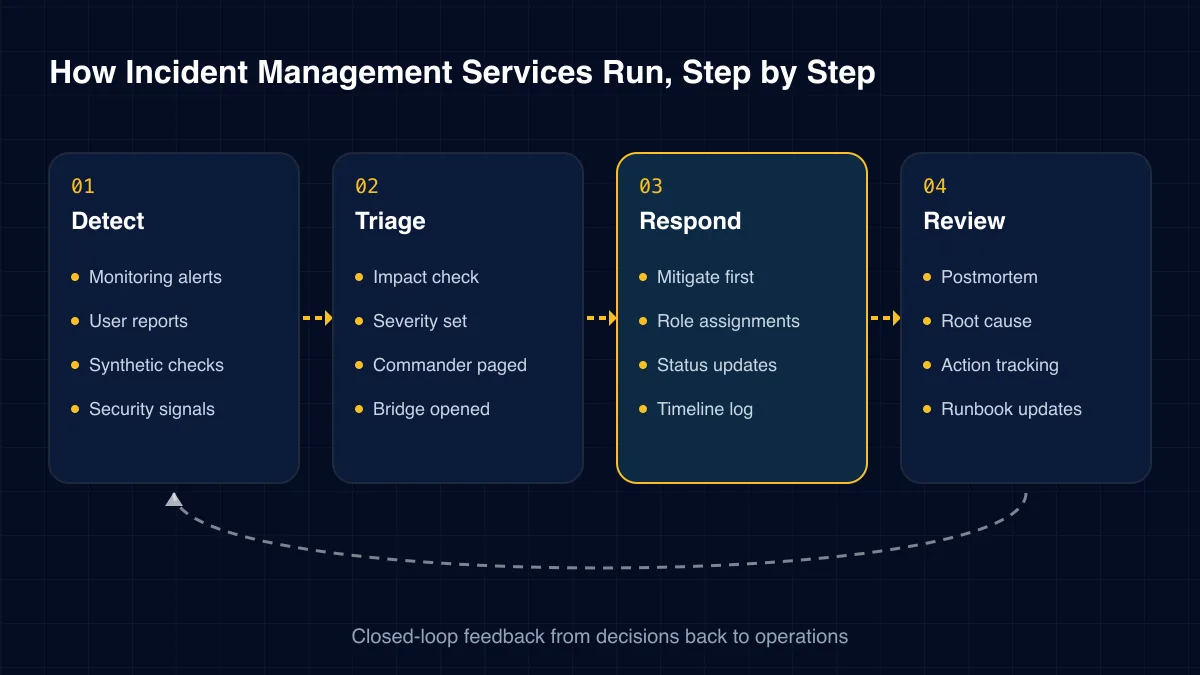
Each disruption moves through the same four stages in our incident management services. Speed comes from knowing the next step before you need it.
01
02
03
04
Challenges we solve
These failure patterns show up in teams of every size. Each one adds minutes or hours to an outage.
People hope the issue will pass. By the time someone calls it, the damage has spread.
Several engineers make changes at once. Fixes clash and the cause gets harder to find.
Users hear nothing while the team works. Support lines flood and trust drops.
Leaders ask for updates every few minutes. Engineers stop fixing to answer them.
Afterwards, nobody can say when things happened. Reviews rely on memory and guesswork.
Postmortems produce good ideas that nobody owns. The same fault returns next quarter.
The right model depends on your size, your hours and how mature your process is today.
Here is how three common setups compare when a serious outage hits.
| Factor | Ad hoc response | In-house process | Managed incident response |
|---|---|---|---|
| Defined severity levels | No | ✓ Yes | ✓ Yes |
| Trained incident commander | No | Partial | ✓ Yes |
| 24/7 coverage | No | Partial | ✓ Yes |
| Postmortem actions tracked | No | Partial | ✓ Yes |
| Regular game days | No | Partial | ✓ Yes |
Better response shows up first in shorter outages, then in fewer outages.
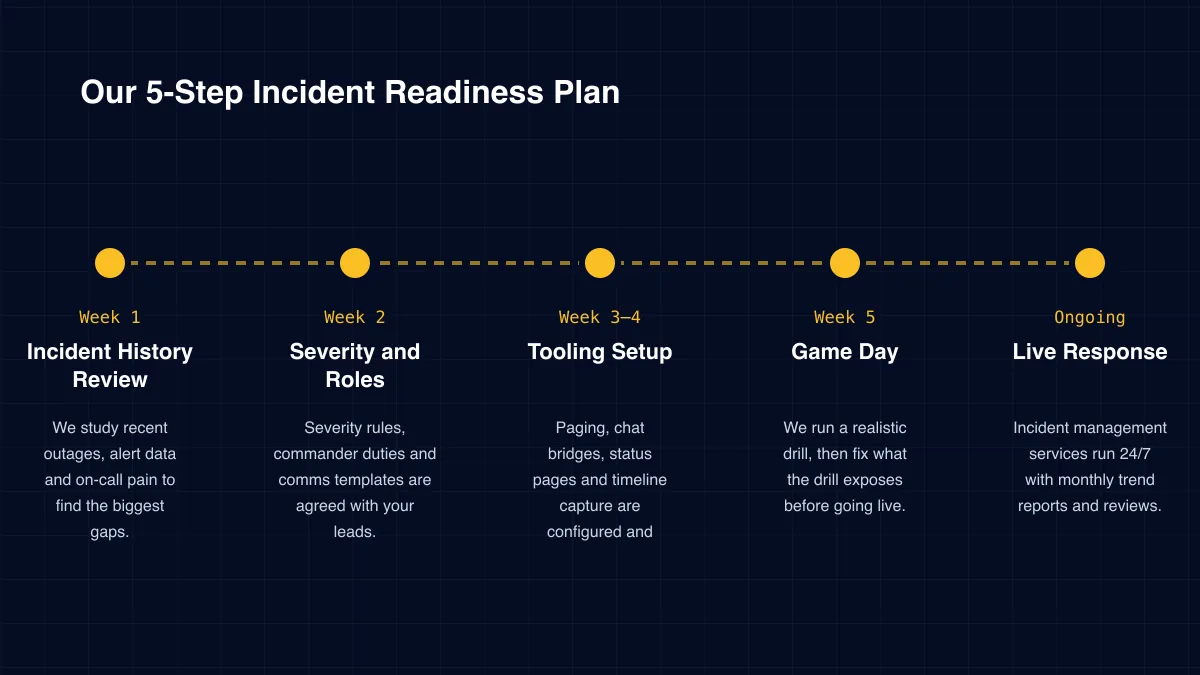
Delivery
Week 1
We study recent outages, alert data and on-call pain to find the biggest gaps.
Week 2
Severity rules, commander duties and comms templates are agreed with your leads.
Week 3–4
Paging, chat bridges, status pages and timeline capture are configured and tested.
Week 5
We run a realistic drill, then fix what the drill exposes before going live.
Ongoing
Incident management services run 24/7 with monthly trend reports and reviews.
Case study
An enterprise partner faced delayed response to critical failures because monitoring was manual and alerts came from too many uncoordinated sources. ICANIO built a unified platform with Prometheus, Grafana and Alertmanager, sending automated alerts to Slack and email, plus log aggregation for faster root-cause analysis. Mean time to recovery fell by 80% and system uptime reached 99.9%.
Read the full case study →Prometheus and Blackbox
Failures were spotted from inside and outside the platform.
Alertmanager
One notification path replaced scattered alert sources.
Log aggregation
Responders had the history needed for quick root-cause work.
Specialist services within our technical support engineering practice.
Every provider says they respond fast. We recommend asking these five questions first.
Strong incident management services make chaos feel routine. That calm comes from practice, and our team practises often.
Some incidents are security events. Our process includes a branch for suspected breaches, with evidence preservation and early contact with your security lead.
ICANIO works under ISO 9001 and ISO 27001 certified processes. Where rules such as GDPR, HIPAA or PCI DSS set notification duties, we build those steps into your runbooks so deadlines are not missed.
Access during an incident is still controlled. Emergency permissions are time-bound, logged and reviewed afterwards, so urgency never becomes a loophole.
Records matter for regulators and customers alike. Each incident keeps a timeline, a list of affected systems and a summary of data exposure, if any. That record makes later reporting faster and more accurate.
Track mean time to acknowledge, mean time to mitigate and mean time to resolve for each severity. These numbers show whether incident management services are getting faster.
Count repeat incidents and open postmortem actions too. A falling repeat rate is the clearest sign that reviews are working.
Put a price on each SEV1 hour, using lost revenue and staff time. Even modest cuts in outage length usually justify the service within a few quarters.
Look at people costs as well. Fewer chaotic night calls mean less burnout and lower staff turnover. Those savings rarely show up in a budget line, yet they are often the reason teams choose incident management services in the first place.
Technology stack
We work in the tools your teams already use and fill gaps where needed.
Paging
Alertmanager
Coordination
SlackMicrosoft TeamsZoom bridges
Status & Comms
StatuspageEmail templatesExec briefings
ITSM
ServiceNow
Diagnosis
Learning
Postmortem templatesAction trackerRunbook library
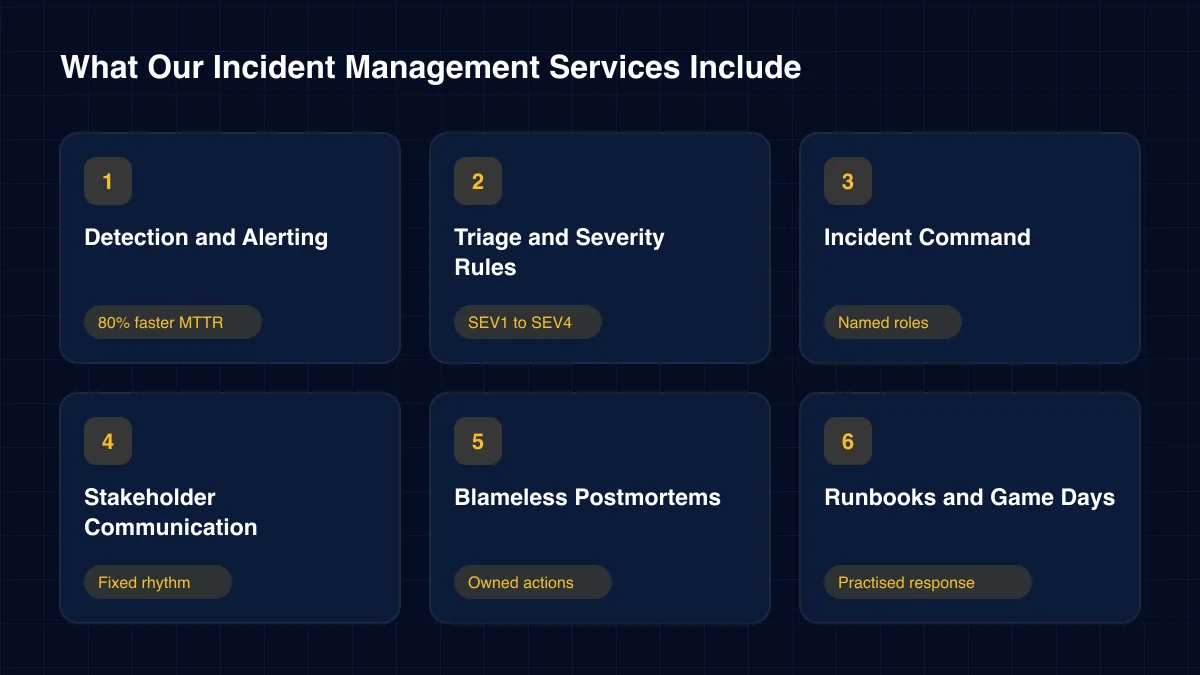
Our incident management services include detection, triage, severity rules, incident command, stakeholder updates, postmortems and runbook drills. You can take the full set or only the parts you need.
Severity is based on user and business impact. A SEV1 might mean a core journey is down for everyone. A SEV4 might be a minor cosmetic fault. We agree the exact rules with you.
The commander coordinates the response. They assign tasks, track decisions, call in experts and decide when to escalate. They do not debug, which keeps the big picture clear.
No. A help desk handles user requests and simple faults. Incident management services handle service disruptions, coordinate engineers and lead the recovery and review.
It is a review that looks at systems, signals and decisions rather than blaming people. Staff speak openly, so the real causes surface and the fixes stick.
Yes. During onboarding we learn your architecture and write runbooks for it. For deep code issues we pull in your developers through agreed escalation paths.
How we deliver incident management services and the wider support engineering practice in each sector.
Every system will fail at some point. What matters is how quickly and calmly your team recovers. Incident management services make that recovery predictable.
ICANIO brings an ITIL-aligned process, trained commanders and 24/7 coverage across three regions. We serve fintech, healthcare, retail and cloud-first manufacturing teams alike. Contact us to test your readiness with a game day and see how incident management services fit your operation.
You do not need a perfect process on day one. Many teams start with severity rules and a commander rota, then add drills and tracked reviews over the following months. Each step makes the next outage a little shorter.
By ICANIO Support Engineering Team · Published · Updated
Book a free discovery call. We will review a recent incident with you and show where structure could have saved time.
Contact Our Incident Team