Route optimization software in 2026 has moved well past static overnight planning. The old model planned routes once before the day began. The new model recalculates optimal paths continuously as conditions change during live delivery windows. Road closures, traffic incidents, breakdowns, new orders and driver hours limits all break a static plan within hours. A platform that cannot react in real time is not just inefficient. It becomes a liability wherever on-time delivery affects contracts and reputation.
ICANIO builds fleet and logistics platforms for transportation clients. The same question comes up in almost every engagement. Does the current tooling match the complexity of the operation, or has the business outgrown what off-the-shelf tools can support? This guide explains the architecture behind genuine real-time routing, what real time fleet tracking needs at the data layer, and how logistics tracking software connects to the enterprise systems a modern fleet depends on.
Key Takeaways
- Dynamic route optimization software recalculates plans during the day, not just before it starts.
- Real time fleet tracking depends on an event streaming pipeline, not scheduled batch jobs.
- Logistics tracking software creates most of its value when it is integrated with ERP, WMS and CRM systems.
- Hours of service data should constrain dispatch decisions before violations happen, not after.
- A phased rollout (visibility, then smarter routing, then predictive maintenance) lowers delivery risk.
What Is Route Optimization Software?
Route optimization software decides which vehicle should visit which stops, in which order, and on which roads. It balances cost, time and constraints. In computer science this is known as the vehicle routing problem, a well-studied optimization challenge. Exact solutions become very expensive as the number of stops grows. That is why practical tools use heuristics and solvers that find very good answers quickly.
Open-source solvers such as Google OR-Tools show how these models are built. They support capacity limits, time windows, pickups and deliveries, and multiple depots. Commercial platforms wrap similar logic in dispatch screens, driver apps and reporting. The engine matters, but the data feeding it matters just as much.
Route Optimization Software: Static vs Dynamic Planning
The gap between planning routes and continuously optimizing them is the most important capability difference in the market. Static route optimization software generates one plan at the start of the day. Every deviation then becomes a manual exception for the dispatcher.
Dynamic route optimization software keeps a live model of each vehicle. It tracks position, load, remaining delivery windows, driver hours and road conditions. When any event changes the best solution, it recalculates. This requires a real-time data pipeline rather than a scheduled batch process.
| Capability | Static planning | Dynamic planning |
|---|---|---|
| Plan timing | Once, before dispatch | Continuous, during execution |
| Traffic events | Manual rework | Automatic recalculation |
| New orders | Next-day plan | Inserted mid-route |
| Driver hours | Checked afterwards | Built into the model |
| Data pipeline | Batch | Event streaming |
Constraint Handling in Route Optimization Software
Modern route optimization software must handle many constraints at once. Static tools often ignore or approximate them. Common constraints include:
- Vehicle weight and dimension limits that decide which roads a truck may legally use.
- Time windows for deliveries that must arrive within an agreed slot.
- Load capacity and sequencing rules for what goes on which vehicle, and in what order.
- Driver hours of service limits, set in the USA by FMCSA regulations.
- Depot opening hours, break rules and customer access restrictions.
Some route optimization software treats these as simple filters. That produces plans that look efficient on paper. In practice, they cause compliance problems and failed deliveries. Constraint depth is therefore one of the most meaningful differences between route optimization software platforms. When our team evaluates a tool, we test it against the hardest real constraints the client faces, not a clean demo dataset.
Fleet Management Software Development: Build vs Buy
Building fleet management software from scratch is a significant investment. Many logistics operations do not need it. Off-the-shelf fleet management software handles GPS tracking, basic routing, maintenance scheduling and driver management well. It suits operations with fairly standard workflows.
Custom development becomes the right choice when workflows are genuinely different. Examples include multi-depot load optimization across hubs, integration with proprietary warehouse or order systems, or regulatory documents no product generates. It also makes sense when routing technology is part of the competitive offer. A third-party logistics provider that sells superior visibility to shippers has a stronger case than a carrier running standard operations.
Our team starts by mapping which capabilities the client actually needs that existing platforms do not provide. Custom route optimization software should never be the default answer just because a vendor evaluation was frustrating.
Questions to Ask Before You Build
In our experience, a short checklist saves months of debate. Ask these questions before choosing a path:
- Which constraints does the current tool fail to model correctly?
- Which systems must exchange data with routing in real time?
- Does routing quality differentiate the business commercially?
- Who will own and maintain the platform after launch?
- Can a configurable product plus custom integrations close the gap?
If most answers point to standard needs, buying is usually faster. If they point to unique constraints and integrations, a custom build or hybrid approach is worth assessing.
Real Time Fleet Tracking: The Data Architecture Layer
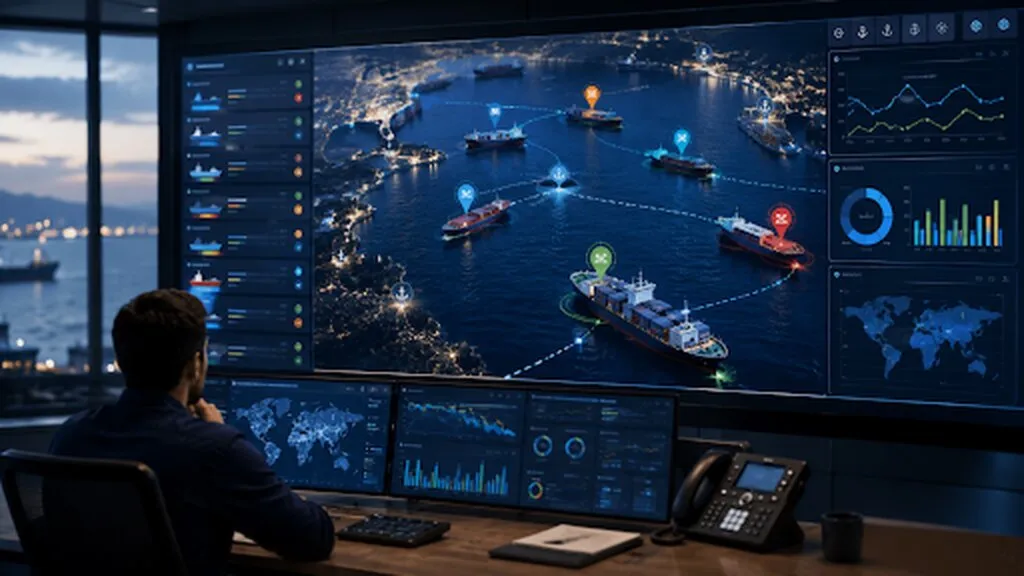
Real time fleet tracking is the foundation for every other capability. Yet the architecture behind it is more demanding than the phrase suggests. A telematics device on each vehicle produces GPS coordinates, engine diagnostics, fuel readings, driver events and sensor outputs. Update intervals can range from seconds to minutes.
Across hundreds or thousands of vehicles, that becomes a very large stream of events. Each one must be ingested, processed, stored and routed to the right downstream systems. The platform must surface useful signals without drowning fleet managers in raw telemetry. This is where IoT engineering and cloud architecture meet.
Event Streaming vs Batch Processing
The choice between event streaming and batch processing largely decides whether real time fleet tracking performs in production. Batch processing collects data over a window and processes it together. It is simpler and cheaper. However, it adds latency that delays alerts, geofence triggers and route recalculation.
Event streaming processes each event as it arrives. Platforms such as Apache Kafka, or cloud-native equivalents, can trigger downstream actions in seconds. Route optimization software that relies on this stream can react while the driver is still on the road.
Our DevOps and cloud engineering practice designs this pipeline as the first layer of a tracking engagement. Retrofitting streaming onto a batch-based system is one of the more costly rework scenarios in fleet platforms. Good observability matters too. Our guide to structured logging and production observability explains how to keep these pipelines debuggable.
Logistics Tracking Software: Integration Architecture
Logistics tracking software that runs as an isolated system delivers only a fraction of its value. Dispatchers and coordinators make decisions using data from several systems at once:
- Inventory status from the warehouse management system.
- Order priorities from the order management system.
- Carrier capacity from the transportation management software.
- Customer preferences and contacts from the CRM.
When people copy data between these systems by hand, delays and errors creep in. Those errors cancel out much of the benefit of live visibility.
ERP and WMS Integration
Connecting logistics tracking software to ERP systems is one of the highest-value integrations in fleet platform work. It is also one of the most complex. A good ERP link enables automatic cost allocation by route and vehicle. It can trigger inventory updates from confirmed deliveries. It also feeds the transport cost analytics that finance teams rely on.
Our application development teams treat these integrations as first-class deliverables. The data model decisions that decide integration depth must be made during architecture design. Adding the integration later forces it to fit schemas built without it in mind. The result is usually fragile. Our article on ERP CRM integration and real-time data sync covers the patterns in more detail.
Customer Visibility Portals
Logistics tracking software increasingly needs to extend visibility to external stakeholders. Shippers and consignees expect live tracking and automated ETA notifications. A customer portal reduces calls to dispatchers asking for status updates. To support this, the platform needs a well-designed API or webhook layer. It should push status updates to customer systems and branded tracking pages. It must do this without exposing internal operational data.
Transportation Management Software: Enterprise Integration
Transportation management software at enterprise scale connects fleet tracking and routing with the wider supply chain. A transportation management system typically covers carrier selection, load tendering, freight audit and multi-modal shipment visibility. When it also sees internal fleet operations, logistics teams get a unified view of transport spend and performance.
The link between transportation management software and route optimization software is what enables shipment-level visibility. Enterprise shippers and 3PLs increasingly expect this from their technology stack. Without it, planners see vehicles in one tool and freight in another.
ELD Compliance and Hours of Service
For US trucking operations, transportation management software must treat electronic logging device compliance as a core requirement. ELD data records driver hours of service. Feeding that data into dispatch and route planning changes how it is used.
A driver approaching their limit must be accounted for before the limit is reached. Route optimization software that reads ELD data as an operational input can plan around those limits. Tools that only treat it as a compliance report miss its most valuable use. The goal is to prevent violations through better dispatch, not to document them afterwards.
Predictive Maintenance in Fleet Management Software
Predictive maintenance is one of the most valuable additions to fleet management software. An unplanned breakdown brings recovery, repair, delayed deliveries and secondary dispatch costs. A planned intervention triggered by early warning signals is usually far cheaper.
Predictive maintenance relies on machine learning models. These are trained on historical sensor data, maintenance records and operating patterns. The aim is to spot degradation signatures that appear before a failure.
The data requirements are stricter than for tracking alone. Sensor data must be captured at enough resolution to detect subtle signals. It must be stored for time-series analysis across vehicle lifetimes. Models must separate genuine degradation from normal variation. Results depend on both the model and the data foundation, never on one alone.
Our data and artificial intelligence service line designs these pipelines and models. Maintenance predictions can also feed route optimization software, so a vehicle flagged for service is not assigned a long route.
How Route Optimization Software Fits a Phased Rollout
Fleet operations tend to get better results when they build capabilities in stages. Deploying routing, real time fleet tracking, predictive maintenance and TMS integration all at once is risky. Our team recommends three phases:
| Phase | Focus | Main outcome |
|---|---|---|
| 1 | Visibility and core routing | Trusted live data |
| 2 | Smarter dynamic routing | Better window compliance |
| 3 | Predictive maintenance and analytics | Fewer unplanned failures |
| Ongoing | Integration and tuning | Less manual work |
Phase one establishes reliable visibility and basic route optimization software. It builds the data foundation and the operational trust that later phases need. Phase two adds AI-enhanced routing that learns from historical patterns. Phase three introduces predictive maintenance and driver behaviour analytics, which depend on the data history from earlier phases.
This approach means each capability has the data it needs at launch. Logistics tracking software and TMS integrations usually land in phases one and two. In our experience, projects that try to deploy everything at once tend to build up more integration debt and face more resistance from users.
Choosing Route Optimization Software: Evaluation Criteria
Whether you build or buy, use consistent criteria. Here is a compact scorecard our team uses during discovery:
| Criterion | What to check | Why it matters |
|---|---|---|
| Constraints | Time windows, HOS, vehicle limits | Plans must be executable |
| Recalculation | Event-driven or batch | Speed of response |
| Integrations | ERP, WMS, TMS, CRM APIs | Removes manual handoffs |
| Driver app | Offline mode, navigation | Adoption on the road |
| Analytics | Plan vs actual reporting | Continuous improvement |
Test each candidate with real historical orders. Compare the plans it produces with what drivers actually did. Route optimization software that cannot explain its decisions to dispatchers will struggle with adoption, however good its solver is. For related thinking on AI in this sector, read our article on AI in logistics.
Benefits of Modern Route Optimization Software
Why invest in this at all? The benefits are practical and easy to explain to operations teams:
- Fewer manual reroutes, because the system handles common disruptions.
- More realistic plans, because real constraints are modelled.
- Better customer communication through accurate ETAs.
- Cleaner compliance records, because hours of service shape dispatch.
- Lower integration overhead once data flows automatically between systems.
The size of each benefit depends on the operation. We do not promise fixed percentages. Instead, our team agrees baseline metrics with the client before launch, then measures change against them.
Where ICANIO Fits in Route Optimization Software Projects
ICANIO engagements begin with workflow mapping. We identify what the client's fleet operation needs that existing tools do not deliver, before any architecture decision. Our teams have worked on logistics tracking software, fleet tracking platforms and route optimization software covering last-mile delivery, long-haul fleets and multi-carrier TMS integrations.
The delivery team combines data and AI, application development, DevOps and cloud engineering, and MLOps skills. That mix matters because fleet platforms touch IoT devices, streaming infrastructure, optimization logic and business systems at once. You can learn more about our work in this sector on our transportation and logistics solutions page.
Conclusion
Route optimization software is no longer a planning tool used once each morning. It is a live decision engine that depends on streaming data, deep constraint models and solid integrations. Real time fleet tracking, logistics tracking software and transportation management software all feed it, and it feeds them in return.
The most reliable path is gradual. Build trusted visibility first, then add dynamic routing, then predictive maintenance. Measure each step against an agreed baseline. If you are weighing a new platform or an upgrade to your current fleet management software, contact ICANIO to talk it through with our team.
References
- Vehicle routing problem (Wikipedia)
- Google OR-Tools: Vehicle Routing
- Apache Kafka documentation
- Telematics (Wikipedia)
- Transportation management system (Wikipedia)
- Electronic logging device (Wikipedia)
- Predictive maintenance (Wikipedia)
Frequently Asked Questions
How does static route optimization software differ from dynamic?
Static route optimization software plans routes once before the working day begins. Dynamic route optimization software keeps recalculating during execution. It responds to traffic changes, vehicle breakdowns, new orders and driver hours of service limits. Dynamic planning needs a real-time data pipeline, while static planning can run on a scheduled batch process.
When does custom fleet management software development make sense?
Custom fleet management software makes sense when workflows need multi-depot optimization, deep ERP or WMS integration, or compliance documents no product generates. It also makes sense when routing technology is a competitive differentiator the business wants to own. Otherwise, a configurable product with custom integrations is often faster and cheaper.
What data infrastructure does real time fleet tracking require?
Real time fleet tracking at scale needs event streaming infrastructure. It processes vehicle data as it arrives rather than in batches. This lets alerts, geofence triggers and route recalculation respond within seconds. It also needs time-series storage, monitoring and secure device connectivity so that data stays reliable as the fleet grows.
How does logistics tracking software integrate with ERP systems?
Logistics tracking software connects delivery confirmations, vehicle cost data and route performance metrics to ERP workflows through APIs or event messages. This enables automatic cost allocation and inventory updates without manual data transfer. The integration works best when it is designed into the data model from the start, not added later.
What does ELD integration add to transportation management software?
ELD integration feeds driver hours of service data into dispatch and route planning. Transportation management software can then account for hours limits when assigning routes. This helps prevent violations before they occur, rather than simply recording them. It also gives planners a clearer view of real driver availability across the day.
How long does it take to roll out route optimization software?
Timelines depend on fleet size, integrations and data quality. Our team usually recommends a phased approach. The first phase focuses on visibility and core routing. Later phases add dynamic routing and predictive maintenance. Each phase should go live with measurable goals, so the business sees value before committing to the next stage.