SAAS MODERNIZATION · AZURE CLOUD MIGRATION · HEALTHCARE COMPLIANCE
ICANIO delivered HIPAA-ready SaaS modernization for a pharma-focused compliance partner, a legacy-to-cloud transformation converting a legacy desktop tool into a scalable, compliant Azure microservices platform.
Quick Answer
What Is HIPAA-Ready SaaS Modernization on Azure?
HIPAA-ready SaaS modernization on Azure is the process of migrating a legacy, single-tenant desktop application to a cloud-native, multi-tenant microservices architecture that meets HIPAA, SOC2, and GDPR compliance requirements while enabling global scalability. ICANIO executed this SaaS modernization for a pharma-focused compliance partner, replacing a legacy desktop tool with a containerized Azure Kubernetes Service environment, cutting deployment and CI/CD complexity by 60%, reducing infrastructure costs by 40%, and shrinking release cycles from weeks to hours.
Executive Summary
Turning a Compliance Bottleneck Into a Cloud-Native Advantage
A legacy desktop tool might work well enough for a single team in a single location, but it becomes a genuine liability once a life sciences platform needs to scale globally under strict regulatory oversight. ICANIO’s pharma-focused compliance partner was running exactly this kind of infrastructure: a legacy desktop tool that could not scale, paired with fragmented DevOps practices that turned every release into a multi-week undertaking. For a platform subject to SOC2 and HIPAA requirements, that combination meant slower regulatory feature updates, rising technical debt, and infrastructure that could not demonstrate the compliance posture life sciences customers expect.
ICANIO approached this SaaS modernization as a full-stack cloud-native transformation rather than a simple lift-and-shift, anchored by an Azure Kubernetes Service migration that reshaped the platform’s core delivery model. The objective was to rebuild the platform’s core logic as a multi-tenant microservices architecture, automate the entire delivery pipeline with CI/CD pipeline automation, and bake HIPAA and GDPR compliance into the infrastructure itself through Infrastructure as Code. The result was a platform that deploys in hours instead of weeks, scales dynamically at 40% lower infrastructure cost, and gives the compliance team the centralized observability the legacy tool never provided.
“A legacy desktop tool that cannot scale is not just a technical constraint, in a regulated life sciences environment, it is a compliance risk that compounds with every delayed release.”
The Challenge
Five Systemic Bottlenecks Blocking Compliance-Ready Scale
Our pharma-focused compliance partner was restricted by a legacy desktop tool that hindered global scalability. This outdated infrastructure created several critical bottlenecks for life sciences teams.
Limited Global Scalability
Legacy desktop tools lack global scalability and accessibility, limiting the platform’s ability to serve life sciences teams operating across regions.
Fragmented DevOps Practices
Fragmented DevOps practices result in severe CI/CD bottlenecks, slowing every release and increasing the risk of manual error.
Delayed Regulatory Updates
Extended release cycles delay critical regulatory feature updates, a direct risk for a platform serving compliance-driven life sciences customers.
Rising Technical Debt
High technical debt increases maintenance costs and system lag, making every new feature more expensive to ship than the last.
Compliance Infrastructure Gaps
Infrastructure inefficiencies prevent meeting strict SOC2 and HIPAA standards, a foundational requirement for any pharma compliance platform.
SaaS Modernization Solutions Provided
A Six-Part SaaS Modernization Blueprint for Compliance-Ready Scale
Icanio Technologies architected a cloud-native Azure SaaS modernization ecosystem, migrating the core logic to a microservices architecture while automating the entire delivery pipeline. The solutions included:
Strategic DevOps Modernization Roadmap
Defined a strategic roadmap for full DevOps and infrastructure modernization, sequencing the migration to minimize risk to live regulatory workflows.
Automated CI/CD Pipelines
Built automated CI/CD pipelines using Azure DevOps and Repos, replacing manual release processes with repeatable, auditable deployments.
Containerized Workload Orchestration
Orchestrated containerized workloads via Azure Kubernetes Service (AKS), giving the platform the elasticity a desktop tool could never offer.
Multi-Tenant Microservices Architecture
Rebuilt the core logic as a multi-tenant microservices architecture for dynamic cloud scalability across customers and regions.
Security Hardening
Hardened security using Azure Security Center and DDoS Protection, strengthening the platform’s defensive posture against evolving threats.
Infrastructure as Code for Compliance
Implemented Infrastructure as Code (IaC) for HIPAA and GDPR compliance, so every environment is provisioned consistently and auditably.
Business Outcomes
Measurable Results Across Speed, Cost, and Compliance
The SaaS modernization programme delivered outcomes across every dimension of the client’s original bottlenecks, converting a scalability-constrained desktop tool into a cloud-native Azure platform that deploys faster, costs less to run, and meets the HIPAA SOC2 GDPR compliance standards its life sciences customers require.
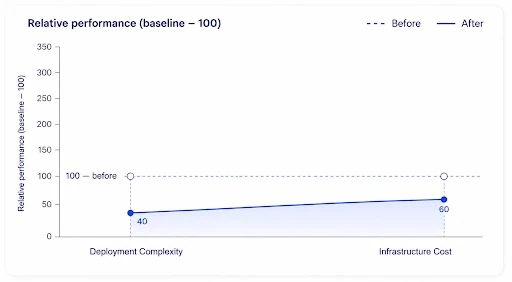
SaaS modernization outcomes: 60% less CI/CD complexity, 40% lower infrastructure costs and feature releases measured in hours instead of weeks.
60%Reduction
In deployment and CI/CD complexity.
40%Lower
In infrastructure costs via dynamic scaling.
Hours vs Weeks
In release cycle time for features.
Automated Workflows
Via 3-click Azure DevOps pipeline triggers.
Full Compliance Alignment
With HIPAA, SOC2, and GDPR standards.
Enhanced Observability
Through integrated Azure monitoring and logging.
Key learnings
What This Engagement Proves for Regulated SaaS Platforms
Compliance and Scalability Are Solved Together
For a platform serving regulated life sciences customers, scalability and compliance aren’t two separate initiatives. The same multi-tenant microservices migration that unlocked dynamic scaling on Azure Kubernetes Service is what made consistent HIPAA and GDPR compliance achievable through Infrastructure as Code. Treating them as one programme, rather than a scalability project followed by a separate compliance retrofit, is what kept this SaaS modernization from becoming two projects instead of one.
CI/CD Automation Makes Fast Releases Sustainable
Cutting release cycles from weeks to hours only holds up if the pipeline enforcing that speed is itself automated and auditable. Building CI/CD on Azure DevOps and Repos, with security hardening and Infrastructure as Code built in from the start, meant faster releases did not come at the cost of the compliance posture the platform depends on.
Observability Has to Be Designed In, Not Added Later
The legacy platform’s lack of centralized observability was not a minor inconvenience, it left the team unable to diagnose performance issues or demonstrate operational control to auditors. Integrating Azure monitoring and logging as part of the core SaaS modernization, rather than as a follow-up project, gave the compliance team the visibility the original architecture never provided.
Conclusion
From Legacy Desktop Tool to a Compliance-Ready Azure Platform
A legacy desktop tool might have been sufficient when the platform served a single market, but for a pharma-focused compliance partner scaling across regions under SOC2 and HIPAA oversight, it had become the primary constraint on the business. This engagement demonstrates that a cloud-native Azure SaaS modernization can resolve scalability, cost, and compliance challenges within a single structured programme rather than three separate initiatives.
By rebuilding the platform as a multi-tenant microservices architecture on Azure Kubernetes Service and automating the delivery pipeline end to end, ICANIO helped this partner cut deployment and CI/CD complexity by 60%, lower infrastructure costs by 40%, and compress release cycles from weeks to hours, achieving full HIPAA SOC2 GDPR compliance across every environment the platform runs in. The automated CI/CD pipelines, security hardening, and Infrastructure as Code delivered through this engagement are the foundation the team will build every future regulatory feature and release on.
Related Resources
This SaaS modernization combines ICANIO's cloud, devops and software development practices. Our team delivers this kind of migration through DevOps and cloud engineering services. Application rebuilds run through our application development services. Healthcare and life sciences teams can explore our healthcare solutions. Related work includes a multi-tenant SaaS platform and DevOps automation. To plan a similar modernization, contact ICANIO.
- DevOps and Cloud Engineering Services
- Healthcare and Life Sciences Solutions
- Multi-Tenant SaaS Platform: 50% Faster
- DevOps Automation: 40% Faster Releases
- Top 5 Best Platform Engineering IDP Wins
References
- Azure Kubernetes Service documentation: Microsoft's official AKS guides.
- Azure DevOps documentation: Microsoft's official guides for pipelines and repos.
- Infrastructure as code: Wikipedia overview of provisioning environments from code.
- Microservices: Wikipedia overview of the microservices architecture style.
- HIPAA: Wikipedia overview of the US health data privacy law.
Frequently asked questions
Common Questions About This SaaS Modernization
Why does HIPAA-ready SaaS modernization matter for pharma platforms?
HIPAA-ready SaaS modernization is the process of rebuilding a legacy application as a cloud-native, multi-tenant architecture that meets HIPAA, SOC2, and GDPR requirements while supporting global scale. For a pharma-focused compliance platform, it matters because a legacy desktop tool that cannot demonstrate this compliance posture becomes a business risk, not just a technical limitation.
Why migrate to AKS instead of a desktop-based architecture?
AKS gives the platform containerized, multi-tenant workload orchestration that a single desktop tool cannot provide, enabling dynamic scaling across customers and regions while keeping infrastructure costs proportional to actual usage, a 40% reduction in this engagement.
How does Infrastructure as Code support HIPAA and GDPR compliance?
IaC defines every environment, networking, compute, and security policies, as version-controlled, auditable code rather than manual configuration. That makes it possible to prove consistent HIPAA and GDPR compliance across every environment the platform runs in, rather than relying on manual reviews after the fact.
How much faster are releases after CI/CD automation on Azure DevOps?
Release cycles that previously took weeks now take hours, driven by automated CI/CD pipelines on Azure DevOps and Repos with 3-click pipeline triggers, replacing the fragmented, manual release process that caused the original bottlenecks.
Does modernizing for compliance slow down feature delivery?
No, in this SaaS modernization it did the opposite. Building compliance into the CI/CD pipeline and Infrastructure as Code from the start meant faster releases and stronger compliance were achieved together, not traded off against each other.
What gave the compliance team better visibility after the migration?
Integrated Azure monitoring and logging replaced the platform's previous lack of centralized observability, giving the team real-time insight into performance and a documented operational trail for compliance audits.