Agentic AI architecture is the design approach that turns a promising AI demo into a system that survives real operations. In 2026, enterprises no longer ask whether AI can perform a task in a lab. Most AI projects can produce a convincing demonstration. The real question is whether the system can operate under real-world conditions: messy sensor data, unpredictable users, legacy integrations and regulatory limits. Production differs from the controlled settings where models are trained in a thousand small ways. Surviving that gap requires a shift from model-centric design to system-centric design. Agentic AI architecture makes this shift concrete. It replaces single-model thinking with coordinated networks of specialised agents that plan, execute and self-correct.
ICANIO's Data and AI practice designs AI architecture programs, AI guardrails frameworks, edge AI deployment solutions and human-in-the-loop AI programs for enterprise clients. This guide explains the six pillars our team uses when designing industrial AI systems: modular agents, context integration, guardrails, human handoffs, edge deployment and governance. It also covers a phased rollout plan.
Key Takeaways
- Agentic AI architecture replaces one large model with a coordinated network of specialised agents, which improves resilience and maintainability.
- The Model Context Protocol (MCP) gives agents a standard way to reach ERP, IoT and operational systems without custom glue for each one.
- AI guardrails enforce hard output limits, and generative models should stay out of safety-critical decision paths.
- Human-in-the-loop AI uses confidence thresholds so routine work runs automatically while edge cases reach people.
- Edge AI deployment solves latency and data sovereignty problems in manufacturing and energy settings.
- Governance and a phased rollout determine whether industrial AI systems keep their value after launch.

What Is Agentic AI Architecture?
Traditional AI was a request-response system. An input arrives, the model processes it, and an output is returned. Industrial AI systems in 2026 work differently. Rather than one large model handling every task, agentic AI architecture uses a coordinated network of specialised AI agents. Each agent owns a specific domain of responsibility. The agents collaborate to execute multi-step workflows with limited human input. This shift from single-model to multi-agent design is the defining trait of production systems that deliver lasting value.
The table below summarises how the two approaches differ in practice.
| Aspect | Traditional AI | Agentic AI architecture |
|---|---|---|
| Unit of design | One model | Network of agents |
| Workflow | Single request, single answer | Multi-step plans |
| Failure handling | Whole system fails | Routes around failed agent |
| Tool access | Custom integrations | Standard protocols such as MCP |
| Oversight | Manual review | Confidence-based handoffs |
If you want a broader primer on agent roles and orchestration patterns, read our companion guide on agentic AI architecture for multi-agent systems.
Pillar 1: Modular Agents in Agentic AI Architecture
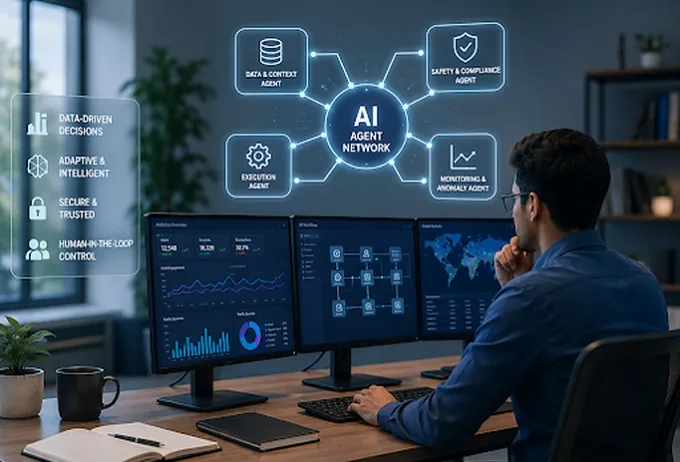
A modular agentic AI architecture divides the task space into specialised domains. A typical split looks like this:
- A retrieval agent gathers data and assembles context.
- A safety agent evaluates operating conditions and limits.
- An execution agent carries out approved decisions.
- A monitoring agent tracks outcomes and escalates anomalies.
This specialisation gives agentic AI architecture two operational advantages over single-model approaches. First, each agent can be optimised for its own domain. You no longer ask a general-purpose model to perform equally well across every task. Second, it creates resilience. If one agent hits an error or produces a low-confidence output, the others keep working. The system routes around the failure rather than collapsing.
For industrial AI systems in energy and manufacturing, these resilience properties are often a deployment requirement rather than a design preference. A plant cannot pause because one model returned an odd result. Our team recommends defining each agent's inputs, outputs and failure behaviour before writing any prompts or training code.
Pillar 2: Industrial AI Systems and the Model Context Protocol
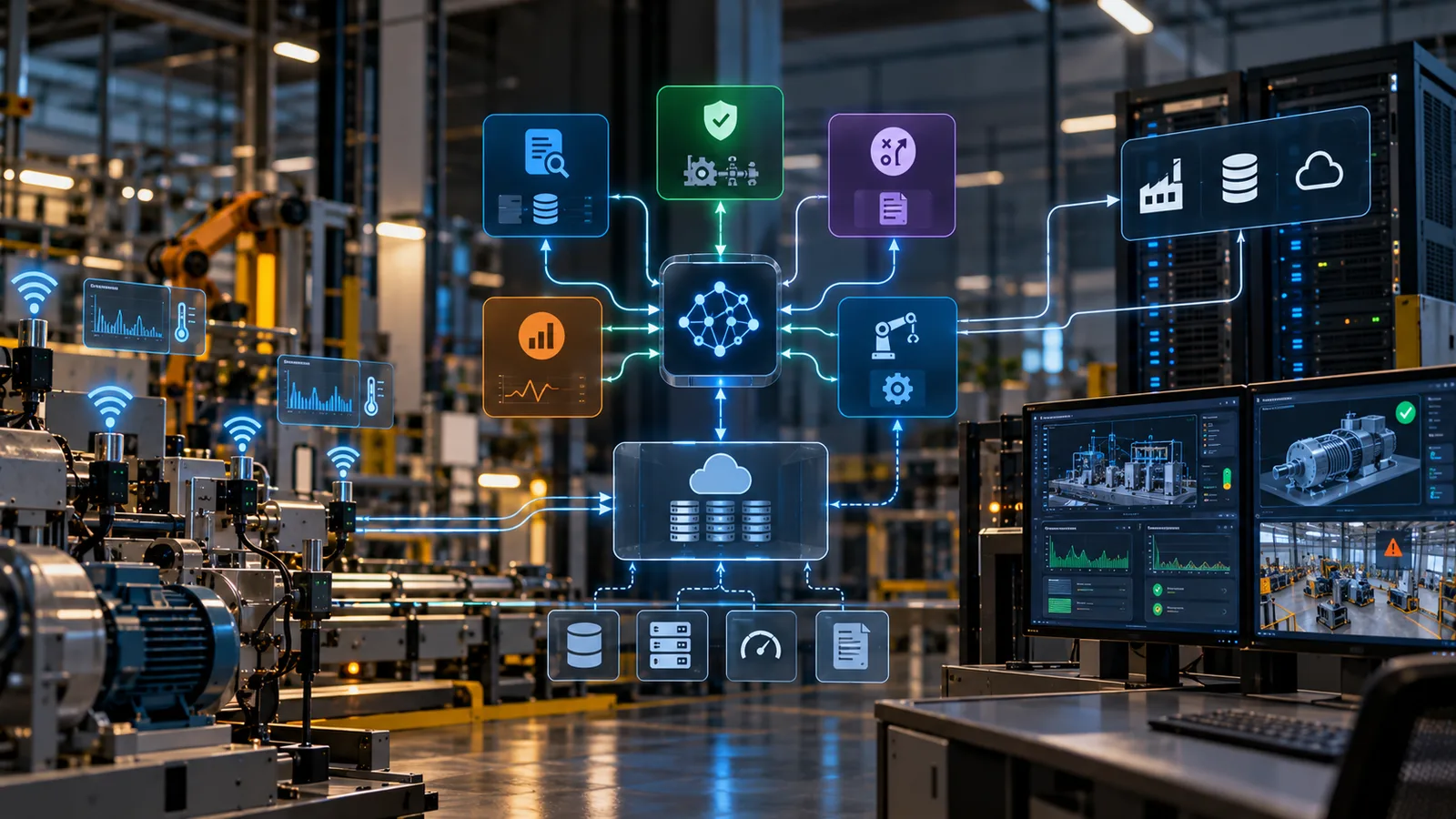
One of the most useful developments for production industrial AI systems is the Model Context Protocol (MCP). It provides a standard framework for giving AI agents awareness of enterprise software environments. MCP lets agents interface with ERP systems, CRM platforms, IoT sensor networks, manufacturing execution systems and operational databases. Isolated models become connected, context-aware systems.
Without MCP or an equivalent standard, every agent must be configured separately for each system it touches. Integration effort grows with every new connection. MCP standardises this context interface. As a result, agentic AI architecture designs can scale across many connected systems without multiplying integration complexity.
For programs spanning complex multi-vendor technology landscapes, MCP integration is often what makes agentic AI architecture practical at enterprise scale. Agents that understand the real technical context produce outputs grounded in operational constraints. They rely less on generic model knowledge, which reduces confident but wrong answers.
Pillar 3: AI Guardrails for High-Stakes Reliability
Tolerance for AI error varies dramatically between contexts, and agentic AI architecture must reflect that. In a recommendation engine, a wrong suggestion is a minor annoyance. In a power grid management system, a wrong decision can trigger a cascade failure. Industrial AI systems in high-stakes environments need AI guardrails. These guardrails enforce strict boundaries on what the AI can output, regardless of the model's confidence.
Schema Enforcement at the Data Contract Layer
AI guardrails in production work at several layers. Output schema enforcement at the data contract layer is the first. It ensures agents cannot produce outputs outside predefined formats and value ranges. Consider three examples:
- A part number that does not exist in the ERP catalogue.
- A safety threshold set outside the permitted operating range.
- A control instruction that exceeds physical equipment limits.
Schema-enforced guardrails block all three at the system layer. They do not rely on the model's internal knowledge to avoid them. In regulated manufacturing, these controls also support compliance. Regulators increasingly expect documented proof that a system cannot produce certain categories of dangerous output.
Separating Generative AI From Predictive AI
The second guardrails principle is separation of duties. Generative AI models excel at communication, summarisation and natural language interaction. They are poorly suited to deterministic safety decisions. Their probabilistic nature creates uncertainty that is unacceptable in safety-critical contexts.
In a well-designed agentic AI architecture, predictive machine learning models and rule-based systems handle safety thresholds, control instructions and operating limits. Generative AI handles the communication layer. It summarises alerts, drafts reports and offers natural language access to the system. It does not participate in safety-critical decisions. Our team designs this separation into industrial AI systems wherever safety standards apply.
Pillar 4: Human-in-the-Loop AI and Effective Handoffs
In any agentic AI architecture, fully autonomous industrial AI systems suit a narrow range of routine, well-understood scenarios. Many operations involve unusual conditions, regulatory duties or decisions with major business or safety consequences. For these, human-in-the-loop AI balances efficiency with accountability. It is not a concession to distrust. It is an architectural choice that assigns each decision to the most appropriate actor.
Confidence-Based Thresholds
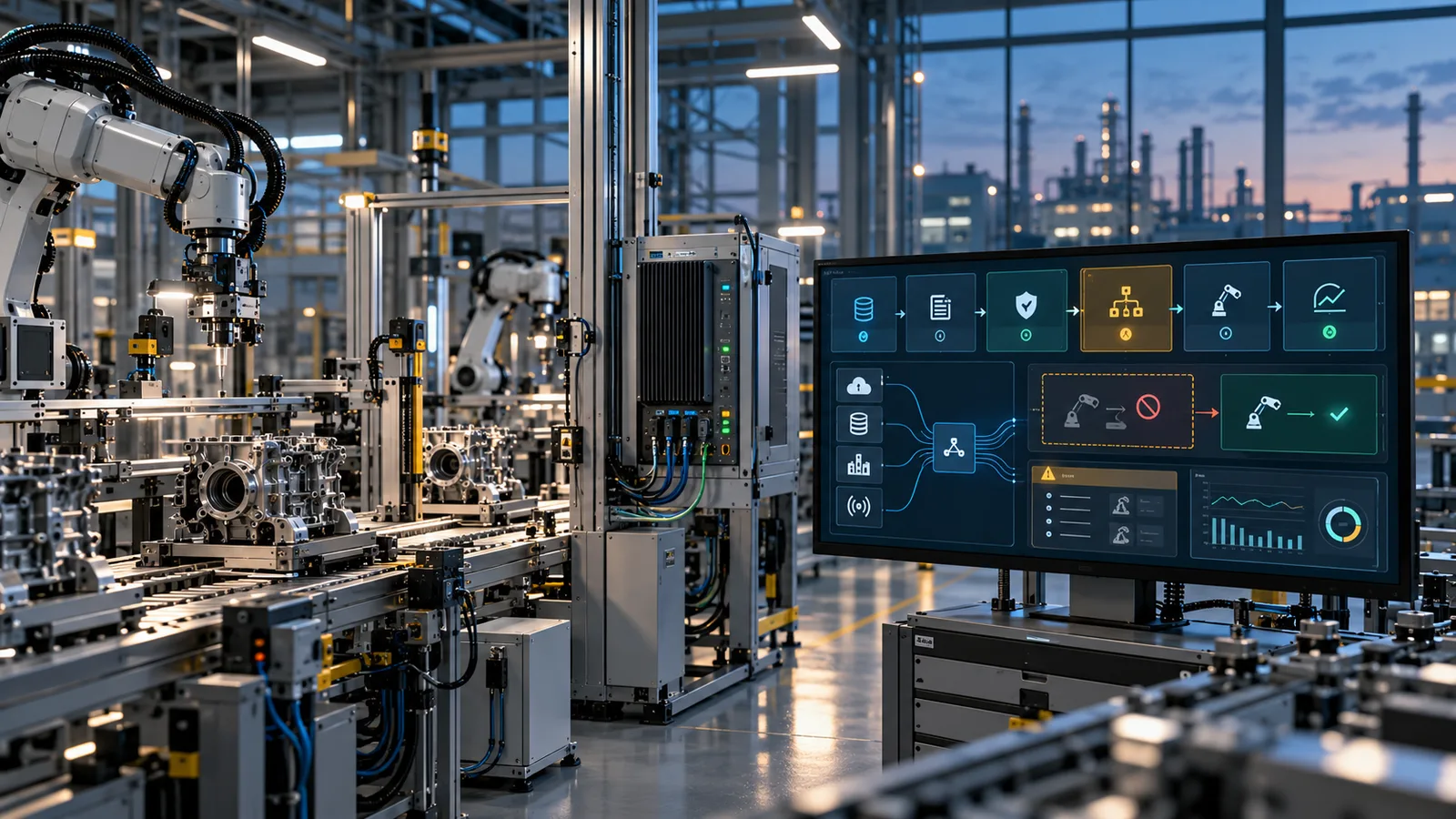
Effective human-in-the-loop AI design inside an agentic AI architecture uses confidence-based handoff thresholds. When an agent's confidence drops below a defined level, the system routes the decision to a human operator. It does not proceed on its own.
The handoff should include a structured package:
- A short summary of the situation.
- The agent's proposed action.
- The reason for the escalation.
- The relevant operational context and data.
This package lets the operator decide quickly. They do not start a fresh investigation from raw data. The system handles high volumes of routine decisions automatically. Edge cases, novel situations and high-consequence decisions still receive human review.
We recommend calibrating thresholds through operational testing rather than setting them arbitrarily. That way, escalation rates reflect real-world uncertainty rather than theoretical estimates. Our human-in-the-loop AI governance guide covers threshold design in more depth.
Pillar 5: Edge AI Deployment and the Data Gravity Problem
Industrial environments generate data at the point of operation, which shapes any agentic AI architecture. Sources include sensors on equipment, monitors on grid infrastructure, cameras on production lines and telemetry from vehicles and robots. The volume and latency sensitivity of this data often make centralised cloud processing impractical. Edge AI deployment addresses this by processing data where it is generated. The underlying idea comes from edge computing.
Edge AI deployment solves two distinct problems at once.
The Latency Problem
In robotics, grid management and automated manufacturing, decision latency matters for safety and efficiency. A round trip to a remote cloud region adds network delay that a local controller does not have. An edge AI deployment processes sensor data and generates decisions locally. Response times can then match the speed of the physical process.
The Data Sovereignty Problem
Industrial organisations increasingly face rules and competitive pressures that limit sending operational data to external infrastructure. Edge AI deployment keeps sensitive data on-site while still enabling AI-driven insight. For teams operating under strict data residency requirements, edge processing is often a firm design constraint. A sound agentic AI architecture therefore decides early which agents run at the edge and which run in the cloud.
Pillar 6: Governance Inside Agentic AI Architecture
Governance in industrial AI has shifted from a compliance concern to a competitive factor. Organisations that embed governance from the first design phase tend to move through approvals faster. They also build trust more easily and face fewer liability surprises than teams that retrofit controls later. The NIST AI Risk Management Framework offers a useful structure for this work.
Industrial AI systems typically need four governance components:
- Explainability documentation records which data inputs drove each agent decision. It supports post-incident analysis and regulatory reporting.
- Audit trail infrastructure captures a timestamped record of every system action. It provides evidence for compliance reviews and data for improvement.
- Data privacy controls separate sensitive operational data from the models that consume it.
- Bias and drift monitoring checks agent outputs for systematic deviations caused by model drift or training data gaps.
ICANIO builds these four components into agentic AI architecture designs from the first sprint. We treat governance as an architectural requirement rather than a post-deployment addition. Our AgenticOps services extend the same controls into day-to-day operations.
Agentic AI Architecture in Practice: Implementation Phases
Implementing agentic AI architecture is a phased program, not a single deployment. Teams that try to launch a fully autonomous multi-agent system in one step tend to meet the same failure modes. Integration gaps surface late. Agents meet edge cases they were not designed for. Operational teams are unprepared for new oversight duties.
Phase 1: Bounded Automation
The recommended sequence starts with bounded automation. Agents handle a narrow set of high-volume, low-risk decisions. Every other decision stays with human operators. This phase establishes monitoring, human-in-the-loop AI escalation pathways and team familiarity. It also generates the data needed to calibrate confidence thresholds. Finally, it reveals the edge cases that need more training data or revised agent logic.
Phase 2: Incremental Autonomy
The second phase expands agent autonomy step by step across the agentic AI architecture. New domains join the autonomous scope only when agents show consistent performance. Escalation rates for the existing scope must also stabilise at acceptable levels. This graduated approach prevents the trust collapse that follows a consequential error by a prematurely autonomous system. Such a collapse can damage long-term AI adoption far more than a slower initial rollout.
Phase 3: Continuous Improvement
The third phase keeps the agentic AI architecture healthy through retraining, threshold recalibration and capability expansion. Agents tuned for one period's conditions may perform worse as conditions change. Drift detection, a defined retraining cadence and a clear change process for updated agents separate lasting systems from those that degrade.
| Phase | Agent scope | Main goal |
|---|---|---|
| 1. Bounded automation | Narrow, low-risk tasks | Build monitoring and trust |
| 2. Incremental autonomy | Expanding domains | Grow scope safely |
| 3. Continuous improvement | Full approved scope | Prevent drift and decay |
| Ongoing governance | All agents | Audit and compliance |
You can see a related pattern in our agentic AI framework case study.
Why Agentic AI Architecture Matters for Industry
The benefits of agentic AI architecture come from the system design, not from any single model. Specialised agents in an agentic AI architecture are easier to test, replace and improve. Standard context protocols cut integration work. Guardrails and handoffs keep risk visible and bounded. Edge processing respects physical and legal constraints. Together, these pillars let industrial teams adopt automation without giving up control.
This matters most where AI touches physical assets. Predictive maintenance, quality inspection and energy optimisation all depend on reliable data and clear accountability. A digital twin of a production line, for example, can feed agents with simulated outcomes before any action reaches real equipment. Teams exploring that route can review our manufacturing industry solutions.
Conclusion
Agentic AI architecture is a practical response to the gap between AI demos and production reality. It breaks work into specialised agents, connects them through standard context protocols and wraps them in guardrails. Human-in-the-loop AI keeps people in charge of high-consequence decisions. Edge AI deployment and built-in governance handle latency, sovereignty and compliance.
In agentic AI architecture, choosing the right agents, defining trust boundaries and designing escalation pathways are the decisions that determine safe operation. They require AI engineering skill, domain knowledge and familiarity with industry regulations. ICANIO's Data and AI services bring these capabilities together.
If you are planning industrial AI systems and want a second opinion on your design, contact ICANIO to talk with our engineers.
References
- NIST AI Risk Management Framework
- Model Context Protocol: Introduction
- Multi-agent system (Wikipedia)
- Human-in-the-loop (Wikipedia)
- Edge computing (Wikipedia)
Frequently Asked Questions
What is agentic AI architecture?
Agentic AI architecture is a design approach where AI systems are built as coordinated networks of specialised agents rather than one large model. Each agent handles a specific domain, such as data retrieval, safety evaluation, decision execution or outcome monitoring. This specialisation gives better resilience, stronger performance per domain and more maintainable industrial AI systems than single-model approaches.
What are AI guardrails and why are they critical in industrial AI?
AI guardrails are mechanisms that enforce strict boundaries on what agents can output. They block results outside predefined formats, value ranges or operating constraints. In industrial AI systems, guardrails ensure agents cannot produce dangerous outputs regardless of model confidence. They also keep generative AI separate from the deterministic requirements of safety-critical decisions.
What is human-in-the-loop AI?
Human-in-the-loop AI is a pattern where agents handle routine decisions automatically but escalate to human operators when confidence drops below a defined threshold. Escalation also applies when a decision falls into a category that needs human accountability. Good designs send structured context with each escalation, so operators can act quickly instead of starting a fresh investigation.
Why does edge AI deployment matter for industrial environments?
Edge AI deployment processes data where it is generated rather than sending it to the cloud. This addresses latency, because safety-critical automation often needs very fast local responses. It also addresses data sovereignty, because some organisations cannot send proprietary operational data to external infrastructure due to regulation or competitive sensitivity.
How does agentic AI architecture differ from traditional AI?
Traditional AI systems answer single queries with single outputs. Agentic AI architecture builds systems that plan multi-step workflows and use enterprise tools such as ERP and CRM systems through protocols like MCP. These systems self-correct when intermediate steps go wrong. They coordinate several specialised agents to complete complex industrial tasks that one model could not handle reliably.
How should a company start with agentic AI architecture?
Start with bounded automation. Pick a narrow set of high-volume, low-risk decisions and let agents handle only those. Build monitoring, audit trails and escalation pathways first. Use the data from this phase to calibrate confidence thresholds. Then expand autonomy step by step, adding new domains only when performance and escalation rates are stable.