AI TEST GENERATION · PERFORMANCE ENGINEERING · DEVOPS TOOLING
Icanio built an API performance testing platform that uses generative AI to turn JSON, HAR, and XHR captures into ready-to-run YAML tests, removing the specialist skills teams once needed to simulate real-world load.
Quick Answer
What Is an API Performance Testing Platform?
An API performance testing platform uses generative AI to turn API captures into ready-to-run load tests, removing the specialist scripting skills teams once needed to simulate realistic traffic. ICANIO built this API performance testing platform on the Artillery engine, cutting testing setup time by 50% and tripling test coverage for development and QA teams.
Executive Summary
Turning Specialist Load Testing Into a Team Sport
Modern API performance testing tools are notoriously complex, forcing teams to spend significant effort just standing up realistic stress-testing environments. ICANIO’s partner was facing exactly that gap: complex tools that made performance testing difficult for teams, significant effort required to set up realistic stress-testing environments, limited collaboration features that slowed feedback between developers and QA and delayed bottleneck detection, and performance metrics that required deep technical expertise to interpret.
ICANIO addressed this by building an API Performance Testing Platform rather than adding more specialist headcount. The objective was to use generative AI to convert JSON, HAR, and XHR captures into ready-to-run YAML tests, add an AI chatbot to guide users through configuration, build on the proven Artillery engine for scalable traffic simulation, and support both functional and non-functional testing with configurable load distribution across users, regions, and servers for realistic multi-region stress testing, all surfaced through visual dashboards.
The result was a 50% faster testing setup and threefold broader test coverage, with automated AI test generation and shared dashboards replacing manual configuration and giving developers and QA a common view of performance data.
“A load test that only a specialist can configure is a load test most teams never run until something has already broken in production.”
The Challenge
Five Barriers Standing Between Teams and Realistic Load Tests
Modern API performance testing tools are often complex and difficult to use, creating barriers for teams trying to simulate realistic traffic, analyze results quickly, and collaborate effectively across development and QA workflows.
The API Performance Testing Platform Gap
Complex tools make API performance testing difficult for teams, putting realistic load simulation out of reach for anyone without specialist scripting skills.
Significant Setup Effort for Stress Tests
Setting up realistic stress testing environments requires significant effort, slowing teams down before they can even run their first test.
Slow Feedback Between Developers and QA
Limited collaboration features slow feedback between developers and QA, delaying the detection of system bottlenecks until later in the release cycle.
Expertise Gaps Before This API Performance Testing Platform
Interpreting performance metrics requires deep technical expertise that many QA and development teams don’t have readily available.
Confidence Gaps Before This API Performance Testing Platform
Inefficient testing workflows reduce release confidence and system reliability, leaving teams uncertain whether they can ship safely.
API Performance Testing Platform Solutions Provided
A Six-Part AI-Powered API Performance Testing Platform
Icanio Technologies developed an AI-powered API performance testing platform that simplifies test creation, automates configuration, and scales performance testing through an intuitive, collaborative interface. The solutions included:
Generative AI Test Generation
Generative AI converts JSON, HAR, and XHR captures into ready-to-run YAML tests, removing the specialist scripting skills teams once needed.
AI Chatbot for Test Configuration
An AI chatbot assists users throughout test configuration workflows, guiding teams through setup instead of leaving them with a blank YAML file.
Built on the Artillery Load Testing Engine
Built on the Artillery engine for scalable API traffic simulations, giving the platform a proven foundation instead of a testing engine built from scratch.
Test Support in This API Performance Testing Platform
Supports functional and non-functional performance testing scenarios, so teams can validate correctness and load behavior in the same platform.
Configurable Multi-Region Load Distribution
Configurable load distribution across users, regions, and servers lets teams simulate realistic, geographically distributed traffic patterns.
Dashboards in This API Performance Testing Platform
Visual dashboards display actionable performance testing insights, giving developers and QA a shared view of results without extra training.
Business Outcomes
Measurable Results Across Speed, Coverage, and Collaboration
This API performance testing platform delivered outcomes across every dimension of the team’s original testing bottleneck, converting a slow, specialist-dependent process into a fast, collaborative, AI-assisted workflow.
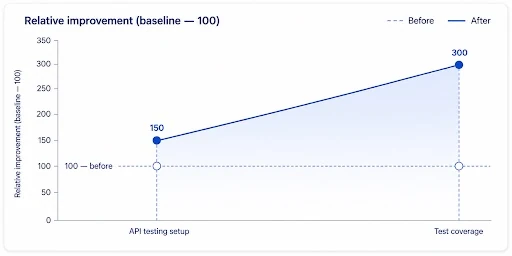
API performance testing platform outcomes: 50% faster test setup and three times better coverage.
50%faster
API testing setup
3ximproved
Test coverage
Automated workflows
AI test generation
Scalable testing
Multi-region stress tests
Better collaboration
Shared testing dashboards
Actionable insights
API performance analytics
Key learnings
What This Engagement Proves for Performance Testing Tools
Generative AI Removes the Scripting Bottleneck
The real barrier to realistic load testing was never the testing engine itself, it was the specialist scripting skill needed to configure it. Converting raw JSON, HAR, and XHR captures into YAML tests with generative AI is what let teams without that skill set start testing immediately.
Shared Dashboards Turn Testing Into a Team Activity
Performance testing stayed slow as long as only one specialist could read the results. Visual dashboards that both developers and QA can interpret without extra training are what turned testing from a solo task into shared performance dashboards the whole team actually uses.
This API Performance Testing Platform Reduces Risk
Building the AI layer on top of the established Artillery engine, rather than a custom load-testing engine from scratch, gave the platform proven scalability from day one instead of an unproven foundation.
Conclusion
From Specialist Bottleneck to Collaborative AI Testing
Complex, specialist-dependent load testing tools might be workable for a small team running occasional tests, but for engineering organizations shipping continuously, they had become a real bottleneck on release confidence. This engagement demonstrates that a single API performance testing platform can resolve setup complexity, feedback speed, and collaboration gaps within one structured programme rather than three separate initiatives.
By using generative AI to convert raw captures into YAML tests, building on the proven Artillery engine, and surfacing results through visual dashboards, ICANIO helped this partner cut testing setup time by 50% and triple test coverage. The AI test generation, multi-region load distribution, and shared dashboards delivered through this engagement are the foundation every future testing workflow this team builds will run on.
Related Resources
This API performance testing platform belongs to ICANIO's data and artificial intelligence services. Our team applies artificial intelligence and test automation to everyday software development workflows. Load testing also fits the release pipelines run by our DevOps and cloud engineering practice. More examples sit in our software development case studies. To plan a similar testing platform, contact ICANIO.
- Data and Artificial Intelligence Services
- Industries We Serve
- DevOps API Support Platform: 3x Faster
- DevOps Automation: 40% Faster Releases
- Continuous Testing for CI/CD: Enterprise Guide 2026
- QA Automation Reduces Time-to-Market: 2026 Guide
References
- Software performance testing: load, stress and other performance test types explained.
- Artillery documentation: official docs for the Artillery load testing engine.
- HAR 1.2 specification: the W3C draft describing the HTTP Archive capture format.
- YAML 1.2.2 specification: the official definition of the YAML data format used for test scripts.
Frequently asked questions
Common Questions About This API Performance Testing Platform
Why does an API performance testing platform use generative AI?
An API performance testing platform uses generative AI to convert raw JSON, HAR, and XHR captures into ready-to-run YAML load tests, removing the specialist scripting skill teams previously needed to simulate realistic traffic.
Why build the platform on the Artillery engine, not a custom one?
Building on the proven Artillery engine gives the platform established scalability for simulating API traffic, instead of spending engineering effort building and hardening a load-testing engine from scratch.
Functional vs non-functional performance testing: what differs?
Functional performance testing checks that the API behaves correctly under load, while non-functional testing measures speed, stability, and capacity, and this platform supports both scenarios in one tool.
How does the AI chatbot help during test configuration?
The AI chatbot guides users through test configuration workflows step by step, replacing a blank configuration file with an assisted setup process.
How does configurable load distribution simulate real-world traffic?
Configurable load distribution across users, regions, and servers lets teams model geographically distributed, realistic traffic patterns instead of a single simplified load profile.
How much faster is testing setup with this platform?
This API performance testing platform cut testing setup time by 50% and improved test coverage threefold compared to manually scripting and configuring load tests.