CLIENT REPORTING PORTAL · FINTECH SELF-SERVICE · COMPLIANCE TOOLS
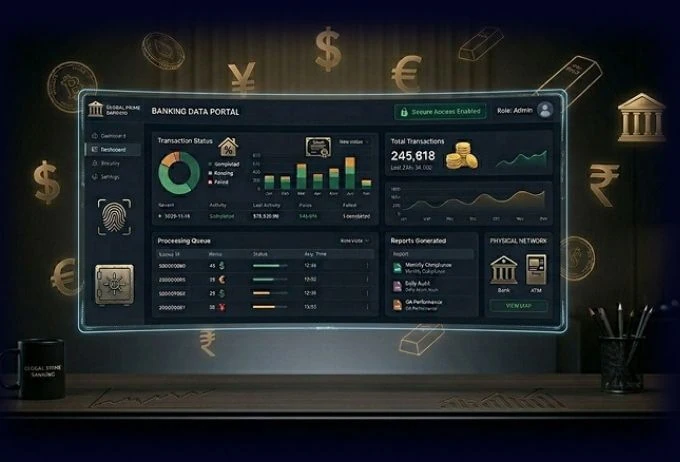
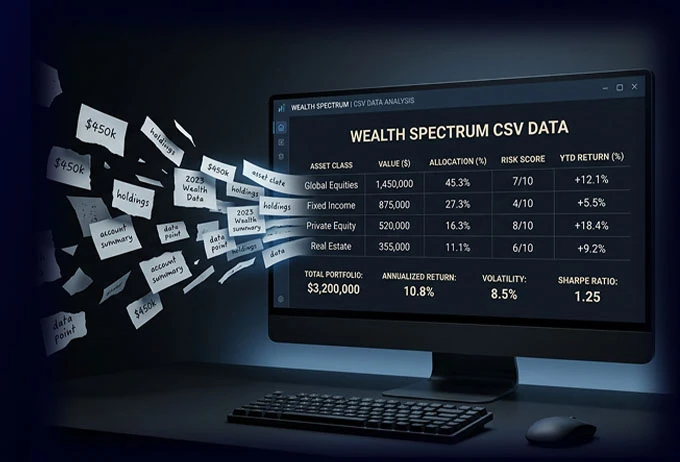
This financial reporting portal gave clients secure, real-time access to ledgers, portfolio reports, and trade confirmations in place of manual, fragmented processes.
Quick Answer
What Is a Financial Reporting Portal?
A financial reporting portal gives clients secure, real-time access to ledgers, portfolio reports, and trade confirmations in place of manual, fragmented processes. ICANIO built this financial reporting portal with self-service tools across Equity, F&O, Currency, and Commodities, cutting report retrieval time by 60% and manual processing effort by 50%.
Executive Summary
Turning Manual Client Reporting Into a Self-Service Portal
An organization needed to modernize client reporting with a unified, secure platform, reducing manual effort, ensuring compliance, and providing real-time visibility into transactions, holdings, and portfolio data. ICANIO’s partner was facing exactly that gap: a lack of a unified platform for client financial report access, manual processes that slowed viewing of ledgers and confirmations, difficulty reconciling holdings across Equity, F&O, Currency, and Commodities, and limited visibility into transactions, P&L, and client requests.
ICANIO addressed this by building a financial reporting portal rather than patching the existing manual process. The objective was to give clients seamless access to real-time ledgers, portfolio reports, and trade confirmations, provide historical data upload with compliance-ready annexures, enable self-service flows for PayIN, PayOut, margin pledges, and profile updates, and secure the platform with SSO, UI-level security, and reconciliation modules, all on a scalable architecture built for future expansion.
The result was 60% faster report retrieval and a 50% reduction in manual processing effort, with improved client service, enhanced regulatory compliance integrity, and real-time data visibility across systems.
“A client who has to email and wait for a portfolio statement has already started wondering what else about the relationship is manual.”
The Challenge
Five Barriers to Modern Client Financial Reporting
An organisation needed to modernize client reporting with a unified, secure platform, reducing manual effort, ensuring compliance, and providing real-time visibility into transactions, holdings, and portfolio data.
The Financial Reporting Portal Gap
Lack of a unified platform for client financial report access meant manual processes slowed viewing of ledgers and confirmations.
Difficult Cross-Asset Reconciliation
Difficulty reconciling holdings across Equity, F&O, Currency, and Commodities left clients and staff working from inconsistent records.
Limited Visibility Into Transactions and P&L
Limited visibility into transactions, P&L, and client requests made it hard for clients to get a current picture of their own accounts.
Compliance Demands for Historical Data
Compliance needs for historical financial data access and integrity required more than the ad hoc records the old process produced.
Why This Financial Reporting Portal Was Needed
Fragmented reporting reduced operational efficiency and client satisfaction, leaving both sides frustrated with the same manual process.
Financial Reporting Portal Solutions Provided
A Six-Part Financial Reporting Portal
Icanio developed the portal, providing secure, real-time client access to financial reports, trade confirmations, portfolio data, self-service flows, and compliance-ready archives. The solutions included:
The Financial Reporting Portal Core
A developed portal provides seamless client financial report access, replacing manual, request-based viewing with instant self-service.
Real-Time Ledgers and Confirmations
Real-time ledgers, portfolio reports, and trade confirmations give clients current data the moment it changes.
Compliance-Ready Historical Data
Historical data upload and compliance-ready annexures give clients and auditors reliable access to past records.
Self-Service PayIN, PayOut, and Profile Tools
Self-service flows for PayIN, PayOut, margin pledges, and profile updates let clients act without waiting on manual requests.
SSO Security and Reconciliation Modules
The platform is secured with SSO, UI-level security, and reconciliation modules, meeting the bar financial services requires.
This Financial Reporting Portal Scales
Scalable architecture supports future features and platform expansion, so new asset classes and tools can be added without a rebuild.
Business Outcomes
Measurable Results Across Speed, Compliance, and Experience
This financial reporting portal delivered outcomes across every dimension of the client’s original manual reporting problem, converting fragmented, request-based access into a fast, compliant, self-service experience.
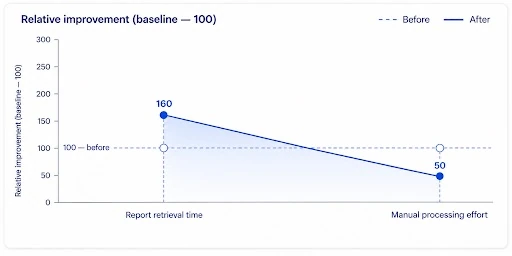
Financial reporting portal results: 60% faster report retrieval, 50% less manual processing and real-time data visibility across systems.
60%Faster
Report retrieval time.
50%Reduced
Manual processing effort.
Improved
Client service experience.
Enhanced
Regulatory compliance integrity.
Scalable
Enterprise-ready foundation.
Real-Time
Data visibility across systems.
Key learnings
What This Engagement Proves for Client-Facing Financial Platforms
Self-Service Only Works With Reconciliation Behind It
Giving clients self-service PayIN, PayOut, and profile tools would have been risky without SSO, UI-level security, and reconciliation modules underneath. Building the compliance layer first is what made self-service safe to expose.
One Portal Beats One Report Per Asset Class
Reconciling Equity, F&O, Currency, and Commodities separately was the actual source of the reconciliation difficulty. Bringing all four into one financial reporting portal is what resolved the cross-asset reconciliation problem, not faster individual reports.
Historical Data Access Is a Compliance Feature, Not an Archive
Treating historical data upload and compliance-ready annexures as core functionality, not an afterthought, is what let the portal meet the integrity requirements the business actually needed to satisfy.
Conclusion
From Manual Client Reporting to a Self-Service Portal
Manual, request-based reporting might have been workable for a smaller client base, but for an organization managing reporting across multiple asset classes, it had become a real constraint on efficiency and client satisfaction. This engagement demonstrates that a single financial reporting portal can resolve access, reconciliation, and compliance gaps within one structured programme rather than three separate initiatives.
By giving clients real-time ledger access, enabling self-service PayIN and PayOut flows, and securing the platform with SSO and reconciliation modules, ICANIO helped this partner reach 60% faster report retrieval and a 50% reduction in manual processing effort. The cross-asset reconciliation, compliance-ready data archives, and scalable architecture delivered through this engagement are the foundation every future asset class this portal supports will run on.
Related Resources
This financial reporting portal is an example of ICANIO's software development work for financial services. Our team builds secure client portals through application development services. Fintech clients can explore our fintech and banking solutions. Related data engineering work includes a bank API data acquisition portal and a data lake integration platform. Our cloud and DevOps engineering practice supports reporting automation at scale. To plan a similar portal, contact ICANIO.
- Application Development Services
- Fintech and Banking Solutions
- Bank API Data Acquisition Portal: 50% Faster
- Data Lake Integration Platform: 50+ Secure Feeds
- Top 5 Best Fintech App Development Wins
References
- Single sign-on: Wikipedia overview of SSO authentication across applications.
- Reconciliation (accounting): Wikipedia overview of matching records between systems.
- General ledger: Wikipedia overview of ledgers in financial accounting.
- Derivative (finance): Wikipedia overview of futures and options instruments.
Frequently asked questions
Common Questions About This Financial Reporting Portal
What is a financial reporting portal and why replace manual reports?
A financial reporting portal gives clients secure, real-time access to ledgers, portfolio reports, and trade confirmations, replacing manual, request-based access that slowed reporting and limited visibility.
How does the portal handle cross-asset reconciliation?
Cross-asset reconciliation across Equity, F&O, Currency, and Commodities happens inside one platform, rather than four separate systems, which is what resolved the reconciliation difficulty clients previously experienced.
What does real-time ledger access actually give clients?
Real-time ledger access lets clients view current ledgers, portfolio reports, and trade confirmations the moment they update, instead of waiting on a manually generated statement.
What can clients do with self-service PayIN and PayOut tools?
Self-service PayIN, PayOut, margin pledge, and profile update flows let clients complete these actions directly through the portal, without submitting a manual request and waiting for staff to process it.
How does the portal keep self-service secure and compliant?
SSO, UI-level security, and dedicated reconciliation modules secure every self-service flow, meeting the compliance bar required for financial services platforms.
How much faster is report retrieval with this portal?
This financial reporting portal cut report retrieval time by 60% and manual processing effort by 50% compared to the previous manual, request-based process.