Framework Selection & Fit
We compare LangGraph, AutoGen, CrewAI and managed options against your state, latency and governance needs. The agentic AI framework you choose should match the work, not the hype.
Neutral advice →AgenticOps · Agentic AI Framework
Your agents are only as steady as the runtime beneath them. We design new frameworks and repair shaky ones, covering model routing, memory, tool calls, state and tests.
⟳ Orchestrating agents…
every step traced · guardrails on · reversible
An agentic AI framework is the runtime layer that turns a language model into a working agent. It decides which model answers, what the agent remembers, which tools it may call and how a run recovers from errors. Get it wrong and every agent built on top inherits the weakness.
Our team designs this layer for new agent programmes and stabilises it for teams whose agents already misbehave. We pick open-source components where they fit, write custom code where they do not, and wrap the whole runtime in tests and tracing.
This page explains what the framework layer contains, the design choices that matter most, and how ICANIO took a real enterprise platform from unstable to dependable.
A software framework gives developers a fixed skeleton and lets them fill in the business logic. An agentic AI framework does the same for AI agents. It supplies the reasoning loop, the model interface, tool registration, memory and state handling, so each new agent does not reinvent them.
Popular open-source options include LangGraph, Microsoft AutoGen, CrewAI, Semantic Kernel and LlamaIndex agents. Cloud vendors add managed services on top. Many enterprises end up with a blend: an open-source core, custom adapters and their own guardrails.
The framework is invisible when it works. Users only see agents that answer well. When it fails, the symptoms look like model problems: inconsistent answers, skipped tools, repeated steps or sudden cost spikes. The root cause usually sits in routing, memory or state.
That is why we treat the agentic AI framework as a product in its own right. It gets versioning, a test suite, release gates and an owner, just like any other critical platform.
Working definition
“An agentic AI framework is the shared runtime that gives AI agents their reasoning loop, model routing, memory, tool access, state persistence and evaluation hooks, so teams can build many reliable agents on one governed foundation.”
Foundations
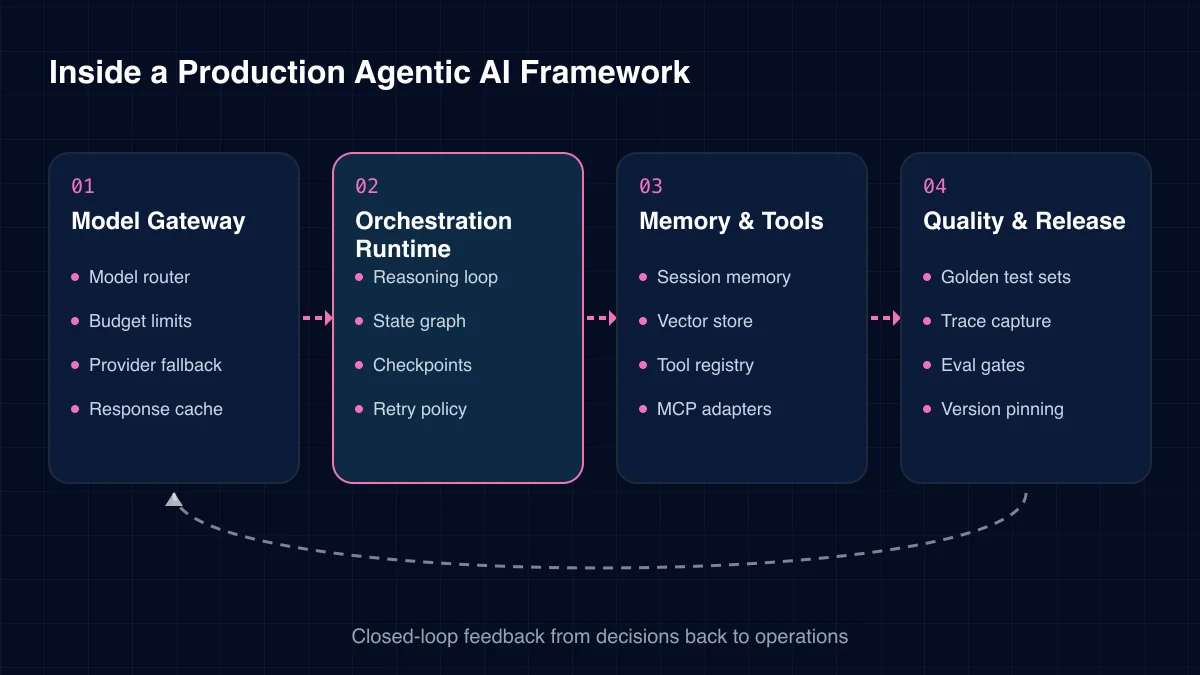
Send each step to the cheapest model that can handle it, with automatic fallback when a provider slows or fails.
Separate short-term session context from long-term knowledge. Expire, summarise and scope both deliberately.
Every tool has a typed schema, a timeout and a clear error format the agent can reason about.
Checkpoint each step so a crashed run resumes where it stopped instead of starting over.
Core capabilities
These are the components we design, build or repair in a framework engagement.
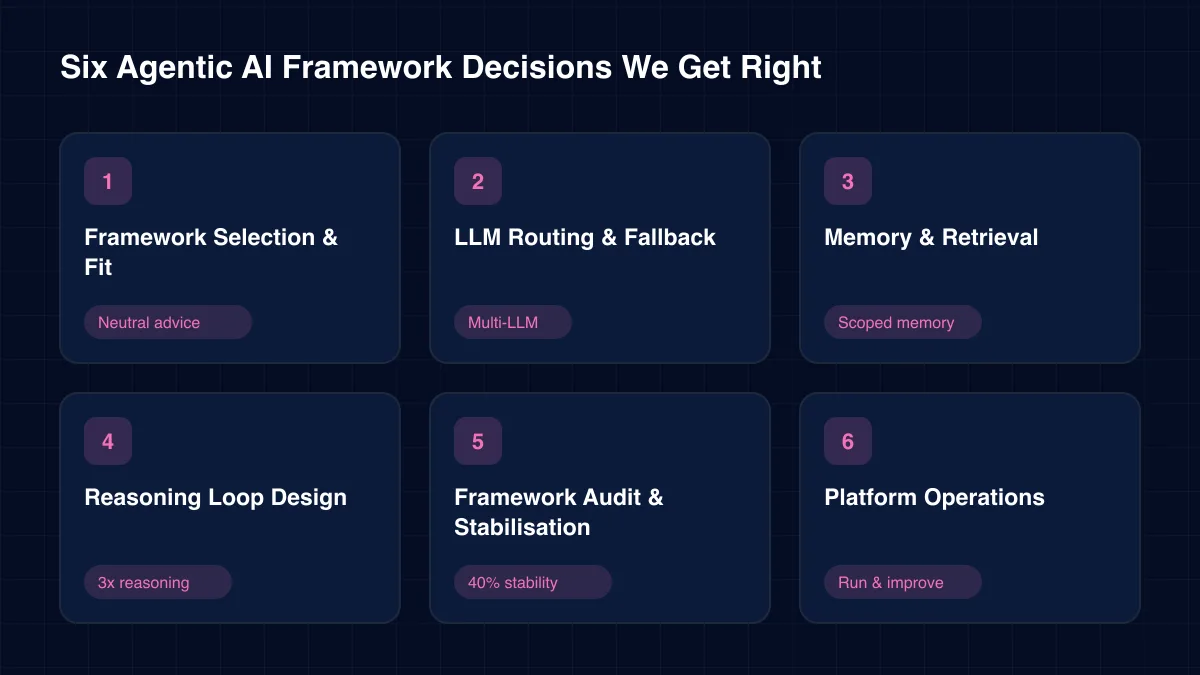
We compare LangGraph, AutoGen, CrewAI and managed options against your state, latency and governance needs. The agentic AI framework you choose should match the work, not the hype.
Neutral advice →A routing layer that picks models per step, enforces budgets and fails over between local and cloud LLMs. Small language models take simple steps; frontier models take hard ones.
Multi-LLM →Session memory, long-term stores and RAG pipelines designed with clear expiry and access rules. Agents recall what matters and forget what could mislead them.
Scoped memory
Plan-and-execute, ReAct and reflection loops tuned per agent. In one agentic AI framework we rebuilt, reflective agents lifted reasoning quality 3x.
3x reasoning →We trace failing runs to their root cause, fix state and tool-call bugs, and add regression tests. Stabilising an agentic AI framework comes before adding any new agents.
40% stability
Deployment, scaling, tracing and release gates for the framework itself, run as part of our wider AgenticOps service so every agent benefits.
Run & improve →Architecture
We organise the runtime into four layers. The orchestration runtime is the core: it owns the loop, the state and the checkpoints.
01
02
03
04
Challenges we solve
Teams rarely say their framework is broken. They say their agents feel unpredictable. These are the usual causes inside an agentic AI framework.
No pinned model versions or temperature settings. Behaviour shifts every time a provider updates.
Tool errors return as plain text the agent ignores. The run continues with missing data.
Memory grows until prompts hit token limits. Agents lose instructions and answer off-topic.
A timeout halfway through means starting again, paying twice and sometimes acting twice.
The design depends on one model provider. A price change or outage stops everything.
Prompt edits go straight to production with no tests. Regressions surface as customer complaints.
There is no single right answer. The best agentic AI framework route depends on your team, your rules and how many agents you plan to run.
A quick view of the trade-offs we discuss with every client.
| Criterion | Open-source | Managed service | Custom |
|---|---|---|---|
| Time to first agent | Fast | Fastest | Slow |
| Control over state | High | Partial | Full |
| Multi-model support | ✓ Yes | Partial | ✓ Yes |
| Operating effort | Medium | Low | High |
| Best for | Most teams | Small estates | Niche, high volume |
A strong agentic AI framework pays off with every new agent you add.
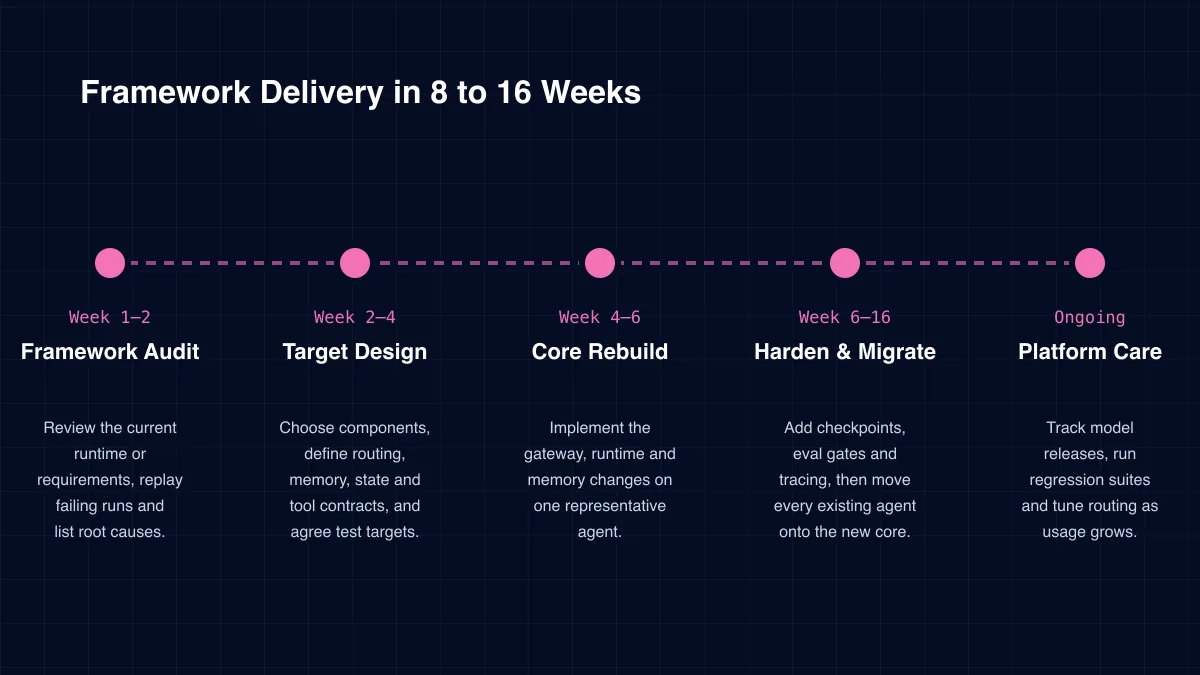
Delivery
Week 1–2
Review the current runtime or requirements, replay failing runs and list root causes.
Week 2–4
Choose components, define routing, memory, state and tool contracts, and agree test targets.
Week 4–6
Implement the gateway, runtime and memory changes on one representative agent.
Week 6–16
Add checkpoints, eval gates and tracing, then move every existing agent onto the new core.
Ongoing
Track model releases, run regression suites and tune routing as usage grows.
Case study
An enterprise AI platform had an agentic AI framework with unresolved stability issues, inconsistent reasoning and limited tool use. ICANIO ran a six-part programme: workflow audit, reasoning and tool-use optimisation, new collaborative and reflective agents, multi-LLM support, low-code architecture upkeep and scalable deployment. Stability improved 40% and reasoning 3x.
“A framework that works in isolation but fails in production is an architecture and workflow engineering problem.”Read the full case study →
Root-cause tracing
Every existing workflow reviewed and its stability failures resolved.
Optimised tool invocation
Consistent reasoning chains and reliable tool calls across agent runs.
Local & cloud LLMs
One framework that runs across several model environments, with scalable deployment.
Specialist services within our agenticops practice.
We recommend asking any partner these five questions before they touch your runtime.
In our experience, handover is where frameworks die. We document, train and pair with your team so the runtime stays healthy.
Security controls belong in the framework, not in each agent. Our gateway strips secrets from prompts, applies output filters and blocks calls to tools an agent is not cleared to use.
We design against the OWASP Top 10 for LLM applications, including prompt injection, insecure output handling and excessive agency. Risk controls map to the NIST AI Risk Management Framework.
ICANIO works under ISO 9001 and ISO 27001 certified processes. Local model support also lets regulated teams keep sensitive data on their own infrastructure.
Framework work pays back through fewer failures and cheaper runs. Measure failed runs per thousand, average cost per run and time to ship a new agent before you start.
Routing is usually the quickest win. Moving formatting, extraction and classification steps to small models cuts token spend without hurting quality on the steps that matter.
The larger gain is speed. When memory, tools and tests are shared, a new agent takes weeks instead of months, and it starts life stable instead of fragile.
Technology stack
We pick per use case and keep every piece replaceable.
Agent Frameworks
Microsoft AutoGenSemantic Kernel
Model Gateway
OpenAI GPT modelsOpen-source LLMsLocal inference
Memory
Vector databasesRAG pipelinesSummarisation memory
Tools
Typed tool schemas
State & Execution
Graph checkpoints
Quality
DeepEvalGolden test setsTrace replay
An agentic AI framework is the shared runtime that gives agents a reasoning loop, model access, memory, tools and state. It lets teams build many agents on one tested foundation instead of wiring each one by hand.
It depends on the work. LangGraph suits stateful, branching workflows. AutoGen suits conversational agent teams. CrewAI is quick for role-based crews. We recommend choosing after mapping your state, latency and governance needs.
Yes. Stabilisation is a large part of our work. We replay failing runs, find root causes in routing, memory or tool handling, then fix and test them. Our team did this for an enterprise platform and improved stability 40%.
Ours do. A model gateway sits between agents and providers, so the same agentic AI framework can call cloud APIs or local models. That helps with cost, outages and data residency.
We build golden test sets from real cases and replay them on every change. Evaluation tools such as DeepEval score answers and tool calls. A change ships only when it passes the agreed thresholds.
An audit takes about two weeks. A full redesign and migration of existing agents usually takes eight to sixteen weeks, depending on how many agents and integrations are involved.
How we deliver agentic ai framework and the wider agenticops practice in each sector.
Agents get the attention, but the agentic AI framework underneath decides whether they hold up. Routing, memory, state and tests are unglamorous work, and they are what production demands.
ICANIO designs new frameworks and repairs existing ones, with measured results on a real enterprise platform. In manufacturing, the same runtime can host agents that read IoT alerts and predictive maintenance forecasts alongside machine learning models in the cloud. Contact us for an honest review of your agentic AI framework.
By ICANIO AgenticOps Engineering Team · Published · Updated
Tell us how your agents fail today. We will review the framework beneath them and give you a clear plan to make them dependable.
Contact Our Framework Engineers