OPC UA & Legacy Protocol Connectivity
We connect PLCs, CNCs and drives over OPC UA, Modbus and vendor protocols. This IoT data integration layer reads data without disturbing control logic.
Read-only by default
Specialist Digital Twin Service
We connect machines, sensors and control systems to one trusted data layer. OPC UA, MQTT and edge gateways deliver clean, contextualised telemetry to your twins and analytics.
Edge Gateway EG-3
Plant 2 · Line B cabinet
Remaining life
212 days
Msgs/sec
1864msg/s
Latency
41ms
Buffer
12%
✓ All signals within physics baseline
IoT data integration is the unglamorous work that decides whether a digital twin succeeds. If the data arrives late, unlabelled or full of gaps, no model on top of it can be trusted.
Industrial sites rarely start from a blank page. They run PLCs from several vendors, a SCADA system, a historian, a few wireless sensors and an ERP. Each speaks its own protocol and names things its own way.
Our team builds the pipelines that join these sources into one governed stream. Every value arrives with a timestamp, a unit, a quality flag and a place in your asset hierarchy. Twins, dashboards and machine learning models then read the same trusted data.
IoT data integration is the practice of collecting data from connected devices and control systems, then moving it reliably to the platforms that use it. It covers protocols, edge processing, transport, storage and the semantic model that gives raw tags meaning.
In industrial settings it bridges two worlds. Operational technology values safety, determinism and uptime. IT values scale, security and open interfaces. Good integration respects both without weakening either.
For a twin, integration is the nervous system. It decides how fresh the mirror is, how complete it is and whether it can be trusted during an audit.
Done well, IoT data integration is invisible. Engineers stop asking where a number came from, because every value can be traced back to its device, its timestamp and its quality check. That traceability is what lets a twin move from pilot to daily operations.
Working definition
“IoT data integration is the engineered flow of device, sensor and control-system data into a governed, contextualised data layer that downstream twins, analytics and business systems can rely on.”
Foundations
Use the protocols the equipment already speaks, such as OPC UA, Modbus or vendor drivers. Avoid fragile screen-scraping and manual exports.
Filter, compress and buffer close to the asset. Sites keep working through network outages and bandwidth stays under control.
A broker-based design lets each consumer subscribe to what it needs. New use cases do not require new point-to-point links.
Tags are mapped to assets, units and hierarchies. A value called T_204 becomes oven zone 3 temperature in degrees Celsius.
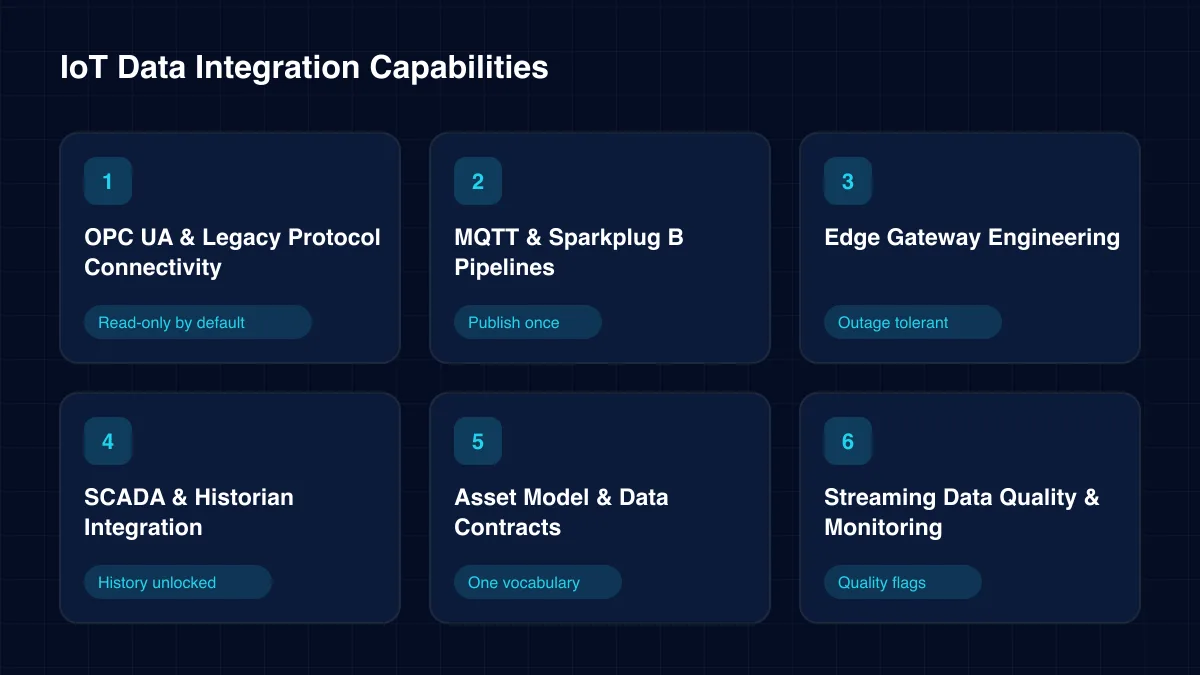
Core capabilities
We can deliver one layer, such as edge gateways, or the full path from sensor to twin.
We connect PLCs, CNCs and drives over OPC UA, Modbus and vendor protocols. This IoT data integration layer reads data without disturbing control logic.
Read-only by default
A broker-based backbone publishes each signal once. Sparkplug B adds state awareness and a consistent payload format across devices.
Publish once
Gateways filter, aggregate and buffer data on site. Store-and-forward keeps the IoT data integration path intact through network drops.
Outage tolerant
Years of history in SCADA and historians are back-filled into the platform. Twins and models then train on real operating records.
History unlocked
We build an ISA-95 style asset hierarchy and data contracts per stream. Every consumer of the IoT data integration layer reads the same names and units.
One vocabulary →Checks for gaps, flatlines, spikes and stale values run on every stream. Data stewards get alerts before a twin acts on bad input.
Quality flags →Architecture
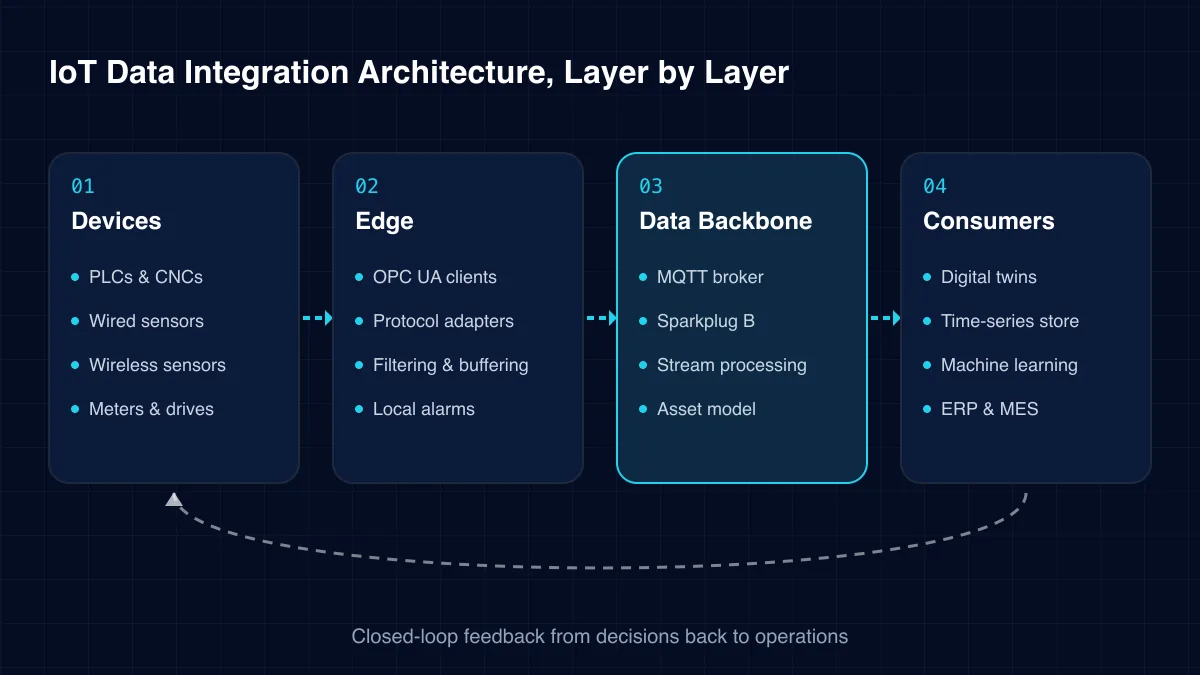
The architecture moves data from the cell to the cloud in four steps. Each step adds reliability or meaning.
01
02
03
04
Challenges we solve
These issues stall twin and analytics projects long before the modelling starts.
Each new dashboard adds another direct link to a PLC. The links break on upgrades and nobody owns them.
Thousands of cryptic tag names live in spreadsheets. Analysts waste weeks guessing which value is which. Two sites may even use different names for the same signal.
When the site link drops, data simply vanishes. Gaps then corrupt trends and model training sets.
Older machines speak legacy protocols. Newer ones speak OPC UA. Few teams can bridge both cleanly.
Plant teams rightly fear opening control networks. Without a secure design, projects never get approval. The data stays locked inside the plant.
A frozen sensor looks like a stable process. Without checks, bad values flow straight into decisions.
There is no single right pattern. We choose based on your sites, network and use cases.
The table compares common approaches to IoT data integration.
| Need | Point-to-point | Historian only | Unified data layer |
|---|---|---|---|
| Add a new consumer easily | No | Partial | ✓ Yes |
| Survives network outages | No | ✓ Yes | ✓ Yes |
| Consistent asset context | No | Partial | ✓ Yes |
| Real-time streaming | Partial | Partial | ✓ Yes |
| Built-in quality checks | No | No | ✓ Yes |
Good integration pays off in every project that reads the data later.
Delivery
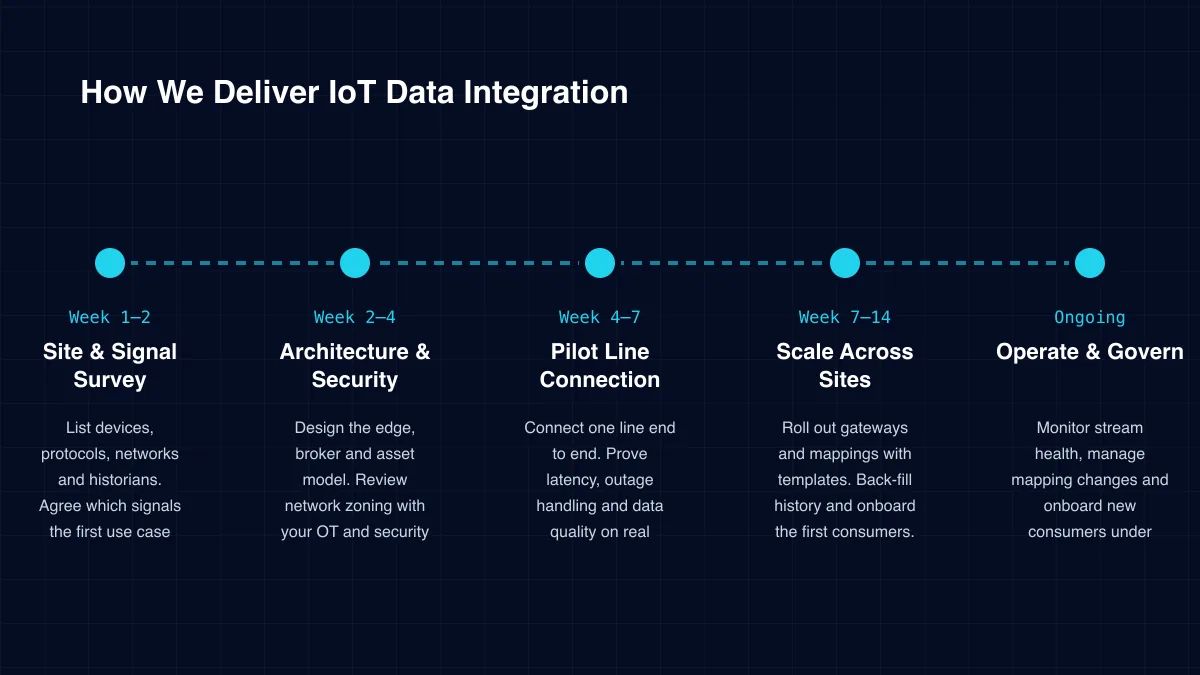
Week 1–2
List devices, protocols, networks and historians. Agree which signals the first use case really needs.
Week 2–4
Design the edge, broker and asset model. Review network zoning with your OT and security teams.
Week 4–7
Connect one line end to end. Prove latency, outage handling and data quality on real equipment.
Week 7–14
Roll out gateways and mappings with templates. Back-fill history and onboard the first consumers.
Ongoing
Monitor stream health, manage mapping changes and onboard new consumers under SLA-based support.
Specialist services within our digital twin solutions practice.
Many vendors can move data to a cloud. Fewer can do it safely on a live plant. Check these five points.
In our experience, the asset model is the step teams most often skip, and the one they most often regret skipping.
Integration must never weaken plant safety. ICANIO works under ISO 9001 and ISO 27001 certified processes and designs with the IEC 62443 zone and conduit model in mind.
Gateways sit in a DMZ between control and business networks. Connections are outbound only, encrypted with TLS and authenticated with certificates. Write access to devices is off unless explicitly approved and logged.
Certificates are rotated on a schedule, and every gateway is patched through a controlled process. Our team documents each conduit so your security staff can review the IoT data integration design before anything goes live.
Integration rarely earns money on its own. Its value shows up in every project that no longer has to build its own connections. Count how many weeks past projects spent on data access alone.
Add avoided data loss during outages and lower cloud transfer costs from edge filtering. We agree these measures with you up front so the platform's value is visible.
We recommend one more measure: time to onboard a new use case. With a governed IoT data integration layer in place, a new twin or dashboard should take days to connect, not months.
Technology stack
We favour open standards and pick tools to fit your existing estate.
Field
PLCsSCADAWireless sensorsEnergy meters
Protocols
OPC UAModbus TCPSparkplug B
Edge
Industrial gatewaysContainerised adaptersStore-and-forward
Backbone
Stream processing
Storage
Time-series databasesCloud data lakeHistorians
Consumers
Digital twinsMachine learningERP & MESDashboards
A twin is only as good as its inputs. IoT data integration makes sure values arrive on time, with units and context, and with gaps flagged. Without it, the twin mirrors noise.
Usually both. OPC UA is strong for reading structured data from machines. MQTT is strong for distributing data to many consumers, because each one subscribes only to the topics it needs. We recommend OPC UA at the edge and MQTT for the backbone in most plants.
Yes. Legacy equipment can be reached through Modbus, serial adapters or retrofit sensors. The edge gateway then translates everything into one consistent format. Your newer and older lines then appear side by side in the same IoT data integration layer.
Not when it is done carefully. We read data with read-only connections at agreed scan rates. Changes to control systems are tested in a maintenance window first.
As close to the asset as is useful. Filtering, buffering and simple alarms belong at the edge. Heavy analytics and cross-site twins usually belong in the cloud.
Every stream gets checks for gaps, flatlines, out-of-range values and late arrivals. Each value carries a quality flag, and data stewards receive alerts when checks fail. Twins can be told to ignore values flagged as suspect.
How we deliver iot data integration and the wider digital twin practice in each sector.
IoT data integration turns a plant full of incompatible devices into one trusted source of live data. It is the foundation every twin, dashboard and machine learning model stands on.
ICANIO brings OT protocol skills, cloud engineering and data governance into one team. We connect one line first, prove reliability, then scale the pattern across your sites.
By ICANIO Digital Twin Engineering Team · Published · Updated
Book a free discovery call with our industrial data engineers. We will review your devices and networks and outline a secure path to one trusted data layer.
Contact Our Digital Twin Team