Physics-Based System Modelling
We build thermal, hydraulic, mechanical and electrical models in Modelica. Each digital twin simulation reflects real physical laws, not only past patterns.
Modelica / FMU
Specialist Digital Twin Service
We build physics-based and scenario models that start from your live operating state. Engineers try new settings, loads and failure cases on the twin before touching real equipment.
Chiller Plant CH-1
Site East · Cooling system
Remaining life
212 days
Supply water
6.9°C
Load
637kW
COP
5.18
✓ All signals within physics baseline
Digital twin simulation lets you ask what happens if, and get a trustworthy answer before anything changes on the real system. It runs engineering models that start from the live state of your asset or process.
Traditional simulation studies are built once and then drift away from reality. They use design values, not the worn pump or the crowded shift you actually have today. Teams stop trusting them, and decisions fall back on trial and error.
Our team builds simulation models that stay connected to live data. They are validated against your own history, calibrated as equipment ages, and ready to test changes, loads and failures on demand.
Digital twin simulation combines a physics or process model with a live data feed. The live feed sets the starting conditions. The model then runs forward under the scenario you choose.
This differs from classic offline simulation in two ways. The starting state is real rather than assumed. And model parameters are tuned continuously, so the model reflects the system as it is now, not as it was designed.
It also differs from pure machine learning. Physics models can explore conditions that have never happened, such as a new product, a rare fault or an extreme load. Data-driven models can only repeat patterns they have already seen.
In practice the best results come from combining both. Physics gives the structure and the ability to extrapolate. Machine learning corrects the small gaps between equations and the real, ageing equipment.
Working definition
“Digital twin simulation is the use of calibrated physics, process or hybrid models, initialised from live system data, to predict how a real asset or operation will respond to changes, faults and scenarios.”
Foundations
Each question gets the simplest model that answers it. Overly detailed models are slow and hard to keep calibrated.
Every run starts from current sensor values and states, not textbook defaults.
Parameters such as friction, fouling or efficiency are re-estimated as the asset ages.
Predictions are compared with real outcomes, and the error is shown to users.
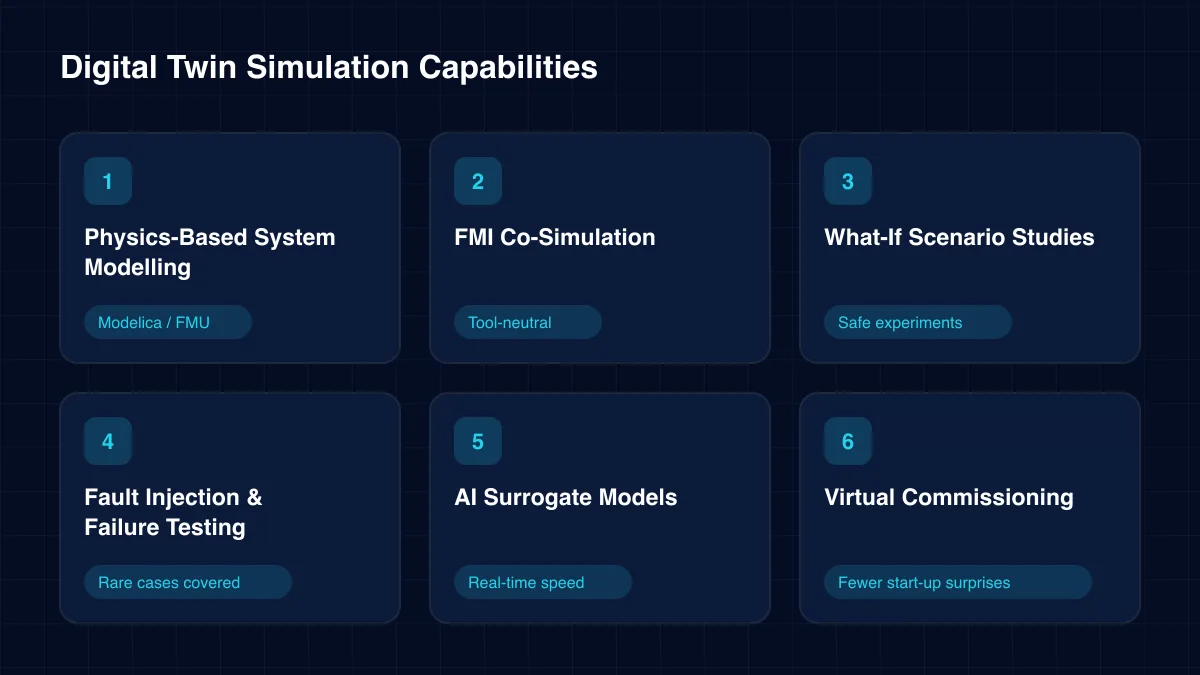
Core capabilities
We match the modelling method to the question, from a single component to a whole site.
We build thermal, hydraulic, mechanical and electrical models in Modelica. Each digital twin simulation reflects real physical laws, not only past patterns.
Modelica / FMU
Models from different tools are packaged as FMUs and run together. A vehicle, its controller and its route can be simulated as one system.
Tool-neutral
Engineers test new setpoints, loads or schedules on a copy of today's state. The digital twin simulation reports the effect on output, energy and risk.
Safe experiments →Rare or dangerous faults are injected in the model to train detection and test responses. This builds a fault library without waiting for real failures.
Rare cases covered →Machine learning surrogates learn from detailed simulations and run far faster. They make real-time digital twin simulation possible on heavy physics.
Real-time speed
PLC logic and new layouts are tested against a simulated plant before installation. Start-up problems are found on screen, not on site.
Fewer start-up surprises →Architecture
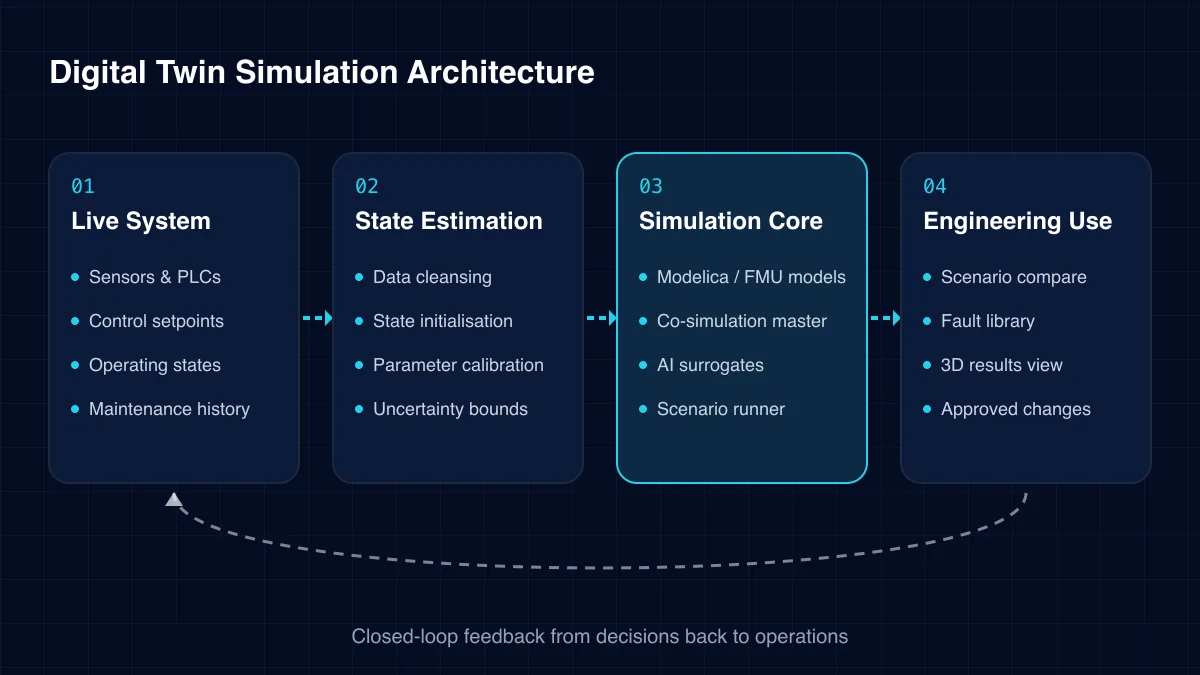
The architecture links live data, calibrated models and a scenario workspace. Results reach engineers through the same tools they already use.
01
02
03
04
Challenges we solve
These challenges push engineering teams toward simulation tied to live data.
Testing a new setting on real equipment can damage it or waste output. Many good ideas are never tried.
Models built for a past project no longer match the plant. Their answers are quietly ignored.
Detection models need examples of failures that rarely happen. Waiting for them is slow and costly.
Detailed solvers take hours per run. That is too slow for operational decisions, so the model is used once and then shelved.
Control logic errors appear only when new equipment starts up. Fixing them on site delays production.
Mechanical, electrical and control models live in separate tools. Nobody can simulate the whole system, so interactions between parts are discovered late and at high cost.
Different questions need different modelling methods. We often combine them.
Digital twin simulation blends the strengths of the other two approaches.
| Capability | Offline simulation | Pure ML model | Twin simulation |
|---|---|---|---|
| Starts from live state | No | ✓ Yes | ✓ Yes |
| Handles unseen conditions | ✓ Yes | No | ✓ Yes |
| Calibrates as assets age | No | Partial | ✓ Yes |
| Fast enough for operations | No | ✓ Yes | ✓ Yes |
| Explains its predictions | ✓ Yes | Partial | ✓ Yes |
The benefits come from testing more ideas, more safely, with more trust in the answer.
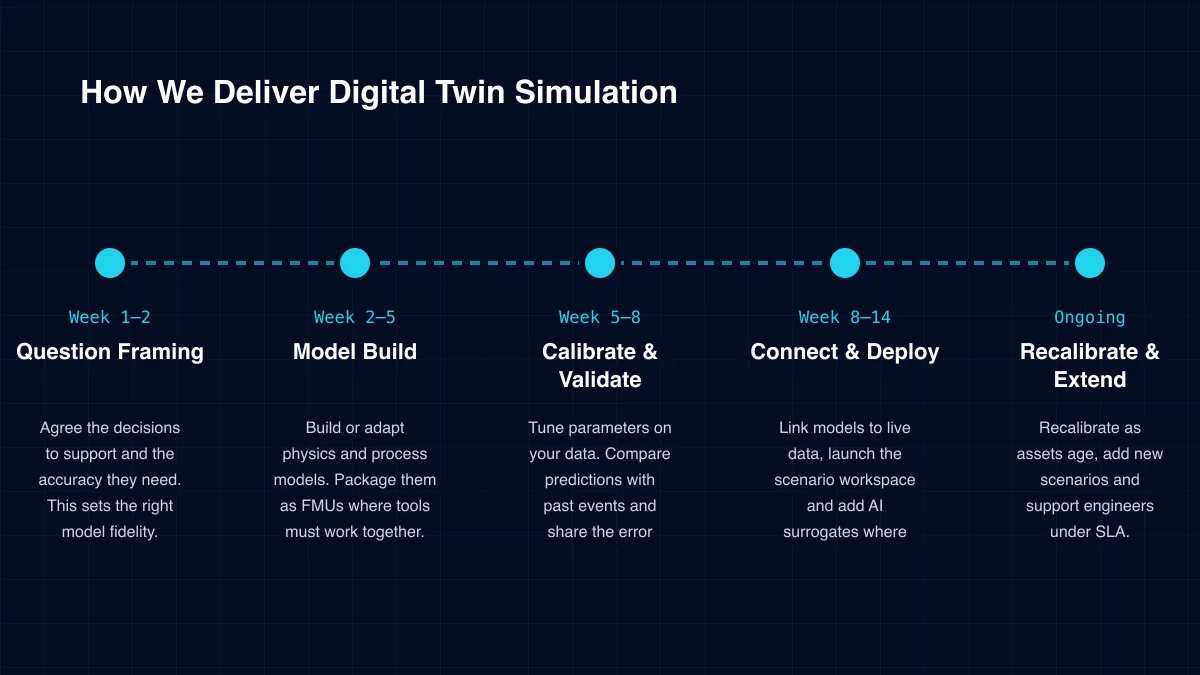
Delivery
Week 1–2
Agree the decisions to support and the accuracy they need. This sets the right model fidelity.
Week 2–5
Build or adapt physics and process models. Package them as FMUs where tools must work together.
Week 5–8
Tune parameters on your data. Compare predictions with past events and share the error openly.
Week 8–14
Link models to live data, launch the scenario workspace and add AI surrogates where speed matters.
Ongoing
Recalibrate as assets age, add new scenarios and support engineers under SLA.
Case study
For a fleet management technology partner, ICANIO built a continuously updated physics simulation of a healthy engine. Live readings were compared with that simulated baseline to detect faults. The proof of concept validated carbon buildup and stuck VVT actuator detection on a simulated mid-size petrol sedan, before any real vehicle was involved.
“The goal was never just an alert. It was an alert an operator could actually trust and act on.”Read the full case study →
CARLA · OpenModelica FMU
Models how a healthy engine should behave under current driving conditions.
XGBoost · Rule engine
Compares live readings with the simulated baseline and alerts on sustained deviation.
NVIDIA Omniverse
Shows the affected component on an interactive 3D vehicle model.
Specialist services within our digital twin solutions practice.
Simulation skills are common. Keeping models live and calibrated is rare. We recommend checking these five points.
In our experience, open validation is what turns a clever model into one engineers actually use.
Simulation models often hold your most valuable design knowledge. ICANIO works under ISO 9001 and ISO 27001 certified processes and treats models as confidential IP.
Models and data run in your own cloud tenancy or on premises. Access is role-based, and every scenario run is logged with its inputs and author. Write-back to live control systems always needs human approval.
Count the physical trials, test rigs and start-up delays from your last few projects. Each one is a cost that digital twin simulation can reduce or remove.
Add energy savings from optimised setpoints and avoided damage from tested limits. We baseline these with you in discovery and track them after deployment.
Value also grows with reuse. A calibrated model built for one decision can answer the next ten questions at little extra cost, so we design models to be shared across teams.
Technology stack
We choose open, proven tools wherever possible.
Physics
ModelicaOpenModelicaFMI / FMUPython solvers
Process
Discrete-event simulationAgent-based modelsSimPy
Environment
CARLAGaussian Splatting scenes
AI
Surrogate modelsXGBoostCalibration methods
Data
IoT streamsTime-series storeCloud data lake
Compute
GPU instancesContainerised runsBatch scenario jobs
Normal simulation starts from assumed conditions and design values. Digital twin simulation starts from the live state of the real system and stays calibrated as it changes. Its answers reflect today, not the original design.
No. We can build models from design data and operating history. If you already have Modelica, Simulink or other models, we can often package them as FMUs and reuse them.
Accuracy depends on the question and the model fidelity. We validate every model against your own history and show the error band. You decide whether it is good enough for each decision.
Yes, with the right approach. Simplified physics or AI surrogates trained on detailed models can run in real time. Detailed models stay available for deeper offline studies. Our team chooses the balance of speed and fidelity per use case.
It means testing PLC logic and new equipment against a simulated plant before installation. Errors are fixed on screen, which shortens start-up and protects production.
Manufacturing, automotive, energy, logistics and building operations use it most. Any sector where physical trials are costly or risky gains from testing virtually first.
How we deliver digital twin simulation and the wider digital twin practice in each sector.
Digital twin simulation gives engineers a safe place to test ideas on a faithful copy of the real system. Fewer risky trials, faster decisions and better designs follow.
ICANIO combines physics modelling, data engineering and machine learning in one team. We frame the question, build and validate the model on your data, then keep it calibrated as your operation evolves.
By ICANIO Digital Twin Engineering Team · Published · Updated
Book a free discovery call with our simulation engineers. We will frame your key question, review your data and outline a validated model with clear milestones.
Contact Our Digital Twin Team