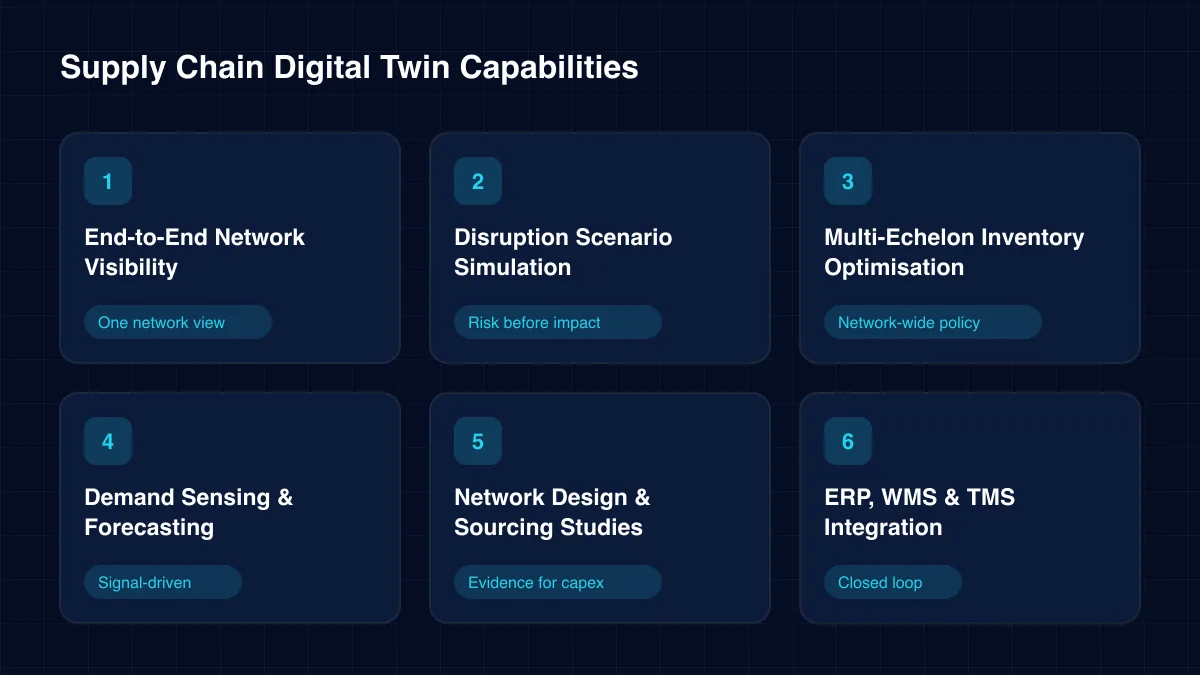
End-to-End Network Visibility
Stock, orders and shipments from every node appear on one map. The supply chain digital twin shows where goods are and where they are late.
One network view →Specialist Digital Twin Service
We model your network from suppliers to customers, feed it with live ERP, WMS and transport data, and let planners test disruptions before they happen.
DC Chennai South
Region South · 3 echelons
Remaining life
212 days
Stock cover
12.1days
Fill rate
96.9%
Dock queue
6trucks
✓ All signals within physics baseline
A supply chain digital twin is a live model of how goods, orders and money move through your network. It lets planners ask what happens if a port closes, a supplier slips or demand jumps, and get an answer before it happens.
Most supply chains run on a patchwork of ERP reports, spreadsheets and emails. Each team sees its own node. When a disruption hits, nobody can quickly see which customers, plants or products it will reach.
Our team builds network twins that join ERP, WMS, TMS and supplier data into one model. Planners see the current state, the likely future state and the best options to protect service and cost. Leaders get one shared answer instead of competing spreadsheets.
A supply chain digital twin represents the nodes and flows of your network: suppliers, plants, warehouses, stores, lanes and customers. Each node has capacities, lead times, stock policies and costs.
Live transactions keep it current. Purchase orders, production plans, inventory levels and shipment events update the model every day or every hour. It always starts from what is true today.
On top of that state sit analytics and simulation. Forecasts project demand. Scenario runs show how a disruption would ripple through the network, and optimisation suggests the best response. Planners can compare several responses side by side, each with its effect on service, cost and stock.
The twin does not replace your ERP or planning tools. It sits beside them as a shared, network-wide view that each tool can feed and draw from.
Working definition
“A supply chain digital twin is a data-synchronised model of a supply network that tracks its current state, simulates disruptions and policy changes, and recommends actions to balance service, cost and risk.”
Foundations
Nodes, lanes, bills of material and sourcing rules describe how products really flow.
Orders, stock, production and shipment events keep the model in step with reality.
Disruptions and policy changes are played forward to show impact on service and cost.
Optimisation and clear trade-off views help planners choose and act quickly.
Core capabilities
We can start with visibility and add simulation and optimisation as trust grows.
Stock, orders and shipments from every node appear on one map. The supply chain digital twin shows where goods are and where they are late.
One network view →Model port closures, supplier failures, demand spikes or capacity loss. Planners see which customers and products are exposed, and when.
Risk before impact →Safety stock is set across the whole network, not node by node. The supply chain digital twin balances service level against working capital.
Network-wide policy
Machine learning models blend order history, promotions and external signals. Short-term forecasts feed the twin's projections, so stock moves before demand shifts arrive.
Signal-driven
Test a new warehouse, a second source or a nearshoring move on the model first. Compare cost, lead time and risk across options. The supply chain digital twin shows how each option behaves under the same disruption scenarios.
Evidence for capex
Connectors pull data from SAP, Oracle, Microsoft Dynamics and transport platforms. Approved actions flow back as transfer or purchase orders.
Closed loop →Architecture
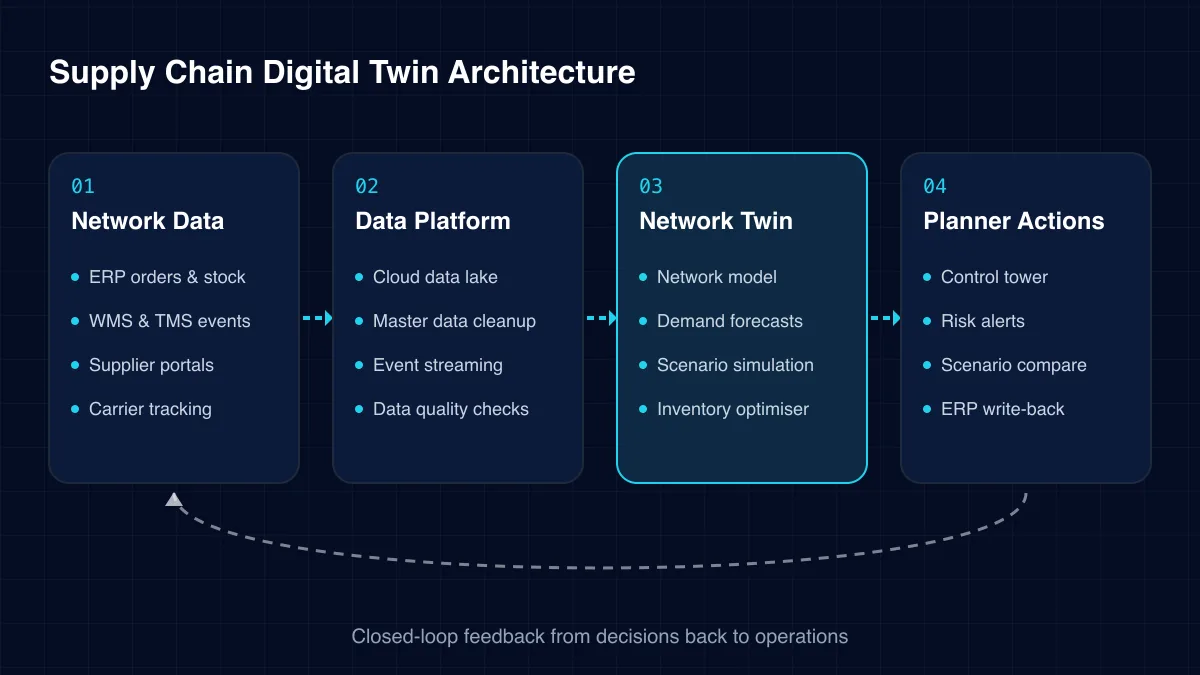
The architecture joins scattered enterprise data into one network model. Simulation and optimisation then run on top.
01
02
03
04
Challenges we solve
These are the pain points we hear most often from planning and logistics leaders.
Teams learn about a delay when goods fail to arrive. By then the cheap options are gone, and expedited freight becomes the only fix.
Procurement, production and distribution plan separately. Local fixes often create problems elsewhere. A cheaper inbound route may starve a key distribution centre.
Some SKUs pile up while others run out. Node-by-node safety stock rarely fits the whole network. Cash ends up tied in the wrong places while customers wait.
Small demand changes grow into large order swings upstream. Suppliers and plants overreact. Shared visibility of real demand calms these swings.
A what-if question takes days of spreadsheet work. Decisions are made before the answer arrives. Leaders then rely on instinct during the very moments that need evidence.
New warehouses and sources are chosen with limited modelling. Mistakes are expensive to undo and can lock in higher costs for years.
Scope depends on the decisions you want to improve. Many clients combine more than one.
A supply chain digital twin builds on tools you may already have. The table shows the difference.
| Capability | Control tower | Planning tool | Network twin |
|---|---|---|---|
| Live end-to-end visibility | ✓ Yes | Partial | ✓ Yes |
| Disruption simulation | No | Partial | ✓ Yes |
| Multi-echelon optimisation | No | Partial | ✓ Yes |
| Network design studies | No | No | ✓ Yes |
| Learns from executed actions | No | No | ✓ Yes |
Value appears first in visibility, then grows as simulation and optimisation are added.
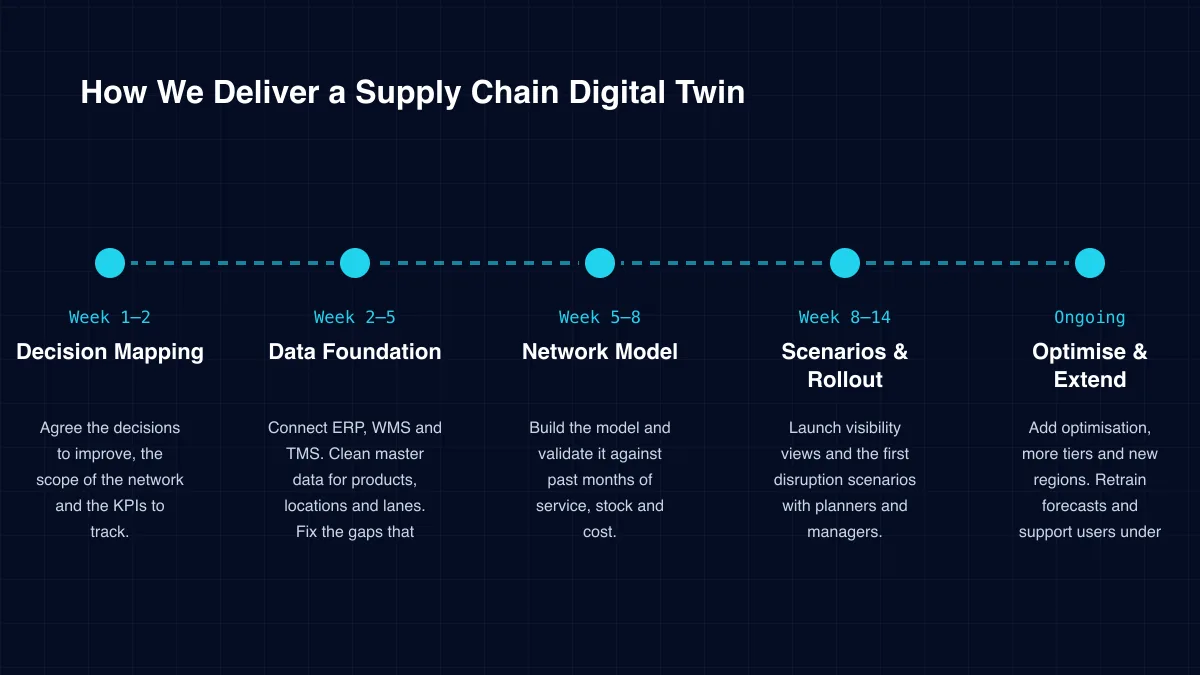
Delivery
Week 1–2
Agree the decisions to improve, the scope of the network and the KPIs to track.
Week 2–5
Connect ERP, WMS and TMS. Clean master data for products, locations and lanes. Fix the gaps that would distort the supply chain digital twin.
Week 5–8
Build the model and validate it against past months of service, stock and cost.
Week 8–14
Launch visibility views and the first disruption scenarios with planners and managers.
Ongoing
Add optimisation, more tiers and new regions. Retrain forecasts and support users under SLA.
Specialist services within our digital twin solutions practice.
A good map is not a twin. We recommend checking these five points before you commit.
In our experience, clean master data decides success more than any algorithm, so we tackle it first.
Supplier prices, volumes and customer orders are commercially sensitive. ICANIO works under ISO 9001 and ISO 27001 certified processes.
Data stays in your own cloud tenancy. Access is role-based, so a supplier or region manager sees only their part of the network. Every scenario and change is logged with its author.
When suppliers share data with you, we keep their feeds separate and limit who can see them. Our team can also mask prices and volumes in scenario workspaces that are shared with partners.
Start with the cost of stockouts, expedited freight and excess inventory last year. These three lines show where a supply chain digital twin can create value.
Add faster planning cycles and better network decisions. We baseline each measure during discovery and report against it as the twin matures.
Expect visibility gains first and optimisation gains later. We recommend reviewing results each quarter, because the biggest savings usually come once planners trust the model enough to act on it.
Technology stack
We fit tools to your ERP landscape and data volumes.
Sources
Microsoft DynamicsWMS & TMS
Integration
APIsEDIEvent streamingCarrier tracking
Data
Cloud data lakeMaster data managementData quality rules
Modelling
Network graphDiscrete-event simulationMonte Carlo runs
Analytics
Machine learning forecastsInventory optimisationRisk scoring
Experience
Control towerScenario workspaceAlertsSSO access
A control tower shows what is happening now. A supply chain digital twin also simulates what could happen next and compares responses. It turns visibility into tested decisions.
Core needs are product and location master data, orders, inventory, lead times and shipments. Most of it sits in ERP, WMS and TMS. Supplier and carrier data improve accuracy over time.
Yes, where data is available. Many clients start with tier 1 and add deeper tiers for critical components. Partial visibility of lower tiers is still useful for risk scenarios. A supply chain digital twin can flag single-source parts even when deeper data is thin.
No. It works beside your ERP and planning tools. It adds network-wide simulation and sends approved actions back to the systems you already use. Planners keep their familiar screens for daily execution.
Retail, consumer goods, manufacturing, logistics and healthcare supply all benefit. Any business with many nodes, long lead times or volatile demand is a strong candidate. Healthcare supply adds the need to protect critical items, which scenario planning supports well.
Visibility views usually arrive in the first two months. Validated disruption scenarios follow soon after. Optimisation gains grow as the model learns from executed actions.
How we deliver supply chain digital twin and the wider digital twin practice in each sector.
A supply chain digital twin gives every planner the same live picture of the network and a safe place to test responses. It replaces late surprises with early, informed choices.
ICANIO brings data engineering, simulation and machine learning together in one team. We start with the decisions that matter most, prove the model on your history, then extend it across your network.
By ICANIO Digital Twin Engineering Team · Published · Updated
Book a free discovery call with our supply chain twin engineers. We will review your network and data, then outline a first model with clear milestones.
Contact Our Digital Twin Team