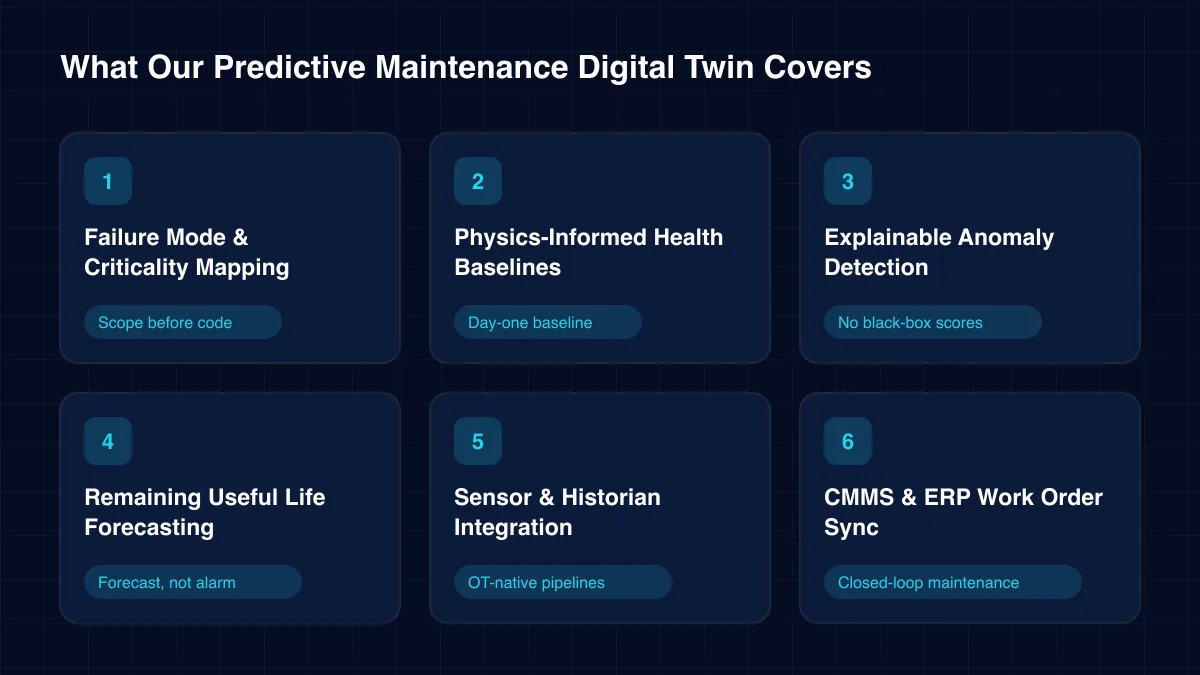
Failure Mode & Criticality Mapping
We start with an FMEA-style review of your critical assets. It decides which failure modes the predictive maintenance digital twin must detect, and which sensors can see them.
Scope before code
Specialist Digital Twin Service
We build asset health twins that compare live sensor readings with a physics baseline, forecast remaining useful life and turn early warnings into planned work orders.
Gearbox G-7
Plant 1 · Conveyor 3
Remaining life
212 days
Oil temp
61.3°C
Vibration
3.16mm/s
Load
71%
✓ All signals within physics baseline
A predictive maintenance digital twin tells you which asset will fail, roughly when, and why. It keeps a live model of how a healthy machine should behave. It then measures how far reality has drifted from that model.
Most maintenance teams still work from calendars or from breakdowns. Calendar work replaces parts that had months of life left. Breakdown work arrives at the worst moment, with no spares on the shelf. Both waste money and both are avoidable.
Our team builds each predictive maintenance digital twin around your critical assets, your failure modes and your maintenance system. The goal is simple. Planners see a trusted warning early enough to schedule the fix on their terms.
A predictive maintenance digital twin is a virtual copy of one asset or asset class, fed by its sensors in real time. It holds an expected-behaviour model built from physics, design data and healthy history. Deviations from that model become health scores.
The twin then projects those scores forward. It estimates remaining useful life, ranks likely failure modes and suggests the next action. That forward view is what separates it from a condition monitoring screen that only shows the present.
Because the twin knows operating context, it can tell a genuine fault apart from a heavy shift, a hot day or a new product run. This context is where most threshold alarms fail.
Working definition
“A predictive maintenance digital twin is a continuously updated model of an asset that compares live condition data with expected behaviour, forecasts degradation, and triggers maintenance before functional failure.”
Foundations
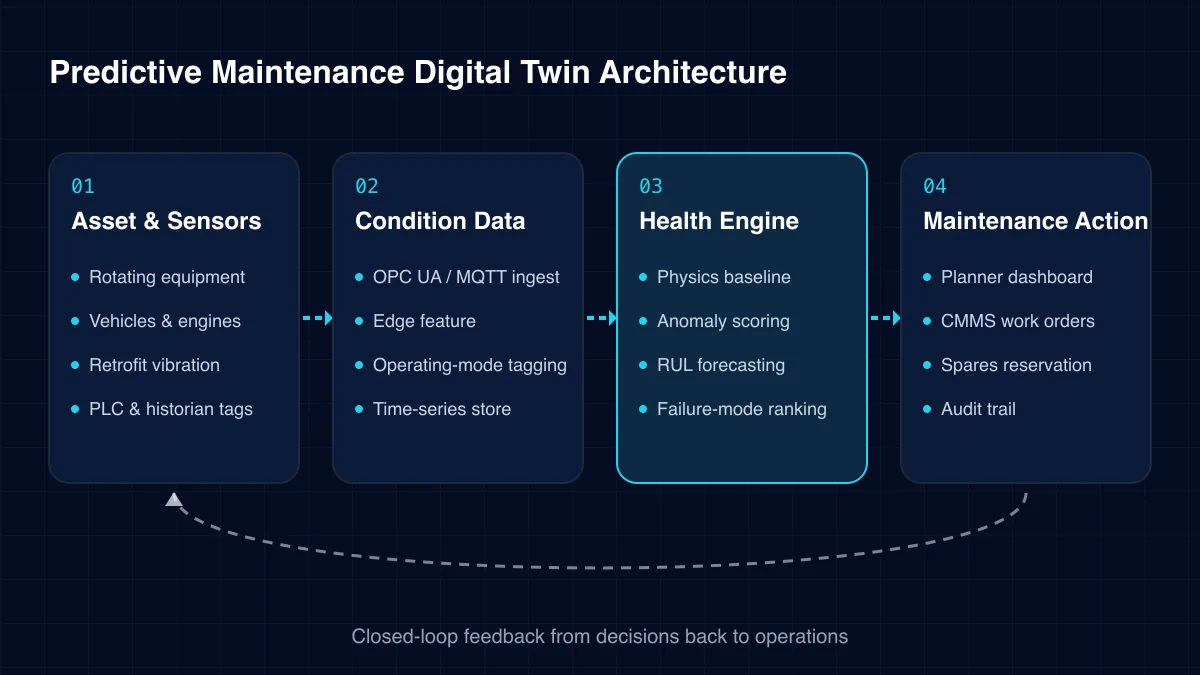
A physics or first-principles model says what the asset should read under current load, speed and temperature. It gives detection a reference point from the first week.
Vibration, temperature, current, pressure, oil quality and acoustic data are cleaned, time-aligned and tagged with operating mode before any model sees them.
Health indicators are trended and projected to estimate remaining useful life. Confidence bands show how certain the forecast is.
Alerts carry a recommended task, parts list and priority. They flow into the CMMS or ERP so the right crew arrives with the right spares.
Core capabilities
Each capability can be delivered on its own or combined into a full asset health programme.
We start with an FMEA-style review of your critical assets. It decides which failure modes the predictive maintenance digital twin must detect, and which sensors can see them.
Scope before code
Modelica and FMU components describe expected behaviour. The baseline removes the need to wait for years of labelled fault data before detection works.
Day-one baseline →Gradient-boosted models and rule engines score deviation from the baseline. Every alert from the predictive maintenance digital twin lists its sensor evidence and a confidence level.
No black-box scores
Survival and trend models inside the predictive maintenance digital twin project each health indicator forward. Planners get a date range for intervention, not just a red light.
Forecast, not alarm
We connect PLCs, SCADA historians and retrofit sensors through OPC UA and MQTT. Clean condition data then reaches the twin with operating context attached.
OT-native pipelines →Alerts from the predictive maintenance digital twin become draft work orders in SAP PM, Maximo or your own system. Feedback on each closed job retrains the model.
Closed-loop maintenance →Architecture
The architecture keeps detection close to the asset and forecasting close to the maintenance plan. Four layers do the work.
01
02
03
04
Challenges we solve
These are the patterns we hear most in discovery calls with plant, fleet and facility teams.
Fixed intervals replace healthy parts and still miss early failures. Condition-based planning spends effort only where degradation is real.
Pure machine learning needs many labelled failures, and good plants rarely have them. A physics baseline lets detection start before that history exists.
Static thresholds fire on every heavy shift. Operators learn to ignore them. Context-aware scoring cuts noise so real warnings get attention.
A vibration trend on a screen does not book a crew. Linking the twin to the CMMS turns each warning into a scheduled, resourced job.
Emergency orders and bloated safety stock both cost money. Forecast failure dates let stores reserve parts only when they are needed.
Warranty claims and audits need evidence. Timestamped readings and alert snapshots create a defensible record for every intervention.
The right variant depends on how much data you have and how critical the asset is.
Each strategy has a place. The table shows where a predictive maintenance digital twin adds value.
| Question | Reactive | Preventive | Predictive twin |
|---|---|---|---|
| Acts before failure | No | Partial | ✓ Yes |
| Uses live condition data | No | No | ✓ Yes |
| Avoids replacing healthy parts | ✓ Yes | No | ✓ Yes |
| Forecasts remaining life | No | No | ✓ Yes |
| Plans spares ahead | No | Partial | ✓ Yes |
The value grows as more assets and more closed work orders feed the model.
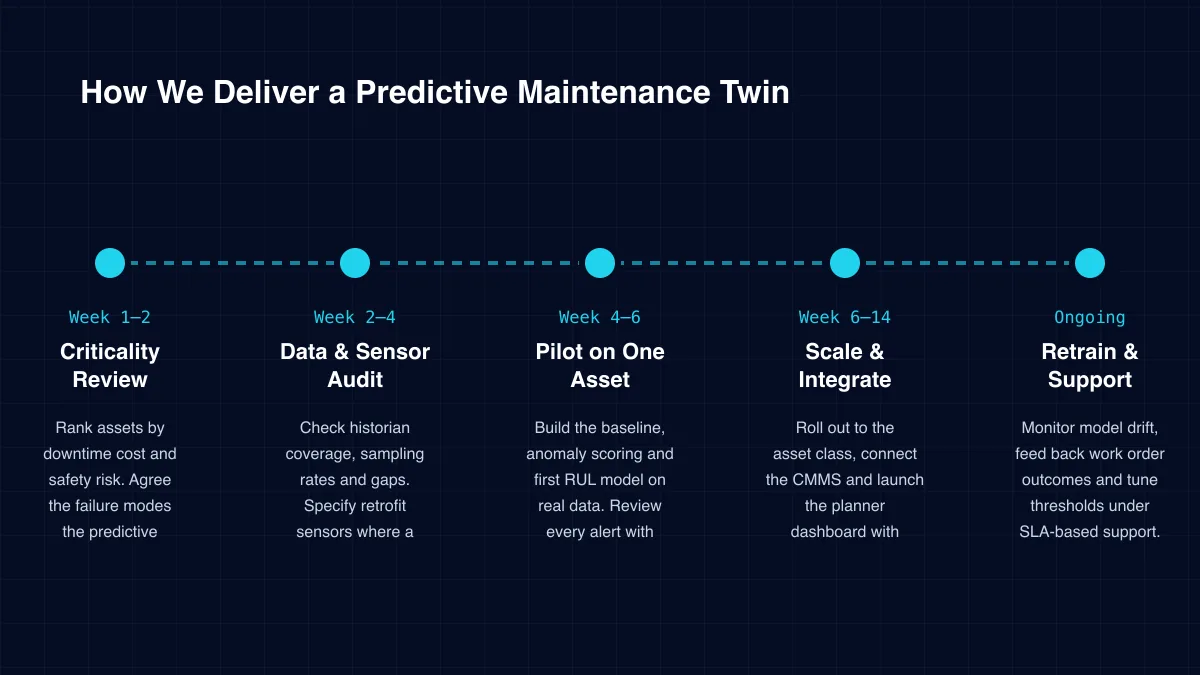
Delivery
Week 1–2
Rank assets by downtime cost and safety risk. Agree the failure modes the predictive maintenance digital twin must detect.
Week 2–4
Check historian coverage, sampling rates and gaps. Specify retrofit sensors where a failure mode is invisible today.
Week 4–6
Build the baseline, anomaly scoring and first RUL model on real data. Review every alert with your engineers.
Week 6–14
Roll out to the asset class, connect the CMMS and launch the planner dashboard with role-based access.
Ongoing
Monitor model drift, feed back work order outcomes and tune thresholds under SLA-based support.
Case study
A fleet management technology partner wanted to catch engine faults before a breakdown. ICANIO built a physics-based engine twin with explainable fault detection and a 3D operator view. The proof of concept validated two real-world fault types, carbon buildup and a stuck VVT actuator, on a simulated mid-size petrol sedan.
“The goal was never just an alert. It was an alert an operator could actually trust and act on.”Read the full case study →
CARLA · OpenModelica FMU
Models how a healthy engine should behave under current driving conditions.
XGBoost · Rule engine
Flags sustained deviation, with dual-signal and oil-temperature checks against false alerts.
NVIDIA Omniverse
Pinpoints the affected component on an interactive 3D vehicle model.
Specialist services within our digital twin solutions practice.
A good demo is easy. A predictive maintenance digital twin that planners trust after a year is harder. Check these five points.
In our experience, the teams that succeed treat the twin as part of the maintenance process, not a side project.
A predictive maintenance digital twin reveals how your plant runs, so we treat its data as sensitive. ICANIO works under ISO 9001 and ISO 27001 certified processes.
Edge gateways can keep raw vibration data on site and send only features to the cloud. Access is role-based, models run in your tenancy, and every alert decision is logged.
Begin with last year's unplanned stoppages on the pilot asset class. Price each hour of lost output, overtime and expedited parts. That total is the pool the predictive maintenance digital twin works against.
Add the cost of healthy parts replaced early by calendar schedules. We agree these baselines during discovery and report against them after go-live.
Technology stack
We choose tools to fit your assets and existing systems. These are typical choices.
Sensing
AccelerometersThermal & current sensorsPLC tagsOil quality probes
Connectivity
OPC UAEdge gateways
Physics
OpenModelicaFMI / FMUCARLA
Analytics
XGBoostRule enginesSurvival modelsMLOps retraining
Visualisation
Planner dashboardsMobile alerts
Enterprise
IBM MaximoERP sparesAudit logs
Condition-based maintenance reacts when a reading crosses a limit. A predictive maintenance digital twin compares readings with expected behaviour for the current context. It also forecasts when the limit will be reached, so work can be planned early.
No. A physics baseline lets the twin detect deviation from the first weeks. Machine learning then improves precision as work order outcomes arrive. This is why we recommend a hybrid approach for most plants.
Assets with high downtime cost and measurable failure modes suit it best. Typical examples are gearboxes, pumps, compressors, motors, spindles, engines and HVAC plant. We rank candidates during the criticality review.
Often yes. We start with historian and PLC data you already collect. Where a failure mode is invisible, we specify a small set of retrofit sensors rather than a full rewire.
Forecasts come with confidence bands that narrow as degradation progresses. Early forecasts are wide by nature. We show the band openly so planners can decide how much margin to keep.
A single-asset pilot on real data usually runs in the first four to six weeks. It proves detection and forecasting before you commit to rolling the predictive maintenance digital twin across the fleet.
How we deliver predictive maintenance digital twin and the wider digital twin practice in each sector.
A predictive maintenance digital twin gives planners a trusted early warning and a date range to act. It replaces guesswork with evidence and emergency repairs with scheduled work.
ICANIO pairs physics modelling, explainable AI and OT integration in one delivery team. We start with one critical asset, prove the value on your data, then scale across the fleet.
By ICANIO Digital Twin Engineering Team · Published · Updated
Book a free discovery call with our asset health engineers. We will review your critical assets and data, then outline a pilot scope with clear milestones.
Contact Our Digital Twin Team