AWS MIGRATION · INFRASTRUCTURE AS CODE · HIGH AVAILABILITY
This JIRA Data Center AWS migration moved the client off costly per-user JIRA Cloud licensing onto a self-hosted, high-availability AWS environment.
Quick Answer
What Is a Self-Hosted JIRA Data Center on AWS?
A self-hosted JIRA Data Center AWS deployment moves an organization off per-user JIRA Cloud licensing onto infrastructure it owns and controls, using Infrastructure as Code to provision a highly available, secure AWS environment. ICANIO executed this JIRA Data Center AWS migration for a partner facing escalating cloud licensing costs, delivering a self-hosted environment built on CloudFormation, Multi-AZ RDS, and Application Load Balancers that cut licensing costs by 50%, achieved 99.9% uptime, and made infrastructure scaling 3x faster.
Executive Summary
Turning Per-User Licensing Costs Into a Self-Hosted AWS Advantage
Per-user JIRA Cloud licensing scales in the worst possible direction for a growing engineering organization: the more the team grows, the more the platform costs, with no corresponding increase in control. ICANIO’s partner was feeling that pressure directly, escalating licensing costs were hindering operational budgeting, and the organization had limited control over its own application environment and data residency. On top of that, it needed high availability across diverse geographical regions, was carrying data-loss risk from fragmented backup strategies, and had run into scaling limitations within its existing proprietary cloud environment.
ICANIO addressed this with a JIRA Data Center AWS migration built around Infrastructure as Code rather than a manual lift-and-shift. The objective was to provision the entire environment through AWS CloudFormation automation, deliver high availability through an Application Load Balancer and Multi-AZ RDS, centralize shared storage across node clusters using Amazon EFS, and harden the security perimeter with AWS WAF and VPC isolation. The result was a self-hosted environment that costs 50% less to license, runs at 99.9% uptime, and scales 3x faster than the proprietary cloud environment it replaced.
Every outcome traces back to the same architectural choice: owning the infrastructure through Infrastructure as Code instead of renting it per user, so cost, control, and availability improved together rather than being traded off against each other.
“Per-user licensing does not just cost more as a team grows, it caps how much control that team ever has over its own environment.”
The Challenge
Five Constraints Behind the JIRA Data Center AWS Migration
Our partners faced escalating operational costs due to JIRA Cloud’s per-user licensing model. To regain financial control and data sovereignty, they needed to overcome several infrastructure challenges.
Escalating JIRA Cloud Licensing Costs
Escalating JIRA Cloud licensing costs hindered operational budgeting, since per-user pricing meant costs kept rising in step with every new engineering hire.
Limited Control Blocking the JIRA Data Center AWS Move
Limited control over the application environment and data residency left the organization unable to dictate where its own data lived or how the platform was configured.
High Availability Across Regions
The need for high availability across diverse geographical regions was not met by the existing setup, leaving the organization exposed to regional outages.
Fragmented Backup Strategies
Fragmented backup strategies increased the risk of data loss, with no single, consistent recovery process across the environment.
Complex Security Requirements
Complex security requirements necessitated a custom VPC architecture that the existing proprietary cloud environment could not provide.
JIRA Data Center AWS Solutions Provided
A Six-Part High-Availability JIRA Data Center AWS Architecture
Icanio Technologies architected a High-Availability JIRA Data Center on AWS, utilizing Infrastructure as Code (IaC) to ensure a secure, scalable, and cost-effective deployment. The solutions included:
Automated Provisioning via AWS CloudFormation
Automated infrastructure provisioning via AWS CloudFormation templates replaced manual setup with a repeatable, version-controlled JIRA Data Center AWS deployment.
High Availability With Multi-AZ RDS
High availability via an Application Load Balancer and Multi-AZ RDS keeps the platform running across zones, closing the regional-outage gap the old environment had.
Centralized Storage for the JIRA Data Center AWS Cluster
Centralized shared storage using Amazon EFS for node clusters gives every node in the JIRA Data Center AWS deployment consistent access to the same file system.
Real-Time Monitoring via AWS CloudWatch
Real-time monitoring and logging integrated through AWS CloudWatch gives the team centralized visibility across the entire self-hosted environment.
Automated Recovery for the JIRA Data Center AWS Setup
Automated recovery and protection using native AWS Backup tools replaced the fragmented backup strategies that had previously put data at risk.
Hardened Security With AWS WAF and VPC
An enhanced security perimeter using AWS WAF and VPC isolation meets the complex security requirements that a shared, proprietary cloud environment could not.
Business Outcomes
Measurable Results Across Cost, Uptime, and Control
The JIRA Data Center AWS migration delivered outcomes across every dimension of the client’s original constraints, converting a costly, hard-to-control licensing model into a self-hosted environment that costs less, runs more reliably, and puts infrastructure decisions back in the client’s hands.
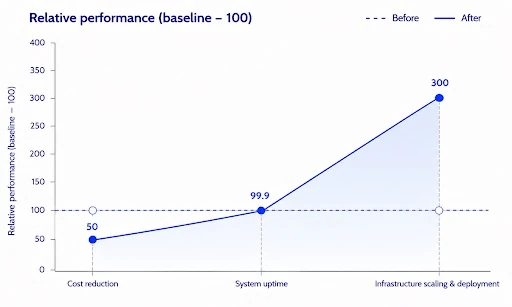
JIRA Data Center AWS outcomes: a 50% cost reduction, 99.9% uptime on Multi-AZ architecture and three times faster automated scaling and deployment.
50%Cost Reduction
By eliminating expensive cloud licensing
99.9%Uptime
Via Multi-AZ high availability architecture
3xFaster
In automated infrastructure scaling and deployment
Automated Workflows
Via 3-click IaC environment provisioning
Full Security Control
Via native AWS WAF and VPC
Centralized Visibility
Via integrated CloudWatch performance monitoring
Key learnings
What This Proves for Teams Weighing Self-Hosting vs. Cloud Licensing
A JIRA Data Center AWS Move Trades Licensing for Ownership
Per-user cloud licensing feels convenient right up until the organization has grown enough for the recurring cost to outweigh the convenience. Moving to a self-hosted JIRA Data Center AWS deployment does not eliminate infrastructure responsibility, it shifts it, but Infrastructure as Code is what makes that shift affordable rather than a new operational burden.
Multi-AZ High Availability Is Non-Negotiable for Uptime
A self-hosted environment only matches or beats a managed cloud’s uptime if it is built with the same resilience assumptions. The Application Load Balancer and Multi-AZ RDS pairing is what let this migration hit 99.9% uptime instead of introducing new availability risk.
JIRA Data Center AWS Security Cannot Be Bolted On Later
Fragmented backup strategies and ad hoc security were part of the original problem, not something to defer until after the AWS migration was live. Building AWS Backup and WAF/VPC isolation into the CloudFormation templates from day one meant the new environment was more secure and more resilient than the one it replaced, immediately.
Conclusion
From Per-User Licensing to a Self-Hosted JIRA Data Center on AWS
Per-user JIRA Cloud licensing might be the simplest option for a small team, but for an organization scaling across regions with strict security and data residency requirements, it had become the primary constraint on the business. This engagement demonstrates that a self-hosted JIRA Data Center AWS migration can resolve cost, availability, and control challenges within a single Infrastructure as Code AWS programme rather than three separate initiatives.
By provisioning the environment through AWS CloudFormation and pairing an Application Load Balancer with Multi-AZ RDS, Amazon EFS, AWS Backup, and WAF/VPC isolation, ICANIO helped this partner cut licensing costs by 50%, reach 99.9% uptime, and scale infrastructure 3x faster than before. The Infrastructure as Code, centralized monitoring, and hardened security perimeter delivered through this engagement are the foundation every future environment this team provisions will run on.
Related Resources
This migration belongs to ICANIO's DevOps and cloud engineering services, built on infrastructure automation. Our team also runs self-hosted tools that software development teams depend on through support engineering services. Related work includes the cloud cost optimization platform and the DevOps observability platform. To plan a similar move, contact ICANIO.
- DevOps and Cloud Engineering Services
- Industries We Serve
- Cloud Cost Optimization Platform: 25% Savings
- DevOps Observability Platform: 99.9% Uptime
- Top 5 Best FinOps AI Workload Cost Wins
References
- Jira Data Center: Atlassian's overview of the self-managed Jira Data Center edition.
- Jira (software): background on the Atlassian issue tracking product.
- What is AWS CloudFormation?: AWS documentation on provisioning infrastructure from templates.
- Amazon RDS Multi-AZ deployments: AWS documentation on database high availability across zones.
- What is Amazon EFS?: AWS documentation on shared file storage for clustered nodes.
Frequently asked questions
Common Questions About JIRA Data Center AWS Migrations
What is a JIRA Data Center AWS migration and why move off JIRA Cloud?
A JIRA Data Center AWS migration moves an organization from per-user JIRA Cloud licensing to a self-hosted deployment it owns and controls on AWS. Organizations choose a self-hosted JIRA migration when licensing costs scale faster than their budget, and when they need more control over data residency and environment configuration than a shared cloud platform allows.
How does AWS CloudFormation make this migration repeatable?
AWS CloudFormation defines the entire JIRA Data Center AWS environment as version-controlled templates rather than a manual setup checklist, so the infrastructure can be provisioned, updated, and audited consistently instead of depending on one-off manual configuration.
Why pair an Application Load Balancer with Multi-AZ RDS?
An Application Load Balancer distributes traffic across healthy nodes while Multi-AZ RDS keeps the database available even if an entire availability zone fails, the combination that let this migration reach 99.9% uptime.
What role does Amazon EFS play in a self-hosted JIRA Data Center?
Amazon EFS provides centralized shared storage that every node in the JIRA Data Center AWS cluster can access consistently, which is required for a multi-node deployment to behave as a single coherent application.
Does self-hosting on AWS add security risk compared to JIRA Cloud?
No, in this engagement it delivered stronger security. Building AWS WAF and VPC isolation into the CloudFormation templates from the start gave the client full security control over its perimeter, control that a shared, proprietary cloud environment could not offer.
How much faster is infrastructure scaling after this migration?
Infrastructure scaling and deployment became 3x faster, driven by automated, 3-click Infrastructure as Code provisioning through AWS CloudFormation, replacing what had previously been a manual, slower scaling process.