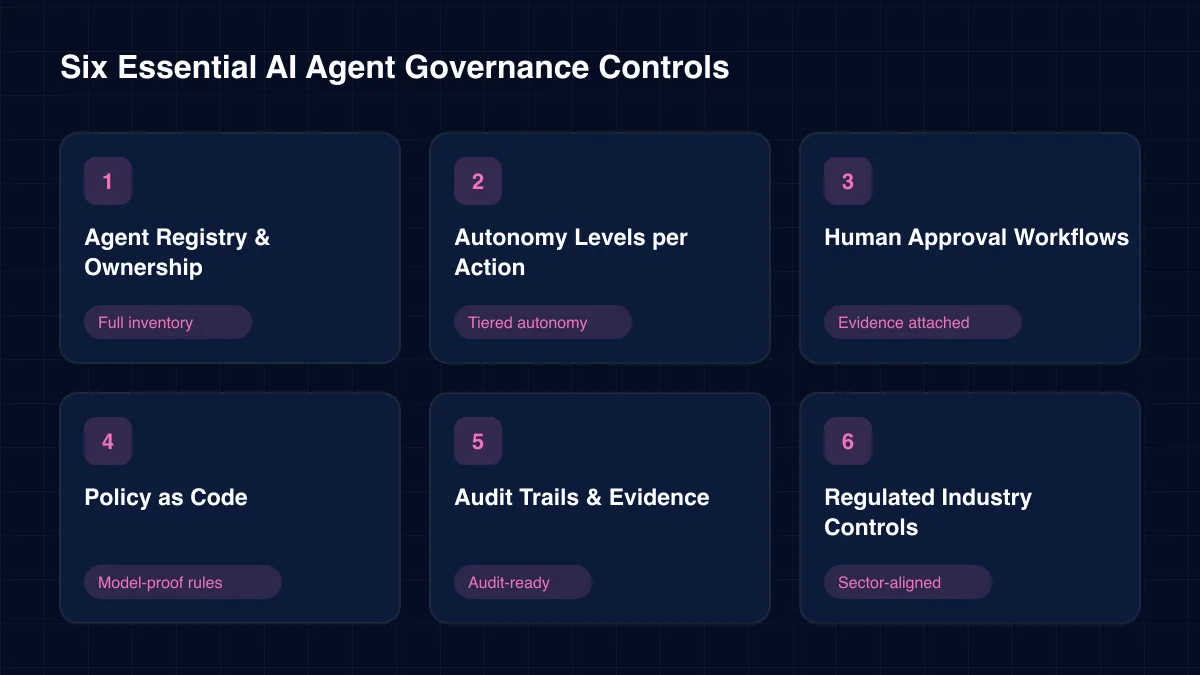
Agent Registry & Ownership
A single inventory of every agent, its purpose, tools, model, version and owners. AI agent governance starts with knowing what is running.
Full inventory
AgenticOps · AI Agent Governance
Agents that act on their own need rules that are enforced, not just written down. We build approval gates, autonomy limits, audit trails and stop switches into the runtime, so every action has an owner.
⟳ Orchestrating agents…
every step traced · guardrails on · reversible
AI agent governance is the set of rules, roles and runtime controls that decide what AI agents may do, who approves their actions and how every decision is recorded. It turns a written AI policy into checks that run on every agent step.
Our team builds AI agent governance into the systems agents run on, rather than bolting it on afterwards. That means autonomy levels per action, approval queues, policy engines, agent registries, audit trails and stop switches that people can actually use.
This page explains what effective AI agent governance includes, how it maps to frameworks such as the NIST AI Risk Management Framework and the EU AI Act, and how we deliver it without slowing your teams to a crawl.
Classic AI governance focuses on models: how they are trained, tested and approved. Agents add a new layer of risk because they act. They send emails, update records, move money and trigger other systems. AI agent governance covers those actions, not just the model behind them.
Good governance answers five questions for every agent. What is it allowed to do? Which actions need a human? Who owns it? How do we know it is behaving? How do we stop it fast if it is not?
Those answers must live in the runtime. A policy document cannot stop an agent at 2 a.m. A policy engine, an approval gate and a circuit breaker can. That is the core shift: governance moves from paperwork into software.
The paperwork still matters. Regulators and auditors need evidence. The runtime controls produce that evidence automatically, as a side effect of normal operation, so compliance work shrinks instead of growing with each new agent.
Working definition
“AI agent governance is the combination of policies, accountable roles and enforced runtime controls, such as autonomy limits, human approvals, audit logging and emergency stops, that keeps autonomous AI agents safe, compliant and explainable.”
Foundations
A clear list of tools and actions, with limits on amounts, volumes and data types for each one.
Defined thresholds where a named person, not a role inbox, must sign off before the agent proceeds.
Every agent has a business owner and a technical owner, recorded in a registry with its version history.
Kill switches at agent and tool level, tested regularly, with a clear playbook for who pulls them.
Core capabilities
These are the controls we design and implement. Together they form a governance layer every agent in your estate can share.
A single inventory of every agent, its purpose, tools, model, version and owners. AI agent governance starts with knowing what is running.
Full inventory
Each action is classed as automatic, notify, approve or forbidden. Levels can tighten by amount, customer type or time of day.
Tiered autonomy
Approval queues in Slack, Teams or your task inbox, with the agent's evidence attached. Approvers see why the agent proposed an action, not just what.
Evidence attached →Business rules enforced by a policy engine outside the model, so a clever prompt cannot talk its way past them. AI agent governance rules are versioned and tested like code.
Model-proof rules
Tamper-evident logs of inputs, reasoning summaries, tool calls, approvals and outcomes. Evidence packs for auditors are generated, not assembled by hand.
Audit-ready →Governance tuned to banking, healthcare and other regulated sectors, built on our wider AgenticOps practice. See how this works for banking agents.
Sector-aligned →Architecture
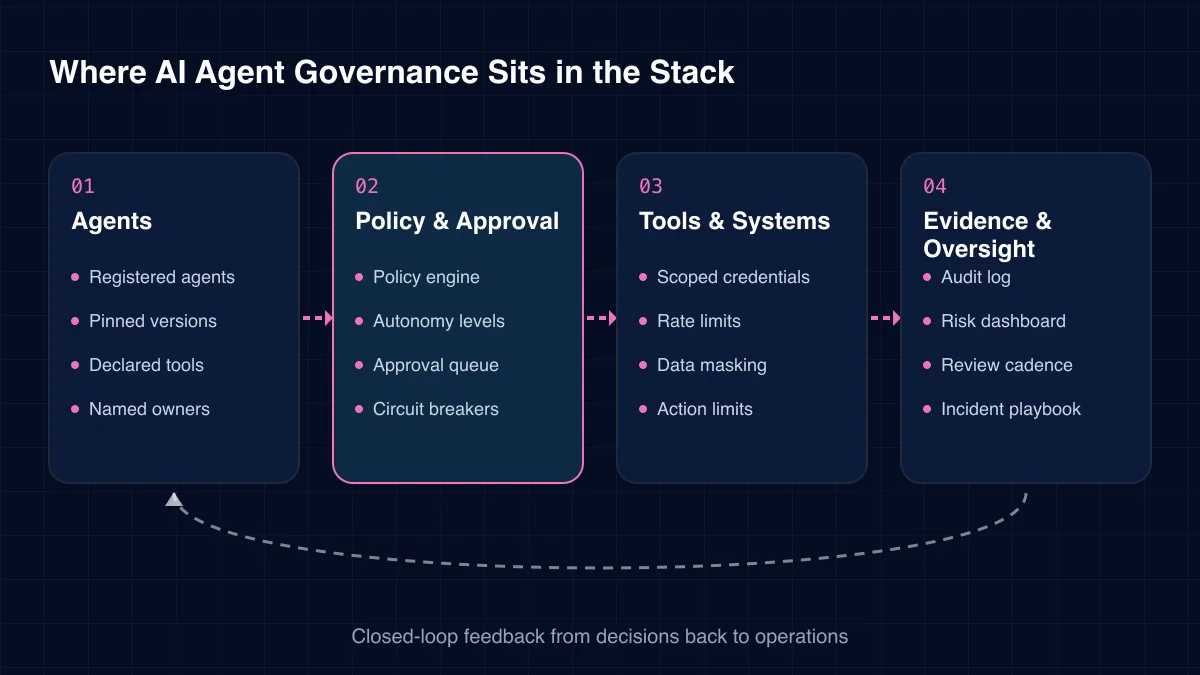
Governance is a layer every agent passes through. The policy and approval layer is the core: no consequential action skips it.
01
02
03
04
Challenges we solve
When we assess an agent estate, the same gaps appear again and again.
Teams launch agents with no central record. Nobody knows how many exist or what they can touch.
Rules live in a PDF. The agent has never seen them and nothing enforces them.
Approvers get a yes or no button with no evidence. Approval becomes a formality, not a control.
Logs show API calls but not why the agent made them. Audits stall on simple questions.
A misbehaving agent can only be stopped by redeploying code. Damage builds while people scramble.
When something goes wrong, IT blames the business and the business blames the vendor.
Governance grows in stages. We meet clients where they are and move them up one level at a time.
Three common ways teams try to govern agents, and how each holds up.
| Criterion | Policy document | Prompt rules | Runtime controls |
|---|---|---|---|
| Enforced on every action | No | Partial | ✓ Yes |
| Resists prompt injection | No | No | ✓ Yes |
| Produces audit evidence | No | No | ✓ Yes |
| Can stop an agent fast | No | No | ✓ Yes |
| Best for | Intent | Tone and style | Real control |
Good governance does not slow agents down. It is what lets you give them more responsibility.
Delivery
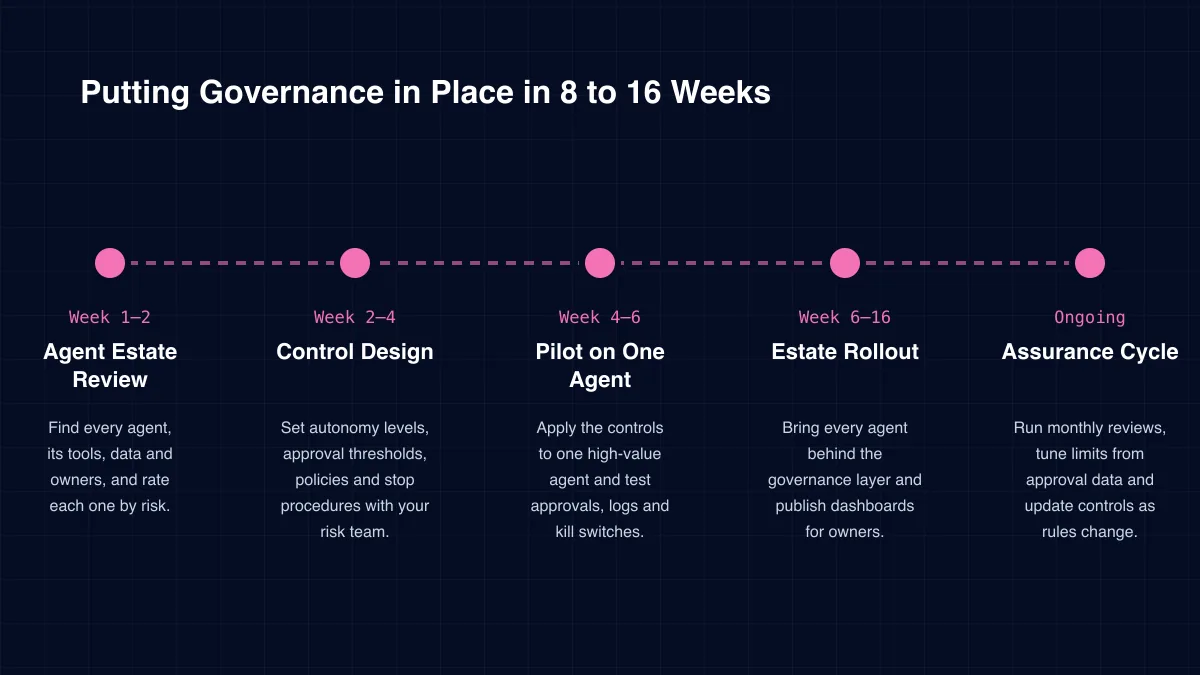
Week 1–2
Find every agent, its tools, data and owners, and rate each one by risk.
Week 2–4
Set autonomy levels, approval thresholds, policies and stop procedures with your risk team.
Week 4–6
Apply the controls to one high-value agent and test approvals, logs and kill switches.
Week 6–16
Bring every agent behind the governance layer and publish dashboards for owners.
Ongoing
Run monthly reviews, tune limits from approval data and update controls as rules change.
Specialist services within our agenticops practice.
We recommend testing partners on five practical points, not on slideware.
In our experience, the approver screen decides whether oversight is real. We design it with the people who will use it.
Governance and security overlap but are not the same. Security stops outsiders. AI agent governance also limits what trusted agents may do. We combine both: least-privilege credentials, data masking and action limits on every tool.
Agents are protected against prompt injection and excessive agency, two risks named in the OWASP Top 10 for LLM applications. Policy checks run outside the model, so manipulated text cannot override them.
ICANIO delivers under ISO 9001 and ISO 27001 certified processes. Audit logs are append-only and retained to your policy, and access to them is itself logged.
The return on AI agent governance is partly avoided cost: incidents that never happen, fines that never arrive, customers who never receive a wrong message. These are real, even if they are hard to count.
The visible return is speed. Risk and compliance teams approve new agents faster when controls are standard and evidence is automatic. Each new agent reuses the same layer instead of starting a fresh review.
Track approval turnaround, override rate, incidents per thousand actions and time to produce audit evidence. Those measures show whether governance is helping or just adding friction.
Over time, approval data becomes a tool for growth. When an action has been approved hundreds of times with no issues, owners can safely raise the agent's autonomy for it. Governance then expands what agents may do, rather than only restricting them.
Technology stack
We combine recognised frameworks with practical tooling that fits your platforms.
Frameworks
NIST AI RMFISO/IEC 42001EU AI Act
Policy Engines
Open Policy AgentCustom rule servicesFeature flags
Approvals
Slack approvalsMicrosoft TeamsTask inboxEmail actions
Registry
Agent catalogueVersion controlOwner records
Evidence
Append-only logsEvidence packs
Oversight
Risk dashboardsCircuit breakersIncident playbooks
AI agent governance is the set of policies, owners and runtime controls that decide what agents may do, which actions need human approval and how every decision is recorded and reviewed.
General AI governance focuses on models and data. AI agent governance adds controls on actions: tool permissions, autonomy limits, approvals and emergency stops, because agents change things in the real world.
It can. The Act classes AI systems by risk, and high-risk systems need human oversight, logging and documentation. Whether an agent is high-risk depends on its use. We help map each agent to the right category with your legal team.
Actions that are costly, irreversible, customer-facing or legally sensitive, such as payments, contract changes or access grants. We set thresholds with your risk team and tune them from real approval data.
Not when it is designed well. Low-risk actions run automatically, and approvers get evidence in the tools they already use. Standard controls also speed up risk reviews for every new agent.
Yes. Our team places a governance layer in front of the tools agents use, so controls apply whether the agent was built in-house, by a vendor or on a managed platform.
How we deliver ai agent governance and the wider agenticops practice in each sector.
Autonomy without oversight is a liability. AI agent governance makes autonomy accountable by giving every agent an owner, clear limits, human checkpoints and a full record of what it did.
ICANIO builds these controls into the runtime so they hold up at scale. The same approach covers manufacturing agents that act on IoT signals, predictive maintenance forecasts and machine learning outputs in the cloud. Contact us to assess your AI agent governance and plan the next step.
By ICANIO AgenticOps Engineering Team · Published · Updated
Book a short review of your agent estate. We will show where controls are missing and which ones to add first.
Contact Our Governance Team