PAYROLL SAAS · MICROSERVICES ARCHITECTURE · MULTI-TENANT PLATFORM
This scalable multi-tenant SaaS platform rebuild transformed a monolithic payroll product into a modern, configurable system for enterprise clients.
Quick Answer
What Is a Multi-Tenant SaaS Platform Rebuild?
A multi-tenant SaaS platform rebuild replaces a rigid, monolithic product with a scalable, configurable architecture that serves many clients from one codebase. ICANIO rebuilt this multi-tenant SaaS platform on microservices and REST APIs with role-based access and drag-and-drop configuration, cutting workflow setup time by 50% and manual effort by 40%.
Executive Summary
Turning a Rigid Payroll Monolith Into a Multi-Tenant Platform
A payroll platform lacked scalability, flexibility, and modern UI/UX, making maintenance, configuration, and compliance workflows inefficient. ICANIO’s partner was facing exactly that gap: a monolithic architecture that restricted scalability and maintenance of features, limited configurability that prevented customization for different client requirements, non-responsive design that resulted in poor experience across devices, and manual workflows that caused frequent errors in payroll compliance tasks.
ICANIO addressed this by rebuilding the product as a multi-tenant SaaS platform rather than patching the existing monolith. The objective was to move to a scalable, flexible microservice-based architecture with REST APIs powering modular backend services, deliver responsive web layouts with dynamic components, implement role-based access control for secure user management, integrate CKEditor for email templates and workflow automation, and enable drag-and-drop configuration for payroll structures and processes.
The result was 50% faster workflow setup time and a 40% reduction in manual operational effort, with a threefold improvement in user experience quality, centralized system management, and enhanced productivity across every tenant the platform serves.
“A payroll platform that can only run one way for one client is not a platform, it is a custom build wearing a platform’s name.”
The Challenge
Five Constraints of the Legacy Payroll Monolith
A payroll platform lacked scalability, flexibility, and modern UI/UX, making maintenance, configuration, and compliance workflows inefficient.
The Multi-Tenant SaaS Platform Gap
Monolithic architecture restricted scalability and maintenance of features, so every change carried the risk of destabilizing the whole platform.
Limited Configurability Blocked Customization
Limited configurability prevented customization for different client requirements, forcing every tenant into the same rigid workflow.
Non-Responsive Design Hurt Device Experience
Non-responsive design resulted in poor experience across devices, leaving mobile and tablet users with a broken interface.
Manual Workflows Caused Compliance Errors
Manual workflows caused frequent errors in payroll compliance tasks, adding real risk to one of the platform’s most sensitive functions.
Why This Multi-Tenant SaaS Platform Was Needed
An outdated technology stack hindered integration with modern tools, and that same rigidity slowed adaptation to evolving compliance and business requirements.
Multi-Tenant SaaS Platform Solutions Provided
A Six-Part Multi-Tenant SaaS Platform Rebuild
Icanio Technologies rebuilt the platform on a scalable, flexible microservice-based architecture with REST APIs powering modular, extensible backend services. The solutions included:
The Multi-Tenant SaaS Platform Core
The platform was rebuilt using scalable, flexible microservice-based architecture, replacing the monolith that previously restricted growth.
Modular REST API Services
REST APIs were adopted for modular, extensible backend services, letting each part of the platform evolve independently.
Responsive, Interactive Web Layouts
Responsive web layouts were developed with dynamic, interactive components, fixing the poor cross-device experience clients had before.
Role-Based Access Control
Role-based access control was implemented for secure user management, giving every tenant the right level of access.
CKEditor for Workflow Automation
CKEditor was integrated for email templates and workflow automation, replacing rigid, hardcoded communication flows.
This Multi-Tenant SaaS Platform's Configuration Tools
Drag-and-drop configuration was enabled for payroll structures and processes, letting administrators tailor workflows without engineering involvement.
Business Outcomes
Measurable Results Across Speed, Experience, and Scale
This multi-tenant SaaS platform delivered outcomes across every dimension of the product’s original monolithic constraint, converting a rigid, single-configuration system into a fast, configurable, enterprise-grade platform.
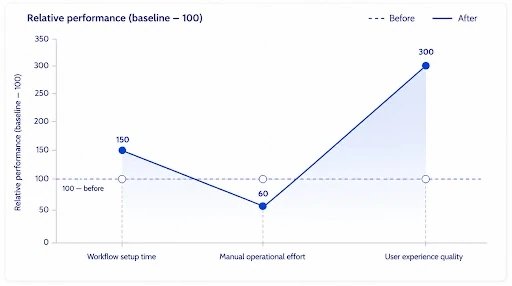
Multi-tenant SaaS platform results: 50% faster workflow setup, 40% less manual operational effort and three times better user experience quality.
50%Faster
Workflow setup time
40%Reduced
Manual operational effort
3xImproved
User experience quality
Centralized
System management platform
Scalable
Enterprise-grade architecture
Enhanced
Overall productivity levels
Key learnings
What This Engagement Proves for Multi-Tenant Platform Rebuilds
Microservices Only Pay Off With Modular APIs
Breaking the monolith into microservices would not have solved configurability on its own without REST APIs exposing modular, extensible backend services that each tenant’s workflow could actually use.
Configuration Should Be a UI, Not an Engineering Ticket
Limited configurability was the real source of the platform’s rigidity. Drag-and-drop configuration for payroll structures and processes is what let administrators tailor workflows without filing a request to engineering.
Responsive Design Is Part of Compliance Reliability
Manual workflows and non-responsive design were treated as separate problems, but both came from the same legacy foundation. Rebuilding the interface and the backend together is what let user experience quality and compliance reliability improve at the same time.
Conclusion
From Rigid Monolith to a Scalable Multi-Tenant Platform
A monolithic payroll platform might have been workable for a single client, but for a product serving diverse enterprise tenants, it had become a real constraint on scalability, configurability, and compliance reliability. This engagement demonstrates that a single multi-tenant SaaS platform rebuild can resolve architecture, experience, and compliance gaps within one structured programme rather than three separate initiatives.
By moving to a microservice-based payroll architecture, adopting modular REST APIs, and enabling drag-and-drop workflow configuration behind role-based access control, ICANIO helped this partner reach 50% faster workflow setup time and a 40% reduction in manual operational effort. The responsive enterprise UI, centralized system management, and scalable architecture delivered through this engagement are the foundation every future tenant this platform onboards will run on.
Related Resources
Our team delivers platform rebuilds like this through ICANIO's application development services. Cloud hosting and DevOps pipelines for multi-tenant products run through DevOps and cloud engineering. Related software development and automation work appears in our internal employee portal and other case studies. To plan a similar multi-tenant SaaS platform, contact ICANIO.
- Application Development Services
- Industries We Serve
- Best HIPAA-Ready SaaS Modernization in 2026
- Insurance Application Modernization: 50% Less Debt
- Top 5 Best MVP Development Enterprise Scaling Wins
References
- Multitenancy: overview of serving many tenants from one software instance.
- Microservices: overview of the microservice architecture style.
- REST: overview of the REST architectural style for APIs.
- Role-based access control: NIST page on the RBAC model.
- CKEditor documentation: official docs for the CKEditor rich text editor.
Frequently asked questions
Common Questions About This Multi-Tenant SaaS Platform
What is a multi-tenant SaaS platform rebuild, and why was it needed?
A multi-tenant SaaS platform rebuild replaces a rigid, single-configuration product with a scalable architecture that serves many clients from shared infrastructure. It was needed because the platform's monolithic architecture restricted scalability and made client customization difficult.
How do microservices improve payroll platform scalability?
A microservice-based payroll architecture breaks the platform into independent services that can scale and update separately, instead of every change requiring a redeploy of one large monolithic application.
What does role-based access control add for a multi-tenant platform?
Role-based access control ensures each tenant's users see and manage only their own payroll data and permissions, keeping multi-tenant operations secure and properly separated.
How does drag-and-drop configuration reduce engineering dependency?
Drag-and-drop workflow configuration lets administrators adjust payroll structures and processes directly in the interface, instead of submitting a request for engineering to hardcode each client's specific workflow.
Why did a responsive enterprise UI matter for this rebuild?
A responsive enterprise UI fixed the poor cross-device experience the non-responsive legacy design created, so administrators and employees get a consistent experience on desktop, tablet, and mobile.
How much faster is workflow setup after this rebuild?
This multi-tenant SaaS platform delivers 50% faster workflow setup time and a 40% reduction in manual operational effort compared to the previous monolithic system.