PROPERTY TECH · CLOUD AUTOMATION · REAL ESTATE
A cloud-native property management software platform for automated rent collection, lease management software workflows, and real-time financial transparency. It is built for high-volume portfolios across multiple locations.
Quick Answer
What is an Automated Property Management Software Platform?
A property management software platform is a cloud-native system that automates rent collection, lease workflows, maintenance tracking, and financial reporting across large property portfolios. It replaces legacy systems that cannot scale without accumulating operational errors. ICANIO built and deployed a property management software platform that delivered a 40% boost in overall operational efficiency, zero errors in automated financial calculations, and 3x faster maintenance response and resolution for property management partners managing high-volume portfolios. ICANIO Technologies delivered this as a full-stack engineering engagement. It integrated QuickBooks and Plaid for financial tracking, rent automation workflows, and real-time dashboards into a single scalable ecosystem.
Executive Summary
Modernizing a Portfolio Operation Held Back by Legacy Systems
Property management at scale is fundamentally a data coordination problem. Every building, lease, tenant, maintenance request, and financial transaction generates information that must be accurate, synchronized, and visible across the portfolio in real time. When the systems that manage that information are outdated, every coordination gap creates an operational cost: miscalculated rents, delayed maintenance responses, fragmented financial reporting, and manual reconciliation work that consumes staff capacity that should be directed at portfolio growth.
ICANIO approached this as a full-stack engineering challenge. The objective was to build an ecosystem that could eliminate the systemic inefficiencies of legacy infrastructure, automate back-office operations end to end, and deliver the financial accuracy and portfolio visibility that high-volume portfolios demand. The result was a property management software platform that replaced fragmented, error-prone manual workflows with a unified, automated, and financially transparent system. That system can manage large multi-location portfolios without proportional increases in operational overhead.
“Legacy property management software that cannot synchronize data across a growing portfolio does not just slow operations down. It actively creates the errors, delays, and blind spots that make scaling a portfolio more expensive with every property added.”
The Challenge
Six Systemic Failures Driving Operational Stagnation
Without modern property management software, every gap in a portfolio’s operational systems compounds the next. Inaccurate financial calculations undermine reporting. Poor reporting delays decisions. Delayed decisions allow maintenance issues to escalate. Escalated maintenance costs reduce portfolio margins. Reduced margins limit the investment capacity needed to modernize the very systems causing the problem. Six distinct failure modes defined the operational state this engagement was commissioned to resolve.
Outdated Interfaces with No Centralized Visibility
Legacy software provided no centralized dashboards and no real-time portfolio insights. Managers were forced to assemble data manually from disconnected systems. Without a unified real estate management platform view, every operational decision was made on incomplete or stale information.
Slow Performance and System Lag
Legacy systems suffered from chronic performance bottlenecks and system lag that degraded staff productivity across every workflow. The absence of modern infrastructure meant that data access was slow, remote access was unreliable, and system capacity could not scale with portfolio growth.
Frequent Calculation Errors in Financial Reporting
Frequent calculation errors led to inaccurate financial reporting across rent, fees, and service charges. Without automated rent collection software enforcing calculation logic, every billing cycle introduced manual error risk that required time-consuming reconciliation to resolve.
Poor Data Synchronization Across the Portfolio
Poor data synchronization created persistent discrepancies across portfolios. Records for the same tenant, lease, or financial transaction conflicted. Without a unified lease management software layer, data integrity degraded with every manual update.
Manual Maintenance Tracking Delaying Responses
Manual maintenance tracking delayed repairs and tenant responses across the portfolio. Without a real estate management platform automating vendor notifications and tracking resolution status, maintenance requests entered informal queues with no visibility, accountability, or escalation logic.
Property Management Software Solutions
A Six-Component Property Management Platform for Full Automation
ICANIO designed and delivered cloud-native property management software that replaces every manual and fragmented workflow with an automated, integrated, and scalable digital system. Each component of the real estate management platform feeds directly into the next. This ensures that rent collection automation, maintenance automation, financial integration, and analytics operate as a single connected platform across the full property portfolio.
Automated Rent and Lease Workflow Engine
Built automated rent collection software and lease management software workflows processing rent cycles and renewals without manual oversight, eliminating calculation errors.
QuickBooks and Plaid Financial Integration
Integrated QuickBooks and Plaid for financial tracking, bank-level transaction verification, and automated reconciliation across all properties.
Real-Time Portfolio Dashboards
Delivered real-time dashboards within the property management software with centralized visibility into occupancy rates, maintenance status, rent collection, and financial performance.
Scalable Cloud-Native Architecture
Architected the real estate management platform on scalable cloud-native infrastructure for secure remote access from any location. This eliminated performance bottlenecks and system lag.
Automated Maintenance Request System
Built an automated maintenance request system with instant vendor notifications, resolution tracking, and escalation logic. It converted informal queues into a structured digital workflow.
Integrated Accounting for Multi-Property Reporting
Delivered an integrated accounting module in the lease management software environment unifying financial reporting across all properties and enabling consolidated multi-property reporting.
Business Outcomes
Measurable Results Across Efficiency, Accuracy, and Response Time
The property management software fundamentally changed how this portfolio operates. It converted a manually intensive, error-prone, and fragmented operation into an environment that delivers consistent accuracy, real-time visibility, and 3x faster maintenance resolution across all properties.
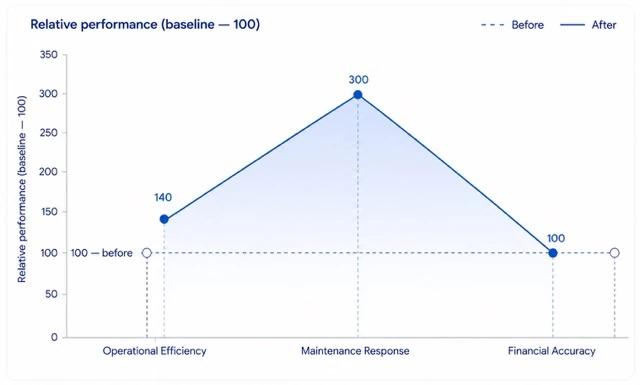
Property management software outcomes: a 40% boost in operational efficiency, three times faster maintenance response and full financial transparency via QuickBooks.
40%Boost
In overall operational efficiency across all portfolio management workflows
3xFaster
Maintenance response and resolution through automated vendor notification workflows
Full Financial Transparency
Via integrated QuickBooks dashboards across all properties in the portfolio
Zero Errors
In automated financial calculations through integrated automated rent collection software
Automated Workflows
Via 3-click rent and lease processing within the property management software platform
Scalable Cloud Access
For efficient multi-location management through cloud property management infrastructure
Key learnings
What This Engagement Proves for Property Technology Leaders
Legacy Property Management Software Creates Compounding Debt
Every quarter an enterprise property portfolio operates on legacy property management software that cannot synchronize data or scale cleanly is a quarter of compounding operational debt. The financial calculation errors, the manual reconciliation cycles, the delayed maintenance responses, and the fragmented reporting are not isolated problems with isolated fixes. They are symptoms of a system architecture that was not designed for the portfolio scale it is now managing. ICANIO’s engagement with this client confirms that addressing these symptoms individually, without replacing the underlying property management software, does not resolve the root problem. The correct intervention is full-stack modernization: rent collection automation, integrated financials, cloud infrastructure, and centralized dashboards deployed as a single connected system rather than as sequential point solutions.
Automated Rent Collection Software Anchors a Scalable Portfolio
Of all the capabilities in property management software, automated rent collection software has the most direct and measurable impact on portfolio profitability. Every calculation error in a manual rent billing cycle represents a revenue risk. Every manual reconciliation cycle represents a staff cost. Every delayed payment caught late represents a cash flow gap. Automated rent collection software eliminates all three failure modes simultaneously by enforcing calculation logic, automating payment processing, and generating verified financial records without human intervention at each step. Real estate management platform leaders should treat rent automation not as a back-office efficiency tool but as the revenue integrity layer that makes a high-volume portfolio financially sustainable at scale.
Cloud Property Management Breaks the On-Premise Scaling Constraint
The most significant constraint in legacy property management is not operational complexity. It is the inability of on-premise infrastructure to scale with portfolio growth without proportional increases in hardware, IT maintenance, and system administration overhead. Cloud property management infrastructure breaks this constraint by providing the compute, storage, and access architecture that portfolio expansion requires without the capital investment and operational burden of on-premise systems. For property management operators managing multi-location portfolios, the difference between a cloud property management platform and a legacy on-premise system is the difference between a portfolio that grows cleanly and one that accumulates technical debt with every new property added to the lease management software environment.
Conclusion
From Fragmented Legacy Systems to Cloud Property Management
Legacy property management software that cannot synchronize data, scale without errors, or provide real-time financial visibility is not a technology preference. It is an operational liability that costs portfolio managers in errors, delays, and the staff time spent compensating for system failures that a modern real estate management platform would eliminate. This engagement demonstrates that with the right property management software architecture, portfolio operators can eliminate financial calculation errors entirely, achieve 3x faster maintenance response, and deliver 40% operational efficiency gains through a single unified cloud property management deployment.
By treating the property management challenge as a full-stack engineering problem rather than a software selection exercise, ICANIO helped this client build a rent collection automation and real-time financial reporting platform that will continue to deliver compounding operational advantage as the portfolio grows. The 40% efficiency improvement, the zero-error financial accuracy, and the 3x maintenance acceleration are not one-time outcomes. They are the operational baseline from which every future portfolio expansion will be managed.
Related Resources
This platform build sits within ICANIO's software development practice, supported by data engineering and artificial intelligence services. Our team delivers similar portals through application development services and DevOps and cloud engineering. For related builds, see ERP integration automation and church CRM software. To scope a similar platform, contact ICANIO.
- Application Development Services
- Industries We Serve
- Fix Slow ERPs: ERP Integration Automation in 2026
- Church CRM Software: 50% Faster
- ERP CRM Integration: Real-Time Data Sync Guide 2026
References
- Property management: overview of the operation, control and oversight of real estate.
- Lease: background on lease agreements between landlords and tenants.
- QuickBooks: official site of the Intuit accounting software named in this case study.
- Plaid documentation: developer documentation for the Plaid financial data platform.
- Cloud-native computing: background on the cloud-native architecture approach.
Frequently asked questions
Common Questions About Property Management Software
What is property management software and what does it automate?
Property management software is a digital platform that automates rent collection, lease workflows, maintenance tracking, financial reporting, and portfolio analytics for residential and commercial property portfolios. ICANIO's property management software integrates automated rent collection, QuickBooks and Plaid financial connectors, and real-time dashboards into a single connected environment. This eliminates the manual workflows and calculation errors that characterize legacy property management systems.
How does automated rent collection software cut calculation errors?
Automated rent collection software eliminates financial calculation errors by encoding rent calculation logic directly into the billing engine. This removes the manual data entry and formula application steps where errors occur in spreadsheet-based or legacy software environments. ICANIO's automated rent collection software processes every billing cycle through the same validated calculation workflow, generating verified financial records without human intervention and producing the zero-error financial accuracy confirmed across this portfolio engagement.
What makes cloud property management better than on-premise systems?
Cloud property management provides remote access, scalable infrastructure, and automatic synchronization across all properties in a portfolio without the hardware investment and IT maintenance overhead of on-premise systems. ICANIO's cloud property management platform eliminated the system lag and synchronization failures that had constrained this portfolio's operational performance. It delivered real-time data access for managers across all locations and providing the architectural foundation for clean portfolio scaling through the lease management software environment.
How does lease management software improve portfolio data accuracy?
Lease management software improves portfolio data accuracy by maintaining a single verified record for every lease, tenant, and associated financial transaction across the real estate management platform, eliminating the data discrepancies that occur when lease information is managed across multiple disconnected systems. ICANIO's lease management software layer synchronizes lease data automatically across the property management software, ensuring that rent schedules, renewal dates, and tenant records are consistent across every operational workflow without manual reconciliation.
What financial integrations does ICANIO's platform include?
ICANIO's property management software integrates QuickBooks for accounting and financial reporting and Plaid for bank-level transaction verification and automated reconciliation across all properties in the portfolio. These integrations replace the fragmented accounting tools that had prevented end-to-end financial visibility in legacy property management software environments. They provide property managers with consolidated multi-property financial reporting and the automated rent collection software accuracy required for transparent investor and stakeholder reporting.
How long does a property management platform implementation take?
Implementation timelines for a property management software platform depend on portfolio size, the number of properties and lease types, the complexity of existing financial integrations, and the volume of historical data to be migrated from legacy systems. ICANIO's delivery approach follows a phased model that prioritizes core rent collection and lease management software workflows first, enabling measurable efficiency gains from early deployment while the real estate management platform accounting integrations and analytics capabilities are brought online progressively.